
TL;DR:
- Effective referral intake requires prompt, multi-channel communication to ensure a high completion rate. Training staff to build rapport quickly and establishing strong provider partnerships improve overall referral success. Prioritizing communication skills over technology yields better patient and provider engagement.
Effective communication in referral intake is defined as the structured exchange of clinical, administrative, and patient-facing information that moves a referral from creation to completed appointment. When that exchange breaks down, patients fall through the cracks and beds stay empty. One-third of referrals are inappropriate because of incomplete clinical information and poor documentation. That single statistic explains why admissions teams at skilled nursing facilities, rehabilitation centers, and post-acute care providers cannot treat communication as a background task. The role of communication in referral intake is the foundation that determines whether your facility fills beds or loses patients to competitors who respond faster.
What are the common communication challenges in referral intake?
Communication breakdowns in referral intake follow predictable patterns. Recognizing them is the first step toward fixing them.

Delayed outreach after referral creation. Most facilities wait 24–48 hours before contacting a patient after a referral is created. That window is far too long. Patient motivation peaks immediately after a provider recommends a specialist or facility. Waiting a full day or two allows that motivation to fade, and the patient either forgets or finds another option.
Incomplete referral documentation. Standardized EMR documentation and clear follow-up plans reduce referral failures significantly. When referring providers send partial clinical notes, missing insurance details, or vague diagnoses, your admissions team cannot make a fast, accurate placement decision. The result is back-and-forth phone calls that add days to the intake timeline.
No closed-loop follow-up. A referral sent is not a referral completed. Many facilities lack a formal protocol for confirming receipt, updating the referring provider on patient status, and documenting the outcome in the EMR. Without that loop, referring providers lose confidence and redirect future referrals elsewhere.
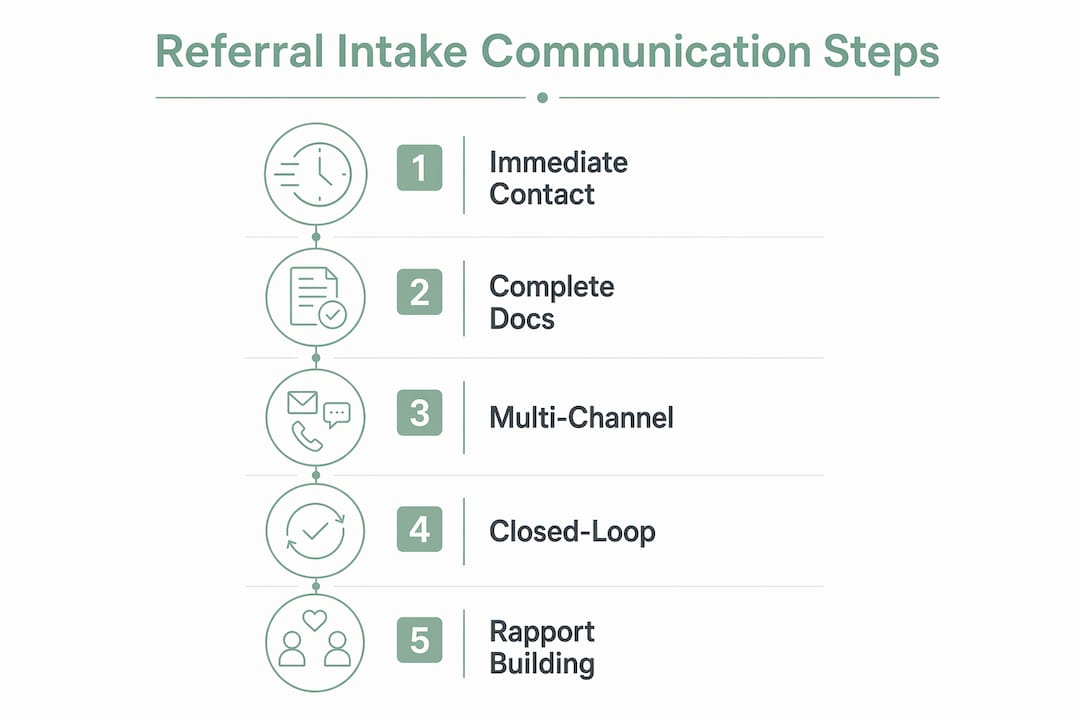
Reliance on phone-only outreach. 30–40% of patients do not respond to traditional phone-based outreach for specialist referrals. That non-response rate is not a patient behavior problem. It is a channel mismatch problem. Patients who ignore calls often respond immediately to a text or email.
Rigid, form-driven intake conversations. When admissions staff lead with a checklist of clinical questions, patients feel processed rather than cared for. That tone increases call abandonment and reduces booking rates, particularly in sensitive care categories like mental health and behavioral health.
How can multi-channel communication improve referral intake outcomes?
Multi-channel outreach is the most direct way to raise referral completion rates. The data is clear: multi-channel outreach achieves 85%+ completion rates compared to the 60–70% ceiling typical of phone-only programs. That gap represents real patients and real revenue.
A practical multi-channel sequence looks like this:
- Immediate SMS outreach. Send a text within minutes of referral creation. Include the facility name, a brief explanation of next steps, and a self-scheduling link. Keep it under 160 characters.
- Follow-up email within the hour. Email gives patients a written record they can reference and share with family members who help with care decisions. Include the referring provider’s name to build credibility.
- Phone call within the same business day. By the time your team calls, the patient has already seen two touchpoints. The call feels like a helpful follow-up, not a cold contact.
- Reminder via patient-preferred channel. Ask during the first contact which channel the patient prefers. Use that channel for all appointment reminders.
The timing of the first contact matters as much as the channel. Contacting patients within 5 minutes of referral creation dramatically increases engagement compared to a 24–48 hour delay. This “5-minute rule” capitalizes on the moment when the patient’s provider has just recommended your facility and the patient is most motivated to act.
| Outreach method | Typical response rate | Best use case |
|---|---|---|
| Phone only | 60–70% | Older patients with limited digital access |
| SMS + phone | Higher than phone alone | General adult patient population |
| SMS + email + phone | 85%+ | Patients with complex care needs or family decision-makers |
Pro Tip: Ask every patient during first contact which communication channel they prefer. Document that preference in the EMR and use it for every subsequent touchpoint. Personalization at this level reduces no-shows and increases trust before the patient ever walks through your door.
To reduce referral times further, your team can apply the intake efficiency strategies that directly connect communication speed to bed fill rates.
What communication strategies build strong referring provider partnerships?
A referral is a clinical relationship, not a data transfer. Treating referrals as clinical relationships and establishing service-level agreements on communication improves both workflow and referral matching. Facilities that internalize this principle receive more referrals and receive better-matched patients.
The following practices build productive partnerships with referring providers:
- Establish service-level agreements (SLAs). Define in writing how quickly your team will acknowledge a referral, when the referring provider will receive a status update, and what format that update will take. SLAs remove ambiguity and set professional expectations on both sides.
- Standardize referral documentation requirements. Give referring providers a clear list of what clinical information your facility needs to make an admission decision. A one-page documentation guide reduces back-and-forth and speeds up your review process.
- Send proactive progress updates. Clinics that maintain closed-loop communication with referring physicians retain higher referral volumes. The update does not need to be lengthy. A brief note confirming the patient was contacted, scheduled, or admitted is enough to keep the referring provider informed and confident.
- Treat documentation as a clinical handoff, not paperwork. Referral disposition should be an actionable clinical handoff with standardized documentation and clear follow-up plans. When your team treats each referral this way, errors drop and care continuity improves.
Proper referral documentation practices are the backbone of every successful provider partnership. Without them, even strong relationships break down under administrative pressure.
How can admissions staff improve communication during patient intake calls?
The first 60 seconds of a patient intake call determine whether that patient books an appointment or hangs up. The first 60 seconds of mental health intake calls, using warm, rapport-building communication, strongly influence booking success. That principle applies across all care categories, not just behavioral health.
Your admissions team can apply these techniques on every call:
- Open with a warm, personalized greeting. Use the patient’s name immediately. Reference the referring provider by name if possible. This signals that your team knows who the patient is and why they are calling.
- Lead with the patient’s concern, not your form. Ask “What brings you to us today?” before asking for insurance information or date of birth. Patients who feel heard are far more likely to stay on the call and complete the booking.
- Use conversational language, not clinical terminology. Phrases like “We want to make sure you get the right care” land better than “We need to verify your clinical eligibility.” The meaning is the same. The patient experience is very different.
- Acknowledge uncertainty without dismissing it. Patients often call with anxiety about their condition or the care process. A simple “That’s a great question, and here’s what we can do” reduces defensiveness and builds trust quickly.
Pro Tip: Record a sample intake call each month and review it as a team. Identify one specific moment where the conversation could have been warmer or more patient-centered. Small adjustments made consistently produce measurable improvements in booking rates over a quarter.
Top-performing clinics focus on patient rapport during intake rather than form-filling. That shift reduces abandonment and improves staff efficiency because patients who feel comfortable provide accurate information faster. Your admissions coordinator team can apply these communication techniques alongside process improvements to see results quickly.
Key takeaways
Effective communication in referral intake directly determines referral completion rates, provider partnership strength, and patient booking success across every care setting.
| Point | Details |
|---|---|
| Speed of first contact | Reaching patients within 5 minutes of referral creation maximizes engagement and booking rates. |
| Multi-channel outreach | Combining SMS, email, and phone achieves 85%+ completion rates versus 60–70% for phone alone. |
| Closed-loop documentation | Proactive updates to referring providers retain referral volume and reduce clinical errors. |
| Intake call tone | Warm, patient-centered greetings in the first 60 seconds directly increase appointment bookings. |
| Standardized SLAs | Written service-level agreements with referring providers reduce back-and-forth and speed up admissions. |
What I’ve learned about communication as the real driver of referral success
After years of working with admissions teams across skilled nursing and post-acute care settings, the pattern I see most often is this: facilities invest heavily in technology and almost nothing in communication training. They buy new software, integrate it with their EMR, and then wonder why referral completion rates barely move. The software did not fail. The communication did.
The facilities that consistently outperform their peers share one trait. They treat every referral as the start of a clinical relationship, not the end of an administrative task. Their admissions staff know how to open a call, how to handle a hesitant patient, and how to send a referring provider an update that actually gets read. That skill set does not come from a software implementation. It comes from deliberate practice and leadership that values communication as a clinical competency.
The other thing I would push back on is the assumption that multi-channel outreach is primarily a technology problem. It is not. The channel mix matters, but the message matters more. A warm, specific SMS sent within 5 minutes of referral creation outperforms a generic automated call sent an hour later, every time. Your team’s words are the product. The platform is just the delivery mechanism.
Invest in both. But if you have to choose where to start, start with your team’s communication skills. The technology will amplify whatever your team already does well.
— Harry
Smartadmissions supports your referral communication workflow
Smartadmissions is built for skilled nursing facilities, rehabilitation centers, and post-acute care providers that need faster, more consistent referral intake communication.
The platform automates multi-channel patient outreach immediately after referral creation, integrates with your existing EMR for standardized documentation, and gives your admissions team real-time visibility into every referral’s status. Referring providers receive automatic progress updates, which supports the closed-loop communication that drives long-term referral volume. If your team is ready to connect communication strategy with technology that supports it, referral management is the right place to start understanding what a complete intake workflow looks like.
FAQ
What is the role of communication in referral intake?
Communication in referral intake is the structured exchange of clinical and administrative information between referring providers, admissions staff, and patients that moves a referral from creation to completed admission. Breakdowns at any point in that exchange cause delays, inappropriate placements, and lost patients.
Why do so many referrals fail to convert to admissions?
One-third of referrals are inappropriate because of incomplete clinical information, and 30–40% of patients never respond to phone-only outreach. Both problems are communication failures, not clinical ones.
How quickly should admissions staff contact a patient after a referral is created?
Contact within 5 minutes of referral creation produces the highest engagement rates. Waiting 24–48 hours allows patient motivation to drop and gives other facilities time to reach the patient first.
What makes closed-loop communication important for referral volume?
Referring providers send more referrals to facilities that keep them informed. Proactive updates on patient status are more important to referral volume than the specific software a facility uses.
How does intake call tone affect booking rates?
Warm, rapport-building communication in the first 60 seconds of an intake call strongly influences whether a patient books an appointment. Admissions staff who lead with patient concerns rather than clinical forms see lower call abandonment and higher conversion rates.