
Every day, admissions coordinators at Veterans skilled nursing facilities face a critical challenge: accurately verifying DD214 eligibility before accepting referrals. A single verification error can trigger claim denials, compliance violations, and lost revenue that quickly adds up to thousands of dollars per facility.
Manual DD214 verification seems straightforward until you’re staring at a faded 1970s discharge document with confusing military codes. One misread character of service designation can mean the difference between a $4,000 monthly VA payment and a complete claim denial. For facilities processing 5-10 veteran referrals daily, these costly mistakes compound rapidly.
Want to see it in action? In a 10-minute demo, we’ll upload a DD214 and show you an accept/deny decision in under 30 seconds—plus the audit-ready summary. Book a quick demo.
Here are the seven most expensive DD214 verification errors plaguing Veterans SNF facilities: and how automated verification prevents each one.
1. Misreading Character of Service Codes
The Mistake: Character of service appears in Box 24 of the DD214 as coded abbreviations like “HON,” “GEN,” “OTH,” or “UNCHAR.” Admissions staff frequently confuse similar codes or misread handwritten entries on older forms.
Financial Impact: Accepting a veteran with “Other Than Honorable” discharge (OTH) when you thought it read “Honorable” (HON) can result in complete claim denials. At $120-150 per day for SNF care, a 30-day stay denial costs $3,600-4,500 in lost revenue.
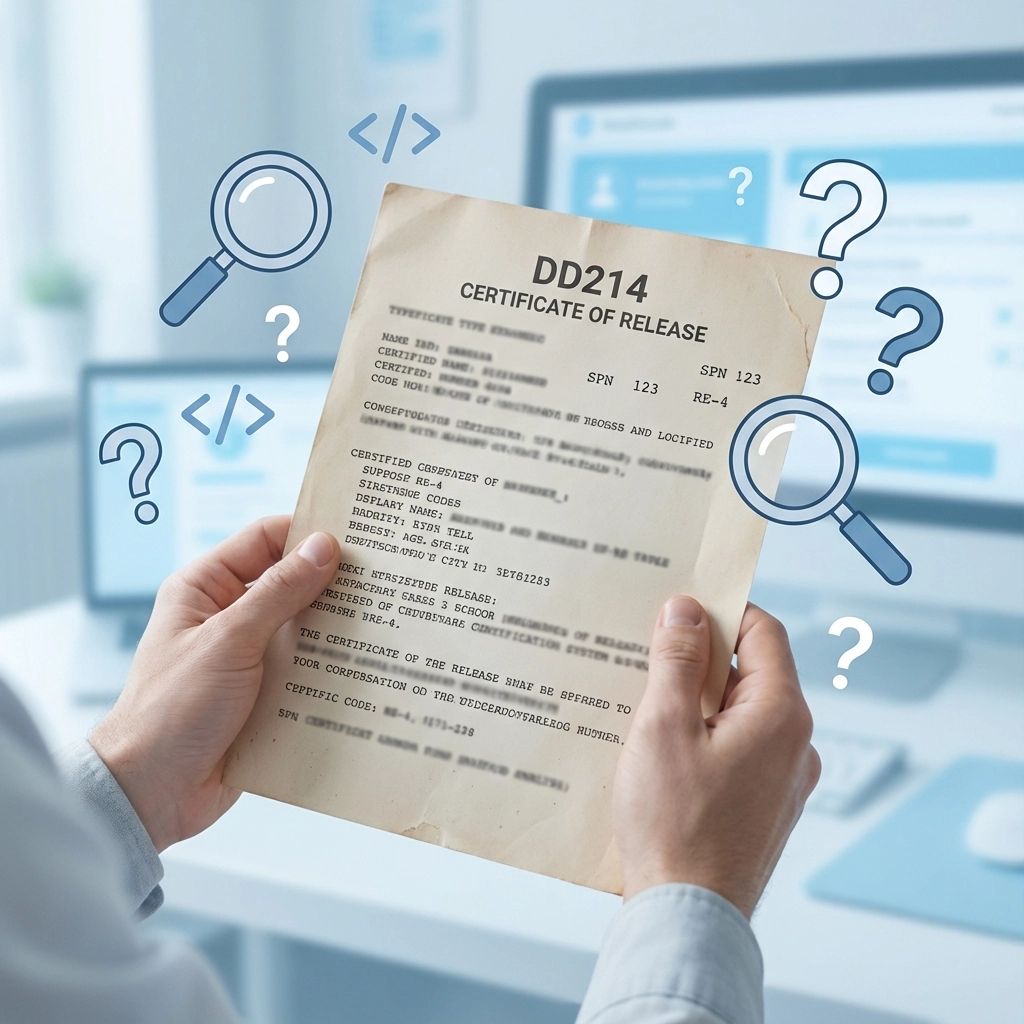
How It Happens: The difference between “HON” and “GEN” (General) affects benefit eligibility. Staff working under time pressure often miss these distinctions, especially when dealing with typewritten forms where letters blur together.
Prevention Through Automation: Smart Admissions’ DD214 Eligibility Checker uses optical character recognition (OCR) technology to identify service character codes with 99.7% accuracy across all DD214 formats. The system flags any questionable readings for human review rather than making assumptions.
2. Missing Eligibility Indicators in Older DD214 Formats
The Mistake: DD214 forms have changed formats 45+ times since 1945. Eligibility indicators appear in different locations and use varying terminology across decades. Staff miss critical service-connected disability ratings or special eligibility codes buried in older formats.
Financial Impact: Overlooking a 30% service-connected disability rating can mean missing $1,000+ monthly additional payments. Over a year-long stay, this represents $12,000+ in lost revenue per resident.
The Complexity: A 1960s DD214 might show disability information in narrative form within Box 18 (remarks), while modern forms use specific numeric codes. Staff trained on current formats often skip over these older designations entirely.
Automated Solution: The DD214 Eligibility Checker maintains a comprehensive database of format variations dating back to 1945. It systematically scans every field where eligibility information might appear, regardless of the document’s age or format structure.
3. Confusing Discharge Status Classifications
The Mistake: Veterans receive different types of discharges that affect benefit eligibility. Staff confuse “Administrative Separation” with “Medical Discharge” or miss the difference between “Retirement” and “Disability Retirement.”
Financial Impact: A medical discharge often qualifies for enhanced VA benefits worth an additional $500-800 monthly. Missing this designation costs facilities $6,000-9,600 annually per affected resident.
Common Confusion Points:
- Medical vs. administrative separations
- Disability retirement vs. regular retirement
- Early separation vs. discharge
- Temporary vs. permanent disability classifications
Verification Automation: Automated systems cross-reference discharge codes with current VA benefit matrices, instantly identifying enhanced payment opportunities that manual reviewers typically miss.
4. Overlooking Service Date Requirements
The Mistake: VA benefits often require minimum service periods or service during specific conflicts. Staff miss nuanced requirements like “90 days active duty” or “service during wartime periods.”
Financial Impact: A veteran who served 89 days instead of 90 might be ineligible for certain benefits. Accepting them without proper verification leads to claim denials averaging $3,000-5,000 per month in lost payments.

The Details Matter: Service date calculations become complex when considering:
- Active duty vs. training periods
- Wartime vs. peacetime service
- Qualifying discharge dates
- Reserve vs. active component time
Automated Calculation: DD214 verification systems automatically calculate total qualifying service time and cross-reference against current VA eligibility requirements, preventing costly miscalculations.
5. Failing to Catch Altered or Incomplete DD214s
The Mistake: Some DD214s arrive with missing information, white-out corrections, or signs of alteration. Staff accept questionable documents without proper verification, leading to compliance violations.
Financial Impact: State surveyors discovering altered documentation can trigger compliance citations with fines ranging from $5,000-25,000. Plus, claims based on fraudulent documents face automatic denial and potential recovery actions.
Red Flags Often Missed:
- Misaligned text suggesting alterations
- Missing official seals or signatures
- Inconsistent dates or service records
- Photocopies without clear origination
Digital Verification: Automated systems flag potential document irregularities and provide direct VA verification channels, ensuring only authentic DD214s support admissions decisions.
6. Not Documenting the Verification Process Properly
The Mistake: Even when staff verify DD214 information correctly, poor documentation creates compliance vulnerabilities. Auditors need clear verification trails showing how eligibility was determined.
Financial Impact: During audits, inadequate documentation can trigger “no fault found” determinations where facilities must refund payments even for legitimate claims. These recoveries average $8,000-15,000 per flagged case.
Documentation Gaps:
- No timestamp on verification completion
- Missing staff signature/identification
- Unclear decision rationale
- No supporting calculation worksheets
Automated Audit Trails: Digital verification systems automatically generate comprehensive documentation including timestamps, decision logic, supporting calculations, and compliance checklists: creating audit-ready records for every verification.
7. Processing Delays That Lose Referrals to Competitors
The Mistake: Manual DD214 verification takes 15-30 minutes per referral. In competitive markets, this delay allows other facilities to accept qualified veterans while you’re still processing paperwork.
Financial Impact: Each lost qualified referral represents $10,000-20,000 in potential annual revenue. For facilities losing 2-3 referrals monthly due to slow processing, this adds up to $240,000-720,000 in missed opportunities.

The Speed Challenge: Manual verification requires:
- Finding and reviewing specific DD214 sections
- Cross-referencing eligibility requirements
- Calculating service periods and benefits
- Documenting findings and decisions
Instant Processing: Automated DD214 verification completes in under 30 seconds, allowing immediate response to referral sources while competitors are still gathering paperwork.
The Compound Cost of Manual Verification Errors
These seven mistakes don’t occur in isolation. A typical Veterans SNF facility experiencing manual verification challenges faces:
- 2-3 verification errors weekly resulting in claim denials worth $7,000-12,000 monthly
- Lost referrals due to processing delays worth $20,000-40,000 monthly
- Compliance citations from documentation gaps averaging $10,000-30,000 annually
- Staff overtime for rework and corrections adding $5,000-8,000 monthly
Combined, these errors cost the average Veterans SNF facility $150,000-400,000 annually in lost revenue, penalties, and operational inefficiencies.
Eliminating Verification Errors Through Automation
Smart Admissions’ DD214 Eligibility Checker addresses each of these costly mistakes through comprehensive automation:
Accurate Code Reading: OCR technology reads character of service codes, service dates, and eligibility indicators with 99.7% accuracy across all historical DD214 formats.
Format Recognition: Built-in knowledge of 45+ DD214 variations ensures no eligibility information gets overlooked regardless of document age or format style.
Fraud Detection: Advanced algorithms flag potential document alterations or inconsistencies for human review before processing.
Complete Documentation: Automatic generation of audit-ready verification records with timestamps, decision rationale, and compliance checklists.
Instant Processing: 30-second verification enables immediate response to referral sources, capturing qualified veterans before competitors.
For Veterans SNF facilities processing 5-10 referrals daily, automated DD214 verification typically saves $200,000-500,000 annually while ensuring 100% compliance accuracy.
Ready to eliminate costly DD214 verification mistakes at your facility? Contact Smart Admissions to see how automated verification can protect your revenue and streamline your admissions process.