
TL;DR:
- Healthcare software selection criteria in 2026 focus on clinical functionality, interoperability, cybersecurity, due diligence, and financial viability. Prioritizing usability and workflow fit reduces staff burnout and improves adoption, while thorough security documentation and clear exit strategies prevent future risks. Evaluating 3–5 vendors with structured demos and pilot tests ensures a reliable choice aligned with clinical operations.
Healthcare software selection criteria are the benchmarks administrators use to evaluate whether a software solution will genuinely support patient admissions, referrals, and daily clinical operations. The wrong choice costs your facility time, money, and staff morale. The right framework, built around clinical workflow fit and interoperability in healthcare, separates software that works from software that sits unused. This guide gives you a weighted, practical evaluation framework built on 2026 industry standards so your team makes a confident, defensible decision.
1. What are the most critical healthcare software selection criteria?

A weighted evaluation framework assigns clinical functionality and interoperability each 25% of the total score, organizational due diligence 20%, cybersecurity 15%, implementation 10%, and financial sustainability 5%. A score of 85 or above signals strategic fit. A score below 65 signals high risk. That structure tells you exactly where to focus your evaluation energy.
Most administrators approach software selection as an IT procurement task. It is not. Software selection is a clinical operations decision that must reflect how your admissions coordinators, nurses, and referral staff actually work every day. Technology that does not fit daily workflows gets abandoned, regardless of its feature list.
- Clinical functionality: Does the software support your specific admissions and referral workflows?
- Interoperability: Can it exchange data with your existing EMR, insurance portals, and referral sources using FHIR and HL7 standards?
- Organizational due diligence: Does the vendor have verifiable references from similar facilities?
- Cybersecurity: Does it meet HIPAA, SOC 2, and encryption requirements?
- Implementation: What is the realistic go-live timeline and training plan?
- Financial sustainability: What is the full five-year total cost of ownership?
Pro Tip: Score each vendor against these six categories before your first demo. It prevents bias toward polished presentations and keeps your evaluation grounded in operational reality.
2. How to evaluate software usability and clinical workflow integration
Usability directly determines provider wellness. Software that minimizes clicks and reduces cognitive load improves adoption and lowers burnout risk. That is not a soft benefit. It is a measurable operational outcome that affects bed fill rates and staff retention.
Start by mapping your current admissions and referral workflows before you speak to any vendor. Document where your team loses time, where data gets re-entered manually, and where referrals stall. This gives you a concrete checklist to test against during demos. Vague complaints like “the system is slow” do not help. Specific pain points like “we re-enter insurance data three times per referral” do.
Structured evaluation steps for usability:
- Identify the five most time-consuming tasks in your current admissions workflow.
- Ask each vendor to demonstrate those exact tasks using your facility’s data, not generic sample data.
- Invite two or three frontline staff members, including an admissions coordinator and a nurse, to observe and score each demo independently.
- Run a structured pilot with real patients before signing any contract.
- Evaluate vendor support responsiveness during the pilot. Slow or vague answers about protected health information handling are a warning sign.
Reducing redundant data entry is the single most reliable indicator of workflow fit. If a platform requires your staff to re-enter data that already exists in your EMR, it will create friction and resistance from day one. Smartadmissions addresses this directly by automating data flow between referral sources, EMR systems, and insurance portals.
Pro Tip: Ask vendors to show you what happens when a referral arrives outside business hours. Platforms that require manual intervention for after-hours intake create gaps that cost you admissions.
3. What security and compliance criteria must healthcare software meet?
The security baseline for healthcare software in 2026 includes AES-256 encryption, role-based access control, audit logging, HIPAA and GDPR compliance, and documented disaster recovery plans. Each of these is a non-negotiable requirement, not a differentiator. Any vendor that cannot confirm all of them in writing should be removed from your shortlist immediately.
Beyond the baseline, your facility needs to verify uptime commitments. Industry-standard uptime SLAs require 99.5%–99.9% availability with documented Recovery Time Objectives and Recovery Point Objectives. An RTO of four hours or less means your operations can resume quickly after an outage. An RPO of one hour or less means minimal data loss. Demand these figures in writing before contract negotiations begin.
Key compliance requirement: Every vendor handling protected health information must sign a Business Associate Agreement before your facility shares any patient data. A BAA defines the vendor’s legal obligations under HIPAA and establishes liability in the event of a breach. Reviewing your BAA with legal counsel is not optional. The HIPAA Enforcement Rule carries significant financial penalties for facilities that fail to secure compliant agreements.
Vendor security posture verification goes beyond asking for a compliance checklist. Request the vendor’s most recent SOC 2 Type II audit report. Ask whether they carry cyber liability insurance. Confirm that their staff with access to your data undergo background checks and annual security training. These questions separate vendors with genuine security programs from those with marketing-level compliance claims.
4. How to assess total cost of ownership and vendor viability
Total cost of ownership covers licensing, implementation, training, customization, ongoing support, upgrades, and exit costs across five years. Most administrators focus on the annual license fee and underestimate everything else. Implementation alone can equal or exceed the first year’s license cost for complex integrations.
Ask every vendor for a written five-year cost projection that itemizes each category. Compare those projections across your shortlisted vendors using a consistent format. Hidden costs appear most often in customization, interface development for EMR connections, and per-user fees that scale with your headcount.
| Cost category | What to ask the vendor |
|---|---|
| Licensing | Is pricing per user, per bed, or flat rate? |
| Implementation | What is included, and what is billed separately? |
| Training | Is initial training included? What about new staff? |
| Upgrades | Are major version upgrades included in the license? |
| Exit costs | Can you export all data in a standard format at no charge? |
Vendor viability matters as much as pricing. A vendor acquired by a private equity firm may change its pricing model, discontinue support, or sunset the product within your contract term. Review the vendor’s funding history, ownership structure, and product roadmap before signing. Ask for references from facilities that have used the platform for three or more years.
Lack of an explicit exit strategy leads to vendor lock-in. Audit data export and portability options before signing. Confirm that you can retrieve all patient records, referral histories, and configuration data in a standard, machine-readable format. This protects your facility if you need to switch platforms in the future.
Pro Tip: Negotiate data portability rights into the contract before you sign, not after. Vendors are far more flexible on this point before the deal closes.
5. Which practical steps ensure a successful vendor evaluation process?
Evaluating 3–5 vendors with structured demos, site visits, and pilot testing reduces selection risk and improves post-go-live adoption. Fewer than three vendors limits your comparison. More than five creates decision fatigue without adding meaningful insight.
Follow this sequence for each vendor you evaluate:
- Issue a structured RFP. Include your specific workflow requirements, integration needs, security standards, and five-year budget parameters. This filters out vendors who cannot meet your baseline before you invest time in demos.
- Run a scripted demo using your data. Provide the vendor with anonymized sample referrals and patient intake scenarios from your facility. Generic demos reveal nothing about real-world fit.
- Conduct a site visit. Visit a similar facility that uses the platform. Ask their admissions team, not just their IT director, about daily usability and vendor support quality.
- Complete a pilot test with end users. Run the software in a controlled environment for 30–60 days with your actual admissions staff. Measure time-per-referral, error rates, and staff satisfaction scores.
- Review the contract with legal counsel. Focus on data ownership, support response time commitments, termination clauses, and BAA terms. Do not rely on the vendor’s standard contract without negotiation.
ONC certification is a baseline, not a mark of excellence. Certified platforms still fail in real-world environments. Pilot testing with your staff and peer organization references is the only reliable way to uncover operational gaps before purchase. For guidance on evaluating electronic medical records systems as part of your vendor review, peer-reviewed frameworks provide a useful starting structure.
Vendor responsiveness during the evaluation process is itself a reliability indicator. If a vendor takes three days to answer a compliance question during the sales process, expect the same response time after you sign. Direct access to knowledgeable support staff who understand PHI handling and BAA obligations is a concrete sign of a vendor worth trusting.
Key takeaways
The most effective healthcare software selection criteria weight clinical workflow fit and interoperability equally at 25% each, with security, due diligence, implementation, and financial sustainability filling the remaining score.
| Point | Details |
|---|---|
| Weight clinical fit first | Clinical functionality and interoperability each carry 25% of the evaluation score. |
| Test with real workflows | Run scripted demos and pilot tests using your actual admissions data, not vendor samples. |
| Demand security documentation | Require AES-256 encryption, HIPAA compliance, BAA, and written uptime SLAs before shortlisting. |
| Calculate full five-year cost | Include licensing, implementation, training, upgrades, and exit costs in every vendor comparison. |
| Audit exit terms before signing | Confirm data portability rights in writing to avoid vendor lock-in after contract execution. |
What most administrators get wrong about software selection
Healthcare software selection is one of those decisions where the process matters more than the product. I have seen facilities choose platforms with impressive feature lists and polished demos, only to watch adoption collapse within six months because the software did not match how their admissions team actually worked.
The most common mistake is treating this as a technology decision rather than a clinical operations decision. Your IT team should be at the table, but they should not lead the evaluation. The people who will use the software every day, your admissions coordinators, referral specialists, and nursing staff, need to drive the usability assessment. Their feedback during a structured pilot is worth more than any vendor-supplied case study.
The second mistake is skipping the exit strategy review. Administrators are optimistic during vendor selection. Nobody wants to think about switching platforms before they have even gone live. But data portability is a leverage point you only have before you sign. Use it.
The third mistake is underweighting vendor responsiveness as a selection criterion. A vendor that answers your toughest compliance questions quickly, clearly, and without deflection during the sales process is telling you something important about how they will treat you as a client. That signal is more reliable than any reference letter.
— Harry
How Smartadmissions supports your admissions software decision
Smartadmissions is built specifically for skilled nursing facilities, rehabilitation centers, and post-acute care providers that need software aligned with the criteria covered here. Its AI-powered referral management assistant integrates directly with existing EMR systems and insurance portals, eliminating the redundant data entry that drives staff burnout and slows bed fill rates.
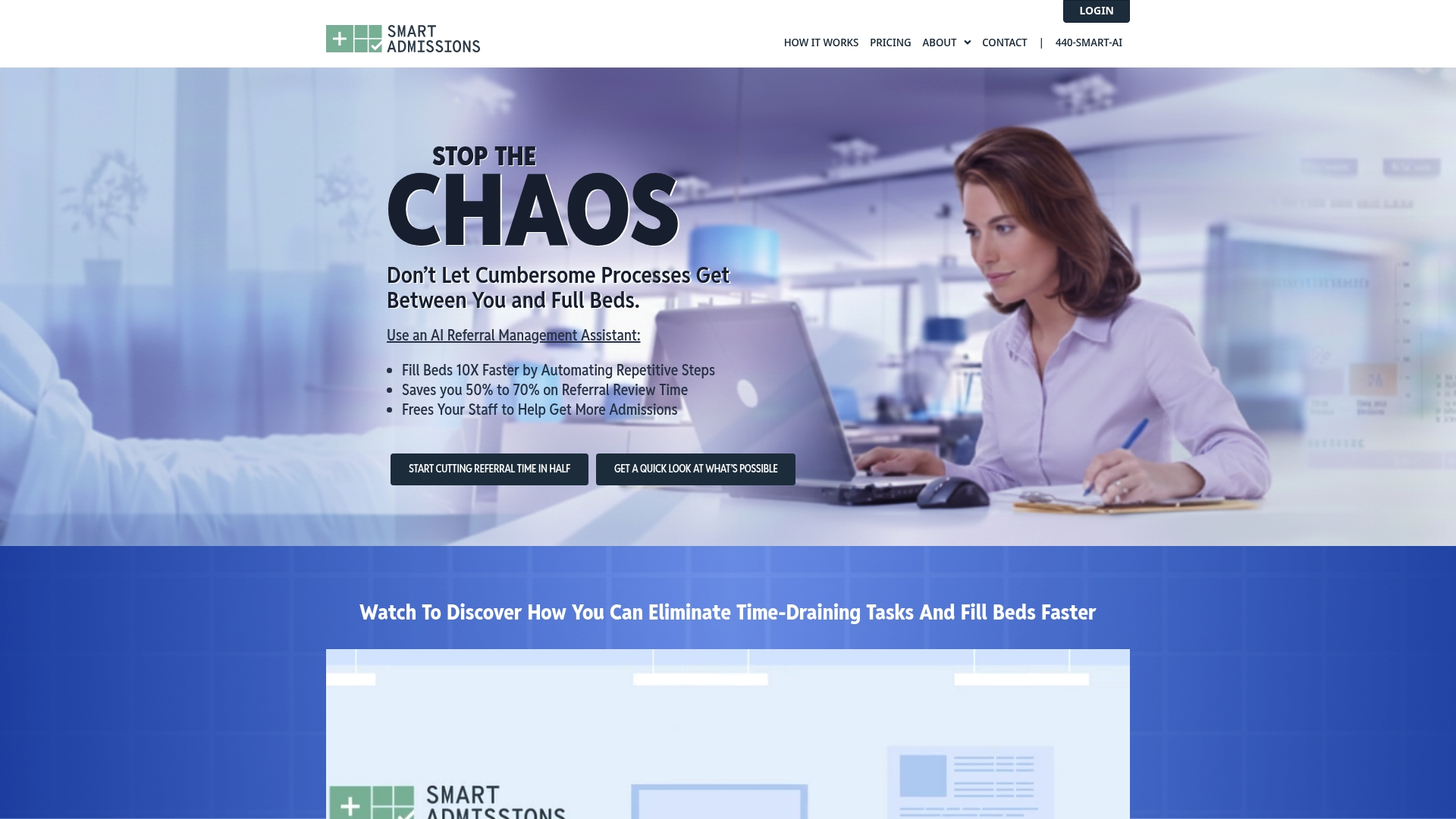
The platform automates patient eligibility verification, clinical assessments, and documentation management, addressing the clinical workflow fit and interoperability requirements that carry the most weight in any serious evaluation. Smartadmissions also offers responsive onboarding support and customizable workflows, so your team is not left to configure a complex system alone. For a concrete look at how purpose-built platforms perform in practice, the referral management system examples page shows real-world applications across post-acute care settings. If your facility is also working to reduce staffing burnout through better intake workflows, Smartadmissions addresses that directly.
FAQ
What are the top healthcare software selection criteria in 2026?
The top criteria are clinical functionality, interoperability, organizational due diligence, cybersecurity, implementation feasibility, and financial sustainability. A weighted framework assigns clinical functionality and interoperability each 25% of the total evaluation score.
How many vendors should you evaluate when choosing healthcare software?
Evaluate 3–5 vendors using structured demos, site visits, and pilot testing. Fewer than three limits meaningful comparison, while more than five creates decision fatigue without improving the outcome.
What security standards must healthcare software meet?
Healthcare software must meet HIPAA compliance requirements, use AES-256 encryption in transit and at rest, enforce role-based access control, maintain audit logs, and provide a signed Business Associate Agreement before any patient data is shared.
What does total cost of ownership include for healthcare software?
Total cost of ownership covers licensing, implementation, training, customization, ongoing support, upgrades, and exit costs across a five-year period. Always request an itemized five-year projection from each vendor before comparing options.
Is ONC certification enough to confirm a platform is ready for your facility?
ONC certification confirms a baseline level of compliance but does not guarantee real-world performance. Pilot testing with your actual admissions staff and peer organization references is the only reliable way to validate operational fit before purchase.
Recommended
- What Top-Performing SNFs Do Differently in Their Admissions Process – Smart Admissions
- Clinical Assessment Automation: What to Automate (and What to Keep Manual) – Smart Admissions
- 7 Key Advantages of Automated Documentation in Healthcare Admissions
- Clinical Assessment Checklist: 7 Essential Tools for Clinicians