
TL;DR:
- Referral overflow occurs when patient referrals exceed a facility’s capacity, risking lost cases and damaged relationships. Managing overflow effectively involves centralized intake, automated processes, structured triage, and real-time communication with referrers to maintain trust and convert overflow into growth.
Referral overflow is the condition where incoming patient referrals exceed your facility’s current capacity to review, accept, or process them in time. Knowing how to handle referral overflow is the difference between a well-run admissions operation and one that loses patients, strains staff, and damages referrer relationships. Industry benchmarks confirm that double-sided referral incentives outperform single-sided programs for both participation and conversion. Smartadmissions addresses this challenge directly with AI-powered intake tools built for skilled nursing facilities, rehabilitation centers, and post-acute care providers. The strategies below cover centralization, triage, communication, and measurement.
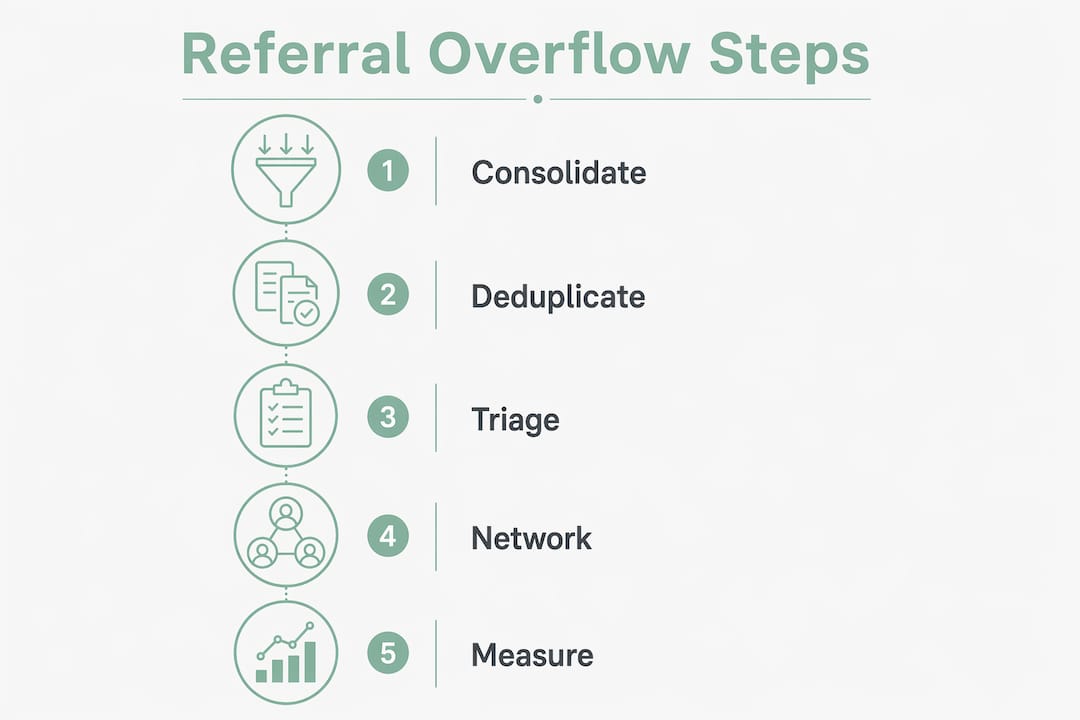
How to handle referral overflow with the right intake systems
The first step in managing referral overload is consolidating every intake channel into one platform. Fax, email, web forms, and EHR feeds all arriving in separate inboxes create gaps where referrals fall through or get entered twice. Centralizing all intake channels prevents missed and duplicate referrals and saves your staff significant processing time.
Automated deduplication is the mechanism that makes centralization work. When a referral arrives from two sources simultaneously, the system flags and merges the records instead of creating parallel workflows. That takes seconds with automation. Without it, your team spends hours reconciling duplicates manually.
Real-time referral status tracking gives every team member a single source of truth. Admissions coordinators can see which referrals are pending review, which are awaiting insurance verification, and which are ready for a bed assignment decision. That visibility alone reduces the back-and-forth communication that slows intake down.
| Feature | Manual process | Automated intake platform |
|---|---|---|
| Deduplication | Hours of manual review | Seconds, system-flagged |
| Insurance verification | Staff calls and fax follow-ups | Real-time eligibility check |
| Referral status visibility | Siloed per coordinator | Centralized dashboard |
| Channel consolidation | Separate inboxes per source | Single unified queue |
Pro Tip: When evaluating intake platforms, confirm support for FHIR and HL7 standards. These protocols govern how your platform exchanges data with hospital EHR systems, and compatibility gaps will create manual workarounds that defeat the purpose of automation.
How to implement structured triage for urgent referrals
Structured triage is a formal classification system that assigns each incoming referral a priority level based on clinical urgency, payer type, and available capacity. Without it, your team processes referrals in the order they arrive, which means a high-acuity patient may wait behind a lower-priority case simply because their paperwork came in first.
A practical triage framework uses three tiers:
- Urgent: High-acuity patients requiring placement within 24 hours. These referrals go to the top of the queue and trigger immediate clinical review.
- Standard: Patients with stable conditions and flexible placement timelines. These move through normal intake workflow with a target response time of 48–72 hours.
- Deferred: Referrals that cannot be accepted at current capacity but may be revisited within a defined window. These are logged, not discarded.
Routing rules work alongside triage tiers. A referral for a patient requiring wound care routes to a coordinator with wound care intake experience. A referral from a high-volume hospital partner routes with a flag for priority response. These rules can be configured once in your intake platform and applied automatically to every incoming case.
The deferred category deserves specific attention. A deferred referral is not a declined referral. It carries a follow-up date, a reason code, and a responsible coordinator. Treating deferrals as active cases prevents them from becoming lost opportunities when capacity opens up.
Pro Tip: Automated triage reduces the cognitive load on your admissions staff during high-volume periods. Set your triage rules during a low-volume week so the logic is tested before your next surge.
What strategies convert referral overflow into growth?
Referral overflow handled well becomes a revenue source. The mechanism is a pre-approved partner network: a set of trusted facilities with reciprocal referral agreements. When your census is full, you refer the patient to a partner. When their census is full, they refer back to you. Overflow referrals directed to pre-approved partners convert lost leads into revenue streams rather than dead ends.

Referral fee structures formalize this arrangement. A facility that receives an overflow referral from your network pays a pre-negotiated fee or agrees to a reciprocal volume commitment. This creates passive revenue from patients you could not accept anyway.
The referrer communication loop is the part most facilities neglect. A hospital discharge planner who sends a referral and hears nothing assumes the referral was lost. Automated referral status updates turn one-time referrers into repeat sources by giving them consistent, timely feedback on every case they send.
“Transparency about capacity constraints frames your limits as quality signals, not failures. Referrers who understand why you are at capacity trust you more, not less.” — Managing client overflow
Communication framing matters too. Pro-social referral messaging that emphasizes benefits to the referred patient increases referral probability by 86% compared to generic or self-focused messaging. Apply that principle to your overflow communications: tell the referrer what happens to their patient next, not just that you are full.
- Build a vetted partner list with signed reciprocal agreements before overflow hits.
- Assign a coordinator to manage partner relationships and track referral volume exchanged.
- Automate status notifications at each stage: received, under review, accepted, deferred, or transferred.
- Review partner performance quarterly and rotate underperforming partners out of the network.
How to measure and maintain referral overflow processes
Measurement is what separates a referral overflow process that holds up under pressure from one that degrades quietly over time. The four metrics that matter most are speed to contact, referral conversion rate, referral volume by source, and referral source attribution at the point of deal creation.
Speed to contact is the most time-sensitive metric. Contacting a referred lead within the first hour can double conversion rates compared to waiting a day. That is not a marginal improvement. It means your response time protocol directly determines how many referrals you convert.
Referral source attribution tells you which hospital partners, discharge planners, or physician groups are generating your highest-value admissions. Tracking conversion rate and revenue impact by referral partner reveals who contributes meaningfully and who sends referrals that rarely convert. That data drives smarter partner investment decisions.
| Metric | What it measures | Why it matters |
|---|---|---|
| Speed to contact | Time from referral receipt to first response | Directly tied to conversion rate |
| Referral conversion rate | Accepted referrals as a share of total received | Measures intake efficiency |
| Volume by source | Referrals received per partner or channel | Identifies high-value referral sources |
| Source attribution | Revenue linked to each referral origin | Guides partner investment decisions |
Regular audits protect your program from fraud and data drift. Review your deduplication logs monthly to catch referrals that are being entered manually outside the system. Confirm that routing rules still reflect your current specialty mix and capacity constraints. A quarterly review of your partner network performance keeps your overflow agreements current.
Pro Tip: Set your CRM to capture referral source at the point of deal creation, not after admission. Retroactive attribution is consistently inaccurate and will skew your partner performance data.
Which mistakes should administrators avoid when managing referral overflow?
Fragmented intake is the most common and most costly mistake. When referrals arrive through fax, email, and phone calls that each feed a different coordinator’s personal queue, duplicates multiply and cases fall through. AI-driven intake deduplication and status tracking reduce this manual work dramatically and improve accuracy across the board.
Slow first contact is the second major failure point. A referral that sits unacknowledged for 24 hours is often already lost. The referring discharge planner has moved on to the next available facility. Speed to contact is not just a courtesy metric. It is a conversion driver.
- Fragmented systems: Multiple intake channels with no central queue create duplicate referrals and missed cases.
- No triage protocol: Processing referrals in arrival order instead of urgency order misallocates your team’s time.
- Broken referrer loop: Failing to update referrers on case status destroys repeat referral volume. Most organizations lose repeat referrals because they never close this loop.
- Manual-only workflows: Manual processing cannot scale. When volume spikes, manual systems fail first.
- No partner network: Declining referrals without a transfer option ends the referrer relationship permanently.
The fix for all five mistakes is the same: standardized, automated workflows with clear ownership at each stage. Automation does not replace your admissions team. It removes the repetitive tasks that prevent them from doing high-value work.
Referral overflow is a signal, not a problem
The facilities I have seen struggle most with referral overflow share one trait: they treat it as a capacity failure rather than a demand signal. When your referral volume exceeds your current intake capacity, that means your referral sources trust you. The problem is not the volume. The problem is the absence of a system designed to handle it.
The shift that changes everything is moving from reactive to proactive management. Reactive teams scramble when volume spikes. Proactive teams have triage rules, partner networks, and automated updates already running before the spike arrives. The infrastructure is built during quiet periods so it performs during busy ones.
Transparency with referrers is the most underused tool in this space. Telling a hospital discharge planner that you are at capacity, that their patient has been transferred to a trusted partner, and that you will follow up when a bed opens is not a failure message. It is a trust-building message. Referrers remember facilities that communicate clearly. They stop sending to facilities that go silent.
Investing in AI-driven triage and automated referrer updates is not a technology decision. It is a relationship decision. The long-term value of a high-volume referral source far exceeds the cost of the system that keeps them informed.
— Harry
Smartadmissions makes referral overflow manageable
Managing excess referral volume requires the right infrastructure, and Smartadmissions is built specifically for that challenge.
Smartadmissions centralizes all intake channels into one platform, automates insurance verification and deduplication, and delivers real-time referral status updates to your team and your referral partners. Its AI-powered triage integrates directly with your existing EMR through FHIR and HL7 standards, so your admissions coordinators spend less time on manual data entry and more time on patient placement decisions. For a full breakdown of how referral management works and why it matters, Smartadmissions has the resources your team needs. You can also explore referral management systems built for post-acute care facilities to find the right fit for your operation.
FAQ
What is referral overflow in healthcare admissions?
Referral overflow occurs when incoming patient referrals exceed a facility’s current capacity to review or accept them in time. Without a structured process, these referrals are lost or delayed, reducing bed fill rates and damaging referrer relationships.
How do I prioritize referrals when volume is high?
Use a three-tier triage system: urgent cases requiring placement within 24 hours, standard cases with flexible timelines, and deferred cases logged for follow-up when capacity opens. Automated triage rules apply these classifications consistently without adding staff workload.
How fast should I respond to a new referral?
Contacting a referred lead within the first hour can double conversion rates compared to a 24-hour delay. Set a protocol that triggers an acknowledgment to the referrer within 60 minutes of receipt.
What should I do with referrals I cannot accept?
Transfer overflow referrals to a pre-approved partner network with reciprocal agreements. This preserves the referrer relationship, provides continuity of care for the patient, and can generate passive revenue through referral fee arrangements.
How do I keep referrers coming back after I decline a case?
Automated status updates at every stage of the referral process close the communication loop that most facilities leave open. Referrers who receive consistent, timely updates become repeat sources regardless of whether their referral was accepted.