
TL;DR:
- Intake forms are essential tools that gather patient information before admission, reducing delays and ensuring compliance. Properly designed forms improve efficiency, patient experience, and data accuracy by being timely, concise, and including active consent acknowledgment. Regular review and integration with electronic medical records optimize workflows and support faster, smoother admissions.
Intake forms are structured documents used to collect essential patient information before the admissions process begins. They serve as the operational foundation of any healthcare admissions workflow, capturing clinical history, consent, insurance details, and demographic data before a patient ever arrives. The role of intake forms in admissions extends well beyond paperwork. When designed correctly, they reduce administrative burden, support HIPAA compliance, and create a better first experience for patients entering skilled nursing facilities, rehabilitation centers, and post-acute care settings. This guide covers what your forms should collect, how to design them well, and where technology makes the biggest difference.

How intake forms shape the admissions intake process
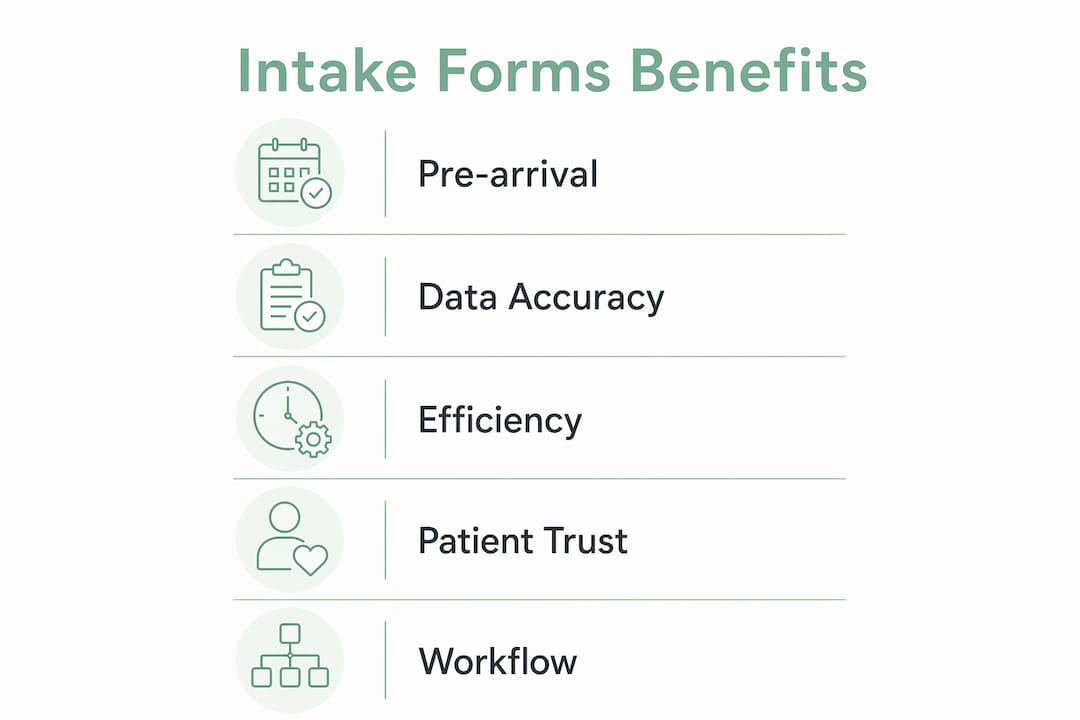
The role of intake forms in admissions is fundamentally operational. Healthcare professionals lose 15–20 minutes per new patient when information is collected manually during the visit. That time adds up fast across a full admissions schedule, and it comes directly out of clinical interaction time.
Well-designed intake forms shift that data collection to before the appointment. Your team receives structured, pre-verified information before the patient walks through the door. That means fewer delays at the front desk, fewer redundant questions during clinical assessment, and a faster path to bed placement decisions.
The efficiency gains follow a clear sequence:
- Pre-arrival data collection removes the need to gather basic demographics, insurance details, and health history on the day of admission.
- Automated workflow triggers can fire as soon as a completed form is received, alerting clinical staff to review flagged conditions or insurance gaps before the patient arrives.
- Reduced manual entry cuts transcription errors, which are a leading cause of billing delays and compliance issues in post-acute care settings.
- Faster eligibility verification becomes possible when insurance and financial consent data arrive in a structured format that integrates directly with EMR systems.
- Staff time reallocates from data entry to clinical judgment, which is where your team’s expertise actually matters.
Pro Tip: Send digital intake forms immediately after booking, not as a cold link days before the appointment. Timing form delivery right after scheduling captures patient motivation at its peak and produces more complete, accurate responses.
The admissions intake process runs more smoothly when your forms do the preparatory work. Your staff spends less time chasing missing information and more time making sound clinical decisions.
What should a healthcare intake form collect?
Healthcare intake forms collect five core data categories: personal and demographic information, clinical and medical history, financial and insurance details, emergency contacts, and legal consents including privacy acknowledgments. Each category serves a distinct purpose in the admissions workflow.
Informed consent and privacy acknowledgments are legally separate from demographic data collection, even when they appear on the same digital form. Active acknowledgment, meaning the patient reads and confirms each consent item individually, is required for legal defensibility. A passive checkbox at the bottom of a long form does not meet that standard.
The table below maps each data category to its primary function in healthcare admissions:
| Form section | Primary purpose |
|---|---|
| Demographics and contact details | Identifies the patient and enables communication |
| Medical and clinical history | Informs clinical assessment and care planning |
| Insurance and financial policy | Supports eligibility verification and billing |
| Emergency contacts | Meets regulatory and safety requirements |
| HIPAA and privacy acknowledgments | Establishes legal compliance and data handling consent |
| Informed consent | Authorizes treatment and documents patient agreement |
For healthcare providers, the ideal form length is 15–20 questions. That range captures the clinical detail needed for admissions decisions without overwhelming patients to the point of abandonment. General service providers can use fewer questions, but healthcare settings require more depth to meet clinical and regulatory standards.
Your form design should treat each section as purposeful, not procedural. Every question you include should connect directly to a clinical, administrative, or legal requirement. Questions that exist “just in case” inflate form length and reduce completion rates.
How intake forms improve patient experience and build trust
The intake form is the first substantive interaction a patient has with your facility. That first impression shapes how they perceive your team’s competence and care before any clinical interaction takes place.
Well-designed intake forms shift the focus of first meetings from data collection to relationship building. When patients complete their information before arriving, your admissions staff can spend the first minutes of contact on clinical conversation rather than paperwork. That shift is noticeable to patients and their families.
Key patient experience benefits of a well-structured admissions form include:
- Reduced wait times at admission. Pre-arrival data collection eliminates the 15–20 minute intake delay that patients experience when forms are completed on-site.
- Normalized process perception. Patients who receive a professional, clearly organized form before arrival perceive the facility as prepared and thorough.
- Reduced anxiety around paperwork volume. Explaining why each section is necessary within the form itself reduces patient resistance and builds confidence in the provider.
- Faster clinical engagement. Admissions staff who already have complete patient data can move directly to clinical assessment, which patients experience as attentive and efficient.
Pro Tip: Add a brief one-sentence explanation before each major form section. For example, “We collect this information to verify your insurance coverage before your arrival.” Patients who understand the purpose of a question are significantly more likely to answer it accurately.
Strategically designed intake forms transform the initial visit from a transactional paperwork session into a clinical relationship-building interaction. That distinction matters for patient retention, family satisfaction scores, and your facility’s reputation in the referral network.
Common challenges and intake form best practices
Form fatigue is the leading cause of incomplete submissions. Overly long or unclear forms drive abandonment before patients reach the consent sections, which creates compliance gaps and forces staff to follow up manually. The fix is not a shorter form. The fix is a better-structured form.
Practical best practices for healthcare intake form design include:
- Separate consent from data collection visually and structurally. Patients who encounter legal language mid-form often stop reading carefully. Place all consents in a clearly labeled section at the end, after demographic and clinical questions.
- Use active acknowledgment for all legal consents. Each HIPAA authorization, financial policy agreement, and treatment consent should require a distinct, individual confirmation. Passive checkboxes at the bottom of a scrollable page do not hold up under audit.
- Prioritize digital forms over paper. Digital intake forms that integrate with your EMR system improve data accuracy and eliminate redundant manual entry. Paper forms introduce transcription errors and slow the admissions workflow.
- Send forms at the right time. Distributing forms immediately after booking produces higher completion rates than sending them days in advance or on the day of admission.
- Audit your forms regularly. Regulatory requirements change. HIPAA standards, state-level privacy laws, and payer documentation requirements all evolve. A form that was compliant in 2024 may have gaps in 2026.
- Test your forms with real patients. Ask a small group of patients to complete a new form and note where they hesitate or ask questions. Their friction points reveal design problems your team will not notice internally.
Healthcare administrators who want a structured approach to intake workflow improvement will find that most completion rate problems trace back to form length, unclear instructions, or poor timing of delivery. All three are fixable without rebuilding your entire admissions process.
For facilities focused on healthcare intake efficiency, the design of your intake form is also a marketing signal. A professional, well-organized form communicates competence to patients and referring providers alike.
Key Takeaways
The role of intake forms in admissions is to collect structured patient data before arrival, reduce administrative delays, support HIPAA compliance, and create a better first experience for patients and families.
| Point | Details |
|---|---|
| Pre-arrival data collection saves time | Healthcare staff lose 15–20 minutes per patient when forms are completed on-site instead of before arrival. |
| Form length affects completion rates | Healthcare intake forms should contain 15–20 questions to balance clinical detail with patient completion rates. |
| Active consent is legally required | Each HIPAA and treatment consent must use active acknowledgment, not passive checkboxes, for legal defensibility. |
| Digital forms reduce data entry errors | EMR-integrated digital forms eliminate transcription errors and speed up eligibility verification at admission. |
| Timing of delivery matters | Sending forms immediately after booking produces higher completion rates than sending them days in advance. |
Why intake forms deserve more strategic attention than they get
Most admissions teams treat intake forms as a compliance checkbox. They build the form once, file it away, and revisit it only when a regulatory audit forces the issue. That approach costs facilities more than they realize.
I’ve seen admissions workflows where the intake form was the single biggest bottleneck. Not the EMR. Not the insurance verification process. The form itself, because it was too long, poorly timed, and never tested with actual patients. Staff were spending significant time each week chasing incomplete submissions, and the clinical team was starting every admission with missing information.
The shift that actually works is treating the intake form as a live operational document. That means reviewing it quarterly, testing it with patients, and measuring completion rates as a performance metric. When you track form completion the same way you track bed occupancy, you start making better decisions about form design.
Technology integration is the other underused lever. When your intake form feeds directly into your EMR, the data your staff collects becomes immediately usable for clinical assessment, insurance verification, and care planning. That connection, between the digital patient intake process and your clinical systems, is where the real efficiency gains live.
The facilities that get this right do not have shorter forms. They have smarter ones. And they treat every revision as an opportunity to reduce friction for patients and staff at the same time.
— Harry
How Smartadmissions supports your intake and admissions workflow
Smartadmissions is built for skilled nursing facilities, rehabilitation centers, and post-acute care providers that need their admissions process to move faster without adding staff workload.
The platform integrates directly with existing EMR systems, pulling intake data into clinical assessments and insurance verification in real time. That connection eliminates the manual re-entry that slows most admissions teams and introduces errors at the worst possible moment. Smartadmissions also automates referral review and documentation management, so your team spends less time on paperwork and more time on placement decisions. If you are evaluating where automation fits into your workflow, the comparison of manual vs automated admissions is a practical starting point. For a broader view of how automation affects bed occupancy and revenue, the resource on automation in healthcare admissions covers the operational case in detail.
FAQ
What is the role of intake forms in admissions?
Intake forms collect essential patient data before admission, including clinical history, insurance details, and legal consents. They reduce on-site delays, support HIPAA compliance, and give clinical staff the information they need before the patient arrives.
How many questions should a healthcare intake form include?
Healthcare intake forms should include 15–20 questions to capture the clinical and administrative detail required for admissions decisions without causing patient abandonment.
What is the difference between data collection and informed consent on intake forms?
Data collection gathers demographic and clinical information, while informed consent requires active, individual acknowledgment from the patient for each authorization. Legally, these are separate and should be structured as distinct sections on any compliant intake form.
When should healthcare facilities send intake forms to patients?
Facilities should send digital intake forms immediately after booking. Sending forms right after scheduling captures patient engagement at its highest point and produces more complete, accurate submissions.
How do digital intake forms improve the admissions process?
Digital intake forms that connect with EMR systems eliminate manual data re-entry, reduce transcription errors, and allow eligibility verification to begin before the patient arrives. That connection directly shortens the time from referral to bed placement.