
TL;DR:
- Effective staff scheduling in healthcare ensures operational efficiency through advance planning, coverage buffers, and automation. Properly managed schedules reduce costs, improve care consistency, and enhance staff retention. Transitioning to data-driven scheduling systems shifts managerial focus from micromanagement to outcome oversight.
Staff scheduling in facility management is the systematic process of assigning employees to shifts and tasks to achieve operational efficiency, compliance with labor rules, and high workforce engagement. For healthcare facility managers, this process is not administrative housekeeping. It is the operational backbone that determines whether your skilled nursing facility, rehabilitation center, or post-acute care unit delivers consistent, safe patient care every single day. Poor scheduling drives up overtime costs, accelerates staff burnout, and creates compliance exposure under predictive scheduling laws. Getting it right means fewer gaps, lower turnover, and a workforce that stays.
How does effective staff scheduling improve operational efficiency in healthcare facilities?
The role of staff scheduling in facility management connects directly to your bottom line. Scheduling quality affects absenteeism rates, overtime spend, and the continuity of care your patients receive. When schedules are built reactively, every callout becomes a crisis. When they are built proactively, your team absorbs variability without disruption.

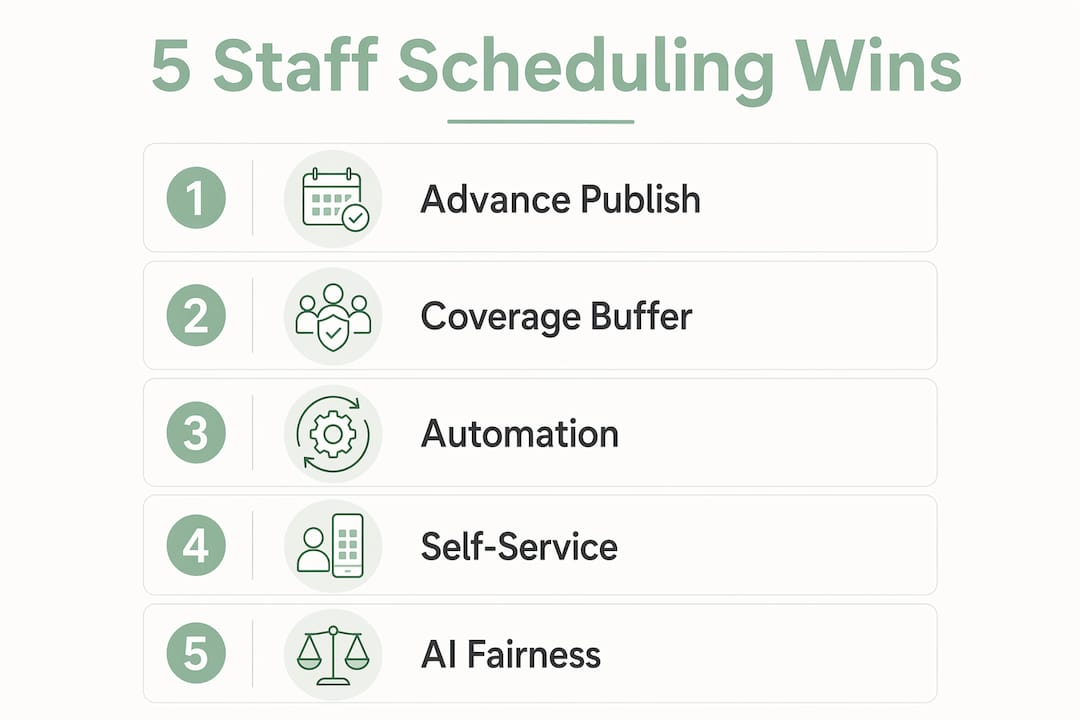
Advance schedule publication is one of the highest-leverage practices available to facility managers. Publishing schedules 2+ weeks ahead reduces last-minute callouts by 20–30% and measurably improves employee retention. That outcome matters because schedule unpredictability is one of the top reasons hourly healthcare workers leave their positions.
Coverage buffers are equally critical. Top-performing facilities build 10–15% staffing buffers into their scheduling models to absorb unexpected callouts without triggering cascading failures. A single uncovered shift in a skilled nursing facility can compromise patient-to-staff ratios and create regulatory risk under CMS staffing standards.
The operational benefits of well-structured scheduling include:
- Reduced overtime costs by filling shifts with appropriately scheduled staff rather than last-minute premium labor
- Improved patient-to-staff ratios that support care quality and survey readiness
- Lower absenteeism driven by schedules that reflect employee availability and preferences
- Faster response to demand spikes through pre-built contingency coverage
- Stronger compliance posture with labor law rest period and shift-length requirements
Pro Tip: Build your coverage buffer before you finalize any schedule. Identify your two or three most reliable per-diem staff members and block their availability for buffer shifts each pay period. This single habit prevents most last-minute scrambles.
What are the key challenges in staff scheduling for facility management?
Healthcare facility scheduling is harder than most industries because the variables never stop moving. Unpredictable occupancy patterns and hybrid workforce attendance have made periodic, static scheduling models inadequate. A census spike on a Tuesday afternoon does not wait for your next weekly schedule build.
The core challenges facility managers face fall into four categories:
-
Fluctuating demand. Patient census in skilled nursing and post-acute care shifts daily. Scheduling built on last week’s census will be wrong by Thursday. You need real-time data feeds and flexible coverage models to keep pace.
-
Compliance requirements. Predictive scheduling laws in jurisdictions like Chicago, New York City, and Oregon require advance notice of schedules and premium pay for late changes. Federal and state labor rules govern rest periods, shift lengths, and overtime thresholds. Violations carry financial penalties and reputational risk.
-
Skill mix and role coverage. A fully staffed shift that lacks a licensed practical nurse or a certified nursing assistant in the right ratio is not a fully staffed shift. Scheduling must account for credential requirements, not just headcount.
-
Employee preferences and fairness. Ignoring employee input directly increases disengagement and costly turnover, with replacement costs running $1,500–$5,000 per hourly worker. Fairness in shift distribution, weekend rotation, and holiday coverage is not a soft concern. It is a retention strategy.
The data-driven approach to scheduling treats these variables as inputs to a structured decision model rather than problems to solve manually each week. Facilities that make this shift stop reacting and start managing.
How does technology and automation transform staff scheduling in healthcare?
Automated scheduling is not a convenience upgrade. It is a structural change in how facility managers spend their time. Manual scheduling averages 3.14 hours per week per manager. That time compounds across pay periods into hundreds of hours annually that could go toward patient care oversight, staff development, and compliance preparation.
The shift from spreadsheets to automated systems moves planners from micromanaging every shift to supervising outcomes and exceptions. That is a fundamentally different and more valuable use of a facility manager’s expertise.
Manual vs. automated scheduling: what changes
| Feature | Manual scheduling | Automated scheduling |
|---|---|---|
| Time per week | 3+ hours | Under 1 hour |
| Compliance tracking | Manual review | Rule-based automatic flags |
| Fairness in shift distribution | Manager judgment | Algorithm-enforced equity |
| Callout response | Phone calls and guesswork | Automated fill alerts |
| Cost visibility | Delayed | Real-time |
AI-driven workforce management takes automation further. Optimization algorithms generate shift rosters that balance institutional coverage needs with individual staff preferences, credential requirements, and labor law constraints simultaneously. No human scheduler can hold all those variables in mind at once.
The results are measurable. Automated scheduling reduces administrative time by over 60%, cuts premium labor spend by up to 40%, and pushes staff fairness scores above 94%. Nurse leaders in documented deployments saved approximately 10 hours per pay period previously spent on manual scheduling.
Employee self-service portals add another layer of efficiency. When staff can submit availability, request shift swaps, and view schedules from a mobile device, the volume of manager-handled scheduling requests drops sharply. Facilities using integrated facility software report faster fill times and fewer unresolved coverage gaps.
Pro Tip: When evaluating scheduling platforms, test the callout-response workflow specifically. The best systems send automated fill alerts to eligible staff ranked by availability, credentials, and overtime status. That single feature eliminates most of the phone-tree chaos that follows an unexpected absence.
What best practices should healthcare facility managers follow for scheduling?
Effective workforce scheduling in healthcare follows a repeatable framework. The goal is to move from reactive, week-to-week firefighting to a proactive system that runs with minimal manual intervention.
-
Collect availability data early and enforce submission deadlines. Set a firm cutoff, typically 10–14 days before the schedule period, and hold staff accountable to it. Availability data collected late produces schedules built on assumptions.
-
Publish schedules at least two weeks in advance. This single practice reduces callouts and improves retention. Staff who can plan their personal lives around a known schedule are less likely to call out or seek employment elsewhere.
-
Use shift templates for predictable coverage patterns. Templates for day, evening, and night rotations reduce build time and prevent coverage gaps caused by forgetting standard requirements. Adjust templates for census variation rather than rebuilding from scratch each period.
-
Build and protect your coverage buffer. Reserve 10–15% of your available per-diem pool for buffer shifts. Do not fill buffer slots with routine coverage until the schedule period opens. This preserves your ability to absorb callouts without overtime.
-
Codify scheduling rules into your system. Automated rule-based task reallocation during emergencies reduces manual intervention and prevents single points of failure. Document your decision logic, then build it into your scheduling platform.
-
Track scheduling metrics every pay period. Monitor overtime hours, unfilled shifts, callout rates, and schedule change frequency. These numbers tell you where your scheduling model is breaking down before the breakdown becomes a staffing crisis.
For facilities managing last-minute coverage needs, on-demand staffing platforms provide a structured way to source qualified workers quickly without compromising credential or compliance requirements.
Key Takeaways
Effective staff scheduling in healthcare facility management requires advance planning, coverage buffers, and automated tools to maintain compliance, control costs, and retain staff.
| Point | Details |
|---|---|
| Publish schedules early | Releasing schedules 2+ weeks ahead reduces callouts by 20–30% and improves retention. |
| Build coverage buffers | Reserve 10–15% of available staff as buffer capacity to absorb unexpected absences. |
| Automate to save time | Automated scheduling cuts administrative time by over 60% and reduces premium labor spend by up to 40%. |
| Enforce fairness with data | Algorithm-driven scheduling distributes shifts equitably and raises staff satisfaction scores above 94%. |
| Track metrics every period | Monitoring overtime, callout rates, and unfilled shifts reveals scheduling failures before they escalate. |
Why scheduling strategy matters more than scheduling software
After years of working with healthcare facility managers, the pattern I see most often is this: facilities invest in scheduling software and then use it like a digital spreadsheet. The tool changes. The thinking does not.
The real shift happens when you stop treating scheduling as a task to complete and start treating it as a management system to design. That means codifying your decision logic, not just your shift templates. It means defining what “fair” looks like in your facility and building that definition into your rules engine. It means reviewing your scheduling metrics with the same discipline you apply to your clinical quality indicators.
The facilities that get this right are not necessarily the ones with the most advanced technology. They are the ones where a manager sat down and asked: “If I were not here, could this system still produce a compliant, fair, fully covered schedule?” When the answer is yes, you have built something durable.
The transition from manual to data-driven scheduling also changes what your managers do all day. Healthcare workflow automation shifts their attention from building schedules to reading exceptions. That is a better use of clinical and operational expertise, and it is where the real gains in workforce morale and operational stability come from.
— Harry
How Smartadmissions supports operational efficiency in healthcare facilities
Healthcare facilities that reduce administrative burden in one area, such as scheduling, often discover that intake and admissions workflows carry the same inefficiencies. Smartadmissions addresses that second layer directly.
Smartadmissions is a SaaS platform built for skilled nursing facilities, rehabilitation centers, and post-acute care providers. It automates referral management, patient eligibility verification, and clinical documentation, integrating with existing EMR systems to reduce manual intake work. Facilities using Smartadmissions report faster bed fill rates and lower administrative workload across their admissions teams. If your facility is working to improve operational efficiency from scheduling through to admissions, referral management systems built for healthcare can close the gap between a well-staffed unit and a fully occupied one.
FAQ
What is the role of staff scheduling in facility management?
Staff scheduling in facility management is the process of assigning employees to shifts and tasks to maintain continuous operations, meet compliance requirements, and control labor costs. It directly affects service quality, staff retention, and financial performance.
How far in advance should healthcare facility managers publish schedules?
Publishing schedules at least two weeks in advance reduces last-minute callouts by 20–30% and improves employee retention by giving staff predictability in their work lives.
What is a coverage buffer and why does it matter?
A coverage buffer is a reserve of 10–15% of available staff held back from routine scheduling to absorb unexpected callouts. Facilities without a buffer face operational failures when staff call out unexpectedly.
How much time does automated scheduling save compared to manual methods?
Manual scheduling averages 3.14 hours per week per manager. Automated scheduling reduces that administrative time by over 60%, freeing managers to focus on care quality and compliance oversight.
How does AI improve fairness in staff scheduling?
AI-driven optimization algorithms distribute shifts based on defined equity rules, credential requirements, and staff preferences simultaneously. Documented deployments show staff fairness scores above 94% when AI-generated rosters replace manual assignment.