
Medicare Advantage plans generally cover skilled nursing care once it’s medically necessary, but nearly all of them layer on plan-specific prior authorization requirements before that coverage kicks in. The single action that prevents an admission delay: verify active enrollment, plan name, network status, and prior authorization requirements the moment a referral lands, then submit a complete authorization packet before or at admission.
TL;DR:
- Verifying active Medicare Advantage coverage requires confirming plan name, member ID, effective date, and network status, not just initial enrollment.
- Submitting complete prior authorization packets through designated portals and notifying plans within their specified timeframes prevents delays and denials.
- A failed initial authorization often results from documentation gaps or incorrect submission channels, which can delay admission by five to six days.
- Medicare Advantage plans deny post-acute care requests at higher rates than Original Medicare, making early documentation and fast appeals critical.
- Automating eligibility checks and building standardized workflows reduce manual errors, accelerate approvals, and decrease the likelihood of costly delays.
Table of Contents
- Verifying Medicare Advantage Eligibility: Six Fields To Confirm At Intake
- How Do You Verify Eligibility And Submit Prior Authorization?
- Billing And Benefit-Day Tracking For Medicare Advantage Stays
- What To Do When A Prior Authorization Is Denied
- Six Changes To Make This Week
- Do Medicare Advantage Plans Verify Eligibility Differently?
- Coordinating With Hospital Discharge Planners And Case Managers
- Common Reasons Eligibility Verification Fails
- A Publisher’s Take On Speed Versus Compliance
- How Smart Admissions Speeds Up Eligibility Verification
- Sources
Verifying Medicare Advantage Eligibility: Six Fields To Confirm At Intake
Medicare Advantage eligibility verification fails most often because someone skipped a field, not because the patient lacked coverage. Build the intake process around six data points and you eliminate most of the rework that eats up your team’s afternoon.
Pull these directly from the hospital referral packet, the patient’s insurance card, or the plan’s provider portal:
- Member ID, plan name, and effective date — confirm the plan is active on the anticipated admission date, not just active generally.
- Network status for your facility — in-network status determines cost sharing and whether authorization even routes through the standard channel.
- Part A history and days remaining — Medicare Advantage plans must cover SNF benefits at least as generously as Original Medicare, but some waive the standard 3-day qualifying hospital stay while others don’t.
- Prior authorization requirement and submission channel — the plan’s portal, phone number, or delegated review vendor.
- Clinical items required for the initial packet — physician orders, discharge summary, therapy evaluations, nursing notes.
- Payer contact and your facility’s internal SLA — who calls, by when, and who escalates if there’s no response.
Pro Tip: Photograph both sides of the insurance card at referral. The phone number on the back routes you to the plan’s actual eligibility line faster than any general customer service number, and it saves a callback when the hospital case manager is unreachable.
How Do You Verify Eligibility And Submit Prior Authorization?
Every Medicare Advantage referral moves through the same five-stage sequence, whether the plan is a national carrier or a regional insurer. Missing a stage is what turns a same-day admission into a three-day holding pattern.
- Check eligibility and benefits. Use the plan’s provider portal, your EMR’s eligibility feed, or the member phone number on the card. Record the plan name, group number, effective date, and whether the plan delegates review to a vendor.
- Assemble and submit the prior authorization request. Attach the physician order, hospital discharge summary, therapy evaluations with frequency and intensity detail, and nursing notes documenting the skilled need. Submit through the plan’s designated portal, since most delegated reviewers, similar to the workflow UnitedHealthcare documents for its SNF admissions, won’t accept faxed packets after the fact.
- Notify the plan at admission. Many plans require notification within a defined window, often 24 hours, separate from the authorization request itself. Confirm this window during step one so it doesn’t slip.
- Schedule continued-stay reviews. Authorizations are rarely open-ended. Calendar the reauthorization date the moment the initial approval comes back so a second denial doesn’t blindside your team mid-stay.
- Confirm what the approval actually says. An authorization number is not a payment guarantee, a distinction UnitedHealthcare’s own provider documentation states plainly. Conditional or pending approvals need a second confirmation call before you treat a bed as filled.
Speed matters more than most admissions teams assume. KFF’s analysis of post-acute care denials found that Medicare Advantage insurers deny prior authorization requests for post-acute care at rates well above their overall denial rate, and an initial denial pushes the admission timeline back by roughly five to six days on average. That’s not a rounding error for a facility trying to fill a bed this week. It’s the difference between admitting Thursday and admitting the following Tuesday, and it’s why front-loading documentation at step two matters more than moving fast and thin.
Billing And Benefit-Day Tracking For Medicare Advantage Stays
Medicare Advantage organizations don’t post SNF stays to the Common Working File the way Original Medicare does, which creates a real accounting gap if your billing team doesn’t act on it. Skip this step and a patient’s benefit days can look untouched in CMS systems even after a genuine SNF stay, which causes problems if that patient later needs Original Medicare coverage.
CMS guidance requires SNFs to submit information-only claims with condition code 04 for every Medicare Advantage enrollee’s stay. This isn’t optional paperwork. It’s the only mechanism that updates the patient’s benefit-day accounting when the payer itself won’t report the stay.
Your billing checklist for every Medicare Advantage stay should include:
- Submit an information-only claim to the FFS intermediary with condition code 04, HIPPS code, and room and board charges.
- Use a default HIPPS code when a Medicare Advantage plan doesn’t require a standard assessment, so the claim isn’t held up waiting on data the plan never asked for.
- Confirm network participation status early. In-network stays typically move through preapproval; out-of-network stays may default to private-pay terms until authorization clears.
- Watch for mid-stay plan disenrollment. If a patient drops Medicare Advantage during the stay, CMS rules allow reversion to fee-for-service for remaining Part A days, and your billing team needs to catch that switch to keep the claim accurate.
A partner like ClaroClaim’s care coordination services can help facilities with thin billing staff manage the more complex Medicare Advantage claims workflows without adding headcount.
What To Do When A Prior Authorization Is Denied
An initial denial is not the end of the admission. The OIG’s review of Medicare Advantage appeals found that Medicare Advantage organizations overturned nearly all appealed prior authorization denials for SNF admission, a finding that points to a documentation problem at the front end, not a coverage problem.
Work the appeal in this order:
- File the internal appeal immediately. Route it directly to the Medicare Advantage organization with a clear timestamp; most plans have short windows for expedited review.
- Attach the documentation the OIG flagged as most persuasive. Detailed therapy evaluations with specific frequency and intensity language, nursing notes documenting the daily skilled need, and a physician’s written rationale tend to reverse denials that generic notes don’t.
- Consider a provisional admission. Admit with a signed patient financial responsibility notice if the clinical picture is strong and the family can absorb short-term risk, then pursue an expedited or peer-to-peer review in parallel.
Given how often appeals succeed, a blanket policy of converting every denial straight to private pay costs facilities admissions they’d otherwise keep. Build the appeal step into your standard workflow rather than treating it as an exception.
Six Changes To Make This Week
Small process fixes compound fast. Here’s where to start:
- Standardize a single referral packet template and make every field mandatory before a referral counts as “received.”
- Set concrete SLAs: eligibility check within 30 minutes of referral, prior authorization submitted within two hours.
- Connect your EMR’s eligibility feed or the plan portals directly into intake, so staff aren’t retyping data from a fax cover sheet.
- Build templated clinical narratives that use medical necessity language reviewers expect to see, then train staff on what belongs in each field.
- Track time to authorization, initial denial rate, appeal overturn rate, and days delayed. Review the numbers weekly, not quarterly.
Pro Tip: Assign one named person, not a rotating shift, as the owner of every Medicare Advantage authorization until it’s confirmed. Shared ownership is how authorizations quietly stall for two extra days.
Do Medicare Advantage Plans Verify Eligibility Differently?
Every Medicare Advantage plan must meet the same federal floor for SNF coverage, but the path to get an authorization approved varies enough between plans that treating them all the same is where most delays start. Some national carriers route every SNF request through a delegated review vendor, meaning the health plan’s own customer service line can’t tell you the authorization status. Others handle review internally and give same-day answers over the phone.
Regional and smaller Medicare Advantage plans often lag on portal functionality, so a phone call to the number on the back of the card may be faster than waiting on a portal response. Larger national plans tend to have more robust self-service eligibility tools but stricter documentation templates that reject incomplete submissions outright rather than flagging what’s missing.
The practical implication: keep a live reference sheet, even a simple spreadsheet, of which plans in your referral area use delegated vendors, which require portal-only submission, and which accept phone-based prior authorization requests. Update it whenever a plan changes its process, because delegated review arrangements shift more often than admissions staff expect. A referral coordinator who knows in advance that a given plan routes through a specific vendor saves fifteen minutes of hold time on every single case involving that plan.
Coordinating With Hospital Discharge Planners And Case Managers
The eligibility verification clock starts well before your facility gets the referral. Hospital discharge planners and case managers are juggling multiple SNF options simultaneously, and the facility that responds with a complete eligibility picture first usually wins the placement.
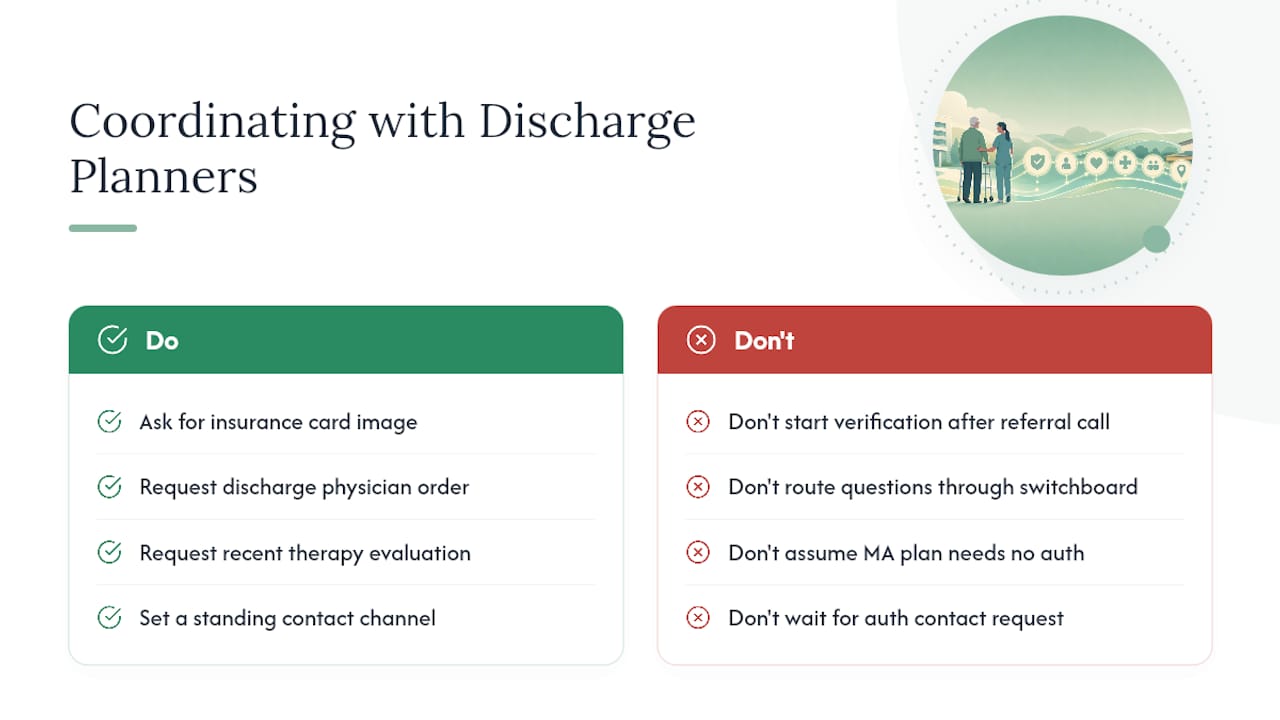
Ask the discharge planner for the insurance card image, the physician’s discharge order, and the most recent therapy evaluation at the moment the referral comes in, not after your team has already started the verification call. Case managers who work Medicare Advantage cases regularly usually know whether a plan requires prior authorization and can often supply the plan’s authorization contact directly, since they’ve likely called it already for other patients.
Set up a standing communication channel, whether that’s a shared referral platform, a dedicated phone line, or a consistent point of contact, so questions about missing documentation don’t bounce through a general hospital switchboard. A documented eligibility checklist shared with hospital partners in advance cuts down on the back-and-forth calls that eat into the same-day window most Medicare Advantage plans expect for notification.
Common Reasons Eligibility Verification Fails
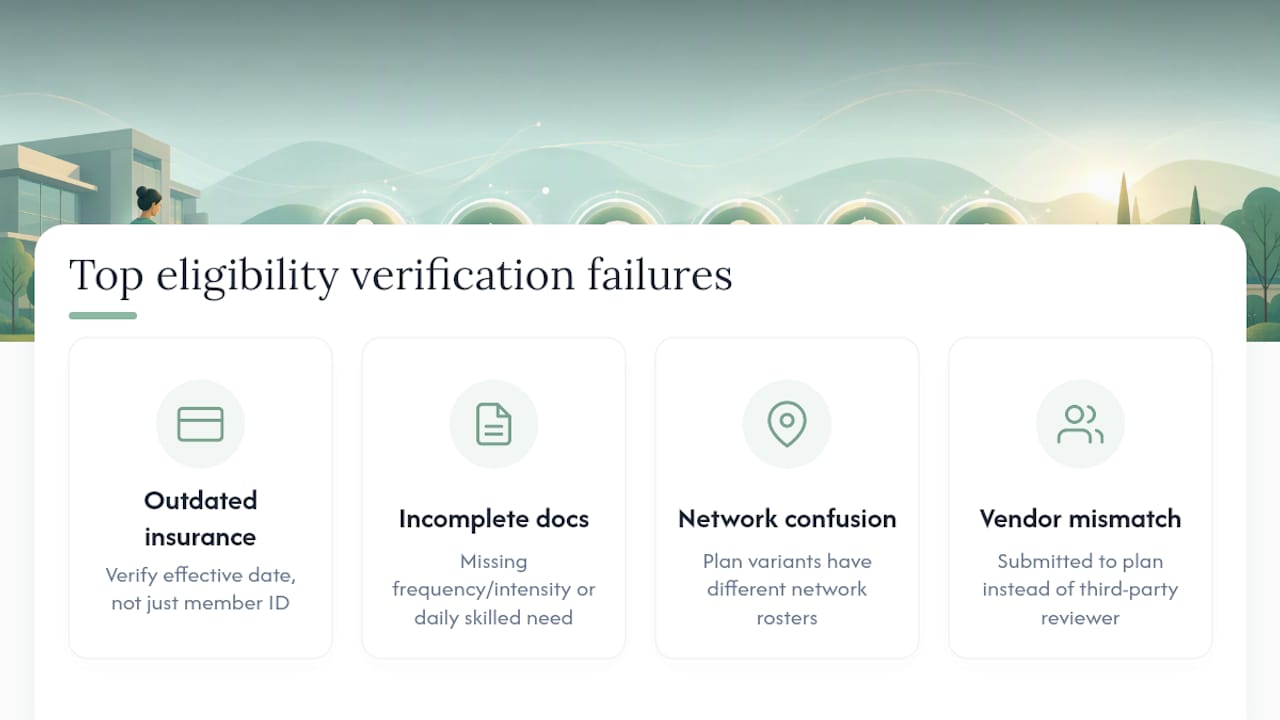
Most Medicare Advantage eligibility verification failures trace back to a handful of repeat offenders, and recognizing the pattern speeds up the fix.
Outdated insurance information tops the list. Patients switch Medicare Advantage plans every fall during open enrollment, and a card from last year won’t match current eligibility systems. Always verify the effective date, not just the member ID.
Incomplete clinical documentation causes the second largest share of failed verifications, echoing the OIG’s findings on appealed denials. A therapy evaluation without specific frequency and intensity language, or nursing notes that describe the diagnosis without documenting the daily skilled need, routinely triggers a request for more information that delays the whole authorization.
Network confusion trips up staff who assume in-network status without checking it for the specific plan variant, since a single carrier often runs multiple Medicare Advantage products with different network rosters in the same region.
Delegated vendor mismatches happen when staff submit an authorization request to the health plan directly when the actual review sits with a third-party vendor. Confirm the correct submission channel during the initial eligibility check, not after a rejection notice comes back days later.
A Publisher’s Take On Speed Versus Compliance
Facilities that survive Medicare Advantage’s paperwork chase are the ones that stopped treating documentation as an afterthought and started treating it as the first deliverable, before the bed assignment. Templates and standing checklists reduce the manual rework that drags out authorizations, and teams using structured admissions documentation consistently report faster referral processing and fewer appealed denials than teams improvising each packet from scratch.
The uncomfortable truth in the OIG’s own findings is that most SNF denials aren’t really coverage disputes. They’re documentation gaps dressed up as coverage disputes. Fix the paperwork discipline and the appeal rate drops on its own.
— Harry
How Smart Admissions Speeds Up Eligibility Verification
Smartadmissions replaces the manual portal-hopping and phone tag most admissions teams still rely on with real-time eligibility verification built directly into your referral workflow. Instead of a coordinator checking three separate payer portals and waiting on hold for a plan’s authorization line, Smartadmissions pulls plan status, network standing, and authorization requirements automatically and flags what’s missing before you submit.
What that looks like day to day for your team:
- Fewer manual verification steps per referral, since eligibility data pulls automatically instead of requiring three separate lookups.
- Faster bed fills, because authorization gaps surface before the patient is on the way, not after they’ve already arrived.
- Clear visibility into denial patterns and delays across your referral pipeline, so you can see which plans are slowing you down before it becomes a habit.
If your team is still tracking Medicare Advantage authorizations across sticky notes and separate payer logins, see how a modern referral management system handles it and request a walkthrough built around your facility’s actual referral volume.
Sources
- KFF — Medicare Advantage insurers deny prior authorization requests for post‑acute care at substantially higher rates than the overall denial rate
- OIG — Medicare Advantage organizations overturned nearly all appealed prior authorization denials for SNF admission
- CMS MLN — Skilled Nursing Facility resources and billing reference
- Medicare