
Patient consent management is the documented, enforceable process that captures, applies, and audits a patient’s permissions across every system that touches their care. The one rule that governs everything else: consent is an ongoing process with a paper trail, not a signature you file and forget. Get that principle wrong, and every downstream policy, form, and workflow inherits the mistake.
TL;DR:
- Enforcing patient consent requires a lifecycle approach involving proper capture, real-time enforcement, and thorough auditing across all systems.
- Documentation must include who obtained consent, when, and the discussion details, not just signatures, to meet federal standards and pass audits.
- Re-consent should be triggered by material changes in circumstances or data use, based on what a reasonable patient would need to know, not form revisions alone.
- Consent systems should leverage FHIR and PCM plus ACS architectures to ensure consistent enforcement, version control, and revocation across integrated platforms.
- Elevating consent management to clinical governance improves trust, reduces compliance failures, and aligns with broader patient safety and operational accountability.
Table of Contents
- What Patient Consent Management Covers and Why It Matters
- What Regulations Govern Patient Consent Management?
- What Are the Types of Consent and How Does the Consent Lifecycle Work?
- How Do Technical Systems Enforce Patient Consent?
- How Do You Build a Compliant Consent Workflow?
- What Do Auditors Actually Check in Consent Records?
- How Do Special Cases Change Consent Requirements?
- How Do FHIR and PCM Standards Support Consent Management?
- Why Consent Management Belongs in Clinical Governance
- Sources
What Patient Consent Management Covers and Why It Matters
Patient consent management is often reduced to a stack of signed forms in a chart. That framing causes most of the compliance failures administrators see during audits. Consent is communication first, documentation second. A form only proves value when it reflects a real conversation, one where a clinician disclosed the procedure, its risks and benefits, and the alternatives, and confirmed the patient actually understood them. The OHRP’s informed consent guidance is explicit on this point: documentation alone does not satisfy the federal standard.
This distinction matters operationally because it changes what your team builds. A signature-only process protects nobody. A documented conversation, backed by a source note describing what was discussed and how comprehension was checked, protects the patient’s autonomy and your facility’s legal standing at the same time. Consent done well also supports shared decision-making, giving patients a genuine role in choices about their own care rather than a rubber stamp on a clinician’s plan.
The operational failures that trip up facilities tend to repeat themselves:
- Treating the consent form as the entire process instead of evidence of a discussion
- Failing to log who obtained consent, when, and for how long the conversation lasted
- Using static paper forms for care plans that change weekly, with no re-consent trigger
- Storing consent records outside the systems that actually enforce them, so a revoked consent never propagates
- Assuming a signed general consent covers specialized procedures it never mentioned
Each of these failures shares a root cause: consent treated as a one-time event rather than a lifecycle with capture, enforcement, and audit stages. Facilities that redesign around the lifecycle model, instead of the paperwork model, tend to pass audits with far less scrambling. Fixing this starts with understanding the specific regulations that define what “documented properly” actually means.
What Regulations Govern Patient Consent Management?
Four regulatory frameworks shape almost every consent workflow in U.S. healthcare, and administrators who know which one applies to which scenario avoid the most common compliance traps.
HIPAA Privacy and Security Rules set the baseline for how patient information tied to consent gets stored, transmitted, and protected. HHS’s HIPAA regulations require administrative, physical, and technical safeguards for any system holding consent records, plus breach notification obligations if that data is exposed. Your consent management software needs a signed business associate agreement if a vendor touches protected health information, full stop.
45 CFR 46, the Common Rule, governs informed consent for research involving human subjects and sets out the required disclosure elements: purpose, procedures, risks, benefits, alternatives, and confidentiality protections. The OHRP FAQ on informed consent makes clear that voluntariness is a required element, not a nice-to-have. A patient who feels pressured to sign has not given valid consent regardless of what the paperwork says.
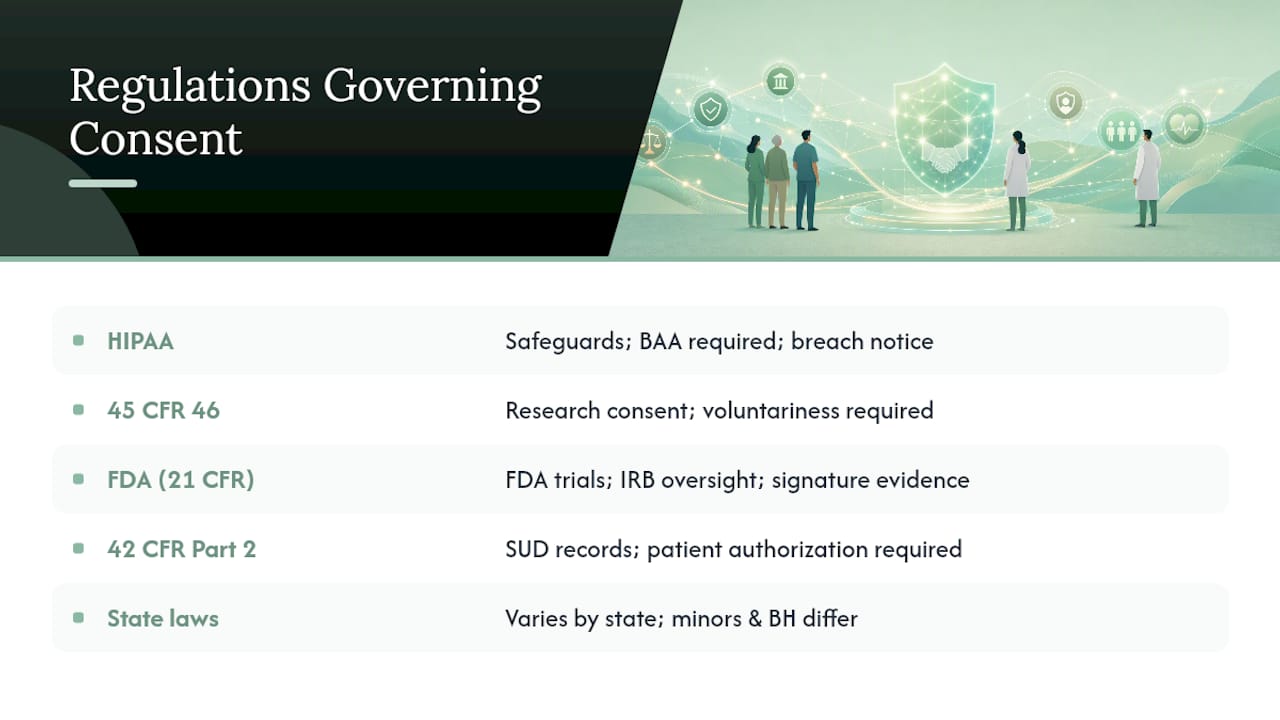
FDA regulations under 21 CFR 50 and 56 apply specifically to FDA-regulated clinical research and add IRB oversight requirements on top of the Common Rule elements. The FDA’s Informed Consent Information Sheet stresses a point administrators frequently miss: the consent discussion itself is the regulatory requirement, and the signature is merely evidence that the discussion happened. Electronic signatures are permitted, but only when the system meets the applicable validation standards.
42 CFR Part 2 imposes stricter sharing rules on substance use disorder treatment records than standard HIPAA does, requiring specific patient authorization before that information moves to another provider, even for treatment coordination. State consent laws layer on top of all four, and they vary enough that a workflow validated in one state can fail in another, particularly around minor consent and behavioral health disclosures.
Quick reference: Under 45 CFR 46 and FDA guidance, valid informed consent requires disclosure of the procedure, comprehension confirmation, and voluntary agreement, documentation is supporting evidence, not the requirement itself.
Practical compliance means mapping each consent type your facility uses to the regulation that governs it, then confirming your capture method (paper, electronic, or hybrid) satisfies that regulation’s signature and audit-trail standards before you scale it across departments.
What Are the Types of Consent and How Does the Consent Lifecycle Work?
Not every patient interaction needs the same consent instrument, and applying research-grade consent to a routine blood draw wastes staff time just as badly as using a quick checkbox for a surgical procedure wastes patient protection.
Explicit consent requires an affirmative, documented action, a signature, a verbal confirmation logged in the record, or a digital acknowledgment, and applies to procedures with meaningful risk. Implied consent covers routine, low-risk interactions where the patient’s cooperative behavior (rolling up a sleeve for a blood pressure cuff) substitutes for a formal document. Short-form consent condenses the required disclosure elements into an abbreviated document, typically used alongside a longer, more detailed information sheet in research settings. LAR (legally authorized representative) consent applies when the patient cannot consent for themselves, a minor, an incapacitated adult, or someone under guardianship. Assent captures agreement from a minor who cannot give full legal consent but can still express understanding and willingness. Emergency exceptions allow treatment without prior consent when delay would endanger life, provided the facility documents the emergency circumstances immediately afterward.
The lifecycle that connects these types runs through five stages:
- Capture. Consent is obtained through the appropriate method for the risk level and documented with a source note, who obtained it, when, and evidence of a comprehension check.
- Enforce. The consent decision gets applied across every system that touches the patient’s data, not just the chart where it was signed.
- Audit. Every access, disclosure, or use of the consent record is logged with an actor, timestamp, and reason.
- Re-consent. A new consent event is triggered when circumstances materially change.
- Revoke. The patient withdraws consent, and the system marks the record revoked without deleting it.
Re-consent triggers deserve special attention because teams routinely under-trigger them. Administrative amendments, a form revision, a scheduling change, rarely require new consent. What does require it is any change a reasonable patient would want to know about: a new risk identified, a safety signal, or a change in how their data will be used. Build automated flags for these specific triggers rather than relying on staff memory.
Pro Tip: Build your re-consent logic around “would a reasonable patient want to know this,” not “did the form change.” That single filter catches the triggers that actually create legal exposure and skips the paperwork churn that doesn’t.
How Do Technical Systems Enforce Patient Consent?
A consent decision that lives only in a PDF accomplishes nothing once a patient’s data starts moving between the EHR, the lab portal, and a referring specialist’s system. Enforcement requires architecture, not just documentation.
The pattern that works best pairs a patient-facing consent front end with a backend Access Control Services (ACS) layer. The front end, sometimes called a patient consent management (PCM) interface, presents the consent “ceremony,” the actual screen or conversation where the patient reviews options and makes a choice, in plain language with clear opt-in and opt-out controls. ONC’s guidance on behavioral health consent describes this pairing directly: the PCM UI lets patients define their privacy preferences, while the ACS backend translates those preferences into enforceable policies that apply across every connected system.
That separation matters because it solves the propagation problem. A patient who revokes consent for data sharing needs that revocation to reach the EHR, the health information exchange (HIE), and any downstream analytics system, automatically. Without a centralized ACS, revocation becomes a manual, error-prone chase across departments.
| Component | Function | Compliance relevance |
|---|---|---|
| PCM front end | Captures patient consent choices in plain language | Supports informed consent documentation requirements |
| Access Control Services (ACS) | Enforces consent policies across connected systems | Enables 42 CFR Part 2 segmentation and granular sharing rules |
| Audit logging layer | Records every access, disclosure, and consent state change | Satisfies HIPAA Security Rule and research audit-trail standards |
| EHR/HIE integration layer | Propagates consent status across care settings | Prevents unauthorized disclosure when patients move between providers |
For FDA-regulated research using electronic consent, the audit trail carries an extra requirement. Systems must be validated against 21 CFR Part 11 standards covering signature manifestation, access controls, and tamper-evident logging, and that validation evidence belongs in the trial master file, not just in an IT department’s notes. Behavioral health data adds another layer still: 42 CFR Part 2 requires segmentation strict enough that a general release of records cannot accidentally expose substance use disorder treatment history.
A well-built consent architecture rests on a few non-negotiable technical controls:
- Role-based access so only authorized staff can view or modify consent status
- Immutable audit logs that record actor, timestamp, and reason for every consent-related action
- Real-time propagation of revocation across every integrated system
- Encryption in transit and at rest for consent records containing protected health information
- Version control that preserves every prior state of a consent record, not just the current one
Facilities considering consent capture as part of a broader admissions workflow often find it easier to design the enforcement layer alongside their broader patient data security architecture rather than bolting it on afterward.
How Do You Build a Compliant Consent Workflow?
Designing a consent workflow from scratch, or fixing a broken one, follows a sequence that holds up across care settings, from a single skilled nursing facility to a multi-site health system.
- Map every data flow and consent touch point. List each place a patient’s information moves, between departments, to insurers, to referring providers, and identify which consent decision governs each movement.
- Define roles and delegation. Decide who can obtain consent, who can witness it, who can approve exceptions, and who reviews the record for completeness. Write this down; verbal understanding evaporates during staff turnover.
- Choose your capture method deliberately. Paper works for low-volume, low-complexity settings. eConsent scales better and creates a cleaner audit trail. Hybrid approaches suit facilities transitioning between the two, but only if the hybrid workflow itself is documented, not improvised.
- Build the training program before the go-live date. Staff need to know not just how to collect a signature, but how to conduct a teach-back and document a comprehension check, a step the NLM Bookshelf’s clinical practice review identifies as one of the strongest predictors of audit-ready documentation.
- Run test audit scenarios before launch. Pull a sample of consent records and check whether an outside reviewer could reconstruct the full story: who consented, to what, when, and whether it was ever revoked.
- Update your SOPs to reflect the actual workflow, not the workflow you wish existed. Gaps between written procedure and daily practice are the first thing auditors find.
- Plan re-consent campaigns in advance, tied to specific triggers (protocol changes, new risk information, data-use changes) rather than an arbitrary calendar date.
This sequence mirrors the procedural model CASRAI’s step-by-step consent guide lays out for research settings: eligibility confirmation, consent discussion, documentation, and defined re-consent triggers. The same logic scales down to routine clinical consent without much modification.
Pro Tip: Run your test audit scenario with someone who did not build the workflow. The gaps that matter most are the ones your own team is too close to notice.
Facilities managing high referral volume often find that consent capture integrates most cleanly when it is mapped directly into the patient records workflow used during intake, rather than treated as a separate compliance task bolted on after admission.
What Do Auditors Actually Check in Consent Records?
Auditors reviewing patient consent management systems are not primarily looking for a signature. They are looking for a reconstructable story: who did what, when, and why, with nothing missing and nothing altered after the fact.
The minimum elements an audit trail needs to satisfy that standard are consistent across HIPAA, research, and behavioral-health contexts:
- The actor who obtained or modified the consent (name and role, not just a system login)
- A timestamp precise enough to establish sequence
- The version of the consent form or policy in effect at that moment
- A documented reason for any change, especially revocation
- A source note confirming the discussion occurred, including a comprehension check
The single most common technical mistake facilities make is deleting revoked consent records instead of marking them revoked and retaining them. HL7’s FHIR consent management guidance is unambiguous here: revoked consents stay in the record as part of an immutable audit trail, with a changelog tying every state change to a specific actor and timestamp. A deleted record looks, to an auditor, exactly like a record that was never properly obtained in the first place.
Audit standard: A complete consent audit trail links every consent state, capture, modification, revocation, back to the specific clinical event it governs. A revocation with no connection to what it revoked is functionally useless during a review.
Monitoring should not wait for the annual audit. Exception reporting, flagging consent records missing a source note, or a re-consent that never happened after a documented trigger, catches problems while they are still cheap to fix. Facilities that build this into a monthly review cycle spend far less time reconstructing history during a real audit. The documentation best practices that support strong clinical records apply just as directly to consent files, since both rely on the same contemporaneous, attributable note-taking discipline.
How Do Special Cases Change Consent Requirements?
Standard consent workflows break down fast in four specific contexts, and treating them with generic rules is where most compliance exposure hides.
Behavioral health records fall under 42 CFR Part 2, which requires stricter, more granular sharing authorization than general HIPAA disclosures. A consent architecture here needs segmentation strong enough that a general medical records release cannot inadvertently expose substance use disorder treatment history to a provider who was never authorized to see it.
Minors and incapacitated patients require a legally authorized representative (LAR) to provide consent, while the minor or patient may still give assent, an expression of understanding and willingness that carries ethical weight even without full legal authority. Facilities need documented protocols distinguishing when a minor can consent independently (varies by state and procedure type) from when an LAR must be involved.
Research settings layer IRB oversight on top of standard consent, with re-consent triggers tied to protocol amendments, new safety information, or changes in data use, and FDA compliance obligations under 21 CFR 50 and 56 for regulated trials.
Emergency exceptions permit treatment without prior consent when delay would endanger the patient, but this exception comes with an obligation, not a pass. Facilities must document the emergency circumstances, the treatment provided, and obtain consent retroactively once the patient can participate, or from an LAR if they still cannot.
A few operational rules apply across all four:
- Segment behavioral health and substance use data separately from general medical records by default
- Document LAR authority (guardianship papers, healthcare power of attorney) alongside the consent record itself
- Flag every emergency-exception case for retroactive consent documentation within a defined timeframe
- Build re-consent triggers into research protocols before enrollment begins, not after an amendment forces the issue
How Do FHIR and PCM Standards Support Consent Management?
Facilities building or upgrading consent systems do not need to invent an architecture from scratch. HL7’s FHIR consent resource and the PCM-plus-ACS pattern already cover most of the ground.
HL7 FHIR consent models a patient’s consent as a structured, versioned resource rather than a static document, tracking status, scope, category, and the specific actors and periods it applies to. This structure is what makes an immutable audit trail technically achievable rather than aspirational. The FHIR US Core technical guidance is the practical starting point for any team scoping an integration.
The PCM plus ACS pattern splits responsibility cleanly: the PCM front end runs the patient-facing consent ceremony, and the ACS backend enforces the resulting policy across every connected system. A typical event sequence looks like this in practice:
- Capture event: Patient completes the consent ceremony in the PCM interface; the choice is logged with a timestamp and actor.
- Enforce event: ACS propagates the policy to the EHR, HIE, and any connected analytics system in real time.
- Re-consent event: A protocol change or new risk disclosure triggers a fresh capture event, versioned separately from the original.
- Revocation event: The patient withdraws consent; ACS updates enforcement everywhere, and the record is marked revoked, never deleted.
Three design rules of thumb hold across nearly every implementation: never delete a consent record, always attribute every state change to a specific actor, and retain full version history rather than overwriting the current state.
Retention of revoked consents and versioned audit records is not optional overhead. It is the mechanism that makes a consent management system defensible during a regulatory review, rather than merely convenient during daily operations.
Why Consent Management Belongs in Clinical Governance
Consent management gets filed under compliance paperwork far too often. It belongs in clinical governance, next to infection control and medication safety, because it is trust infrastructure. A patient who cannot trust that their stated preferences will actually be honored across every system that touches their care has a weaker relationship with the entire institution, not just with the admissions desk.
Facilities that elevate consent to a governance function, with an accountable owner, defined metrics, and regular review, see fewer audit surprises and fewer patient complaints tied to unauthorized disclosures. That is not a coincidence. Reduced legal exposure and better patient experience come from the same root cause: a system that treats consent as an ongoing operational responsibility rather than a form filed once at intake.
The short next step for compliance and clinical leaders: put consent management on the same governance calendar as your other patient safety metrics, with a named accountable owner, not scattered ownership across admissions, IT, and legal with nobody actually watching the whole lifecycle.
— Harry
Facilities looking to build consent capture directly into intake without slowing down bed placement should see how referral management automation handles documentation and eligibility verification in parallel, so consent workflows strengthen the admissions process instead of adding friction to it.
This article is general information, not a substitute for advice from a qualified doctor. Consult a qualified healthcare professional about your own circumstances before acting on anything here.
Sources
- OHRP: Informed consent FAQs
- FDA: Informed Consent Information Sheet
- ONC: Consent management for behavioral health
- NLM Bookshelf: Informed consent in clinical practice and research