
The single most effective PDPM admission strategy is documentation-first intake: capturing diagnoses, procedures, Section GG function scores, and comorbidities before the five-day assessment locks in your payment classification. This approach relies on CMS PDPM guidance and the PDPM calculation worksheet as your reference points, and it requires an explicit nurse-to-nurse verification call on every referral, not just the complicated ones.
TL;DR:
- Collect all key clinical and functional documentation during the initial contact to accurately classify residents before the five-day assessment window closes.
- Use templated requests and designated contacts to reduce delays in obtaining discharge summaries, operative notes, and medication lists, ensuring timely data collection.
- Focus on four critical MDS items—Section GG, diagnosis, cognitive assessment, and comorbidities—that heavily influence PDPM classification and payment.
- Implement automated data exchange tools and structured intake workflows to minimize assessment modifications and improve revenue stability.
- Regularly monitor case-mix index, modification rates, and record completeness weekly to identify issues early and adjust admission processes accordingly.
Table of Contents
- Building Your PDPM Admission Strategy Checklist
- Documentation and Timing: Winning the Five-Day Window
- PDPM Classification Essentials for Admission Decisions
- Operations and Technology That Protect PDPM Accuracy
- Metrics That Prove Your PDPM Strategy Is Working
- What Changed When We Rebuilt Our Intake Process
- Where to Verify PDPM Rules and Coding
- Sources
Building Your PDPM Admission Strategy Checklist
A good referral decision takes 5 to 15 minutes if your team knows exactly what to ask for. Waiting until after admission to chase down clinical details is how facilities end up guessing at case-mix classification instead of documenting it.
Request these items on first contact with the referring hospital or discharge planner:
- Primary diagnosis and its ICD-10 code
- Recent surgical or procedure history, including operative notes
- Discharge summary and current medication list
- IV therapy, feeding tube, or wound care status
- Cognitive screening results (BIMS or staff assessment)
- Mobility status and functional performance, ideally mapped to Section GG items
Run the decision in a fixed order: clinical fit first, then PDPM case-mix potential, then payer and insurance eligibility, then staffing and skill match against what your floor can actually support today. Assign each check to a specific role. The admissions nurse validates clinical fit and Section GG proxies. The records clerk chases the discharge summary and operative notes. The therapy lead flags whether the resident’s functional profile matches your current caseload capacity.
Certain red flags justify a same-day decline: unresolved IV antibiotic orders your facility can’t support, ventilator dependence outside your scope, or a diagnosis that contradicts the referral’s stated acuity level. A patient eligibility checklist built around these criteria keeps the decision consistent across shifts.
Pro Tip: Have your admissions nurse call the hospital’s bedside nurse directly instead of relying only on the case manager’s summary. Bedside nurses often know functional details, like whether a patient actually stood at the bedside that morning, that never make it into the written referral packet.
Documentation and Timing: Winning the Five-Day Window
The Assessment Reference Date (ARD) for the initial Medicare assessment falls on day 8 at the latest, but the clock on gathering evidence starts the moment the referral lands. Discharge summaries and operative notes routinely arrive a day or two behind the patient, which is exactly why waiting to request them is the most expensive habit in admissions.
Four MDS items decide most of your PDPM classification accuracy:
- Section GG function items, which set your PT, OT, and Nursing component scores
- The I8000 diagnosis field, which anchors your clinical category
- Cognitive items (BIMS or staff assessment), which affect SLP and Nursing groupings
- Comorbidity indicators tied to NTA points, which can shift per-diem payment significantly
Missing data between day 5 and day 14 is a common cause of MDS modifications, and modifications draw more audit attention than clean initial assessments. Templated document requests sent the moment a referral is accepted, a single designated hospital contact for follow-up calls, and direct EMR data exchange all shrink that lag. A documentation management guide built around these controls reduces how often your MDS coordinator has to amend a submitted assessment after the fact.
PDPM Classification Essentials for Admission Decisions
PDPM sorts every resident into five separate case-mix components, each scored independently rather than bundled into one therapy-driven number the way the old RUG system worked.
- PT and OT — grouped using function scores and clinical category, with 16 groups each
- SLP — grouped by cognitive status, swallowing disorder, and mechanically altered diet, with 12 groups
- NTA — grouped by comorbidity point totals across 6 groups, weighted heavily toward the first three days of the stay
- Nursing — grouped by function score and clinical complexity across 25 groups
PT, OT, and NTA all carry variable per-diem adjustments, meaning the payment rate itself declines as the stay progresses. NTA points front-load especially hard, which is why a comorbidity documented on day 2 is worth more to your reimbursement than the same comorbidity added on day 20.
Accurate ICD-10 mapping isn’t a coding formality. The primary diagnosis you select determines the clinical category that anchors PT, OT, and SLP scoring, so a vague or generic code can quietly undercut a classification the resident’s actual condition would have supported.
The PDPM calculation worksheet walks through exactly how these components combine into a per-diem rate, and it’s worth keeping open during your weekly case-mix review.
Operations and Technology That Protect PDPM Accuracy
Reliable data capture depends on process design as much as clinical judgment. Assign one person as the single point of contact for each referral, so hospital case managers aren’t fielding five different calls from your facility about the same patient.
A workable intake sequence looks like this: the admissions nurse confirms clinical fit and pulls the discharge summary, the records clerk requests operative notes and current medication lists, and the MDS coordinator pre-populates provisional ICD-10 and Section GG proxies so therapy and nursing can plan their own assessments the moment the resident arrives.
Prioritize technology that offers:
- Secure document import directly from hospital systems or referral portals
- EMR integration that pulls diagnosis and procedure history automatically
- Built-in ICD-10 crosswalks tied to current PDPM clinical categories
- Referral-data templates that flag missing Section GG or comorbidity fields before submission
Pre-admission data pulls and templated hospital requests measurably reduce five-day MDS edits and speed bed fill, according to industry PDPM survival guidance. Manual chasing works at low referral volume. Once your facility processes more than a handful of referrals weekly, an automated admissions workflow starts paying for itself in staff hours alone.
Pro Tip: Build a one-page template that lists every field your MDS coordinator needs at ARD, and require admissions staff to fill it out live during the intake call, not from memory afterward.
Metrics That Prove Your PDPM Strategy Is Working
Track a short list of numbers weekly, not quarterly, so problems surface while they’re still fixable.
- Facility-level case-mix index (CMI) trend over the past 4 to 8 weeks
- Five-day MDS modification rate
- Percentage of admissions with complete records by the ARD
- Average per-diem revenue by clinical category
- Denial and appeal rates tied to documentation gaps
Run a weekly admissions review that walks backward from each denial or modification to the checklist step that failed. Accepting more clinically complex residents can raise your CMI, but only if staffing and skill mix scale with them; a higher case-mix score with insufficient nursing coverage creates its own risk. Assign the MDS coordinator to own the modification-rate metric and the admissions director to own the completeness rate, reporting both at the same weekly meeting where referrals get discussed. A data-driven admissions approach turns this from a gut-check into a repeatable habit.
What Changed When We Rebuilt Our Intake Process
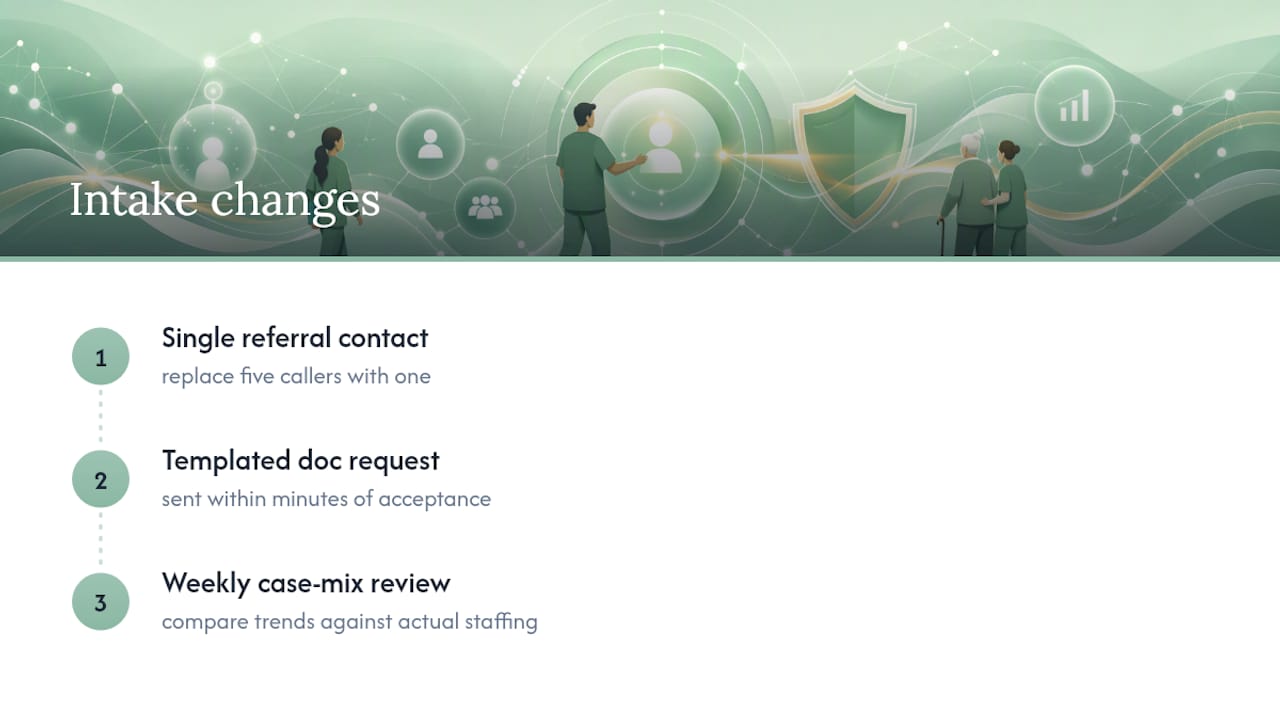
Moving from a therapy-volume mindset to documentation-first intake is less about new software and more about who owns what. The clearest wins came from three changes: one designated contact per referral instead of five people calling the same hospital, a templated document request sent within minutes of accepting a referral, and a standing weekly review of case-mix trends against actual staffing.
None of it eliminates the five-day pressure. It does mean fewer surprises land in that window. Facilities making this shift tend to see fewer MDS modifications and steadier revenue per admission within a few months, largely because the data arrives before day 5 instead of after it.
— Harry
Where to Verify PDPM Rules and Coding
Bookmark these before your next complex referral:
- CMS Patient Driven Payment Model for official guidance and effective-date details
- PDPM Calculation Worksheet for component-by-component grouping logic
- Administrator perspectives on PDPM-driven admissions for peer-reviewed operational insight
- AAPACN’s PDPM Admission Documentation Request Tool for a ready-made hospital document request template
If your team is still chasing paperwork after admission instead of before it, a referral management system built for PDPM data capture can close that gap faster than adding more phone calls to the process.
This article is general information, not a substitute for advice from a qualified financial advisor. Consult a qualified financial professional about your own circumstances before acting on anything here.
Sources
- Patient Driven Payment Model | CMS
- PDPM Calculation Worksheet for SNFs (MDS manual Ch.6, PDPM)
- PDPM Admission Documentation Request Tool – AAPACN