
Real-time eligibility verification returns coverage and benefit detail in seconds, so your admissions team can confirm patient responsibility and stop eligibility-related denials before they happen. Run it at scheduling and again at check-in, and you catch coverage changes before they turn into rework, delayed collections, or an awkward conversation at the front desk.
TL;DR:
- Running eligibility checks 48 to 72 hours before appointments can reduce coverage issues by catching plan lapses early enough for staff to intervene.
- Using real-time 270/271 exchanges, payers may return partial or delayed data, especially for new plans or unupdated coordination-of-benefits records.
- Failure or partial responses often result from typos, missing service codes, or plan updates, requiring follow-up or escalation to payer representatives.
- Implementing automation typically decreases eligibility-related denials, shortens time-to-collect, and reduces front-desk manual coverage confirmation hours.
- Integrating eligibility verification into referral workflows supports faster bed filling, fewer post-admission coverage surprises, and streamlined billing processes.
Table of Contents
- Why Real-Time Eligibility Verification Cuts Denials and Speeds Collections
- How Does a Real-Time 270/271 Eligibility Check Work?
- When Should You Run Eligibility Checks?
- Choosing an Integration Path: EHR, Clearinghouse, or API
- What to Do When an Eligibility Check Fails or Returns Partial Data
- What Does Eligibility Verification Cost, and What’s the ROI?
- How Smart Admissions Embeds Real-Time Eligibility Checks Into Referral Workflows
- Rollout Lessons: What to Expect in the First 90 Days
- Ready to Stop Chasing Eligibility Denials Manually?
- Sources
Why Real-Time Eligibility Verification Cuts Denials and Speeds Collections
Eligibility errors are not a minor line item on your denial report. They account for roughly 14 to 18 percent of all claim denials, which means a facility processing 2,000 claims a month could be losing revenue on 280 to 360 of them purely because someone didn’t catch a lapsed policy or a plan change before service.
The Real Cost of Skipping Verification: For every claim denied on eligibility grounds, staff spend time reworking it, resubmitting it, and often writing it off. Verifying coverage within a few days before the appointment helps close most of that gap.
Automating the eligibility verification process moves that work off the front desk and onto software that runs the check the moment a referral or appointment lands in the system. Track these three metrics to know whether it’s working:
- Denial rate tied specifically to eligibility causes, not total denials
- Time-to-collect from date of service to payment posted
- Front-desk hours spent per week on manual coverage confirmation calls
Facilities that automate eligibility verification typically see all three numbers move in the same direction within the first billing cycle.
How Does a Real-Time 270/271 Eligibility Check Work?
Every real-time eligibility check runs on the same electronic backbone: the X12 270 request and 271 response. Your system sends a 270 transaction containing the patient’s member ID, date of birth, and the service you’re checking coverage for. The payer’s system answers with a 271 that lists plan status, deductible remaining, copay and coinsurance amounts, network status, and any prior authorization flags tied to that service.
That exchange happens two ways:
- Clearinghouse routing. Your practice management system or EHR sends the request through a clearinghouse, which translates it, routes it to the right payer, and returns the 271 in a standardized format your staff can read.
- API or FHIR alternatives. Newer platforms accept a JSON request and translate it to an X12 270 behind the scenes, returning both a human-readable summary and the raw X12 payload for downstream systems.
Not every 271 comes back clean. Some payers return partial data when a plan is newly enrolled, when coordination-of-benefits records haven’t updated, or when the request is missing a service type code. That’s a system limitation on the payer’s end, not a sign your request failed.
When Should You Run Eligibility Checks?
Timing determines whether a coverage problem gets caught in advance or discovered at the billing stage, weeks after the visit. Here’s the cadence that works for most admissions and billing teams:
- 48 to 72 hours before the appointment. This window catches most plan terminations, coverage changes, and enrollment lapses while there’s still time to call the patient. Checking any earlier often returns stale data since payer systems update on rolling cycles.
- At check-in, same day. A quick recheck confirms nothing changed overnight, which matters most for high-cost procedures where a denial would be expensive to absorb.
- Real time for walk-ins, telehealth, and same-day adds. Batch checks cover your scheduled list; real-time single checks handle anyone who shows up outside that batch.
- With payer-specific caveats. Medicaid plan assignment can shift monthly in some states, and CMS guidance on financial eligibility verification recommends electronic data sources and defined AVS timelines. Medicare Beneficiary Identifier lookups need their own check when the MBI isn’t already on file.
Choosing an Integration Path: EHR, Clearinghouse, or API
Most facilities pick between three integration models, and the right one depends on your existing EHR, your IT staffing, and how many payers you bill regularly.
An EHR-integrated module embeds eligibility checks directly into your existing workflow screens, which means less staff training but often a longer setup timeline tied to your EHR vendor’s release schedule. A standalone clearinghouse portal gets you running faster with minimal IT involvement, though staff will toggle between systems. A direct API or FHIR connector gives the most flexibility for facilities running custom admissions software, at the cost of needing developer time upfront.
Whichever path you choose, your test requests need these fields:
- Member ID and date of birth, matched exactly to the payer’s records
- Service type code or procedure code. Including a specific STC rather than a generic one returns richer benefit detail
- Provider NPI and the rendering location
Pro Tip: Run your go-live test against your five highest-volume payers first, not your easiest one. A clean test with a payer you rarely bill tells you nothing about the exceptions your staff will actually hit.
Build your go-live checklist around payer coverage testing, a documented exception-handling path, and staff training on what a partial response looks like before you flip the switch. Reviewing a patient eligibility verification checklist alongside your test plan catches gaps before launch, not after.
What to Do When an Eligibility Check Fails or Returns Partial Data
A failed or incomplete 271 response is common, not catastrophic, if your staff knows the next step. Partial responses usually trace back to a mismatched member ID, a newly effective plan the payer hasn’t fully loaded, or a missing service type code on the original request.
Work through these steps in order:
- Recheck immediately with a corrected member ID or date of birth. Typos account for a large share of failed matches.
- Add or adjust the service type code and resubmit before assuming the payer has no data.
- Escalate to a live payer call if the second attempt still returns nothing, especially for high-cost procedures where a denial is expensive.
- Loop in your prior authorization team the moment a response flags an auth requirement, rather than waiting for the claim to bounce.
- Log the confirmation number, timestamp, and response details for every check, clean or partial. That record is your defense if a claim gets denied anyway.
Teams that follow a structured verification checklist resolve partial responses faster because staff aren’t improvising the escalation path on the fly.
What Does Eligibility Verification Cost, and What’s the ROI?
Pricing generally lands in two buckets: per-transaction fees ranging from a few cents to a little over a dollar per check, or a flat subscription that covers unlimited checks up to a volume tier. Vendor case data reports meaningful reductions in eligibility-related denials after automation, though those figures come from vendor-published sources and should be treated as directional rather than guaranteed.
Build your own ROI model around three inputs: denials avoided at your current eligibility-denial rate, front-desk hours reclaimed from manual coverage calls, and days shaved off your average time-to-collect. Even a modest facility can justify the subscription cost against one avoided high-dollar denial per month.
How Smart Admissions Embeds Real-Time Eligibility Checks Into Referral Workflows
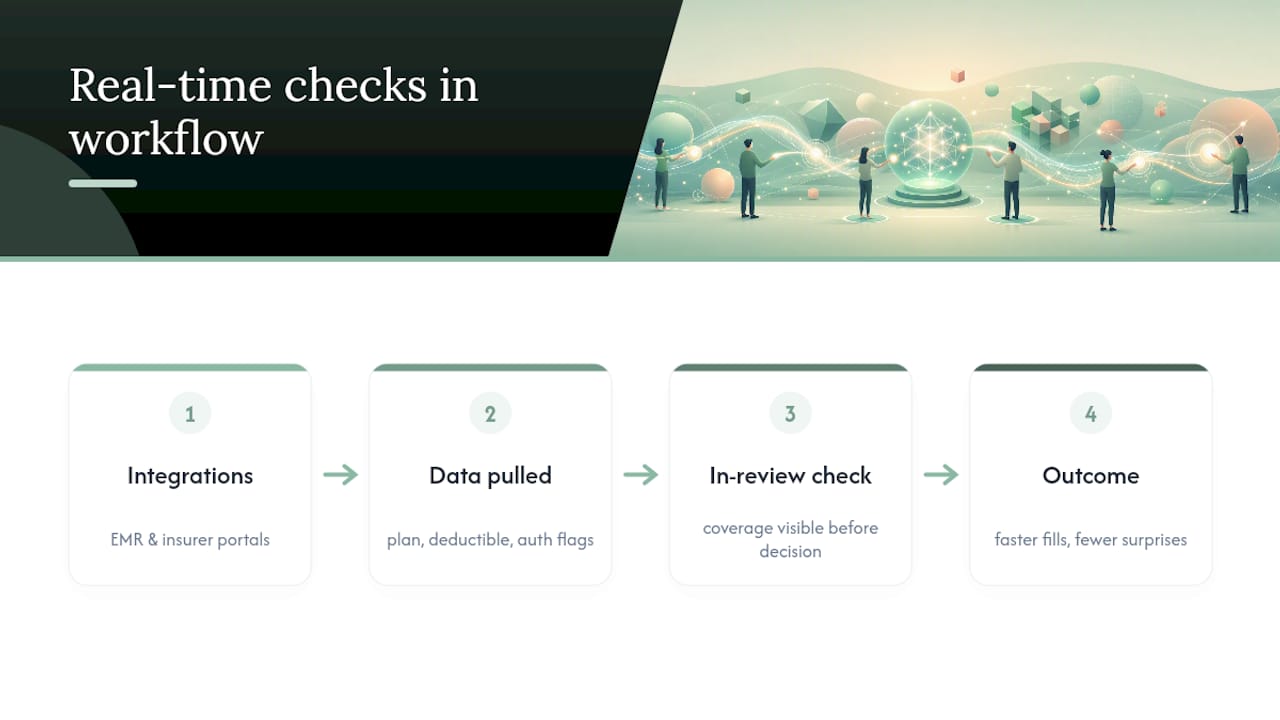
The platform runs real-time eligibility verification directly inside the referral review, so your team sees coverage status before a bed decision gets made, not after. The platform connects to existing EMR and insurance portals, pulling plan status, deductible remaining, and prior authorization flags into the same screen where you’re reviewing clinical fit.
That matters most in post-acute settings, where a referral might arrive on a Friday afternoon and a bed decision needs to happen within hours. Onboarding is built around your current systems rather than requiring a rebuild, with support available as your admissions team adjusts to the automated workflow. The goal is straightforward: fewer surprises after admission, faster bed fill, and less time your staff spends chasing coverage confirmations by phone.
Rollout Lessons: What to Expect in the First 90 Days
Expect a four-to-six-week rollout, with most delays traced to payer connection testing rather than the software itself. Get your front-desk team involved early. Their buy-in determines whether checks actually run at intake or get skipped under pressure. In the first 90 days, track eligibility-caused denials, average time-to-collect, and how many partial responses your team resolves without escalating.
— Harry
Ready to Stop Chasing Eligibility Denials Manually?
If you’ve made it this far, you already know the fix isn’t another spreadsheet or a second phone call to the payer. It’s catching coverage problems before the referral turns into an admission. This software builds real-time eligibility verification into the referral review itself, so your team sees plan status, deductible detail, and authorization flags at the same moment they’re deciding whether a bed fits the patient.
That’s a different starting point than running eligibility as a separate step after the clinical decision is already made. Facilities using referral management systems built for efficiency report faster bed fill because eligibility, clinical review, and documentation happen in one workflow instead of three. Onboarding comes with hands-on support to connect your existing EMR and insurance portals, so your team isn’t left configuring integrations alone. If eligibility-related denials are eating into your revenue cycle, request a demo and see how the referral screen looks with coverage data already built in.
Sources
- Experian Healthcare analysis (2025)
- CMS: CIB on financial eligibility verification (Nov 2024)
- Stedi docs — providers eligibility checks