
Healthcare admissions professionals constantly juggle complex patient data, tight timelines, and the pressure to make accurate intake decisions that impact both patient outcomes and facility operations. Inefficient decision-making slows patient flow, increases staff burnout, and compromises care quality. This guide explores how AI-powered analytics and modern technology transform admissions workflows in skilled nursing and rehabilitation facilities, enabling faster, more accurate decisions that improve patient care and operational efficiency.
Table of Contents
- Understanding The Challenges In Healthcare Admissions Decision-Making
- Preparing For Enhancement: Prerequisites And Tools Needed
- Executing Enhanced Decision-Making With Ai And Analytics
- Verifying Results And Optimizing Decision-Making Over Time
- Explore Technology Solutions For Smarter Healthcare Admissions
- What Is Data-Driven Decision-Making (Dddm) In Healthcare Admissions?
- How Does Ai Improve Patient Acuity Assessments?
- What Are Best Practices To Maintain Data Quality For Decision-Making?
- How Do Healthcare Admissions Teams Balance Ai Tools With Human Judgment?
Key takeaways
| Point | Details |
|---|---|
| AI and analytics streamline intake | Leveraging intelligent tools improves acuity assessment accuracy and accelerates patient processing. |
| System integration reduces friction | Connecting AI with existing EHR and referral platforms creates seamless workflows and minimizes staff burden. |
| Predictive models identify needs early | Data-driven forecasting enables proactive care planning for high-acuity patients in skilled nursing settings. |
| Data quality drives trust | Prioritizing validation and governance ensures reliable analytics that support confident decision-making. |
| Human oversight remains essential | Balancing automation with clinical judgment optimizes admission outcomes, especially for complex cases. |
Understanding the challenges in healthcare admissions decision-making
Admissions decisions in skilled nursing and rehabilitation facilities depend on timely access to accurate patient information. You need to evaluate clinical histories, medication lists, insurance coverage, and acuity levels, often under intense time pressure. When data arrives fragmented across multiple sources or buried in lengthy clinical notes, your team faces cognitive overload that slows decision-making and increases error risk.
Common obstacles include incomplete referral packets, delayed responses from insurance verifiers, and difficulty interpreting complex medical documentation. Staff spend hours manually reviewing records, chasing missing information, and coordinating between providers. This administrative burden contributes directly to employee fatigue and turnover. Early discharge planning improves care delivery by reducing delays, but without proper tools, your team struggles to execute efficiently.
Poor decision-making cascades through your entire operation:
- Extended referral review times delay bed fills and reduce revenue
- Inaccurate acuity assessments lead to care mismatches and readmissions
- Staff burnout from repetitive tasks increases recruitment costs
- Patient satisfaction declines when admission processes feel chaotic
Data quality issues compound these challenges. Missing fields, inconsistent formatting, and outdated information undermine your ability to assess patient fit accurately. Data-Driven Decision Making in healthcare faces interpretability challenges, yet offers substantial advantages in delivering effective, patient-centered care when implemented correctly.
Human judgment remains critical even as technology advances. Complex cases involving multiple comorbidities, unusual medication regimens, or unclear discharge plans require experienced clinical eyes. Your admissions coordinators bring invaluable expertise that no algorithm can fully replace. The goal isn’t eliminating human involvement but enhancing it with better tools that streamline administrative tasks healthcare teams handle daily.
“The challenge isn’t having too little data. It’s transforming overwhelming information into actionable insights that support confident, timely decisions.”
Recognizing these obstacles sets the foundation for meaningful improvement through strategic technology adoption.
Preparing for enhancement: prerequisites and tools needed
Successful implementation of decision-enhancement technology starts with understanding your current infrastructure and data landscape. Your existing Electronic Health Record (EHR) systems, referral management platforms, and insurance verification tools form the foundation for AI integration. GenAI optimizes patient admissions to skilled nursing facilities through seamless custom API connections that preserve existing workflows while adding intelligent automation.

Identify the critical data elements your admissions team needs for every intake decision. These typically include patient demographics, primary and secondary diagnoses, current medications and dosages, recent vital signs, functional status assessments, insurance coverage details, and anticipated length of stay. Each element contributes to your overall picture of patient acuity and facility fit.
Data governance establishes the quality standards that make analytics trustworthy. Predictive analytics reduces intake time effectively only when built on accurate, complete information. Implement validation rules that flag missing required fields, identify inconsistent entries, and alert staff to outdated information. Regular audits catch systematic errors before they compromise decision quality.
| Data Element | Validation Check | Impact on Decision |
|---|---|---|
| Diagnosis codes | ICD-10 format compliance | Determines care requirements and reimbursement |
| Medication list | Drug interaction screening | Identifies specialized nursing needs |
| Insurance verification | Real-time eligibility check | Prevents billing delays and denials |
| Functional assessments | Standardized scoring | Matches patient needs to facility capabilities |
AI models excel at transforming unstructured clinical notes into structured, actionable summaries. Physician discharge summaries, nursing assessments, and therapy evaluations contain crucial information buried in narrative text. Natural language processing extracts key clinical indicators, risk factors, and care requirements automatically, presenting them in formats your team can quickly review.
Integration planning requires collaboration between your IT department, admissions leadership, and potential technology vendors. Map existing data flows to identify integration points where AI tools can access needed information without disrupting current processes. The benefits of AI healthcare admin multiply when implementation respects your team’s established workflows rather than forcing radical change.
Pro Tip: Start with a pilot program involving your most experienced admissions coordinators. Their feedback on AI-generated summaries and recommendations helps calibrate systems before broader rollout, ensuring technology truly supports rather than hinders decision-making.
Equipped with the right infrastructure and quality data, your facility gains the foundation for AI-powered decision enhancement. The role of AI patient intake expands from simple automation to genuine intelligence that amplifies your team’s clinical expertise and judgment.
Executing enhanced decision-making with AI and analytics
Implementing AI-driven decision tools transforms raw patient data into clear risk profiles that support rapid, confident intake decisions. Modern systems analyze referral information within minutes, highlighting critical clinical indicators that might take your staff hours to extract manually. You receive concise snapshots showing acuity levels, required resources, reimbursement likelihood, and potential complications.
Predictive analytics identifies high-acuity patients who need skilled nursing care before they even arrive at your facility. AI model predicts skilled nursing after discharge with 88% accuracy, increasing nurse flagging likelihood by 13.5 times compared to standard protocols. This early identification enables proactive bed planning, staff scheduling, and care preparation that improves both patient outcomes and operational efficiency.
Follow this execution framework:
- Configure AI systems to access referral data from all sources including fax, email, EHR interfaces, and direct hospital feeds.
- Set clinical criteria that align with your facility’s capabilities, specializations, and strategic goals for patient mix.
- Enable automated data extraction that populates standardized intake forms, reducing manual entry by 70% or more.
- Review AI-generated summaries that highlight key decision factors like wound care needs, IV therapy requirements, or behavioral health considerations.
- Apply clinical judgment to AI recommendations, overriding or adjusting when your expertise identifies nuances the algorithm missed.
- Track decision outcomes to continuously improve both AI accuracy and your team’s confidence in the technology.
AI excels at summarizing lengthy physician notes into actionable insights. Research shows that condensing doctor documentation improves prediction accuracy while dramatically reducing data input requirements. Your admissions coordinators gain hours previously spent reading through complex medical histories, freeing them to focus on nuanced decision-making and patient communication.
| Traditional Process | AI-Enhanced Process | Time Saved |
|---|---|---|
| Manual record review (45 min) | AI summary review (10 min) | 35 minutes |
| Insurance verification calls (30 min) | Automated eligibility check (5 min) | 25 minutes |
| Clinical assessment compilation (20 min) | Structured AI extraction (3 min) | 17 minutes |
| Total per referral | Total per referral | 77 minutes |
Predictive analytics reduces intake time by up to 20% on average, but facilities optimizing their AI implementation often see even greater gains. The key lies in balancing automation with human oversight, especially for complex cases involving multiple specialists, rare conditions, or unclear discharge trajectories.
Pro Tip: Adopt a multi-model approach that combines specialized AI tools for different tasks. Use one model for insurance verification, another for clinical summarization, and a third for acuity prediction. This flexibility optimizes both performance and cost-effectiveness while reducing dependence on any single vendor.
Never allow AI to make final admission decisions autonomously. Your experienced staff should review all AI recommendations, particularly for patients with unusual presentations or borderline acuity levels. The technology serves as an intelligent assistant that enhances rather than replaces clinical judgment. Complex cases benefit from collaborative review where AI highlights risk factors while humans weigh contextual factors the algorithm cannot fully appreciate.
Continuous learning improves AI performance over time. Systems that track which referrals your facility accepts versus declines, along with subsequent patient outcomes, refine their recommendations to match your specific capabilities and preferences. This personalization makes AI increasingly valuable as it learns the nuances of your decision-making philosophy.
The most successful implementations of ai in healthcare admissions combine powerful technology with thoughtful change management. Train your team thoroughly, address concerns transparently, and celebrate early wins that demonstrate value. When staff see technology genuinely making their jobs easier and decisions better, adoption accelerates naturally. Understanding why use AI admission tools helps your team embrace rather than resist technological change.
Verifying results and optimizing decision-making over time
Measuring the impact of AI-enhanced decision-making requires tracking specific metrics that reflect both operational efficiency and decision quality. Monitor average referral review time from initial receipt to final decision, comparing pre-implementation and post-implementation periods. Track admission accuracy by measuring readmission rates, length of stay variance from predictions, and care plan adjustments needed after admission.
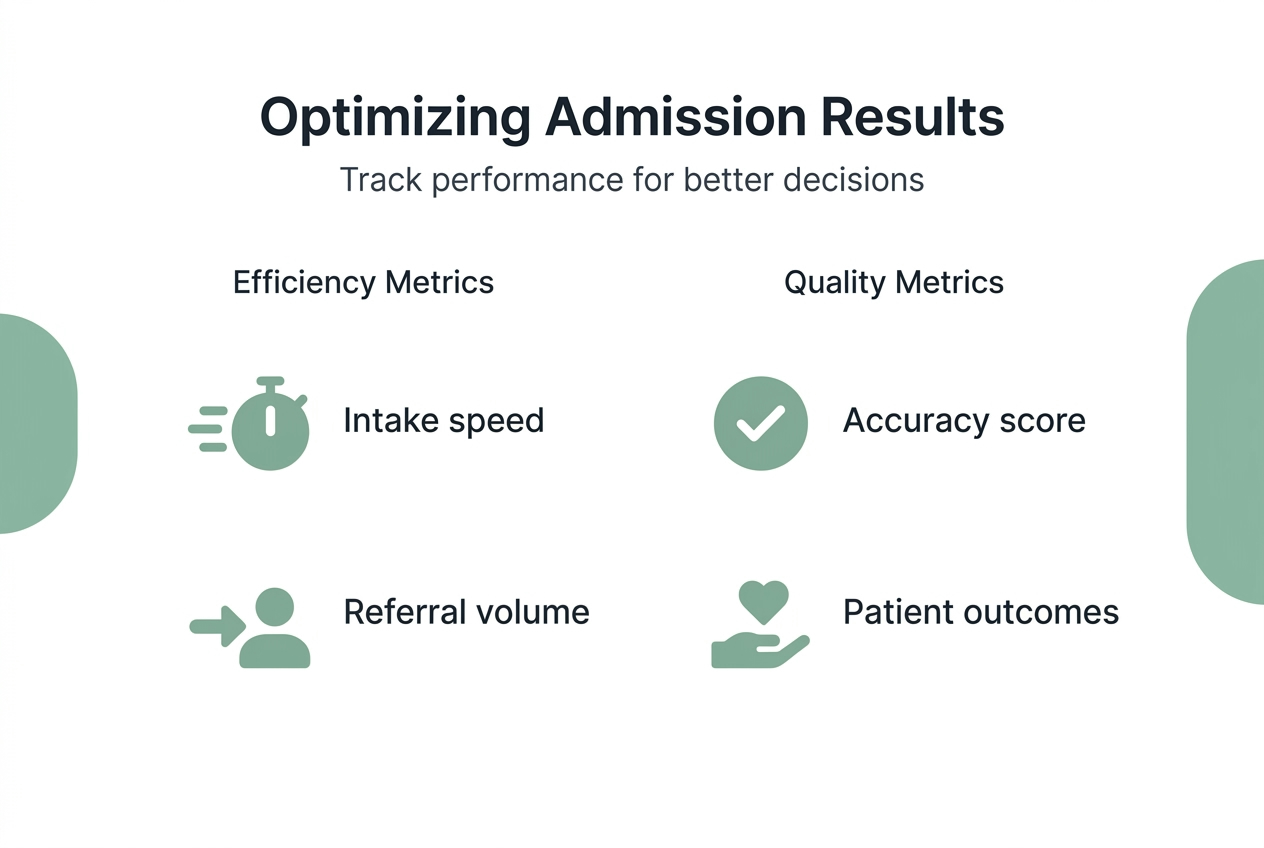
Staff workload indicators provide crucial insight into whether technology truly reduces burden or simply shifts it elsewhere. Survey your admissions coordinators regularly about time spent on repetitive tasks versus complex problem-solving. Data-driven improvements in acuity assessment accuracy by 15% translate directly to better patient-facility matching and fewer unexpected care complications.
Key performance indicators to monitor:
- Referral conversion rate showing percentage of reviewed cases resulting in admissions
- Time to bed fill measuring speed from referral receipt to patient arrival
- Staff overtime hours indicating workload sustainability
- Decision confidence scores from coordinator self-assessments
- Patient satisfaction ratings for the intake experience
Data quality issues often surface during performance reviews. If AI recommendations seem inconsistent or unhelpful, audit your source data for systematic gaps or errors. Missing medication lists, incomplete functional assessments, or outdated insurance information undermine even the most sophisticated analytics. Address root causes by working with referring hospitals and physicians to improve documentation completeness.
Retrain AI models periodically as your patient population, service offerings, or strategic priorities evolve. An algorithm trained on historical data may not reflect current capabilities if you’ve added new therapy programs, specialized units, or clinical partnerships. Regular model updates maintain alignment between AI recommendations and facility reality.
Gather qualitative feedback from your admissions team through structured interviews or focus groups. They often identify usability issues, confusing interface elements, or workflow friction points that metrics alone cannot reveal. Their suggestions for system improvements reflect real-world experience that enhances both adoption and effectiveness.
Avoid common pitfalls that undermine decision-making enhancement:
- Overreliance on AI without maintaining human validation protocols
- Neglecting staff training that builds confidence in interpreting AI outputs
- Failing to customize algorithms for your facility’s unique characteristics
- Ignoring feedback loops that help AI learn from decision outcomes
- Accepting vendor defaults rather than tailoring systems to your needs
Regular performance reviews should examine both wins and misses. When AI correctly predicts a patient requiring intensive wound care resources, document what data elements drove that accuracy. When a low-acuity prediction proves wrong, analyze whether missing information, data errors, or algorithm limitations caused the failure. These case studies inform continuous improvement.
Patient-centered decision-making remains the ultimate goal. Technology should enable your team to focus more on individual patient needs and less on administrative friction. When streamline administrative tasks healthcare teams handle become automated, coordinators gain capacity for meaningful conversations with patients, families, and referring providers that improve care transitions and satisfaction.
Explore technology solutions for smarter healthcare admissions
Ready to transform your admissions workflow? Smart Admissions offers AI-powered tools specifically designed for skilled nursing and rehabilitation facilities facing the decision-making challenges explored throughout this guide. Our platform integrates seamlessly with your existing systems to accelerate patient intake while improving accuracy and reducing staff burden.
Discover how automation healthcare admissions efficiency can cut referral review times dramatically while empowering your team to make confident decisions faster. Our intelligent assistant handles data extraction, insurance verification, and clinical summarization automatically, presenting your coordinators with clear, actionable insights.
Explore comprehensive referral management systems for efficiency that centralize communication, track referral status in real time, and provide analytics dashboards showing your intake performance. Understanding referral management essentials helps you evaluate solutions that truly fit your facility’s needs and strategic goals. Smart Admissions combines powerful automation with intuitive design, enabling faster implementation and immediate value without extensive IT support or workflow disruption.
What is data-driven decision-making (DDDM) in healthcare admissions?
Data-driven decision-making uses analytics and evidence from patient information to guide admission choices rather than relying solely on intuition or limited manual review. In healthcare admissions, DDDM involves collecting structured data about patient acuity, diagnoses, functional status, and insurance coverage, then applying analytical tools to identify patterns that predict successful placements. This approach improves consistency, reduces bias, and enables faster processing of complex referrals by highlighting the most relevant clinical and operational factors.
How does AI improve patient acuity assessments?
AI analyzes comprehensive clinical documentation including physician notes, nursing assessments, and therapy evaluations to identify indicators of patient complexity and care needs. Machine learning models trained on thousands of patient records recognize patterns that correlate with higher acuity levels, such as specific medication combinations, diagnoses, or functional limitations. This automated analysis delivers more consistent, objective assessments compared to manual review, which can vary based on individual coordinator experience or time constraints.
What are best practices to maintain data quality for decision-making?
Implement robust validation rules that flag incomplete referrals, missing critical fields, or inconsistent entries before data enters your decision systems. Establish regular audits of source data from referring hospitals and physicians, providing feedback when documentation gaps or errors appear systematically. Create governance processes that assign clear ownership for data accuracy, define quality standards, and track metrics showing improvement over time. Quality data forms the foundation for trustworthy analytics.
How do healthcare admissions teams balance AI tools with human judgment?
Use AI as a decision support system that highlights important information and suggests recommendations, but keep final admission authority with trained clinical staff. Review AI outputs critically, especially for complex cases involving unusual presentations, multiple comorbidities, or borderline acuity levels where contextual factors matter significantly. Establish protocols defining which decisions AI can expedite independently versus which require human validation, ensuring technology enhances rather than replaces your team’s expertise and experience.