
Let's be honest: the way most skilled nursing facilities handle admissions eligibility verification today isn't just outdated, it's actively holding them back.
We're talking about phone tag with insurance companies, faxed documents that disappear into the void, and staff manually keying data from crinkled paperwork into three different systems. Meanwhile, beds sit empty and referrals slip away to competitors who moved faster.
The good news? That's all changing. AI-driven eligibility verification is rapidly replacing these legacy processes, and the facilities that embrace this shift are seeing dramatic improvements in speed, accuracy, and revenue capture.
Here's what you need to know about where post-acute admissions is headed, and why clinging to the status quo is becoming an increasingly expensive choice.
The Manual Verification Problem Nobody Wants to Talk About
Manual insurance eligibility verification is one of the top causes of claim denials in healthcare, accounting for nearly one in four rejected claims. Think about that for a second. A quarter of your denied claims could be traced back to verification issues that happened before you even admitted the patient.
The traditional workflow looks something like this:
- Staff calls the insurance company and waits on hold
- Someone navigates multiple payer portals (each with different logins and interfaces)
- Documents get faxed back and forth
- Information is manually entered into your EHR
- Someone double-checks the data… hopefully
Every single step in that process is vulnerable to human error. A mistyped policy number. A coverage change that happened yesterday. A DD214 form that's been photocopied so many times it's barely readable.
And let's not forget the opportunity cost. Every minute your admissions coordinator spends on hold with an insurance company is a minute they're not building relationships with referral sources or evaluating clinical fit for incoming patients.

What AI-Driven Verification Actually Looks Like
AI-powered eligibility verification isn't just "faster data entry." It's a fundamentally different approach to the entire process.
Modern platforms connect directly with payer databases and clearinghouses to provide instant eligibility status. No phone calls. No portal hopping. Your staff can confirm benefits, deductibles, copays, and authorization requirements before the patient even arrives at your door.
But speed is just the beginning. Here's where it gets really interesting:
Predictive Analytics That Catch Problems Before They Happen
AI doesn't just verify current coverage: it can examine historical data to anticipate issues before they impact your admissions. Maybe a patient's coverage is approaching its limit. Maybe their policy has specific pre-authorization requirements that are easy to miss. AI flags these proactively, giving your team time to address them rather than discovering the problem when the claim gets denied.
Error Elimination at Scale
When AI pulls verified payer data directly from insurance databases, it eliminates the manual input errors that plague traditional workflows. Automated data validation catches inconsistencies that humans might miss, especially when staff are handling high volumes or unfamiliar document formats.
Audit-Ready Documentation
Every verification is timestamped and documented automatically. When auditors come knocking (and they will), you've got a complete paper trail that meets HIPAA compliance and payer documentation standards.
The DD214 Example: Where Manual Processes Fall Apart
Want a perfect case study in why manual verification is failing? Look at DD214 verification for veteran admissions.
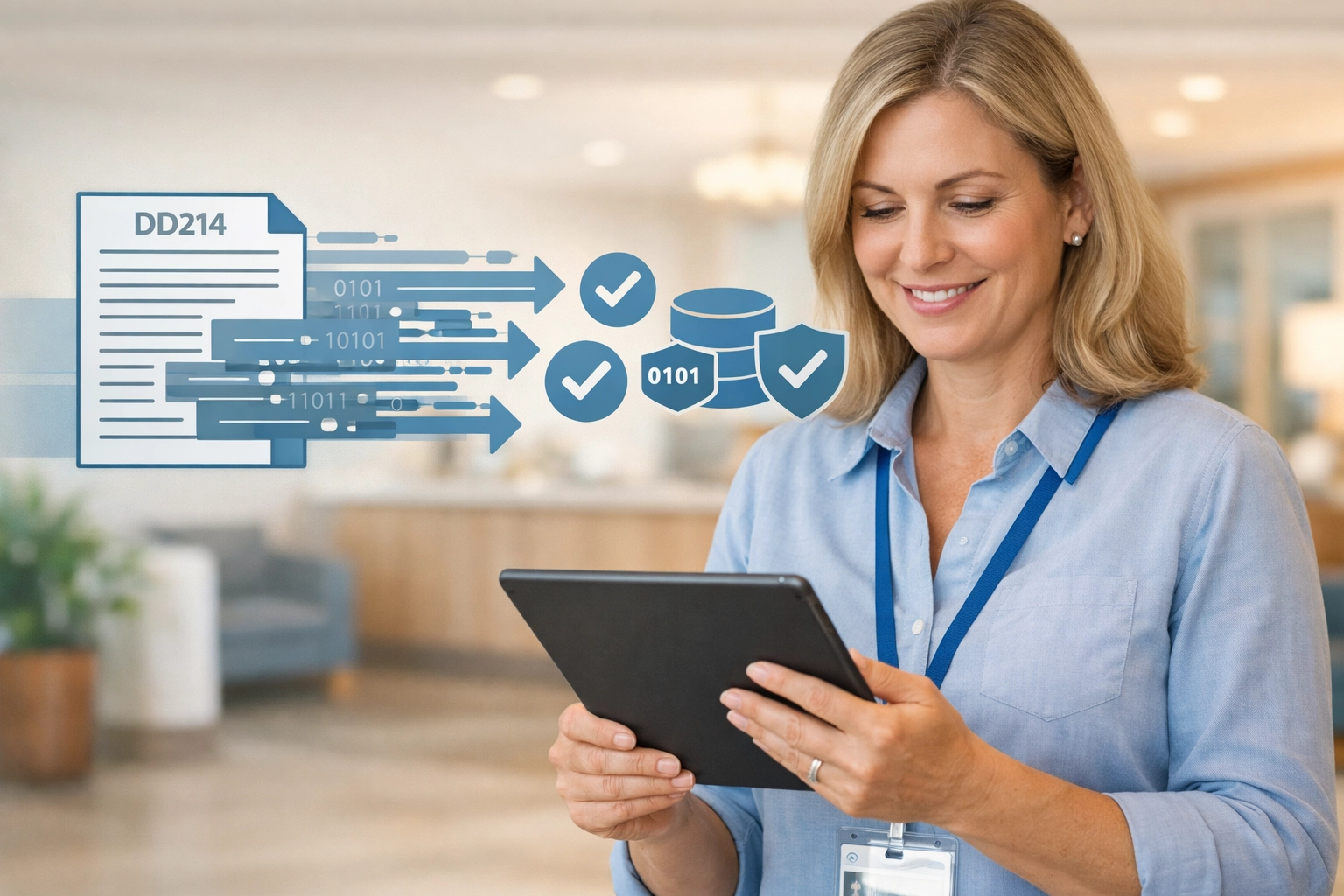
The DD214 military discharge document has gone through dozens of format variations over the decades. A form from 1968 looks nothing like one from 2015. Service codes have changed. Document quality varies wildly: some are crisp digital files, others are faded carbon copies that have been folded and refolded for 50 years.
Asking staff to manually verify eligibility across all these variations is asking for trouble. They'd need to memorize format differences across multiple eras, interpret faded text and handwriting, and understand service codes that changed meaning over time.
AI handles this differently. Advanced OCR (optical character recognition) technology can read documents that generic scanners: and often human eyes: simply can't. Machine learning models trained on historical DD214 formats can extract the relevant data points regardless of which version they're looking at.
The result? Verification that takes seconds instead of minutes, with dramatically improved accuracy.
Why This Matters More for Post-Acute Care
Post-acute care facilities face unique pressures that make eligibility verification especially critical:
The Speed Game
When a hospital discharge planner is looking to place a patient, they're often evaluating multiple facilities simultaneously. The SNF that can confirm eligibility and clinical fit fastest has a massive advantage. Every hour of delay is an opportunity for a competitor to swoop in.
Complex Payer Mix
SNFs often deal with a more complicated payer landscape than acute care settings: Medicare, Medicaid, Medicare Advantage plans, VA benefits, private insurance, and various combinations thereof. Each payer has different rules, and patients frequently have coverage through multiple sources.
Continuous Coverage Changes
Unlike a one-time hospital admission, SNF stays can extend for weeks or months. Coverage can change mid-stay. Benefits can exhaust. AI systems that run daily checks on active patients can alert you to coverage changes before they impact billing or disrupt care.
The Integration Advantage
The most powerful AI verification systems don't operate in isolation. They integrate directly with your existing healthcare infrastructure: your EHR, your referral management system, your billing platform.
This means eligibility data flows automatically into the workflows where it's needed. No more re-keying information. No more switching between systems to piece together a complete picture.
For facilities still relying on manual intake processes, this integration alone can save 50-70% on administrative time.
What's Coming Next
The AI-driven verification we're seeing today is just the beginning. Here's what's on the horizon:
Smarter Machine Learning
As these systems process more data, they get better at identifying patterns and predicting issues. Future systems will catch potential problems that current technology might miss.
Deeper Interoperability
Expect tighter connections between verification systems, EHRs, telehealth platforms, and payer networks. The goal is a seamless flow of information across the entire care continuum.
Blockchain for Security
Some solutions are exploring blockchain technology to make insurance verification data secure, immutable, and fully auditable. This could be a game-changer for compliance and audit readiness.
The Strategic Reality
Here's the bottom line: manual eligibility verification isn't just inefficient: it's becoming a competitive liability.
Facilities that stick with legacy processes will continue to face:
- Higher claim denial rates
- Slower admissions and lost referrals
- Staff burnout from tedious administrative work
- Compliance risks from documentation gaps
- Revenue leakage that compounds over time
Meanwhile, facilities that embrace AI-driven verification are capturing more admissions, reducing denials, and freeing their teams to focus on what actually matters: providing excellent patient care.
The technology exists today. The question isn't whether AI will transform post-acute admissions: it's whether you'll be leading that transformation or scrambling to catch up.
Ready to see what AI-driven eligibility verification can do for your facility?
Visit us at NASVH Booth #6 or book a demo to see Smart Admissions in action. We'd love to show you how facilities like yours are filling beds faster while eliminating the verification headaches that slow everyone down.