
Let's talk about something that's probably giving your admissions team headaches right now: those tiny alphanumeric codes buried in DD214 forms. You know the ones, a jumble of letters and numbers that supposedly tell you everything you need to know about a veteran's military eligibility.
Spoiler alert: they're a compliance landmine if you're handling them manually.
If you've ever had a claim denied because someone misread a "1" as an "I" or confused an RE-1 code with an RE-3, you already know where this is going. And if you haven't? Well, consider this your warning.
What Exactly Are Military Service Codes?
Before we dive into the costly mistakes, let's get on the same page about what we're dealing with here.
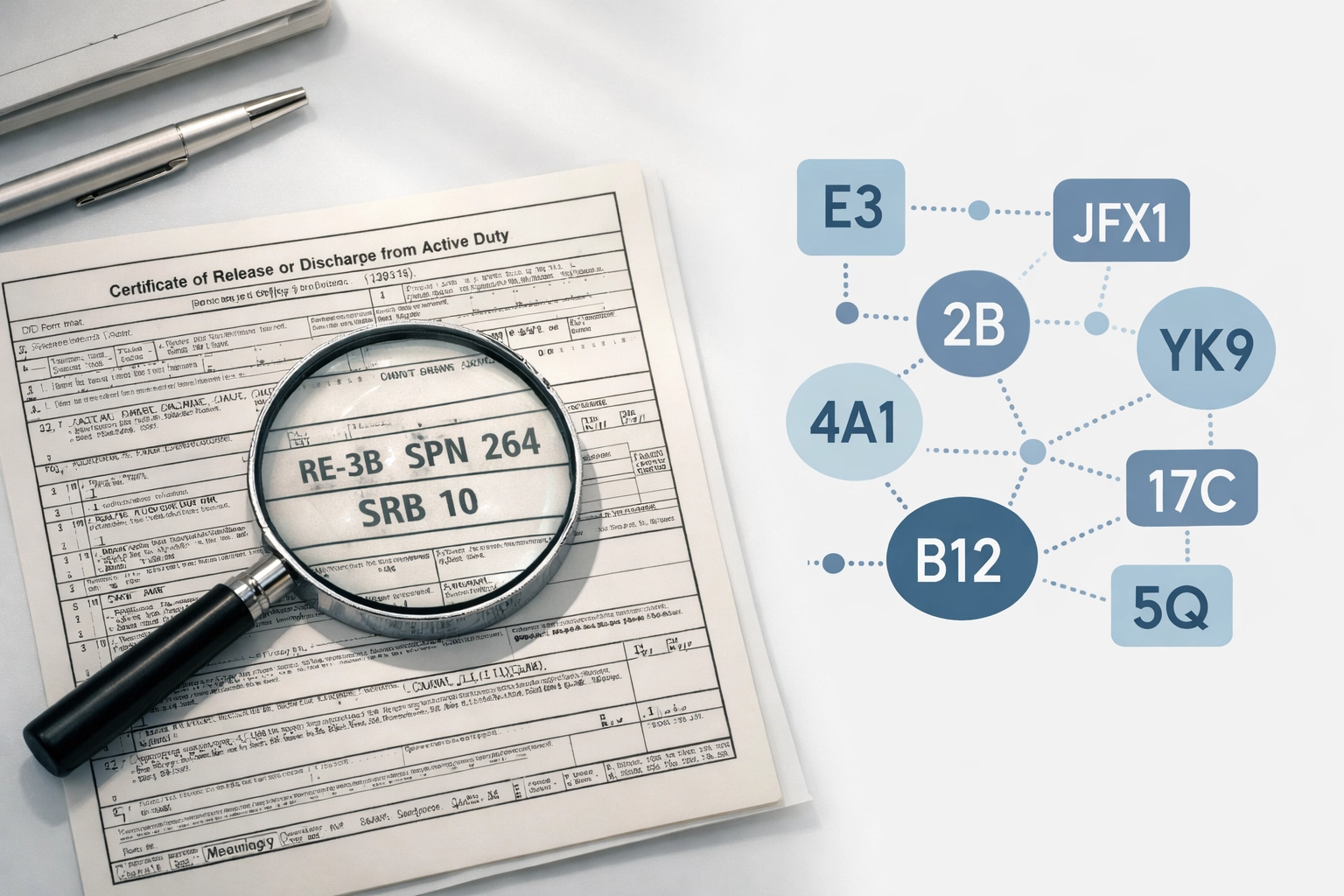
DD214 forms contain several critical codes that determine a veteran's eligibility for VA benefits and, by extension, their admission status at your skilled nursing facility. The main ones you need to know:
- Separation Program Designator (SPD) Codes: Three-character alphanumeric codes indicating the reason for discharge
- Reenlistment Eligibility (RE) Codes: Determine whether a service member can reenlist
- Character of Service: Honorable, General, Other Than Honorable, etc.
- Narrative Reason for Separation: The written explanation that should match the SPD code
Here's the kicker: there are literally hundreds of SPD codes, and they've changed over the decades. A code that meant one thing in 1975 might mean something completely different, or not exist at all, on a form from 2015.
Why Manual Verification Is Playing With Fire
Your admissions staff are talented, hardworking people. But asking them to accurately interpret military service codes across DD214 format variations that span 70+ years? That's not fair to them, and it's definitely not fair to your facility's bottom line.
Here's what they're up against:
The Typography Nightmare
DD214s from different eras were created using different technologies, typewriters, dot matrix printers, early computer systems, and modern digital formats. Each one has its own quirks:
- Faded ink that makes "8" look like "B"
- Typewriter keys that struck unevenly
- Poor-quality photocopies that blur critical characters
- Handwritten amendments that are anyone's guess
When you're dealing with codes like "JBK" vs "J8K" vs "JEK," a single misread character can completely change the eligibility determination.
The Knowledge Gap
Let's be real: most admissions staff aren't military records experts. They shouldn't have to be. But manual verification essentially requires them to:
- Memorize hundreds of SPD codes and their meanings
- Understand how those codes have evolved over decades
- Cross-reference multiple code systems simultaneously
- Recognize when something doesn't add up
That's a tall order for anyone, especially when they're also juggling phone calls, family questions, and a dozen other admissions tasks.

The Real Costs of Getting It Wrong
So what happens when a military service code gets misread? The consequences ripple out in ways you might not expect.
Financial Penalties and Denied Claims
This is the obvious one. Misinterpreting a code can lead to:
- Improper admission determinations: Admitting a veteran who doesn't qualify for VA benefits, leaving your facility on the hook
- Claim denials: The VA isn't known for being lenient when paperwork doesn't match up
- Recoupment requests: If you've already been paid for services and the VA discovers an eligibility error, they want that money back
We're not talking pocket change here. A single misread code can cost your facility thousands in denied reimbursements or clawbacks.
SNF Compliance Headaches
VA auditors take military eligibility seriously. If your facility shows a pattern of verification errors, you're looking at:
- Increased audit scrutiny
- Potential contract issues
- Reputation damage with VA referral sources
- Staff time devoted to appeals and corrections instead of admissions
The compliance burden alone can eat up hours of administrative time that your team simply doesn't have.
Delayed Admissions and Lost Beds
Here's something that doesn't show up on a spreadsheet but hurts just as much: the beds you're not filling while your team sorts out verification questions.
When admissions staff encounter a confusing code, they have two choices:
- Guess and risk getting it wrong (see above for why that's bad)
- Stop everything and research (which means that bed sits empty)
Neither option is great. Meanwhile, the veteran and their family are waiting, the referring hospital is getting impatient, and your competitors are filling their own beds.

The Human Cost We Don't Talk About Enough
Beyond the dollars and compliance issues, there's a human element here that deserves attention.
Veterans have earned their benefits through service to our country. When a misread code delays their admission or incorrectly flags them as ineligible, we're failing the people who deserve our best effort.
And your admissions staff? They're stressed. They know the stakes are high, they know they're working with incomplete information, and they know that a single mistake can create a cascade of problems. That's not a recipe for job satisfaction or staff retention.
How Automation Changes the Game
Okay, so manual verification is a minefield. What's the alternative?
This is where technology actually lives up to its promise. Modern AI-powered verification systems can:
- Read any DD214 format: Whether it's a faded 1960s typewriter original or a crisp digital copy, OCR technology specifically trained on military documents can accurately extract codes
- Instantly cross-reference code databases: No more hunting through reference manuals or second-guessing interpretations
- Flag inconsistencies automatically: If the SPD code doesn't match the narrative reason for separation, the system catches it before you make an admission decision
- Create audit-ready documentation: Every verification is logged, timestamped, and traceable
The result? Your admissions staff can focus on what they do best: building relationships with veterans and families: while the technology handles the tedious code interpretation.
Want to see how this works in practice? Check out our breakdown of how veterans' SNF facilities can verify DD214 eligibility in seconds.
What This Means for Your Facility
Let's bring this back to the practical level. If your facility is still relying on manual verification of military service codes, you're:
- Leaving money on the table through preventable claim denials
- Exposing yourself to SNF compliance risks
- Burning out your admissions staff
- Missing opportunities to fill beds faster
The math is pretty simple. The time and money you're spending on manual verification: plus the cost of errors: almost certainly exceeds what you'd invest in automation.
Ready to Stop Playing Code Roulette?
Military service codes don't have to be a compliance landmine. With the right tools, they become just another data point that gets verified automatically, accurately, and instantly.
If you're heading to the NASVH conference, swing by Booth #6 and let us show you how Smart Admissions handles even the trickiest DD214 format variations. We'll walk you through real examples of codes that trip up manual verification: and how our system reads them correctly every time.
Can't make it to the conference? No problem. Book a demo and we'll give you the full tour online. Your admissions staff (and your compliance team) will thank you.