
TL;DR:
- Healthcare staffing burnout is a clinical syndrome caused by systemic occupational stress, impacting staff well-being and patient safety. Addressing root causes such as inadequate staffing, administrative overload, and poor leadership yields the most effective prevention, rather than relying solely on resilience programs. Regular measurement using validated tools and operational data is essential for monitoring burnout trends and guiding strategic interventions.
Healthcare staffing burnout is defined as a clinical syndrome marked by emotional exhaustion, depersonalization, and a measurable decline in professional accomplishment, caused by chronic occupational stress in medical environments. The formal diagnostic standard is the Maslach Burnout Inventory, which quantifies all three dimensions across clinical roles. Understanding healthcare staffing burnout matters because its effects reach far beyond individual staff members. It compromises patient safety, drives up turnover costs, and strains the operational capacity of skilled nursing facilities, rehabilitation centers, and hospitals alike. The 2026 data makes the scale undeniable.
What causes healthcare staffing burnout?
Burnout in healthcare workers is primarily a system-level problem, not a personal failure. The most common structural drivers include excessive patient loads, inadequate staffing ratios, and administrative workflows that consume hours of clinical time without contributing to patient care.

The contributing factors fall into two categories: organizational and individual.
Organizational factors:
- Chronic understaffing that forces staff to cover multiple roles simultaneously
- Documentation requirements that extend well beyond clinical necessity
- Limited decision-making authority for frontline nurses and physicians
- Poor communication between departments and leadership
- Absence of structured peer support or formal wellness programs
Individual factors:
- Maladaptive coping strategies such as self-distraction, which mask stress but worsen burnout over time
- Lack of perceived control over scheduling or patient assignments
- Insufficient recovery time between high-intensity shifts
The administrative burden deserves specific attention. Admissions staff and nurses in post-acute care settings routinely spend 30–40% of their shift on documentation, insurance verification, and referral processing. That time comes directly out of patient interaction and personal recovery. When your team spends more time on paperwork than on care, the conditions for burnout are already in place.
Pro Tip: Before investing in wellness programs, audit your team’s actual time allocation across a typical shift. If more than 25% goes to administrative tasks, workflow redesign will deliver more burnout relief than any resilience training program.
How prevalent is burnout across healthcare roles?
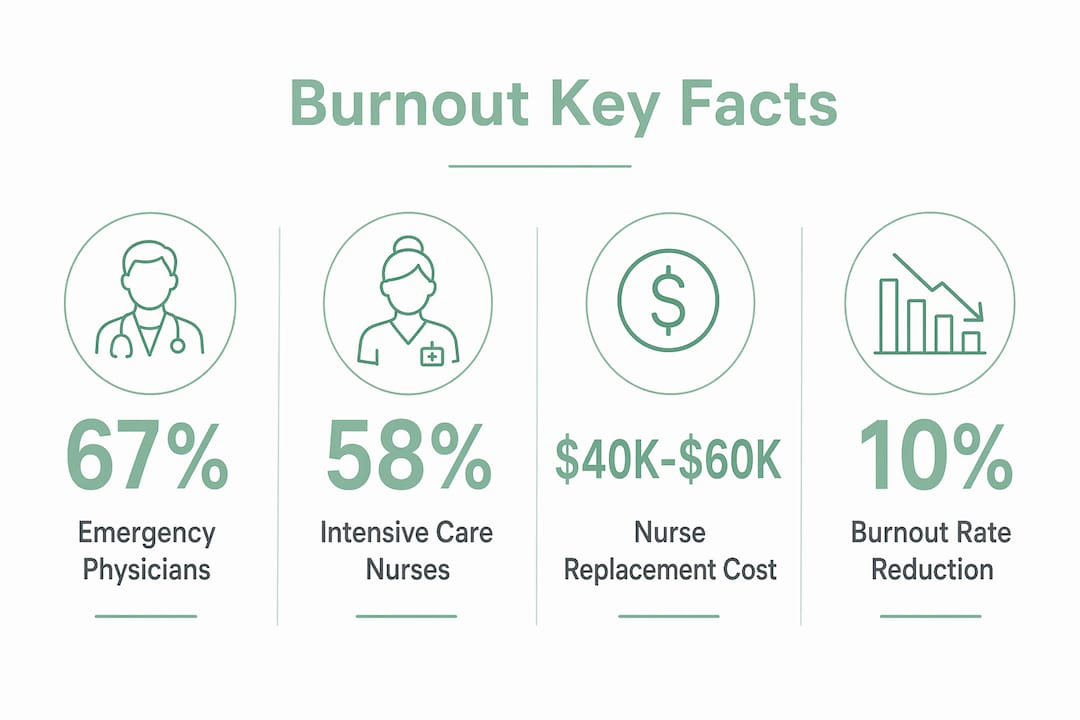
Burnout rates across healthcare are not uniform. Prevalence ranges from 35% to 52% across the general healthcare workforce, but specific roles carry significantly higher risk. Emergency physicians report burnout at 67%, intensive care nurses at 58%, and oncology staff at 54%. These numbers reflect the compounding effect of high patient acuity, unpredictable workloads, and limited organizational support.
The patient safety implications are direct and measurable. Burnout is associated with a 66.4% probability of worsening patient safety, including higher rates of medication errors and lower patient satisfaction scores. That is not a marginal risk. It means a burned-out care team is statistically more likely to harm the patients it is trying to help.
“Burnout negatively affects clinicians, patients, and organizations, causing fatigue, detachment, reduced performance, and increased medical errors.” — StatPearls, NCBI Bookshelf
The financial consequences compound the clinical ones. Replacing a single nurse costs between $40,000 and $60,000. That figure covers recruitment, onboarding, temporary staffing, and lost productivity during the transition period. For a 100-bed skilled nursing facility losing five nurses per year to burnout, the annual cost exceeds $200,000 before accounting for the downstream effects on census and care quality.
| Role | Burnout Prevalence | Key Impact |
|---|---|---|
| Emergency Physicians | 67% | Higher diagnostic errors, increased patient complaints |
| Intensive Care Nurses | 58% | Medication errors, reduced monitoring frequency |
| Oncology Staff | 54% | Emotional withdrawal, lower patient satisfaction |
| General Healthcare Workers | 35–52% | Elevated absenteeism, increased turnover intent |
The signs of staffing burnout often appear in operational data before they surface in staff surveys. Rising absenteeism, increased incident reports, and declining patient satisfaction scores are early indicators your facility should track consistently.
What strategies actually prevent staff burnout?
Preventing staff burnout requires structural change, not just individual support programs. Research is clear that addressing supply constraints and workflow inefficiencies produces better retention outcomes than salary increases alone. Your facility needs a layered approach that targets the root causes.
Here are the evidence-based interventions that produce measurable results:
-
Improve staffing adequacy. A 10% improvement in nurse staffing reduces physician intent to leave by 22%, dissatisfaction by 19%, and burnout rates by 10%. Staffing ratios are not just a nursing issue. They affect every clinical role in the facility.
-
Redesign administrative workflows. Identify every manual task in your admissions and intake process. Automate insurance verification, referral documentation, and eligibility checks wherever possible. Reducing non-clinical workload directly reduces the emotional exhaustion component of burnout.
-
Invest in leadership development. Leadership involvement and workplace wellness activities are among the most effective adaptive coping strategies available. Managers who actively support their teams and communicate transparently reduce burnout risk at the unit level.
-
Build peer support structures. Formal peer support programs, including structured debriefs after critical incidents, reduce the isolation that accelerates burnout. These programs work best when participation is normalized rather than stigmatized.
-
Use technology to reduce administrative load. AI-powered documentation and scheduling tools reduce the administrative burden that consumes clinical staff time. Facilities that have integrated EMR-connected intake platforms report measurable reductions in after-hours documentation and referral processing time. You can explore workflow optimization strategies specifically designed for post-acute care settings.
Pro Tip: Avoid the common mistake of deploying mindfulness apps or resilience workshops as standalone solutions. These tools have value, but only when paired with structural changes. Staff recognize the difference between genuine organizational investment and a low-cost substitute for real change.
Managing healthcare employee stress at the organizational level also means giving staff more control over their schedules. Predictable scheduling, adequate notice of shift changes, and protected time off after high-intensity periods all reduce chronic stress accumulation.
How can administrators measure and monitor burnout?
Measuring burnout requires validated tools applied consistently, not periodic surveys sent during a staffing crisis. The Maslach Burnout Inventory remains the gold standard for quantifying emotional exhaustion, depersonalization, and personal accomplishment across clinical roles. The Professional Quality of Life Scale and the Copenhagen Burnout Inventory are also widely used in healthcare settings and offer role-specific variants.
Beyond formal surveys, your operational data already contains burnout signals. Track these metrics on a monthly basis:
- Turnover rate by unit: A rate above 20% annually in any unit warrants immediate investigation.
- Absenteeism frequency: Frequent short-term absences are a stronger burnout predictor than extended leave.
- Patient safety event rates: Rising incident reports correlate directly with staff exhaustion levels.
- Overtime hours per staff member: Chronic overtime is both a cause and a consequence of burnout.
Integrate these metrics into your quality and operational dashboards alongside patient satisfaction scores. Burnout does not exist in isolation from your facility’s performance data. When you see patient satisfaction declining alongside rising overtime, the two trends are almost certainly connected.
| Tool | Frequency | Metrics Captured |
|---|---|---|
| Maslach Burnout Inventory | Biannually | Emotional exhaustion, depersonalization, accomplishment |
| Copenhagen Burnout Inventory | Quarterly | Personal, work-related, and client burnout dimensions |
| Turnover and absenteeism tracking | Monthly | Unit-level retention, short-term absence patterns |
| Patient safety event reports | Monthly | Incident rates, near-misses, complaint frequency |
| Overtime hours per staff member | Monthly | Chronic overwork indicators by role and unit |
Pro Tip: Run your first Maslach Burnout Inventory survey anonymously and share the aggregate results with your team. Transparency about the data builds trust and signals that your facility takes burnout seriously as an organizational issue, not a personal one.
For skilled nursing facilities specifically, connecting burnout metrics to admissions and bed occupancy data reveals a pattern most administrators have not formalized: reducing burnout in skilled nursing settings directly supports census stability by keeping experienced staff in place.
Key takeaways
Healthcare staffing burnout is a structural problem that requires structural solutions, and facilities that address staffing adequacy, workflow design, and leadership quality together see the strongest results in retention and patient safety.
| Point | Details |
|---|---|
| Burnout is a clinical syndrome | Defined by emotional exhaustion, depersonalization, and reduced accomplishment, measured by the Maslach Burnout Inventory. |
| High-risk roles need targeted action | Emergency physicians at 67% and ICU nurses at 58% face the highest burnout rates and require priority intervention. |
| Patient safety is directly at risk | Burnout carries a 66.4% probability of worsening patient safety outcomes, including medication errors. |
| Turnover costs are substantial | Replacing one nurse costs $40,000–$60,000, making retention investment financially justified at every facility size. |
| Structural fixes outperform individual programs | Staffing adequacy, workflow automation, and leadership development reduce burnout more effectively than resilience training alone. |
What i’ve learned about burnout that most guides get wrong
After years of working closely with healthcare administrators across skilled nursing and post-acute care settings, the most consistent mistake I see is treating burnout as a morale problem rather than an operational one. Facilities invest in yoga subscriptions and employee appreciation weeks while their admissions staff manually re-enters the same patient data into three separate systems every single day.
The research backs this up. A 10% improvement in staffing adequacy reduces burnout rates by 10% and physician intent to leave by 22%. No wellness program produces numbers like that. The ROI on structural investment is not just clinical. It is financial. When you factor in the $40,000–$60,000 cost of replacing a single nurse, even modest improvements in retention pay for workflow redesign projects within a single fiscal year.
The other thing most guides miss is the compounding nature of administrative burden in post-acute care specifically. Admissions coordinators in skilled nursing facilities are not just doing intake. They are managing referral documentation, insurance verification, clinical assessments, and EMR data entry simultaneously, often without adequate support or technology. That is a burnout environment by design, not by accident.
My honest view is that the facilities making real progress on burnout are the ones that have stopped asking their staff to absorb system failures through personal resilience. They are fixing the systems instead. That means investing in staffing ratios, automating repetitive intake tasks, and building leadership cultures where burnout is discussed openly and addressed structurally. The proven strategies for reducing burnout all point in the same direction: change the work environment, not just the worker.
— Harry
How Smartadmissions helps reduce administrative burnout
One of the most direct causes of burnout in admissions and intake teams is the volume of manual, repetitive work that technology can handle far more reliably than any human should be expected to. Smartadmissions is built specifically for skilled nursing facilities, rehabilitation centers, and post-acute care providers who need to reduce that burden without adding implementation complexity.
The platform automates referral review, real-time insurance eligibility verification, and clinical documentation management, all integrated with your existing EMR system. Your admissions staff stops re-entering data and starts focusing on decisions that actually require clinical judgment. Facilities using admissions automation report faster bed fill rates and measurable reductions in after-hours administrative work. If your team is showing signs of staffing burnout, the intake workflow is the right place to start. Explore how Smartadmissions supports referral management efficiency at your facility.
FAQ
What is healthcare staffing burnout?
Healthcare staffing burnout is a clinical syndrome defined by emotional exhaustion, depersonalization, and reduced professional accomplishment, resulting from chronic occupational stress. The Maslach Burnout Inventory is the standard tool used to measure it across clinical roles.
What are the most common signs of staffing burnout?
The most visible signs of staffing burnout include rising absenteeism, increased patient safety incidents, declining patient satisfaction scores, and higher voluntary turnover rates. At the individual level, staff may show emotional detachment, reduced productivity, and frequent complaints about workload.
Which healthcare roles have the highest burnout rates?
Emergency physicians report the highest burnout prevalence at 67%, followed by intensive care nurses at 58% and oncology staff at 54%, according to 2026 research. General healthcare workers experience burnout at rates between 35% and 52%.
Does raising salaries reduce healthcare burnout?
Salary increases alone do not resolve burnout or fill vacancies effectively. Research shows that addressing workflow inefficiencies and staffing adequacy produces stronger retention outcomes than compensation changes alone.
How often should facilities survey staff for burnout?
Facilities should administer validated tools like the Maslach Burnout Inventory at least twice per year, while tracking operational indicators such as turnover, absenteeism, and overtime monthly. Regular data collection allows administrators to detect burnout trends before they reach a crisis point.