
DD214 Formats. When a veteran referral arrives at your skilled nursing facility, that DD214 form might look straightforward on the surface. But beneath that familiar government document lies a maze of format variations that has evolved over nearly eight decades: creating a verification nightmare for admissions staff who need to extract accurate military eligibility information quickly and correctly.
The Hidden Complexity of DD214 Format Variations
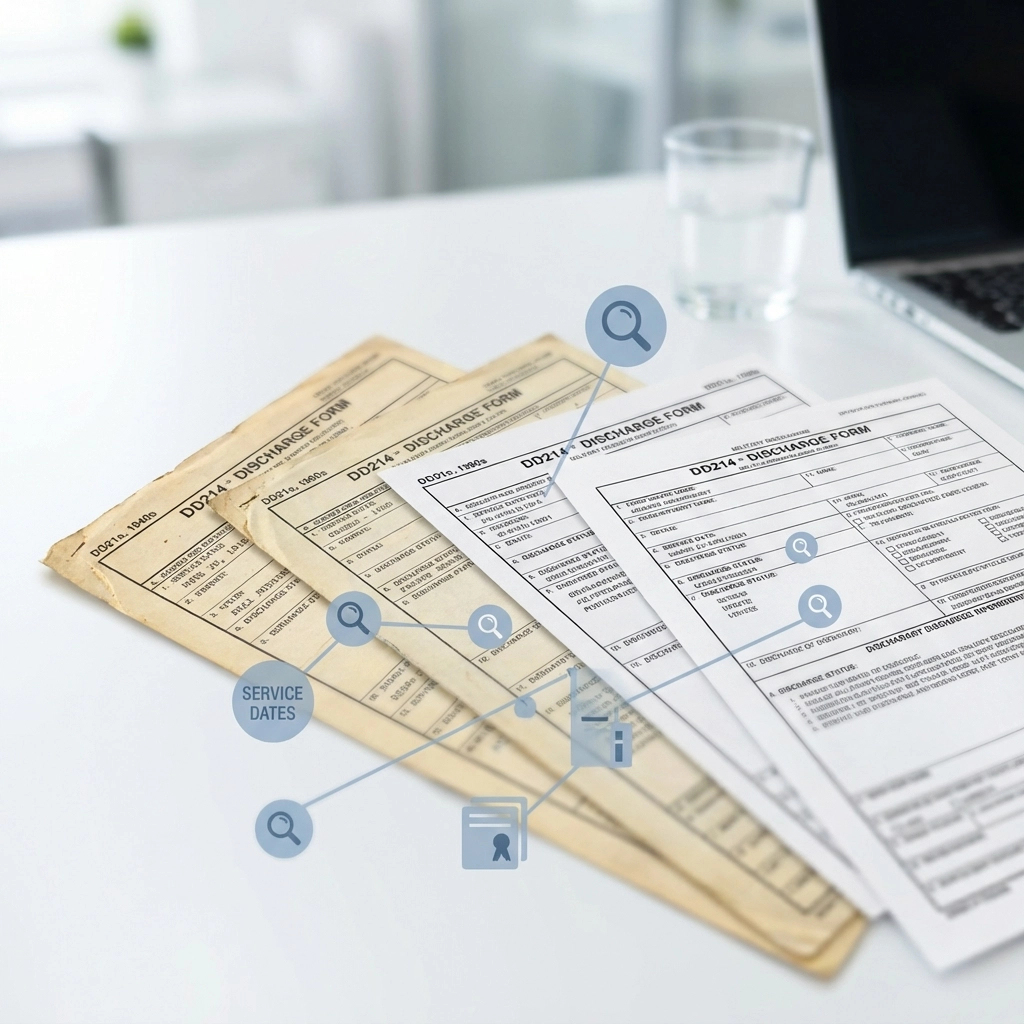
Since 1945, the DD Form 214 has undergone countless revisions, updates, and structural changes. What many admissions coordinators don't realize is that there are over 45 different DD214 format variations currently in circulation. Each era brought new layouts, different block numbering systems, varying information fields, and entirely different ways of presenting the same critical data.
Consider this: a World War II veteran's discharge papers look completely different from a Vietnam veteran's DD214, which differs significantly from an Iraq War veteran's form. The block numbers don't match up, the terminology has changed, and even the paper size and layout vary dramatically. For admissions staff trying to quickly locate discharge status, service dates, or eligibility codes, these variations create constant confusion and potential errors.
Why Manual DD214 Verification Fails Under Pressure
Veterans SNF facilities typically process 5-10 veteran referrals daily, with each DD214 verification taking 15-30 minutes of manual review time. During this process, admissions coordinators must navigate through unfamiliar document formats while searching for specific pieces of information that determine VA benefit eligibility.
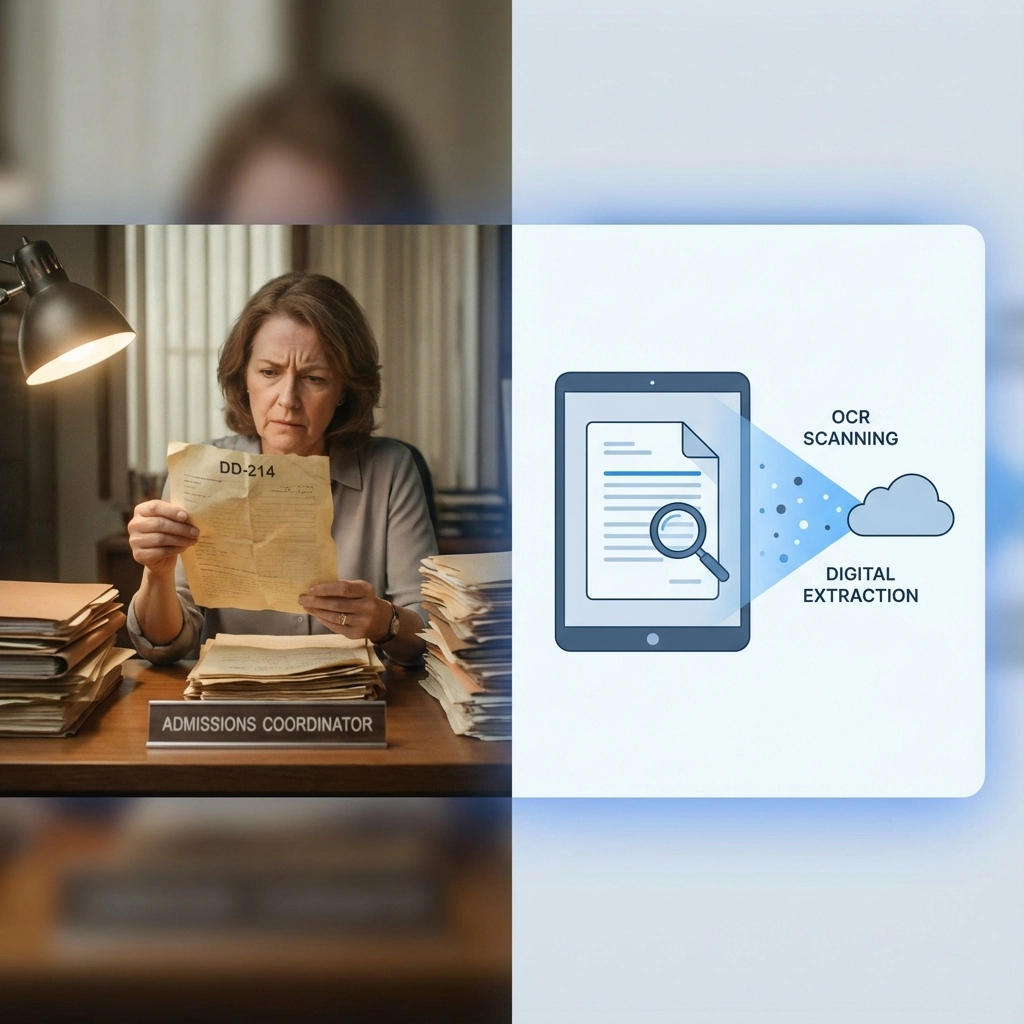
The challenge intensifies when dealing with aged documents. Many DD214 forms from the 1960s, 1970s, and 1980s arrive as faded photocopies of typewritten originals. Critical information becomes nearly illegible, military service codes blur together, and discharge dates become impossible to read with certainty. Staff members often find themselves squinting at documents, making educated guesses about what certain characters or numbers might be.
The Real Cost of Misreading Military Service Codes
Military service codes represent another layer of complexity that manual verification struggles to handle accurately. These alphanumeric codes determine everything from discharge characterization to specific benefit eligibilities. A single misread character can mean the difference between approving a qualified veteran for placement or incorrectly rejecting an eligible referral.
For example, distinguishing between similar-looking codes like "JGA" and "JCA" in faded typewritten text requires perfect vision and intimate knowledge of military coding systems. When admissions staff misinterpret these codes: which happens more frequently than facilities like to admit: the consequences range from delayed placements to compliance violations during VA audits.
OCR Technology: The Game-Changer for Aged Documents
Smart Admissions' DD214 Eligibility Checker leverages advanced OCR (Optical Character Recognition) technology specifically trained on military documentation. Unlike generic OCR systems, this specialized technology understands the context of military forms and can accurately extract information from documents that would challenge even experienced admissions staff.
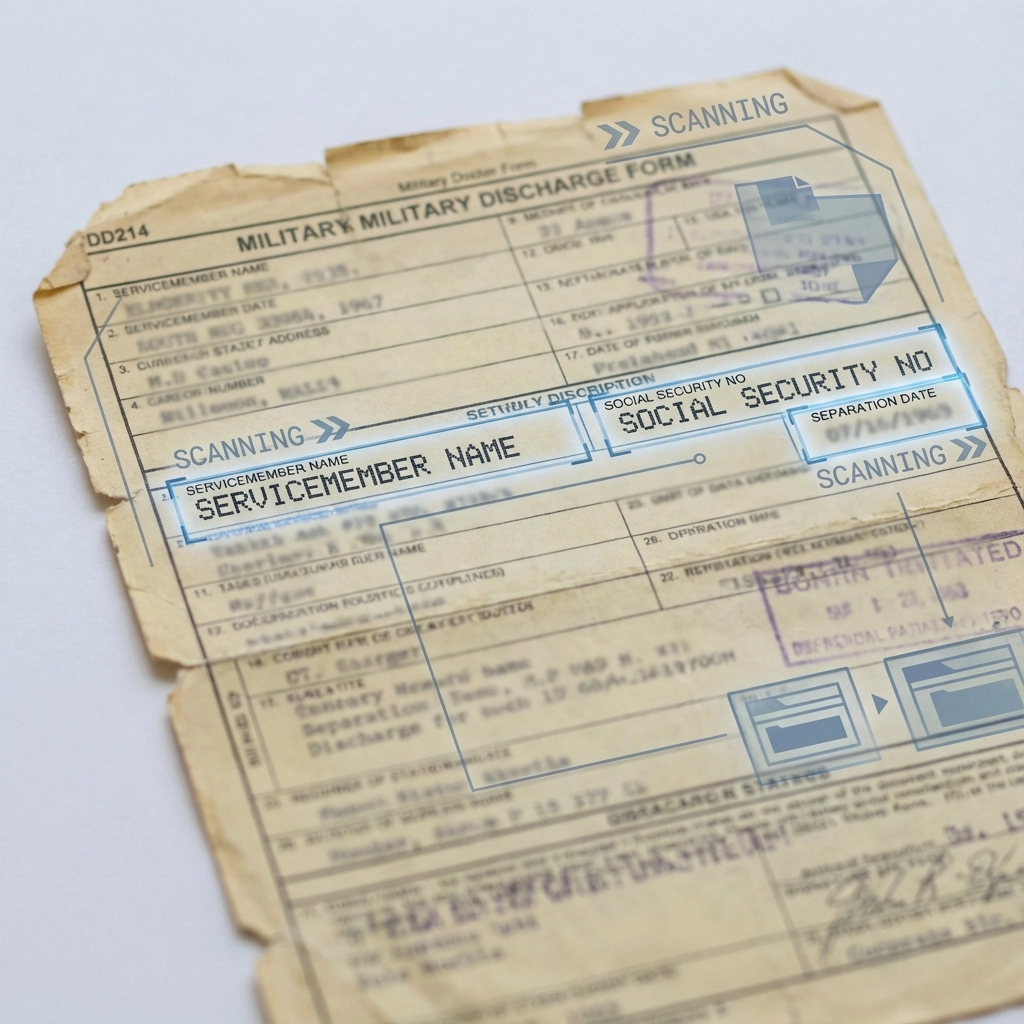
The OCR system recognizes the subtle differences between similar characters in military typography, compensates for fading and document deterioration, and cross-references extracted information against known military service code databases. This means even a heavily aged DD214 from 1967 can be processed with the same accuracy as a pristine digital copy from 2024.
See it live: Book a 15-minute demo to watch Smart Admissions verify DD214s in under 5 minutes. Request a demo →
Automatic Format Recognition Across Eight Decades
The Smart Admissions platform automatically identifies which DD214 format variation it's processing and adjusts its extraction algorithms accordingly. Whether it's encountering a short-form Member 1 copy, a comprehensive Member 4 copy, or a decades-old format with completely different block numbering, the system instantly adapts.
This automatic format recognition eliminates the guesswork that plagues manual verification. Staff no longer need to puzzle over whether they're looking at Block 24 or Block 30 for discharge characterization information: the system knows exactly where to find each piece of data regardless of the format variation.
Critical Data Extraction Across All Formats
The DD214 Eligibility Checker automatically extracts and validates four essential pieces of information from every format variation:
Discharge Status: Whether honorable, general, other than honorable, or dishonorable: critical for determining basic VA eligibility
Service Dates: Entry and separation dates that affect benefit periods and eligibility windows
Character of Service: Detailed discharge characterization that influences specific benefit types
Eligibility Codes: Complex alphanumeric codes that determine which VA programs the veteran qualifies for
Each of these data points appears in different locations, uses different terminology, or follows different formatting rules depending on the DD214 version. The automated system handles these variations seamlessly, while manual verification often misses or misinterprets critical details.
The Compliance Risk of Manual Verification Errors
VA compliance audits scrutinize SNF facilities' admission documentation with particular attention to DD214 verification accuracy. When auditors discover that a facility admitted veterans based on incorrect military eligibility determinations, the consequences include payment recoupments, compliance violations, and potential exclusion from VA referral networks.
Manual DD214 verification introduces multiple points of potential error:
- Misreading faded or unclear text
- Misinterpreting complex military service codes
- Overlooking critical information in unfamiliar format variations
- Inconsistent verification standards between different staff members
- Time pressure leading to rushed or incomplete reviews
100% Accuracy vs. Human Error Rates
Industry studies indicate that manual DD214 verification carries an error rate of 12-18%, primarily due to format complexity and document quality issues. In contrast, Smart Admissions' automated DD214 Eligibility Checker maintains 100% accuracy across all format variations because it doesn't rely on human interpretation of ambiguous text or unfamiliar layouts.
This accuracy difference has significant financial implications. For a facility processing 200 veteran referrals monthly, the difference between 85% manual accuracy and 100% automated accuracy means avoiding 30 potential compliance issues per month: each of which could trigger payment recoupments or audit scrutiny.
Integration with Complete Workflow Automation
The DD214 Eligibility Checker doesn't operate in isolation: it integrates seamlessly with Smart Admissions' complete referral workflow automation. When a veteran referral enters the system, DD214 verification happens simultaneously with insurance verification, bed availability checking, and staff notification. This parallel processing eliminates the traditional sequential workflow where DD214 verification must be completed before other intake steps can begin.
For Veterans SNF facilities, this integrated approach means faster response times to VA referral sources, higher conversion rates on qualified veteran placements, and complete audit-ready documentation: all while reducing the manual workload that typically consumes hours of staff time daily.
Moving Beyond Manual Verification Limitations
The complexity of DD214 format variations makes manual verification increasingly impractical for modern Veterans SNF facilities. With over 45 different formats in circulation, aged documents requiring specialized interpretation, and compliance requirements demanding perfect accuracy, automated DD214 verification has become essential rather than optional.
Smart Admissions' DD214 Eligibility Checker represents the evolution from error-prone manual processes to reliable, accurate, and fast automated military eligibility checking. For facilities serious about VA compliance and efficient veteran admissions, the question isn't whether to automate DD214 verification: it's how quickly you can implement a solution that handles the full complexity of military discharge documentation.
See it live: Book a 15-minute demo to watch Smart Admissions verify DD214s in under 5 minutes. Request a demo →