
TL;DR:
- Staffing burnout is a systemic issue caused by chronic understaffing and poor work design, not individual weakness. Addressing it through organizational reforms like safe staffing policies and leadership empowerment yields sustainable improvement for both staff well-being and patient safety. Regular shift-level staffing monitoring and workload automation can proactively prevent burnout and associated patient harm.
Staffing burnout is defined as the progressive physical, emotional, and mental exhaustion healthcare workers experience when chronic workplace stress exceeds their capacity to recover. Understanding why decrease staffing burnout matters is not a philosophical question for healthcare administrators. It is an operational imperative. Research published in JAMA Network Open links nurse understaffing directly to higher burnout rates, increased medical errors, and measurable patient harm. In skilled nursing facilities, rehabilitation centers, and post-acute care settings, the consequences compound quickly. Reducing employee fatigue at the organizational level, not just the individual level, is the most evidence-backed path to protecting both your staff and your patients.
Why decrease staffing burnout: the core case for healthcare leaders
Burnout in healthcare is the clinical term for what the World Health Organization classifies as an occupational phenomenon, characterized by exhaustion, cynicism, and reduced professional efficacy. It differs from ordinary work stress in one critical way: stress is temporary, while burnout is cumulative and self-reinforcing. A nurse who is stressed after a difficult shift can recover overnight. A nurse experiencing burnout cannot recover without structural change.
The scale of the problem in 2026 is significant. Over 287,000 staff nurses left their jobs in a single recent year, and nearly 1.6 million intend to leave within five years. That figure represents a workforce crisis, not an individual motivation problem. When your facility loses experienced nurses to burnout-driven turnover, you lose institutional knowledge, care continuity, and the financial investment made in their training and onboarding.
The importance of lowering burnout extends beyond staff wellbeing. Facilities with persistently high burnout rates face a feedback loop that is difficult to break: understaffing causes reactive overtime, overtime accelerates burnout, burnout drives turnover, and turnover worsens the understaffing cycle. Recognizing this cycle is the first step toward interrupting it with deliberate policy.

How does staffing burnout affect patient safety and care quality?
The connection between staffing burnout and patient outcomes is not theoretical. Multiple peer-reviewed studies confirm that when nurses are burned out and understaffed, patients pay a measurable price.
A study analyzing shift-level nurse staffing data found that understaffing during day shifts is directly associated with increased in-hospital mortality, higher readmission rates, and longer lengths of stay. This means that a single shift running below the ward median in nurse-to-patient ratios creates clinically significant risk. The effect is not limited to extreme understaffing events. Even moderate, routine deviations from adequate staffing levels produce worse outcomes.
Research conducted in Japan found that nurses in poorly staffed hospitals were 50% more likely to report high burnout and 75% more likely to rate care quality as fair or poor. Those are not marginal differences. They represent a systematic degradation of care that your patients, families, and regulators will notice.
The downstream effects on your facility’s reputation and financial standing are equally serious:
- Higher readmission rates trigger Medicare and Medicaid penalties under value-based purchasing programs.
- Lower patient satisfaction scores reduce reimbursement rates tied to HCAHPS metrics.
- Increased incident reports and adverse events elevate liability exposure and regulatory scrutiny.
- Accelerated staff turnover raises recruitment and agency staffing costs, often exceeding the cost of proactive retention investments.
“Safe staffing policy reform is an effective approach for both improving nurse well-being and enhancing patient safety simultaneously.” — JAMA Network Open
Monitoring daily staffing levels, rather than reviewing aggregate monthly data, gives your leadership team the lead time needed to respond before patient outcomes deteriorate.
Why organizational interventions outperform individual resilience programs
The most common mistake healthcare facilities make when addressing burnout is treating it as an individual problem. Resilience workshops, mindfulness apps, and employee assistance programs have their place, but a systematic review published in the International Journal of Environmental Research and Public Health confirms that organizational-level interventions are consistently more effective than individual-focused strategies for reducing workplace burnout.
The distinction matters because it redirects responsibility. Asking burned-out nurses to become more resilient while leaving the conditions that caused burnout unchanged is not a strategy. It is a delay tactic. The evidence points clearly toward changing the work system itself.
Organizational interventions that produce measurable results include:
- Staffing policy reform: Establishing minimum nurse-to-patient ratios and enforcing them at the shift level, not just on paper.
- Workload redistribution: Auditing task allocation to identify administrative burdens that can be automated or reassigned to non-clinical staff.
- Leadership accessibility: Implementing Magnet model principles where nurse managers are visible, approachable, and empowered to act on staff concerns in real time.
- Role clarity: Defining responsibilities precisely so staff are not absorbing tasks outside their scope due to systemic gaps.
- Psychological safety: Creating a culture where staff can report concerns, flag errors, and request support without fear of retaliation.
Magnet-style hospital redesign provides the strongest evidence base for this approach. A study of 56 European and U.S. Magnet hospitals found a 6.3 percentage-point drop in nurse burnout following organizational changes. That improvement came from pairing staffing upgrades with governance changes and role clarity, not from wellness programs alone.
Pro Tip: Before investing in another staff wellness initiative, audit your current workload distribution data. If nurses are spending more than 20% of their shift on documentation and administrative tasks, that is your highest-leverage burnout reduction target.
What are the operational and financial benefits of reducing burnout?
Reducing employee fatigue through safe staffing is not just the right thing to do. It is the financially sound decision for your facility’s long-term stability.
The turnover cost calculation is straightforward. Replacing a single registered nurse costs between $40,000 and $60,000 when you account for recruitment, onboarding, agency fill costs, and the productivity gap during the transition period. Multiply that by the number of nurses your facility loses annually to burnout-related attrition, and the case for investing in staff wellbeing strategies becomes undeniable.
| Financial Driver | Impact of High Burnout | Impact of Reduced Burnout |
|---|---|---|
| Nurse turnover cost | $40,000–$60,000 per replacement | Reduced through improved retention |
| Agency staffing spend | Elevated due to coverage gaps | Decreased with stable core staff |
| Readmission penalties | Higher under value-based purchasing | Lower with consistent care quality |
| Recruitment cycle time | Extended, disrupting care continuity | Shortened with stronger employer brand |
| Regulatory compliance risk | Increased with fatigued staff | Reduced with engaged, rested workforce |
Safe staffing policies in jurisdictions like British Columbia and California demonstrate that mandated minimum staffing improves patient safety and nurse retention without the hospital closures that critics predicted. The added salary costs of adequate staffing are offset by reduced readmission penalties, lower agency spend, and improved bed fill rates driven by stronger care quality ratings.
Pro Tip: Calculate your facility’s 12-month nurse turnover cost before your next budget cycle. Present that figure alongside the cost of a safe staffing policy upgrade. The comparison typically makes the investment decision straightforward for your board.
How can healthcare administrators implement burnout reduction strategies?
Translating the evidence into practice requires a structured approach. The following framework draws from the Magnet model, systematic review findings, and the proven ways to reduce staff burnout documented in skilled nursing settings.
Monitor staffing at the shift level. Daily monitoring of nurse staffing deviations, rather than monthly or quarterly reviews, allows your team to treat understaffing as a leading indicator and respond before patient outcomes are affected. Build a rapid adjustment protocol that activates when any shift falls below your established threshold.
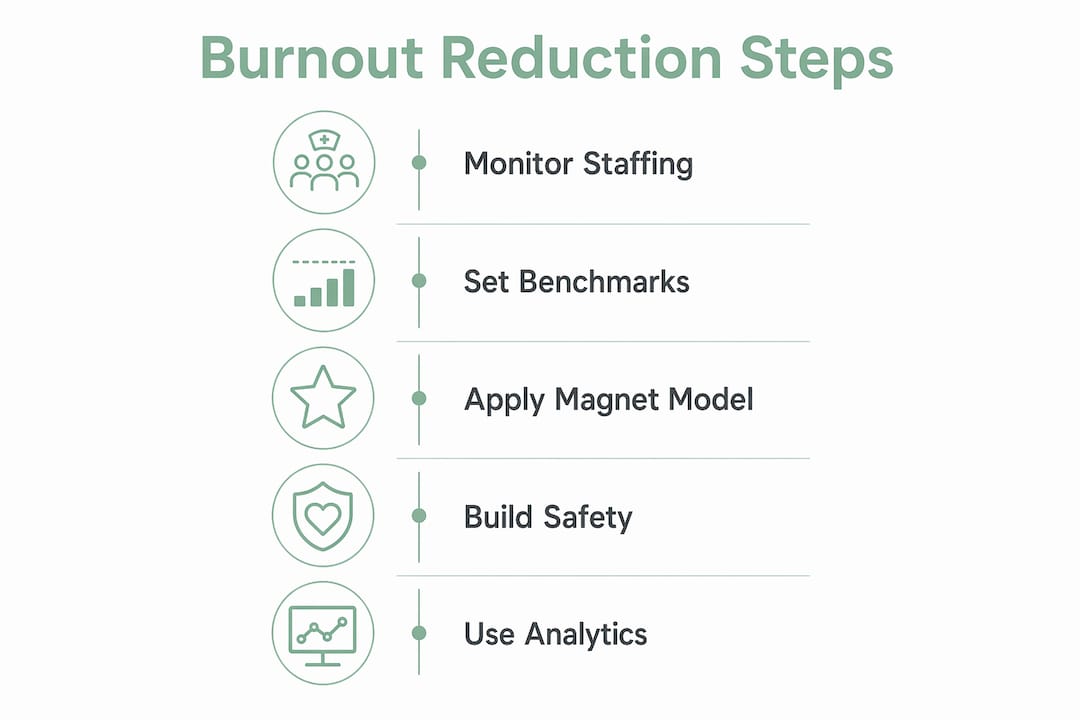
Adopt evidence-based staffing benchmarks. Set nurse-to-patient ratios based on your facility’s acuity mix and align them with the best available research. Review these benchmarks quarterly as your patient population changes.
Apply Magnet model principles to your governance structure. This means giving charge nurses decision-making authority, creating formal channels for clinical staff to influence policy, and holding leadership accountable for staff wellbeing metrics alongside financial performance.
Build psychological safety into your culture deliberately. A psychologically safe environment with balanced workload and emotional support is a measurable organizational driver of burnout reduction. Conduct anonymous staff surveys quarterly, act on the results visibly, and close the feedback loop by communicating what changed and why.
Use workforce analytics to guide decisions. Tracking workload balance, role clarity scores, and emotional support metrics gives you more meaningful data than participation rates in coping programs. Pair this with your staff efficiency improvements to identify where administrative burden is highest and where automation can provide the most relief.
| Strategy | Individual-Focused Approach | Organizational Approach |
|---|---|---|
| Burnout prevention | Resilience training, wellness apps | Staffing policy reform, workload audits |
| Stress response | Mindfulness workshops | Role clarity, leadership accessibility |
| Retention | Incentive bonuses | Sustainable scheduling, Magnet governance |
| Measurement | Program participation rates | Workload balance, role clarity, safety scores |
The combination of integrated structural and cultural support consistently outperforms either approach in isolation. Your goal is not to choose between them but to sequence them correctly, starting with the structural changes that make cultural improvements possible.
Key takeaways
Reducing staffing burnout requires organizational redesign, not individual coping programs, and the evidence consistently shows that safe staffing policies, Magnet model governance, and psychologically safe cultures produce the most durable results.
| Point | Details |
|---|---|
| Burnout is systemic, not personal | Chronic understaffing and poor work design cause burnout, not individual weakness. |
| Patient outcomes depend on staffing levels | Day-shift understaffing is directly linked to higher mortality, readmissions, and longer stays. |
| Organizational interventions work best | Systematic reviews confirm structural changes outperform resilience training for sustained burnout reduction. |
| Turnover costs justify safe staffing investment | Replacing one nurse costs $40,000 to $60,000. Retention through safe staffing is the lower-cost path. |
| Daily monitoring is the operational standard | Treating shift-level staffing gaps as leading indicators allows rapid response before harm occurs. |
The case for treating burnout as a leadership responsibility
I have spent years reviewing how healthcare facilities respond to burnout, and the pattern is consistent. Facilities that treat burnout as a staff problem invest in wellness programs and see modest, temporary improvement. Facilities that treat burnout as a leadership problem redesign their systems and see lasting change.
The research from the Leonard Davis Institute at the University of Pennsylvania is unambiguous. Magnet-style redesign, which pairs staffing improvements with governance changes and role clarity, produces a measurable drop in nurse burnout and a simultaneous improvement in patient safety. That is not a coincidence. It is cause and effect.
What I find most telling is the turnover data. Nearly 1.6 million nurses intend to leave their jobs within five years. That is not a workforce that lacks commitment to patient care. That is a workforce that has concluded the conditions are not sustainable. Your job as an administrator is to make the conditions sustainable, and the evidence tells you exactly how to do it.
The facilities that will be best positioned in 2030 are the ones that start the structural work now, not the ones that wait for a regulatory mandate to force their hand.
— Harry
How Smartadmissions helps your team reduce burnout risk
Administrative burden is one of the most controllable contributors to staffing burnout in post-acute and skilled nursing settings. When your admissions team spends hours manually reviewing referrals, chasing insurance verifications, and re-entering data across disconnected systems, that is time and cognitive load that accelerates fatigue.
Smartadmissions is an AI-powered referral management platform built specifically for skilled nursing homes, rehabilitation centers, and post-acute care providers. It automates repetitive intake tasks, integrates directly with your existing EMR and insurance portals, and reduces referral review times so your staff can focus on patient care rather than paperwork. Explore how admissions automation reduces the administrative workload that drives burnout, or see how EMR integration with referrals simplifies your intake workflow from day one.
FAQ
Why decrease staffing burnout in healthcare settings?
Reducing staffing burnout protects patient safety, lowers turnover costs, and prevents the understaffing cycle that worsens care quality over time. Research in JAMA Network Open links high burnout directly to increased patient mortality and readmissions.
What is the most effective way to reduce nurse burnout?
Organizational interventions, including safe staffing policies, Magnet model governance, and workload redistribution, are more effective than individual resilience programs. A systematic review confirms that structural workplace changes produce more sustained burnout reduction.
How does burnout affect staff retention in skilled nursing?
Burnout is a primary driver of turnover. Over 287,000 staff nurses left their positions in a single recent year, and replacing each one costs $40,000 to $60,000. Addressing burnout through safe staffing directly improves retention and reduces that financial burden.
What role does daily staffing monitoring play in preventing burnout?
Monitoring nurse staffing at the shift level, rather than reviewing monthly aggregates, allows administrators to treat understaffing as a leading indicator and make rapid adjustments before burnout and patient harm accumulate.
Can reducing administrative burden help decrease staffing burnout?
Yes. When nurses and admissions staff spend significant time on documentation, manual data entry, and referral management, that administrative load compounds clinical fatigue. Automating intake workflows reduces this burden and frees staff capacity for direct patient care.