
TL;DR:
- Active follow-up is essential to improve referral completion rates, which are over 70% with automated systems. Speed and multi-channel outreach within the first 24 hours significantly increase patient engagement and appointment scheduling. Clear ownership and EMR integration ensure consistent follow-up, reducing clinical risk and optimizing bed occupancy.
Referral follow-up is defined as the active process of tracking, contacting, and confirming each step of a patient referral until the appointment is completed and clinical notes are returned. Without it, referral completion rates drop to 18–30% for manual processes, compared to over 70% for facilities using automated closed-loop systems. That gap represents real patients who never received care, and real beds that stayed empty. For healthcare admissions professionals managing pending referrals in skilled nursing facilities and post-acute care settings, understanding why follow up on pending referrals matters is the first step toward fixing the problem systematically.
Why follow up on pending referrals: the failure points you need to close
Referrals fail at predictable stages, and most of those failures are preventable. Five key failure points account for the majority of lost referrals: the patient is never contacted, the patient is contacted but never scheduled, the patient no-shows without rescheduling, consultation notes are never returned, and notes are returned but never reviewed by the referring team.
Each failure point carries a distinct operational and clinical cost. A patient who is never contacted after a referral is sent represents a complete breakdown in care continuity. A patient who is contacted but not scheduled is the most common failure point and typically requires manual escalation beyond what automated systems alone can handle.
| Failure Point | Operational Impact | Clinical Risk |
|---|---|---|
| Patient not contacted | Referral stalls immediately | No care initiated |
| Contacted, not scheduled | Referral sits idle in queue | Delayed diagnosis or treatment |
| No-show, not rescheduled | Referral closed prematurely | Condition worsens without follow-up |
| No consultation notes returned | Loop stays open | Referring team lacks clinical data |
| Notes returned, not reviewed | Loop technically closed but clinically incomplete | Care decisions made without full information |
Invisible technical failures compound these visible gaps. Fax errors and EHR interoperability issues are major hidden causes of referral loss that admissions teams rarely detect in real time. A referral sent via fax to a specialist’s office may never arrive due to a transmission error, and without a follow-up protocol, no one catches it. EHR mismatches between sending and receiving systems create the same silent failure. Your team cannot fix what it cannot see, which is exactly why tracking and follow-up are non-negotiable.
How does timely, multi-channel outreach improve referral completion?
Speed is the single most important variable in referral completion. Contacting patients within 24 hours of referral creation is the strongest predictor of whether that referral will be completed. Every hour of delay reduces the likelihood that a patient will engage, schedule, and follow through.
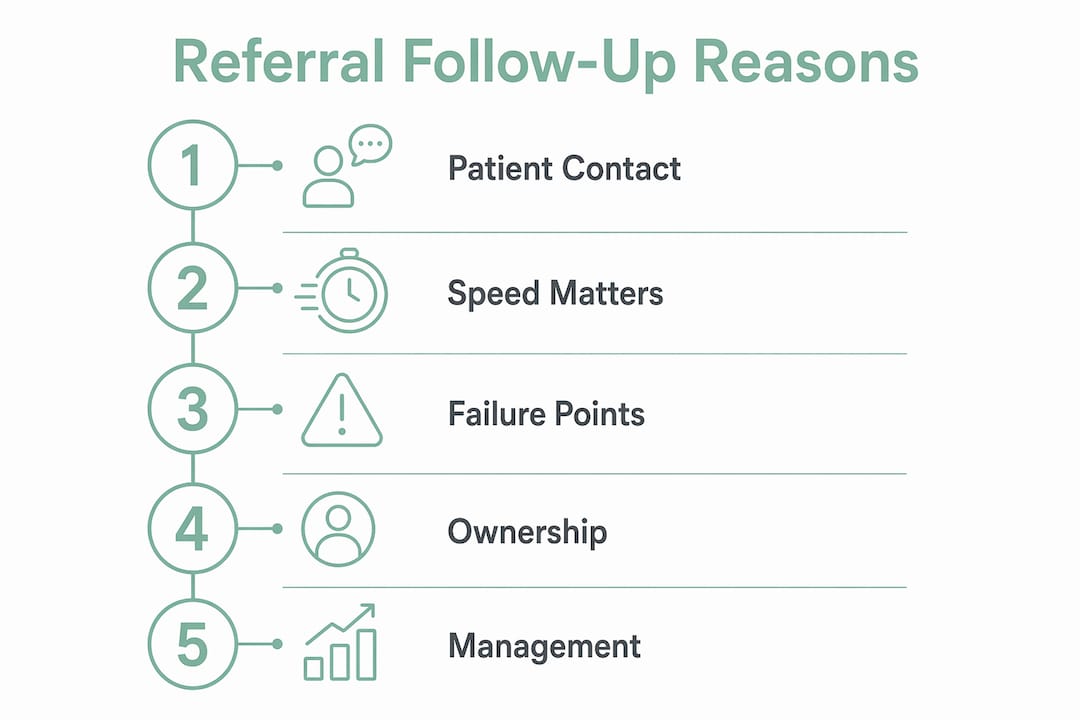
Channel diversity amplifies the effect of speed. Facilities using three or more communication channels, such as SMS, email, and voice calls, achieve referral completion rates above 85%. That compares to an average of 50% for facilities relying on a single outreach method. The combination of speed and channel variety is not additive. It is multiplicative in its effect on patient engagement.
A structured multi-touch outreach sequence gives your team a repeatable framework:
- Hour 0–4: Send an automated SMS notification to the patient confirming the referral and providing specialist contact details.
- Hour 4–24: Follow up with an email containing appointment scheduling instructions and any required pre-visit documentation.
- Day 2: Place a voice call if no scheduling confirmation has been received.
- Day 4: Trigger an escalation alert to the admissions coordinator if the patient remains unscheduled.
- Day 7: Conduct a final outreach attempt and document the outcome in the EHR, closing or escalating the referral accordingly.
Pro Tip: Automate the first two touchpoints in your sequence so your staff focuses human effort on the escalation steps where personal contact makes the biggest difference.
Reducing referral processing delays at the outreach stage directly improves the speed of your first contact, which is where the most completion gains are available. Well-managed practices using this kind of automated multi-channel approach see 85–95% completion rates versus the 50% industry average.
Who owns the referral follow-up process in your facility?
The most common reason referrals fall through is not a technology failure. It is an ownership failure. Most admissions staff view the referral process as ending when the referral request is sent. That assumption leaves the entire follow-up phase unassigned, which means it simply does not happen.

Assigning clear ownership of each referral step within your admissions team is a proven driver of completion rates. When a specific coordinator is accountable for a specific referral from outreach through note receipt, the referral is far less likely to stall. Accountability creates visibility, and visibility creates action.
Proactive provider-owned follow-up consistently outperforms patient-initiated follow-up. Patients who receive a referral and are told to “call the specialist” complete that referral at far lower rates than patients whose care team contacts them directly. The burden of follow-up belongs with the facility, not the patient.
Ownership best practices for your admissions team:
- Assign a named coordinator to every referral at the moment it is created, not after it stalls.
- Define escalation triggers clearly: if no scheduling confirmation arrives within 48 hours, the referral escalates automatically to a supervisor.
- Set a maximum queue age for pending referrals: any referral older than five business days without a status update requires immediate review.
- Document every outreach attempt in the EHR so the full contact history is visible to the entire care team.
- Close the loop formally by confirming receipt of consultation notes and flagging any notes not returned within the agreed timeframe.
Referral partner relationships also depend on this ownership model. Specialists and referring physicians trust facilities that follow through consistently, and that trust translates directly into higher referral volume over time.
What practical strategies improve pending referral management?
Effective referral management systems integrate tracking, outreach, scheduling, and consultation note receipt into a single workflow. Facilities that manage these functions in separate tools, or manually across spreadsheets and fax logs, create the gaps that cause referral loss.
Automated referral tracking gives your team a real-time view of every pending referral and its current status. Dashboard alerts flag referrals that have stalled at any stage, so coordinators can act before a referral ages past the point of recovery. Routine queue reviews, scheduled at least twice weekly, catch the cases that automated alerts miss.
| Approach | Manual Follow-Up | Automated Follow-Up |
|---|---|---|
| First contact speed | Dependent on staff availability | Triggered within minutes of referral creation |
| Channel coverage | Typically one channel | SMS, email, and voice simultaneously |
| Escalation | Reactive, often delayed | Rule-based, triggered by defined criteria |
| Documentation | Inconsistent, prone to gaps | Logged automatically in EHR |
| Completion rate | 18–30% | 70%+ with closed-loop systems |
EMR integration is the foundation of any automated approach. When your referral management system connects directly to your EHR, patient data flows without manual re-entry, reducing both errors and the time your staff spends on administrative tasks. EMR integration with referral workflows also makes it possible to verify insurance eligibility and clinical criteria in real time, so your team knows before outreach whether a patient is likely to be approved for admission.
Pro Tip: Reserve human follow-up effort for the post-contact phase, where a patient has been reached but has not yet scheduled. This is the stage where personal conversation converts more reliably than any automated message.
Referral prioritization strategies help your team direct that human effort toward the referrals with the highest clinical urgency and the greatest likelihood of conversion, rather than treating every pending referral as equally urgent. Healthcare SEO and patient acquisition strategies also depend on a facility’s ability to demonstrate follow-through, since referring physicians track which facilities actually complete the referrals they send.
Failing to confirm patient completion of specialist follow-up steps leaves clinical risk open and directly affects value-based care performance metrics. Payers and accreditation bodies increasingly measure care coordination quality, and referral completion rates are a core data point in those assessments.
Key Takeaways
Consistent referral follow-up is the single most effective action healthcare admissions teams can take to close the gap between referral creation and patient admission.
| Point | Details |
|---|---|
| Follow-up defines completion | Without active follow-up, referral completion rates stay at 18–30% versus 70%+ with closed-loop systems. |
| Speed drives results | Contacting patients within 24 hours of referral creation is the strongest predictor of completion. |
| Multi-channel outreach works | Using three or more channels raises completion rates above 85% compared to the 50% average. |
| Ownership prevents loss | Assigning a named coordinator to each referral step eliminates the most common cause of referral failure. |
| Automation scales the process | Automated tracking, escalation, and EMR integration replace manual gaps with consistent, documented workflows. |
The uncomfortable truth about referral follow-up in healthcare admissions
After years of working with admissions teams across skilled nursing and post-acute care settings, I have seen the same pattern repeat. A facility invests in a referral intake process, trains staff carefully, and then watches occupancy plateau. The intake process is not the problem. The follow-up process is.
The uncomfortable truth is that follow-up is not administration. It is clinical risk management. Every referral that stalls without follow-up is a patient whose condition may worsen while waiting, and a facility that absorbs the financial and reputational cost of an empty bed. Those two consequences are directly connected, and most facilities treat them as separate problems.
The second thing I have learned is that technology solves the wrong part of the problem if it is implemented without ownership clarity. Automated reminders are powerful, but they do not replace the coordinator who calls a hesitant patient and answers their questions about what to expect. The best-performing facilities I have seen combine automation for speed and consistency with human judgment for the moments that require it.
Value-based care contracts are making this more urgent, not less. Payers are measuring care coordination quality, and referral completion is a visible metric. Facilities that treat follow-up as optional are not just losing beds. They are losing contract performance scores that affect reimbursement rates. That is a financial consequence that compounds over time.
— Harry
How Smartadmissions supports your referral follow-up process
Smartadmissions is built specifically for skilled nursing facilities, rehabilitation centers, and post-acute care providers that need to close the gap between referral creation and patient admission.
The platform’s AI-powered referral management tools automate first-contact outreach, track every pending referral in real time, and integrate directly with your existing EMR system. Facilities using Smartadmissions report 60% faster referral processing and 15% higher occupancy compared to manual workflows. You can also explore referral management system examples to see how closed-loop tracking works in practice. If your team is ready to move from reactive to proactive referral management, Smartadmissions gives you the tools to do it without adding administrative burden to your staff.
FAQ
Why follow up on pending referrals in healthcare?
Follow-up on pending referrals prevents referral loss at each stage of the process, from initial contact through consultation note receipt. Without active follow-up, completion rates remain at 18–30%, leaving patients without care and beds unfilled.
What is the most common referral failure point?
The post-contact phase, where a patient has been reached but has not yet scheduled an appointment, is the most frequent failure point. This stage typically requires direct human escalation rather than automated outreach alone.
How quickly should admissions teams contact a referred patient?
Contacting a patient within 24 hours of referral creation is the strongest predictor of referral completion. Delays beyond that window significantly reduce the likelihood that the patient will schedule and attend the appointment.
What channels work best for referral follow-up outreach?
Using three or more channels, specifically SMS, email, and voice calls, raises referral completion rates above 85%. Single-channel outreach averages 50% completion, which means a significant portion of referrals are lost before the patient ever schedules.
How does EMR integration improve referral follow-up?
EMR integration connects referral tracking directly to patient records, eliminating manual data re-entry and enabling real-time eligibility verification. This reduces the administrative gaps that cause referrals to stall and gives coordinators a complete, up-to-date view of every pending case.