
TL;DR:
- Mastering post-acute care terminology is essential for accurate patient placement, risk reduction, and revenue protection.
- Using precise language helps admissions teams ensure patients qualify for coverage while avoiding costly denials and audits.
Post-acute care terminology is defined as the specialized clinical and administrative language used to classify, authorize, and manage patient care services that follow an acute hospital stay. Admissions coordinators and facility administrators who master these terms make faster, more accurate placement decisions. The core settings covered by this language include Skilled Nursing Facilities (SNFs), Inpatient Rehabilitation Facilities (IRFs), Long-Term Acute Care Hospitals (LTACHs), and home health agencies. Between 25% and 40% of hospitalized adults are discharged to one of these settings. That figure represents a significant portion of your daily referral volume, and every misread term in that pipeline carries real clinical and financial risk.
What is post-acute care terminology and why does it matter?
Post-acute care (PAC) is the formal industry term for the continuum of services that support patient recovery after a hospital discharge. The phrase “post-acute care terminology” describes the specific vocabulary that governs how those services are classified, billed, and authorized. Post-acute care accounts for roughly 40% of Medicare’s fee-for-service institutional spending. That scale means a single documentation error or misclassified admission can trigger a coverage denial or a compliance audit.
For admissions coordinators, the stakes are direct. You are the first line of defense against misplacement. When your team speaks the same clinical language as the referring hospital, discharge planners, and insurers, referrals move faster and patients land in the right setting on the first attempt.
What are the main types of post-acute care settings?
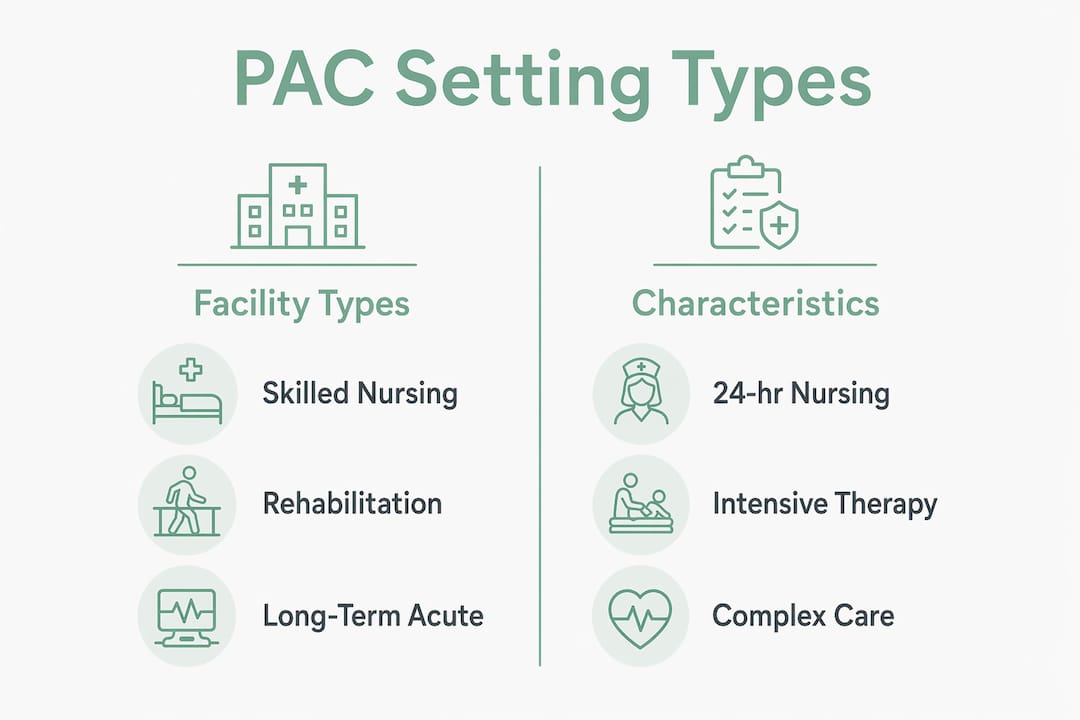
Understanding the types of post-acute care starts with knowing what separates each setting clinically and operationally. The table below maps the four primary environments against their key features.
| Setting | Primary Patient Profile | Therapy Intensity | Typical Payer |
|---|---|---|---|
| Skilled Nursing Facility (SNF) | Post-surgical, medically complex, wound care | Moderate (1–2 hours/day) | Medicare Part A, Medicaid |
| Inpatient Rehabilitation Facility (IRF) | Stroke, TBI, joint replacement | High (3+ hours/day) | Medicare Part A |
| Long-Term Acute Care Hospital (LTACH) | Ventilator-dependent, multi-organ failure | Medical management focus | Medicare Part A |
| Home Health Agency (HHA) | Homebound, lower acuity | Intermittent skilled visits | Medicare Part A/B |
Skilled Nursing Facilities provide 24-hour nursing supervision alongside physical, occupational, and speech therapy. They serve patients who need medical oversight but do not require hospital-level intensity. Learn more about what SNFs serve and who qualifies for admission.
Inpatient Rehabilitation Facilities operate under a strict clinical threshold. IRFs require patients to tolerate at least 3 hours of intensive therapy daily, which is the primary clinical differentiator from SNFs. Patients who cannot meet that threshold on admission are not appropriate IRF candidates, regardless of diagnosis.
Long-Term Acute Care Hospitals serve the most medically complex patients, including those on mechanical ventilation or with multi-system organ failure. Average LTACH stays exceed 25 days. Home Health Agencies provide intermittent skilled nursing or therapy visits to patients who are homebound and require lower-intensity care.
Pro Tip: When evaluating a referral for IRF placement, document the patient’s demonstrated tolerance for therapy in the acute setting, not just the physician’s expectation. Medicare auditors look for evidence of actual performance, not projected capacity.
How do clinical criteria and insurance rules affect PAC placement?
Clinical eligibility and insurance authorization rules are inseparable in post-acute care. The terms that govern coverage directly shape which patients your facility can accept and how you document their needs.

Skilled care vs. custodial care
The distinction between skilled and custodial care is the primary driver for insurance authorization. Skilled care requires active medical intervention delivered by a licensed professional, such as a registered nurse administering IV antibiotics or a physical therapist performing gait training after a hip fracture. Custodial care covers assistance with activities of daily living, such as bathing or dressing, and does not qualify for Medicare Part A reimbursement on its own. Admissions staff must document the specific skilled service being provided, not just the patient’s diagnosis.
Medicare’s 3-day hospital stay rule
Medicare’s 3-day inpatient hospitalization rule requires at least three consecutive inpatient days before SNF coverage activates. Observation days do not count toward that threshold. This is one of the most consequential distinctions in post-acute care language. A patient who spent two days under observation status and one day as an inpatient does not qualify for Medicare Part A SNF coverage, even if the clinical need is clear.
The table below summarizes the key eligibility criteria your team should verify on every referral.
| Criteria | Rule | Common Pitfall |
|---|---|---|
| Medicare SNF Coverage | 3 consecutive inpatient days required | Observation days excluded from count |
| IRF Admission | 3+ hours of therapy tolerance per day | Projecting tolerance without documented evidence |
| Skilled Care Authorization | Licensed professional intervention required | Documenting diagnosis only, not the skilled service |
| LTACH Qualification | Average length of stay exceeds 25 days | Admitting patients who will discharge too quickly |
Pro Tip: Request the hospital’s admission status documentation on every referral before conducting your clinical review. Catching an observation-only stay at the referral stage prevents a coverage denial after admission.
Admissions staff must carefully document skilled care needs, such as wound care or IV therapy, to prevent insurer denials that often result from diagnosis-only categorization. Mastering patient eligibility criteria is the most direct path to reducing authorization delays and protecting your facility’s revenue.
What are the most common post-acute care terminology mistakes?
Terminology errors in post-acute care admissions create downstream problems that range from inappropriate placement to regulatory penalties. Misunderstandings in post-acute terminology often lead to passive discharge planning and inappropriate placement, increasing the risk of poor outcomes and readmissions. Knowing where your team is most likely to go wrong is the first step toward preventing those errors.
Subacute vs. post-acute: not the same thing
Subacute and post-acute care terms are often used interchangeably, but they describe different levels of intensity. Post-acute care is the broad category covering all recovery services after hospital discharge. Subacute care refers to a higher-intensity level within that category, typically delivered in an SNF with more specialized services such as complex wound management, tracheostomy care, or oncology support. Using these terms as synonyms in documentation can misrepresent the level of care being provided and trigger payer scrutiny.
Common terminology pitfalls in admissions
- Confusing observation status with inpatient status. Observation is an outpatient billing classification. It does not satisfy Medicare’s 3-day rule for SNF coverage.
- Applying the IRF 3-hour rule loosely. The 3-hour therapy rule for IRFs is strictly enforced by Medicare audits. Facilities that admit patients who cannot meet the threshold face financial and compliance penalties.
- Documenting custodial needs as skilled care. Listing assistance with activities of daily living without identifying a licensed professional’s clinical intervention will result in denial.
- Misclassifying subacute patients as standard SNF admissions. Subacute patients require higher staffing ratios and specialized equipment. Admitting them without the right resources creates both clinical and liability risk.
- Overlooking goals-of-care alignment. Post-acute care admissions are a critical window for prognosis discussions. Skipping this step leads to misaligned expectations and premature discharges.
The primary clinical differentiator between post-acute rehabilitation and long-term custodial care is the expectation of measurable improvement versus maintenance of stability. When your documentation does not reflect that distinction, payers will default to the lower-coverage classification.
How can admissions teams apply PAC language to improve intake?
Applying post-acute care definitions correctly at the point of referral review reduces errors, speeds up intake, and protects your facility from audit exposure. The following steps give your team a repeatable process for every referral.
- Verify inpatient admission status first. Confirm the patient has three consecutive inpatient days before proceeding with SNF referral review. Pull the hospital’s admission documentation, not just the referral summary.
- Identify the skilled service, not just the diagnosis. Document the specific licensed intervention required, such as daily wound debridement or IV antibiotic administration, to establish Medicare eligibility.
- Assess therapy tolerance for IRF or subacute referrals. Review therapy notes from the acute stay to confirm the patient demonstrated the ability to participate in the required intensity of treatment.
- Align placement with goals of care. Proactive advocacy for correct post-acute placement significantly improves outcomes and reduces readmissions, especially under insurance restrictions. Confirm that the patient and family understand the setting’s purpose and expected trajectory.
- Use referral management technology to flag eligibility gaps. Platforms that integrate with EMR systems and insurance portals can surface observation status flags, missing documentation, and eligibility mismatches in real time, before a bed is committed.
Hospital clinicians often lack deep knowledge of post-acute facility capabilities, which limits discharge planning effectiveness. Your admissions team fills that gap. When you communicate clearly using precise PAC language, you become a trusted partner in the discharge process rather than a passive recipient of referrals. Review the 7 post-acute care process steps to build a structured intake workflow your team can follow consistently.
Key takeaways
Mastering post-acute care terminology is the single most effective way for admissions coordinators and facility administrators to reduce placement errors, protect revenue, and improve patient outcomes.
| Point | Details |
|---|---|
| Define the setting correctly | SNFs, IRFs, LTACHs, and HHAs each have distinct clinical thresholds that determine appropriate patient placement. |
| Verify inpatient status early | Medicare’s 3-day rule excludes observation days; confirm status before accepting any SNF referral. |
| Document skilled services, not diagnoses | Authorization requires evidence of licensed professional intervention, not just a clinical condition. |
| Distinguish subacute from post-acute | Subacute care implies higher intensity and specialized services; using the terms interchangeably creates payer risk. |
| Use technology to close eligibility gaps | EMR-integrated referral platforms surface documentation errors and eligibility mismatches before admission. |
Why terminology mastery is the admissions team’s sharpest tool
I have worked alongside admissions teams at skilled nursing facilities and rehabilitation centers long enough to see the same pattern repeat itself. A referral arrives, the coordinator reviews the diagnosis, the bed gets committed, and three weeks later the facility is fighting a Medicare denial because nobody caught that the patient was under observation status the entire hospital stay. The clinical team did everything right. The documentation error happened at the intake stage, and it cost the facility thousands of dollars.
The uncomfortable truth is that most admissions errors are not clinical failures. They are terminology failures. When your team does not know the precise difference between skilled and custodial care, or treats “subacute” and “post-acute” as interchangeable labels, the consequences show up in your denial rate and your audit history.
What I have found actually works is treating post-acute care language as a core competency, not background knowledge. Facilities that invest in structured terminology training for their admissions staff, and back that training with technology that flags eligibility issues in real time, consistently outperform those that rely on experience alone. The data analytics available through modern admissions platforms make it possible to track where terminology errors cluster in your intake process and address them systematically.
The goal is not just faster admissions. It is accurate admissions. Speed without accuracy creates readmissions, denials, and compliance risk. Accuracy built on solid terminology knowledge creates the kind of intake process that referring hospitals trust and patients benefit from.
— Harry
How Smartadmissions helps your team handle PAC complexity
Understanding post-acute care language is one part of the equation. Applying it consistently across every referral, every shift, and every payer type is where most facilities struggle.
Smartadmissions is built specifically for skilled nursing facilities, rehabilitation centers, and post-acute care providers. Its AI-powered referral management assistant integrates with your existing EMR and insurance portals to verify patient eligibility, flag observation status issues, and surface documentation gaps before a bed is committed. Your team spends less time chasing records and more time making accurate placement decisions. Explore referral management systems that reduce intake errors and improve bed fill rates, or review referral documentation best practices to strengthen your team’s intake process today.
FAQ
What is post-acute care terminology?
Post-acute care terminology is the clinical and administrative language used to classify, authorize, and manage recovery services after a hospital stay, including terms like SNF, IRF, LTACH, skilled care, and custodial care.
What is the difference between skilled care and custodial care?
Skilled care requires active intervention by a licensed professional, such as a nurse or therapist, while custodial care covers assistance with daily activities and does not qualify for Medicare Part A reimbursement on its own.
Do observation days count toward medicare’s 3-day SNF rule?
No. Medicare requires three consecutive inpatient days for SNF coverage to activate. Observation days are classified as outpatient and do not count toward that threshold.
What is the IRF 3-hour therapy rule?
Inpatient Rehabilitation Facilities require patients to tolerate at least three hours of intensive therapy per day. Medicare audits enforce this threshold strictly, and facilities that admit patients who cannot meet it face financial and compliance penalties.
What is the difference between subacute and post-acute care?
Post-acute care is the broad category covering all recovery services after hospital discharge. Subacute care refers to a higher-intensity level within that category, requiring more specialized services and staffing than a standard SNF admission.