
TL;DR:
- Prospective referral management is a strategic, pipeline-oriented process that tracks and converts patient referrals from initial contact to admission. Using automation and real-time analytics, facilities can improve response times, reduce errors, and strengthen referral relationships for better occupancy and revenue stability. High-performing organizations prioritize timely communication, technology integration, and executive ownership to sustain continuous improvement and competitive advantage.
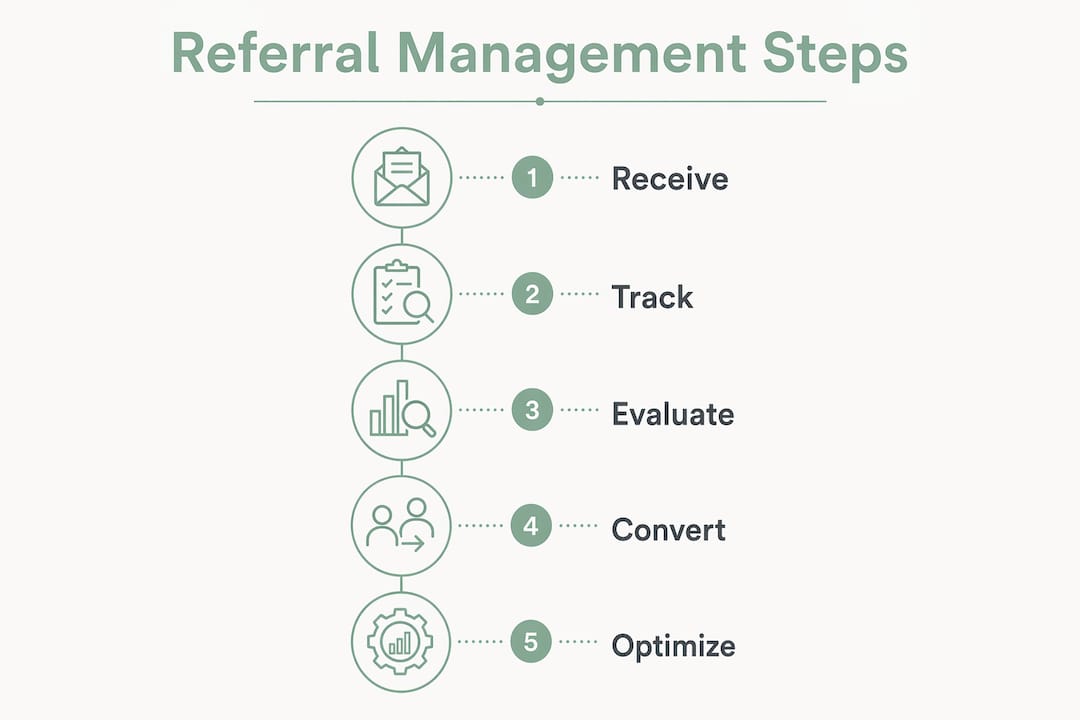
Prospective referral management is defined as the systematic process healthcare organizations use to receive, track, evaluate, and convert incoming patient referrals from initial contact through admission and post-admission follow-up. The term “prospective” signals that this process is forward-looking. Your team actively manages each referral as a live opportunity rather than a passive administrative record. Platforms like Behave Health and tools built into modern EHR systems have formalized this approach, giving admissions teams measurable pipelines, conversion benchmarks, and relationship data. For skilled nursing facilities, rehabilitation centers, and post-acute care providers, a well-run prospective referral process is the difference between a full census and preventable vacancy.

What is prospective referral management and how does it work?
Prospective referral management is the organized workflow that moves a patient from referral receipt to confirmed admission. It covers every step between a hospital discharge planner calling your facility and a patient arriving at your door. The process is not linear in practice. It requires parallel tracks of clinical review, insurance verification, and relationship communication running at the same time.
The core workflow includes eight distinct steps:
- Referral creation. A referral source, such as a hospital, physician office, or managed care organization, submits patient information to your facility.
- Insurance and eligibility verification. Your admissions team confirms payer coverage, authorization requirements, and benefit limits before accepting the referral.
- Clinical assessment. A nurse or admissions coordinator reviews the patient’s diagnosis, acuity level, and care needs against your facility’s capabilities.
- Specialist or bed matching. The patient is matched to an available bed, care program, or specialist based on clinical fit.
- Patient and family notification. Your team contacts the patient or family to confirm the placement, explain next steps, and address questions.
- Scheduling and pre-visit preparation. Admission date, transport, and documentation requirements are confirmed in advance.
- Completion tracking. Your team monitors whether the patient actually arrives and completes the admission.
- Closed-loop communication. Your facility reports the admission outcome back to the referring source, closing the communication loop.
Referral coordinators and physician liaisons manage this workflow daily. Physician liaisons identify and resolve scheduling bottlenecks, which directly improves patient volume and referral source satisfaction. CRM platforms and dedicated referral management systems provide the tracking layer that keeps every step visible and accountable.
Pro Tip: Automating insurance verification and data entry at step two reduces manual errors and cuts intake processing time significantly. Facilities using integrated e-referral systems report duplicate entry reductions of 70–90% and referral handoff completion rates above 95%.

Using source-specific referral playbooks also improves triage speed. An emergency transfer from a hospital requires a different response protocol than a planned specialist referral from a primary care physician. Documenting those differences and training your team on them is a referral management best practice that most facilities overlook until they experience a costly delay.
What metrics define success in referral management?
Performance measurement is what separates facilities that manage referrals from those that simply receive them. The right metrics give your team a clear picture of where referrals are being won, lost, or delayed.
| Metric | Benchmark | What It Tells You |
|---|---|---|
| Inquiry-to-admission conversion rate | 25–35% overall | Measures how effectively your team converts referrals into actual admissions |
| Top-source conversion rate | 40%+ | Identifies your highest-value referral relationships for prioritized attention |
| Partner acknowledgment time | Within 1 hour | Tracks responsiveness to referring partners, a key relationship signal |
| Initial patient contact time | Within 24 hours | Measures speed of patient outreach after referral receipt |
| Referral handoff completion rate | Above 95% with automation | Confirms that accepted referrals result in completed admissions |
High-performing organizations achieve inquiry-to-admission conversion rates of 25–35%, with top-tier referral sources yielding 40% or higher. That gap between average and top performance is almost always explained by relationship quality and response speed, not clinical capacity.
Industry best practices call for acknowledging referral partners within 1 hour and completing the transition from referral to first patient contact within 24 hours. These are not aspirational targets. They are the minimum standards that high-volume referral sources expect before they will consistently send patients your way.
Referral leakage is the metric most facilities undertrack. Leakage occurs when a referred patient ends up at a competing facility because your team was too slow, unresponsive, or unable to verify coverage in time. Segmenting referral data by diagnosis, demographics, and service line reveals exactly where leakage is happening and which service lines need targeted improvement.
Pro Tip: Maintain a dedicated referral source database that includes conversion history, preferred communication channels, and assigned internal ownership. This database protects your referral pipeline when staff turns over, which is a constant reality in post-acute care.
What challenges do healthcare organizations face in referral management?
The most common and costly mistake in referral management is treating it as a back-office administrative function. Organizations that treat referral management strategically, with executive sponsorship and accountable teams, consistently outperform those that assign it to whoever has spare capacity.
The core challenges your facility likely faces include:
- No closed-loop communication. Failing to report admission outcomes back to referring sources risks losing those relationships permanently to competitors. Referral sources need confirmation that their patients arrived and received care.
- Fragmented workflows. When clinical review, insurance verification, and scheduling happen in separate systems with no integration, delays compound at every handoff. A referral that should take two hours to process ends up taking two days.
- Manual data entry. Retyping patient information from fax or phone into your system introduces errors and slows intake. It also burns out your admissions staff on work that adds no clinical value.
- No executive accountability. When no one at the leadership level owns referral conversion rates, the metric never improves. Referral management requires the same executive attention as occupancy rates and revenue cycle performance.
- Reactive rather than proactive relationship management. Many facilities only contact referral sources when they have a problem. Proactive outreach, regular check-ins, and performance reporting build the trust that generates consistent referral volume.
Addressing these challenges requires two parallel investments. First, your team needs dedicated referral relationship management roles, whether that is a physician liaison, a referral coordinator, or a business development manager. Second, your facility needs technology that automates the repetitive steps so your staff can focus on the relationship work that technology cannot replace. Exploring referral prioritization strategies gives your team a structured framework for deciding which referrals to act on first when volume is high.
How do technology and analytics improve referral outcomes?
Technology does not replace good referral management. It makes good referral management scalable. The right platform gives your team real-time visibility into every referral in the pipeline, automates the steps that do not require human judgment, and surfaces the data your leadership needs to make strategic decisions.
| Capability | Manual Approach | Technology-Enabled Approach |
|---|---|---|
| Insurance verification | Staff calls payer manually, 30–60 minutes per case | Automated eligibility check via EHR integration, results in minutes |
| Referral tracking | Spreadsheet or whiteboard, updated inconsistently | Real-time dashboard with status, owner, and next action |
| Closed-loop communication | Staff remembers to call back, or does not | Automated notification sent to referral source upon admission |
| Referral source analytics | Anecdotal knowledge of top sources | Data-segmented reports by source, diagnosis, and conversion rate |
| Patient outreach | Phone calls scheduled manually | Automated outreach triggered by referral status changes |
EHR integration facilitates quick sharing of patient records and referral data, reducing delays and improving care coordination across the admission process. Platforms built on FHIR and HL7 standards connect your referral workflow directly to clinical documentation, eliminating the duplicate entry that slows intake.
Physician Relationship Management tools, commonly called PRM systems, extend CRM functionality specifically for healthcare referral sources. They track communication history, flag sources that have gone quiet, and give your business development team a structured way to manage dozens of referral relationships simultaneously.
AI-powered tools go further by automating insurance verification, generating patient outreach messages, and flagging referrals at risk of leakage based on response time patterns. Behave Health’s referral management platform is one example of an integrated solution that combines these capabilities for behavioral health and post-acute providers. Understanding the role of technology in referral management helps your team evaluate which capabilities matter most for your facility’s specific referral mix.
Referral analytics must be formalized and persistent to drive continuous improvement and earn executive attention. A one-time report does not change behavior. A monthly dashboard that your leadership reviews in operations meetings does.
Key takeaways
Prospective referral management is a strategic, data-driven process that directly determines your facility’s census stability, revenue predictability, and referral source relationships.
| Point | Details |
|---|---|
| Definition is forward-looking | Prospective referral management tracks each referral as a live opportunity from receipt through admission and follow-up. |
| Conversion benchmarks matter | Top-performing facilities achieve 40%+ conversion from their best sources; the average range is 25–35%. |
| Speed is a relationship signal | Acknowledging partners within 1 hour and contacting patients within 24 hours are the minimum standards referral sources expect. |
| Technology scales good process | EHR integration and automation reduce duplicate entry by 70–90% and push handoff completion rates above 95%. |
| Strategic ownership drives results | Facilities with executive sponsorship and accountable referral teams consistently outperform those treating it as back-office work. |
Why referral management deserves a seat at the strategy table
I have worked with enough healthcare administrators to know that referral management is almost always underfunded relative to its impact on revenue. Facilities will invest heavily in clinical staff, building upgrades, and marketing materials, then assign referral tracking to a coordinator who is also handling admissions paperwork and answering phones.
The data tells a different story. The gap between a 25% conversion rate and a 40% conversion rate from your top referral sources is not a clinical gap. It is a process and relationship gap. That gap represents real beds that could be filled and real revenue that is going to a competitor who responds faster and communicates more consistently.
What I find most underappreciated is the compounding effect of closed-loop communication. When your facility consistently reports back to referral sources, those sources trust you with their most complex patients. Complex patients often have longer lengths of stay and higher reimbursement rates. The facilities that build that trust do not just fill beds faster. They fill the right beds with the right patients.
My recommendation is direct: assign a named owner to referral management at the director level or above, set a 90-day target for response time compliance, and invest in a platform that gives your team real-time pipeline visibility. The return on that investment shows up in your census within one quarter. You can also review ways to reduce referral times for specific tactics your team can implement immediately.
— Harry
See referral management systems that drive real results
Your facility’s referral process is only as strong as the tools and workflows behind it. The right referral management software gives your admissions team real-time tracking, automated insurance verification, EHR integration, and the analytics your leadership needs to make confident decisions.
Smartadmissions is built specifically for skilled nursing facilities, rehabilitation centers, and post-acute care providers that need to move faster without adding administrative burden to already stretched teams. If you are evaluating your options, start with a review of 7 referral management systems that healthcare facilities are using to improve efficiency and fill rates in 2026. You can also compare manual vs. automated admissions to see exactly where automation delivers the greatest operational gains for your team.
FAQ
What is prospective referral management in healthcare?
Prospective referral management is the structured process of receiving, tracking, evaluating, and converting incoming patient referrals from initial contact through confirmed admission. It treats each referral as an active opportunity with defined steps, owners, and performance benchmarks.
What is the difference between referral management and prospective referral management?
Referral management is the broad term for handling patient referrals. Prospective referral management specifically emphasizes the forward-looking, pipeline-oriented approach where each referral is actively managed toward conversion rather than simply processed and filed.
What is a good inquiry-to-admission conversion rate for referrals?
High-performing healthcare organizations achieve inquiry-to-admission rates of 25–35% overall, with top referral sources converting at 40% or higher. Rates below 20% typically indicate process gaps in response time or insurance verification.
How does technology improve the prospective referral process?
Integrated e-referral systems reduce duplicate data entry by 70–90% and push referral handoff completion rates above 95%. EHR integration, automated eligibility checks, and real-time dashboards give admissions teams the speed and visibility needed to compete for high-value referrals.
What is closed-loop communication in referral management?
Closed-loop communication means your facility notifies the referring source of the admission outcome after a patient is placed. Failing to close this loop risks losing the referral relationship permanently, as sources need confirmation that their patients received care.