
TL;DR:
- Managing patient intake volumes effectively requires structured triage, automated workflows, and clear service agreements to ensure timely care. Implementing a tiered triage model, leveraging automation platforms, and setting measurable SLAs helps optimize staffing and reduce burnout in skilled nursing and rehabilitation facilities. Regular staff training and proper software tools further improve efficiency and control over referral management processes.
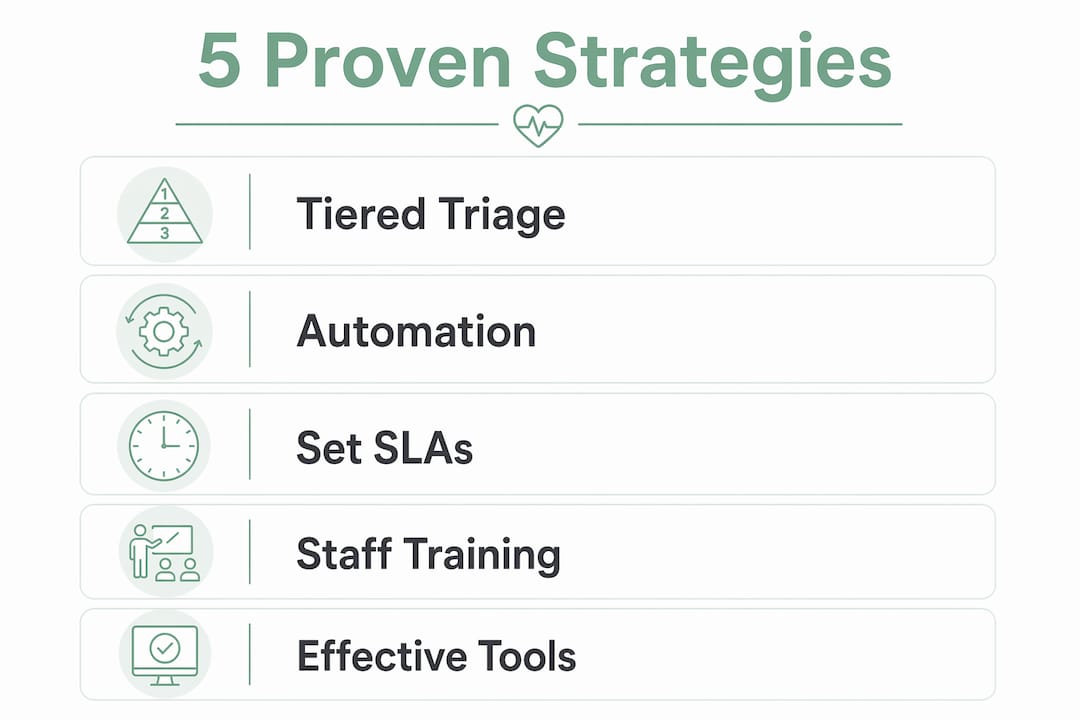
Managing intake volumes is the process of balancing patient admissions efficiently by using structured triage, automated workflows, and clear service agreements to deliver timely, consistent care. For healthcare administrators and admissions managers in skilled nursing facilities and rehabilitation centers, getting this right is not optional. Uncontrolled intake volume creates staff burnout, delayed bed occupancy, and lost revenue. This guide covers five validated strategies for how to manage intake volumes in 2026, drawing on tiered triage models, automation platforms like Smartadmissions, and standardized service level agreements (SLAs) that leading post-acute care facilities use today.
How to manage intake volumes with a tiered triage model
A tiered intake triage model is the most direct method for controlling patient intake volume at scale. It works by categorizing every incoming referral into one of three priority levels, then assigning the right resources and response times to each tier. This prevents your highest-complexity cases from competing for the same staff attention as routine referrals.
Here is how the three tiers typically operate in a skilled nursing or rehabilitation setting:
- Tier 1 (Urgent): High-acuity patients requiring immediate clinical review and bed placement. These cases receive same-day contact and a dedicated admissions coordinator.
- Tier 2 (Standard): Referrals that meet clinical criteria but have flexible placement timelines. These cases follow SLA-driven workflows with a target first contact within 48 hours.
- Tier 3 (Low-touch): Inquiries that do not meet current admission criteria. These are routed to automated referral responses or community resource lists, freeing staff for higher-priority work.
The 3-tier triage approach balances workload and preserves staff capacity during volume spikes. Tier 3 automation alone can remove a significant portion of low-value inquiries from your team’s daily queue.
Pro Tip: Assign a rotating daily triage lead who owns tier classification decisions. This single role reduces context switching for the rest of your team and protects intake quality when referral volume surges unexpectedly.

Implementing this model with a 48-hour first-contact goal within a 60-day rollout period is a recognized benchmark for balancing volume and quality. Facilities that hit this benchmark report measurable reductions in staff burnout within the first quarter.
What role does automation play in managing intake levels?
Automation is the fastest lever available for reducing the manual labor burden in your admissions workflow. Manual record checks for completeness typically consume 15 to 40 minutes per inquiry. Automation reduces that same task to seconds. The cumulative effect across a high-volume facility is significant.
Automated intake workflows can reduce operational cycle times by up to 50%. That is not a marginal efficiency gain. It means your team can process twice the referral volume without adding headcount, or maintain current volume with fewer errors and less overtime.
Key software features that support volume control in healthcare admissions include:
- Smart intake forms with conditional logic that collect only the data required for each referral type, reducing incomplete submissions
- AI-powered triage routing that classifies referrals by acuity and directs them to the correct tier automatically
- EMR integration using FHIR and HL7 standards to eliminate duplicate data entry between your referral management system and your electronic health record
- Real-time eligibility verification that confirms insurance coverage before a bed is committed, reducing downstream denials
| Feature | Manual process | Automated process |
|---|---|---|
| Record completeness check | 15–40 minutes per referral | Under 60 seconds |
| Insurance eligibility verification | 1–2 business days | Real-time |
| Referral routing to coordinator | Manual assignment | Automatic by tier |
| Documentation filing | Staff-dependent | System-generated |
Pro Tip: Before deploying any automation platform, audit your current manual workflow step by step. Automating flawed processes only accelerates mistakes. Fix bottlenecks like manual data re-entry first, then automate the corrected process.
Smartadmissions is built specifically for this environment. Its AI-powered referral management assistant integrates with existing EMR systems and insurance portals, giving your team real-time data without switching between platforms. You can explore automated patient intake strategies in more detail to see how facilities like yours have reduced review times significantly.
How to set and measure SLAs to control intake volume
Service level agreements are the operational backbone of any intake volume strategy. An SLA defines exactly what your team commits to doing, and by when, for every referral that enters your system. Without SLAs, intake volume management is reactive. With them, it becomes predictable.
Leading organizations in 2026 use a three-stage SLA structure for patient referrals:
- Initial contact: Attempt first outreach within 5 minutes of referral receipt during business hours. Standardized contact SLAs at this speed significantly increase the rate of successful qualification.
- Secondary outreach: If the first contact attempt is unsuccessful, follow up within 1 hour using an alternate contact method or referral source.
- Nurture workflow: For referrals that remain unresponsive after initial attempts, activate a structured 30-day follow-up sequence to maintain the relationship and capture future placement opportunities.
The metrics your team should track to measure SLA performance include:
- Time-to-first-contact: The minutes or hours between referral receipt and first outreach attempt
- Queue size by tier: The number of open referrals in each triage tier at any given time
- Rework rate: The percentage of referrals requiring additional data collection due to incomplete initial submissions
- Disposition timeframe: The average time from referral receipt to a final admission or decline decision
| SLA metric | Target benchmark | Review frequency |
|---|---|---|
| Time-to-first-contact | Under 5 minutes (Tier 1) | Daily |
| Tier 2 first contact | Within 48 hours | Daily |
| Rework rate | Below 10% | Weekly |
| Disposition timeframe | Under 72 hours | Weekly |
Tracking these metrics inside your intake platform, rather than in spreadsheets, gives you a live view of where volume is building and where your SLAs are at risk.
Best practices for staff training under volume pressure
Standardized staff training is what separates a team that scales with volume from one that breaks under it. The core principle is simple: every team member must handle every inquiry using identical criteria and scripts. Deviation creates what operations managers call the variability tax, the hidden cost of inconsistent intake handling that compounds during high-volume periods.
Practical training standards for admissions teams in skilled nursing and rehabilitation settings include:
- Scripted intake interactions: Short, structured scripts for initial contact reduce cognitive load and protect data quality during surges. Short scripted intake interactions improve consistency and allow better automation downstream.
- Defined role boundaries per tier: Each team member should know exactly which tier they own during a given shift. Ambiguity about responsibility is the primary cause of referral delays.
- Rotation schedules: Rotating staff through triage lead responsibilities prevents burnout and builds cross-functional knowledge across your admissions team.
- Regular calibration sessions: Brief weekly reviews where the team compares how they classified the same referral type catches drift before it becomes a pattern.
Pro Tip: Log every intake request in your system, even the ones you decline. Structured data logging creates a defensible record that you can use to advocate for additional staff or technology resources with hard numbers rather than anecdotal complaints.
One counterintuitive reality of intake volume management is that more volume does not always equal more revenue. Saying no to low-value inquiries is critical to maintaining capacity for high-impact cases. Training your team to recognize and decline poor-fit referrals quickly is as valuable as training them to process good ones fast.
What tools support effective intake volume strategies?
The right software infrastructure makes every other strategy in this article easier to execute. Below is a comparison of the core tool categories your facility needs to manage intake volumes at scale.
| Tool category | Core function | Key requirement |
|---|---|---|
| Referral management platform | Centralize and route all incoming referrals | EMR integration via FHIR/HL7 |
| Intake workflow automation | Automate form collection, routing, and documentation | Conditional logic and AI triage |
| SLA tracking dashboard | Monitor time-to-contact and queue metrics in real time | Configurable alerts and reporting |
| Eligibility verification | Confirm insurance coverage before bed commitment | Real-time payer portal integration |
| Clinical assessment tools | Support admissions decisions with structured clinical data | Integration with existing EHR systems |
Smartadmissions covers all five categories within a single platform designed for skilled nursing facilities and post-acute care providers. Its workflow automation for admissions connects referral management, eligibility verification, and clinical documentation in one place. For facilities evaluating their options, reviewing the top referral management tools for 2026 is a practical starting point.
The non-negotiable requirements for any intake software in this setting are HIPAA compliance, real-time EMR integration, and configurable SLA alerts. Platforms that require manual data export between systems will not reduce your team’s workload. They will redistribute it.
Key takeaways
Effective intake volume management requires a tiered triage model, automated workflows, and measurable SLAs working together as a unified system rather than isolated fixes.
| Point | Details |
|---|---|
| Tiered triage reduces overload | A 3-tier model routes urgent, standard, and low-touch referrals to the right resources automatically. |
| Automation cuts cycle time | Automated workflows reduce operational cycle times by up to 50%, freeing staff for complex cases. |
| SLAs create predictability | Standardized contact SLAs, starting with a 5-minute first-contact target, keep intake volume manageable. |
| Training prevents variability | Scripted, standardized intake handling eliminates the variability tax during high-volume periods. |
| Data logging builds the case | Logging every request gives you hard numbers to justify additional staff or technology investment. |
Why I stopped treating intake volume as a staffing problem
The most common mistake I see healthcare administrators make is treating intake volume as a headcount problem. When referrals pile up, the instinct is to add staff. That instinct is understandable, but it is usually wrong.
In my experience, the real problem is almost always structural. The intake process has no triage logic, no SLAs, and no automation. Every referral gets the same level of attention regardless of acuity or fit. The result is that your best coordinators spend equal time on a Tier 1 urgent placement and a Tier 3 inquiry that should have been declined in 90 seconds.
The process audit step is where most facilities skip ahead. They see automation as the solution and implement it before fixing the underlying workflow. That approach accelerates the existing inefficiency rather than removing it. I have seen facilities automate a broken intake form and then wonder why their rework rate went up after implementation.
The shift that actually works is treating intake volume management as permanent infrastructure, not a crisis response. You build the triage model, set the SLAs, train to the scripts, and then measure weekly. The system improves over time because you have data. Without that structure, you are managing by feel, and volume spikes will always feel like emergencies.
— Harry
How Smartadmissions helps you take control of intake volume
Managing referral volume at scale requires more than good intentions. It requires a platform built for the specific demands of skilled nursing and rehabilitation admissions.
Smartadmissions gives your team a single platform for referral management, automated intake workflows, real-time eligibility verification, and EMR integration. Facilities using Smartadmissions report faster bed occupancy and significant reductions in manual data entry. The platform’s AI-powered triage assistant routes referrals by acuity automatically, so your coordinators focus on decisions rather than data entry. If you are ready to move from reactive volume management to a structured, measurable system, explore how Smartadmissions supports intake workflow optimization for skilled nursing facilities like yours.
FAQ
What is the fastest way to reduce intake volume backlog?
Implement a tiered triage model immediately to separate urgent cases from low-touch referrals. Routing Tier 3 inquiries to automated responses removes a large portion of low-value work from your team’s queue within days.
How do SLAs help with managing intake levels?
SLAs define specific response time targets for each stage of the referral process, turning reactive intake handling into a predictable, measurable system. A 5-minute first-contact SLA for Tier 1 referrals is a recognized 2026 benchmark.
What metrics should I track to measure intake efficiency?
Track time-to-first-contact, queue size by tier, rework rate, and disposition timeframe. Reviewing these metrics weekly gives you early warning when volume is building beyond your team’s capacity.
Should I automate intake before fixing my current process?
No. Audit and correct your manual workflow before deploying automation. Automating a flawed process accelerates mistakes rather than eliminating them, which increases rework and reduces the return on your technology investment.
How does EMR integration support intake volume management?
EMR integration via FHIR and HL7 standards eliminates duplicate data entry between your referral management platform and your electronic health record. This reduces the time per referral from minutes to seconds and cuts the documentation errors that create downstream rework.