
TL;DR:
- A referral packet is an organized set of patient documents sent from a referring provider to support admission decisions. It includes core items like clinical notes, diagnostic reports, and a summary page to ensure quick review and regulatory compliance. Properly structured digital workflows can significantly reduce admission delays and improve bed occupancy in skilled nursing facilities.
A referral packet is a standardized collection of critical patient documents sent from a referring provider to a receiving facility to support timely admission decisions. In skilled nursing facility admissions, the referral packet serves as the primary vehicle for transferring clinical and administrative data before a patient arrives. Without a complete packet, your admissions team cannot verify insurance, confirm clinical necessity, or allocate a bed with confidence. Getting this document set right is the single most controllable factor in reducing admission delays.
What is a referral packet and why does it matter?
A referral packet is defined as an organized set of patient records, clinical notes, and administrative documents assembled by the referring provider and delivered to the receiving facility at the point of referral. The industry also refers to this as a “referral documentation package” or “admission referral bundle,” though referral packet is the most widely used term in post-acute care settings. Its core purpose is to give your admissions team everything they need to make an informed accept-or-decline decision without requesting additional records.
Referral packets form the primary documentation to establish clinical necessity, scope of care, and urgency. That function directly affects how quickly your facility can allocate resources and begin care planning. A well-constructed packet removes guesswork from the intake process and protects your facility from regulatory gaps caused by missing documentation.
The importance of a referral packet extends beyond speed. Standardized packets reduce the back-and-forth communication that drains your admissions staff’s time. They also create a consistent audit trail that supports compliance with HIPAA requirements and payer documentation standards.

What are the essential components of a referral packet?
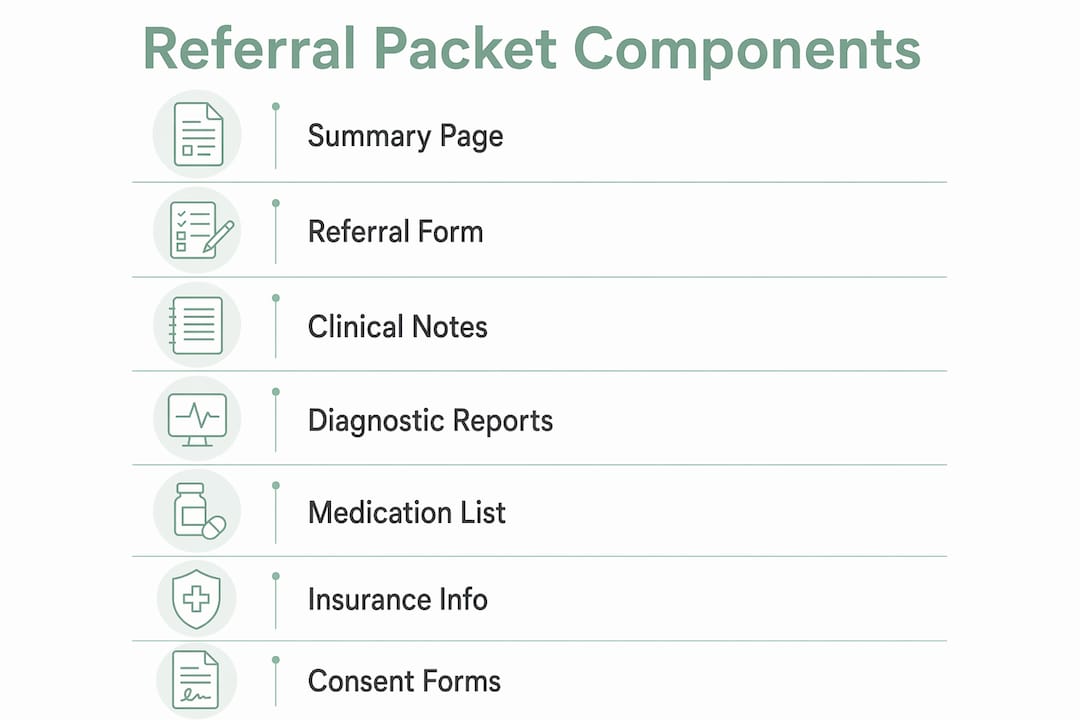
A complete referral packet must include a minimum of three core documents: a detailed referral form, the most recent clinical visit note, and relevant diagnostic reports. All three elements represent the recognized minimum standard for a successful referral submission. Missing any one of them forces your team to chase records, which delays the admission and risks losing the bed to another facility.
Beyond the core three, a thorough packet includes the following elements:
- Patient demographics: Full legal name, date of birth, address, and emergency contact information
- Insurance and payer information: Medicare or Medicaid ID, secondary payer details, and prior authorization status
- Clinical findings: Diagnosis codes (ICD-10), current medications, allergy list, and functional status scores
- Urgency indicators: Discharge date from the referring hospital, physician orders, and level-of-care designation
- HIPAA authorization: Signed release forms permitting information transfer between providers
- Documentation summary page: A front page listing every attachment and the referring provider’s contact information
The documentation summary page deserves special attention. Including a summary page with contact details and an attachment listing reduces lost or incomplete packets and speeds up follow-up when pages go missing. Think of it as a table of contents that lets your intake coordinator confirm completeness in under 30 seconds.
| Component | Purpose |
|---|---|
| Referral form | Captures referring provider details and reason for referral |
| Clinical visit note | Documents current medical status and treatment history |
| Diagnostic reports | Supports clinical necessity with lab, imaging, or therapy results |
| Insurance information | Enables real-time eligibility verification before admission |
| HIPAA authorization | Ensures legally compliant information transfer |
| Documentation summary page | Confirms packet completeness and provides contact reference |
Pro Tip: Always place the documentation summary page as the first sheet in both digital and printed packets. Receiving coordinators review the first page first, and a clear contents list prevents unnecessary phone calls.
How to create and organize referral packets for maximum efficiency
The most frequent failure in referral packets is excessive, unstructured information that buries key clinical details. When a receiving coordinator cannot locate the diagnosis or payer information within the first scan, the packet gets set aside. Referral packets should be scannable within 120 seconds to prevent rejection or delay by receiving providers. That 120-second window is your design constraint.
Follow these steps to build packets that meet that standard:
- Lead with a one-page summary. Place patient name, date of birth, diagnosis, payer, and urgency level at the top of page one. Receiving teams make a preliminary decision in the first 30 seconds.
- Use standardized grids and bullet points. Avoid dense paragraph-style clinical notes in the summary section. Reserve narrative notes for the attached clinical documentation.
- Separate clinical from administrative documents. Tab or clearly label each section so coordinators can jump directly to insurance details or lab results without reading through the entire packet.
- Maintain multiple templates. Separate templates for general admissions, complex clinical cases, and insurance-driven referrals reduce omission risk and manual entry errors. A general admission template differs significantly from one built for a patient requiring wound care or ventilator support.
- Customize by referral source. Dynamic, audience-specific packet design increases referral utilization among primary care providers and hospital discharge planners. A hospital case manager needs different information emphasis than a home health agency.
- Format for multiple delivery channels. Your packet must work as a PDF email attachment, a printed copy, and a document stored in your CRM or EMR. Test readability in all three formats before finalizing your template.
Pro Tip: Add an admissions process flowchart as a one-page insert for referring providers. Treating the receiving provider as a partner by including a clear flowchart reduces uncertainty and increases referral rates from repeat sources.
Your referral documentation best practices should be reviewed and updated at least quarterly. Provider feedback from hospital discharge planners is the fastest way to identify what your current packets are missing.
Why is a referral packet important in skilled nursing facility admissions?
A referral packet directly determines how fast your facility can admit a patient and fill a bed. The packet serves as the core structural narrative documenting admission necessity and urgency, which affects both bed occupancy and patient care timelines. Every hour a bed sits empty while your team chases missing records is revenue lost and care delayed.
The operational benefits of a complete, well-organized packet include:
- Faster admission decisions: Your clinical team can review and accept a referral in one review cycle instead of multiple rounds of follow-up.
- Reduced administrative burden: Admissions staff spend less time on phone calls and fax requests when packets arrive complete.
- Regulatory protection: Standardized referral packets ensure regulatory compliance and reduce processing delays by capturing all required documentation at submission.
- Stronger provider relationships: Referring hospitals and physicians return to facilities that process referrals quickly and professionally.
- Better care continuity: A complete clinical picture at admission allows your nursing team to begin care planning before the patient arrives, reducing medication errors and care gaps.
The compliance dimension is particularly significant for skilled nursing facilities operating under Medicare and Medicaid conditions of participation. Missing documentation at admission creates audit exposure. A standardized referral packet checklist, applied consistently, closes that gap before it becomes a deficiency citation.
What technologies and workflows enhance referral packet management?
EMR and CRM integration is the most effective way to reduce manual errors in referral packet assembly. Digital transmission via secure fax alternatives and EMR integrations accelerates packet delivery and minimizes errors over traditional fax machines. Modern web-based solutions send and receive HIPAA-compliant packets faster and with a complete delivery audit trail.
Your facility’s EMR integration with referrals can automate several steps that currently require manual effort:
- Auto-population of patient demographics from the referring provider’s system directly into your intake form
- Real-time insurance eligibility checks triggered the moment a referral arrives
- Template-based packet assembly that pulls the correct document checklist based on diagnosis or payer type
- Automated status notifications sent to the referring provider when a packet is received, under review, or accepted
Workflow checklists built into your EMR or CRM prevent omissions that paper-based processes miss. When a coordinator opens a new referral, the system prompts for each required document before the record can advance to clinical review. That single process change eliminates the most common cause of admission delays: incomplete packets that reach clinical staff without all required attachments.
For facilities managing high referral volumes, a dedicated referral management platform adds tracking, analytics, and workflow automation that generic EMR modules cannot match. These platforms provide visibility into referral acceptance rates, average review times, and documentation gap patterns across referring sources. Understanding those patterns lets your team address systemic issues rather than fixing individual packets one at a time. For a broader view of how these workflows connect, the professional patient reception guide for 2026 offers useful context on documentation standards in clinical admissions settings.
Key Takeaways
A complete referral packet, built on standardized components and delivered through integrated digital workflows, is the most direct lever your facility has for reducing admission delays and protecting regulatory compliance.
| Point | Details |
|---|---|
| Core components are non-negotiable | Every packet needs a referral form, clinical visit note, diagnostic reports, and a documentation summary page. |
| Scannability determines acceptance | Structure packets so a coordinator can locate key details within 120 seconds or risk rejection. |
| Multiple templates reduce errors | Maintain separate templates for general, complex clinical, and insurance-driven referrals in your EMR or CRM. |
| Digital transmission outperforms fax | Secure web-based delivery provides speed, HIPAA compliance, and a complete audit trail. |
| Standardization protects compliance | Consistent packet checklists reduce audit exposure under Medicare and Medicaid conditions of participation. |
The detail that most facilities overlook
Most admissions teams focus on what goes into a referral packet. Far fewer think carefully about how it is received. I have seen facilities with thorough, well-documented packets lose referrals simply because the receiving coordinator could not find the payer information fast enough. The clinical content was excellent. The layout was not.
The fix is not adding more information. The fix is ruthless prioritization. Your first page should answer three questions in under 30 seconds: Who is this patient? What do they need? Who is paying? Everything else is supporting documentation. When I work with admissions teams, I ask them to time themselves finding the payer ID in their own packet. If it takes more than 20 seconds, the layout needs work.
The other overlooked element is feedback loops. Your best source of packet improvement data is the discharge planners at your top referring hospitals. Ask them directly what slows them down when they send you a referral. Most will tell you immediately. That conversation costs nothing and typically produces a better packet than any internal review process.
— Harry
How Smartadmissions supports referral packet management
Smartadmissions is built specifically for skilled nursing facilities that need to move faster from referral receipt to admission decision. The platform integrates with your existing EMR to auto-populate packet fields, run real-time insurance eligibility checks, and flag missing documentation before it reaches your clinical reviewer. Customizable templates let your team build and maintain separate packet formats for different referral types without manual reformatting. If your team is ready to reduce the administrative time spent chasing incomplete records, the referral documentation best practices resource is a strong starting point. You can also review referral management system examples to see how facilities at different volumes have structured their intake workflows.
FAQ
What is a referral packet in healthcare?
A referral packet is an organized set of patient documents sent from a referring provider to a receiving facility to support an admission decision. It typically includes a referral form, clinical notes, diagnostic reports, insurance information, and HIPAA authorization.
What should be included in a referral packet checklist?
A referral packet checklist should cover the referral form, most recent clinical visit note, diagnostic reports, patient demographics, insurance and payer details, urgency indicators, HIPAA authorization, and a documentation summary page listing all attachments.
How do you create a referral packet for a skilled nursing facility?
Build a one-page summary leading with diagnosis, payer, and urgency level, then attach supporting clinical and administrative documents in clearly labeled sections. Maintain separate templates in your EMR for general, complex clinical, and insurance-driven referrals to reduce omission risk.
Why does referral packet quality affect bed occupancy?
An incomplete or disorganized packet forces your admissions team into multiple follow-up cycles, delaying the accept decision and leaving beds unfilled. A complete, scannable packet allows a single-review acceptance, directly improving your facility’s bed fill rate.
How does digital transmission improve referral packet delivery?
Secure web-based and EMR-integrated delivery methods replace traditional fax with faster, HIPAA-compliant transmission that includes a full delivery audit trail. This reduces errors, confirms receipt, and accelerates the time from referral submission to clinical review.