
TL;DR:
- A multi-facility management model consolidates oversight of healthcare sites through a centralized system. It reduces operational costs by up to 30% and improves coordination using shared data, standards, and vendor contracts. Successful implementation requires starting with a pilot site, ensuring complete asset data, and respecting site-specific workflows while maintaining unified governance.
A multi-facility management model is defined as a centralized framework that consolidates oversight of multiple healthcare sites under a single, unified management structure. In practice, this means hard services (maintenance, engineering), soft services (housekeeping, security), and procurement all operate from one coordinating layer rather than being managed independently at each site. Organizations that adopt this model report operational cost reductions of 15–30% within 12–18 months. For healthcare administrators overseeing skilled nursing facilities, rehabilitation centers, or post-acute care networks, that figure represents real budget relief and measurable gains in care delivery capacity.
What is a multi-facility management model and how is it structured?
A multi-facility management model rests on four core pillars: a centralized data platform, standardized operating procedures, single-source vendor accountability, and portfolio-wide dashboards. Each pillar addresses a specific failure point that emerges when facilities operate in isolation.

The centralized data platform is typically a Computerized Maintenance Management System (CMMS) or an Integrated Workplace Management System (IWMS). These platforms pull asset data, work orders, and maintenance records from every site into one view. Centralizing this data gives leadership the ability to drill from portfolio-level KPIs down to individual work orders in seconds, rather than waiting for site-level reports.
Standardized operating procedures (SOPs) define how tasks are performed consistently across all locations. This does not mean every site operates identically. It means the rules for how decisions get made, how vendors are evaluated, and how compliance is documented follow the same framework. Local teams still handle site-specific scheduling and contacts, but they work within a shared structure.
Single-source vendor accountability reduces the administrative burden of managing dozens of separate contracts. One vendor relationship, governed by a master service agreement, covers multiple sites. This creates negotiating leverage and simplifies performance tracking.
- Centralized CMMS or IWMS platform for real-time, portfolio-wide asset visibility
- Standardized SOPs that govern decision-making without removing local flexibility
- Single-source vendor contracts to reduce procurement complexity and cost
- Portfolio dashboards that surface KPIs, compliance gaps, and maintenance backlogs across all sites
Pro Tip: When evaluating a CMMS for multi-site use, confirm it supports role-based permissions at both the portfolio and site level. This single feature determines whether your central team retains oversight without overriding local staff.
What operational and financial benefits does multi-facility management deliver?
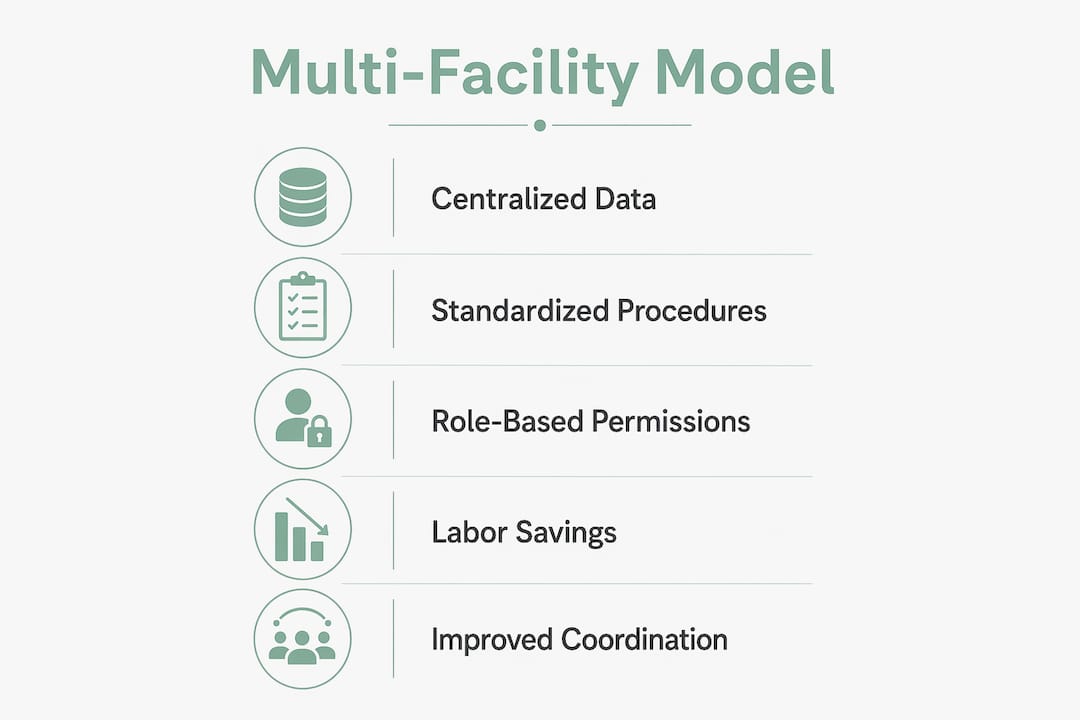
The financial case for multi-facility management is specific and well-documented. Cost savings break down into three categories: 12–15% labor reductions through mobile technician deployment, 8–12% material cost reductions through bulk procurement, and 10–15% energy savings from enterprise-wide efficiency programs. These are not theoretical projections. They reflect what organizations achieve when they stop managing each facility as a separate cost center.
Labor savings come from scheduling technicians across sites based on geography and skill, rather than assigning one technician per building. A technician who handles HVAC at three nearby facilities costs less per facility than three separate technicians. Bulk procurement reduces per-unit costs on everything from cleaning supplies to replacement parts. Energy savings follow from centralized monitoring, which identifies waste patterns that site-level staff rarely detect.
Beyond direct cost reduction, the model improves asset utilization. Centralized reporting platforms unify maintenance data across sites, which means administrators can transfer inventory between locations rather than ordering duplicate parts. A facility with excess wheelchair inventory can supply a sister site that is short, rather than both sites placing separate orders.
The broader operational benefits include:
- Reduced administrative overhead from consolidated billing and vendor management
- Improved regulatory compliance through standardized documentation across all sites
- Faster response to maintenance emergencies via shared technician pools
- Better resource allocation driven by portfolio-level data rather than site-level guesswork
- Lower staff burnout from clearer workflows and reduced duplicate reporting
Healthcare administrators managing bed management across multiple sites will recognize this pattern. The same logic that applies to centralizing facility maintenance applies to centralizing patient intake and referral tracking.
How to implement multi-facility management in healthcare: best practices
Implementation succeeds or fails based on how you handle the first 90 days. The most common mistake is attempting a portfolio-wide rollout before validating the model at a single site.
-
Start with a pilot site. Choose one facility with a complete asset registry. Pilot projects should focus on reducing diagnostic time and eliminating duplicate parts orders. A successful pilot gives your leadership team concrete data to justify the broader rollout.
-
Achieve 100% asset registry completeness before scaling. Every asset at the pilot site must be cataloged with location, condition, and maintenance history. Incomplete registries produce unreliable dashboards, which erodes trust in the entire model.
-
Separate portfolio-level standards from site-level configurations. Shared KPIs and failure codes apply across all sites. Maintenance schedules, local contacts, and site-specific compliance requirements stay at the site level. This separation preserves oversight without removing local responsiveness.
-
Prioritize change management alongside technology. Site managers often resist centralized models because they fear losing authority. Address this directly. Show them that the model gives them better data, not less control.
-
Choose a platform that onboards new facilities quickly. Modern platforms onboard new facilities in under four hours by importing asset lists and assigning standardized permissions. This avoids costly migrations and supports growth from a handful of sites to hundreds.
Pro Tip: Avoid the trap of uniform rigidity. The goal is unified execution through shared intelligence, not identical procedures at every site. A rehabilitation center and a skilled nursing facility in your portfolio have different workflows. Your management model should accommodate both.
Healthcare workforce coordination is another factor worth planning for early. Resources on healthcare staffing structures can help administrators understand how workforce models interact with facility management frameworks across sites.
How does multi-facility management improve coordination across healthcare sites?
Coordination is the defining advantage of this model. The best multi-site operators do not treat facilities as isolated units. They build a connected operational model that gives leadership visibility without removing local responsiveness.
Portfolio dashboards make this possible in practice. A healthcare administrator can view compliance status, open work orders, and maintenance backlogs across all sites from a single screen. When one site shows a spike in equipment failures, leadership can reallocate technician resources from a lower-demand site the same day. Without centralized data, that decision takes days of phone calls and spreadsheet reconciliation.
Centralized data also improves maintenance scheduling. When your platform holds maintenance histories for assets across all sites, you can schedule preventive maintenance based on actual usage patterns rather than calendar intervals. This reduces emergency repairs, which are consistently more expensive than planned maintenance.
“Successful operators create shared operational models connecting data and systems to enable leadership visibility without removing local site responsiveness. This approach breaks down complexity by unifying operations across sites.”
The coordination benefits extend to patient-facing operations as well. When facility operations run reliably across all sites, clinical staff spend less time managing building failures and more time on care delivery. Centralized referral tracking follows the same principle: unified data at the portfolio level produces faster, more accurate decisions at the site level.
Key Takeaways
A multi-facility management model reduces operational costs by 15–30% and improves coordination by centralizing data, vendor management, and SOPs across all healthcare sites.
| Point | Details |
|---|---|
| Core definition | A centralized framework managing hard services, soft services, and procurement across multiple healthcare sites. |
| Financial impact | Organizations report 15–30% operational cost reductions within 12–18 months of adoption. |
| Four pillars | CMMS or IWMS platform, standardized SOPs, single-source vendors, and portfolio dashboards. |
| Implementation start | Begin with a pilot site at 100% asset registry completeness before scaling portfolio-wide. |
| Coordination gain | Portfolio dashboards give leadership real-time visibility from KPIs down to individual work orders. |
Why most administrators underestimate this model
The most common misconception I encounter is that multi-facility management is primarily a technology problem. Administrators invest in a CMMS, connect their sites, and expect results. The technology is necessary, but it is not sufficient.
The real work is governance. Deciding which standards apply at the portfolio level and which decisions stay at the site level requires deliberate policy design. Most organizations skip this step and end up with a centralized platform that nobody trusts because the data is inconsistent across sites.
The second thing practitioners overlook is the timeline. The 15–30% cost reduction figure is real, but it materializes over 12–18 months, not 90 days. Administrators who expect immediate returns often abandon the model before it delivers. The pilot site approach exists precisely to build internal confidence during that waiting period.
What I find genuinely encouraging about where this model is heading in 2026 is the speed of onboarding. When a platform can bring a new facility online in under four hours, the barrier to scaling drops dramatically. Healthcare networks that were previously too small to justify a centralized model can now adopt one without a major capital investment. That changes the math for mid-size post-acute care operators in a meaningful way.
The administrators who get the most from this model treat it as an operating philosophy, not a software purchase. They build governance first, then select technology that fits the governance structure.
— Harry
Smartadmissions and multi-site healthcare operations
Managing multiple healthcare facilities means your admissions process carries the same coordination challenges as your physical operations.
Smartadmissions is built for skilled nursing facilities, rehabilitation centers, and post-acute care providers that need centralized visibility across their patient intake workflows. The platform integrates with existing EMR systems and insurance portals to deliver real-time eligibility verification and documentation management across all your sites. Administrators get portfolio-level reporting on referral volume, bed fill rates, and intake cycle times without logging into each facility separately. For teams ready to see what centralized admissions management looks like in practice, referral management system examples show how leading healthcare networks have structured their intake operations.
FAQ
What is a multi-facility management model in healthcare?
A multi-facility management model is a centralized framework that consolidates oversight of hard services, soft services, procurement, and data management across multiple healthcare sites under one coordinating structure.
What are the main benefits of multi-facility management?
Organizations report operational cost reductions of 15–30%, driven by 12–15% labor savings, 8–12% material cost reductions through bulk procurement, and 10–15% energy savings from enterprise-wide programs.
How do you implement a multi-facility management model?
Start with a pilot site that has a complete asset registry, separate portfolio-level standards from site-level configurations, and choose a platform that can onboard new facilities quickly without complex migrations.
What is the difference between CMMS and IWMS in this context?
A CMMS focuses on maintenance and asset tracking, while an IWMS covers a broader range of workplace functions including space management and lease administration. Both can serve as the centralized data platform in a multi-facility model.
How does centralized management improve coordination across sites?
Portfolio dashboards give leadership real-time visibility from KPIs down to individual work orders, enabling same-day resource reallocation and data-driven maintenance scheduling across all facilities.