
TL;DR:
- Effective post-acute referral processes depend on complete documentation, written capacity confirmation, and real-time status tracking to prevent delays. Technology and governance work together to reduce referral leakage and improve patient safety by ensuring timely admissions and follow-up.
The post-acute referral process is defined as the structured clinical and administrative workflow that moves a patient from an acute care setting into skilled nursing, home health, or rehabilitation services. When this process breaks down, the consequences go well beyond paperwork. Referral failures are often clinical and safeguarding failures, leading to medication drift, functional decline, and avoidable emergency department visits. Your team’s ability to execute each referral step with precision directly determines patient safety and your facility’s bed fill rate. This guide gives you a practical, step-by-step framework built on closed-loop referral integrity, CMS compliance, and real-world workflow design.
What does a post-acute referral process guide cover?
A post-acute care referral workflow covers every action from the moment a discharge planner identifies a patient’s need through the confirmed start of care at the receiving facility. The process spans clinical assessment, documentation assembly, provider selection, capacity confirmation, and admission scheduling. Each stage carries its own compliance requirements, particularly under CMS discharge planning standards codified in 42 CFR 482.13 and 42 CFR 482.43.
Getting this right requires more than good intentions. Your team needs defined tools, complete data, and a centralized system that tracks every referral from receipt to care start.
Essential tools and prerequisites
Before your team sends a single referral, three foundational elements must be in place.
- Referral management software integrated with your EMR. Centralized digital platforms integrated with EMRs reduce administrative review time and surface clinical, behavioral, and financial insights automatically. Manual fax and phone workflows cannot match that speed or accuracy.
- A complete referral packet. A clean referral packet requires six essential elements: a physician-signed plan of care (Form 485), a clinical summary, a current medication list, emergency contacts, insurance information, and EVV activation confirmation. Missing any one element causes delays and complicates Medicare claim billing.
- Standardized referral status tracking. Your team needs a centralized referral queue with defined statuses: received, triage, accepted, scheduled, started, and closed. Without these labels, referrals stall silently and no one owns the follow-up.
Pro Tip: Before going live with any new referral workflow, map your current process on a whiteboard and identify every step where information changes hands. Those handoff points are where packets go incomplete and delays accumulate.
The table below shows the core prerequisites and why each one matters.
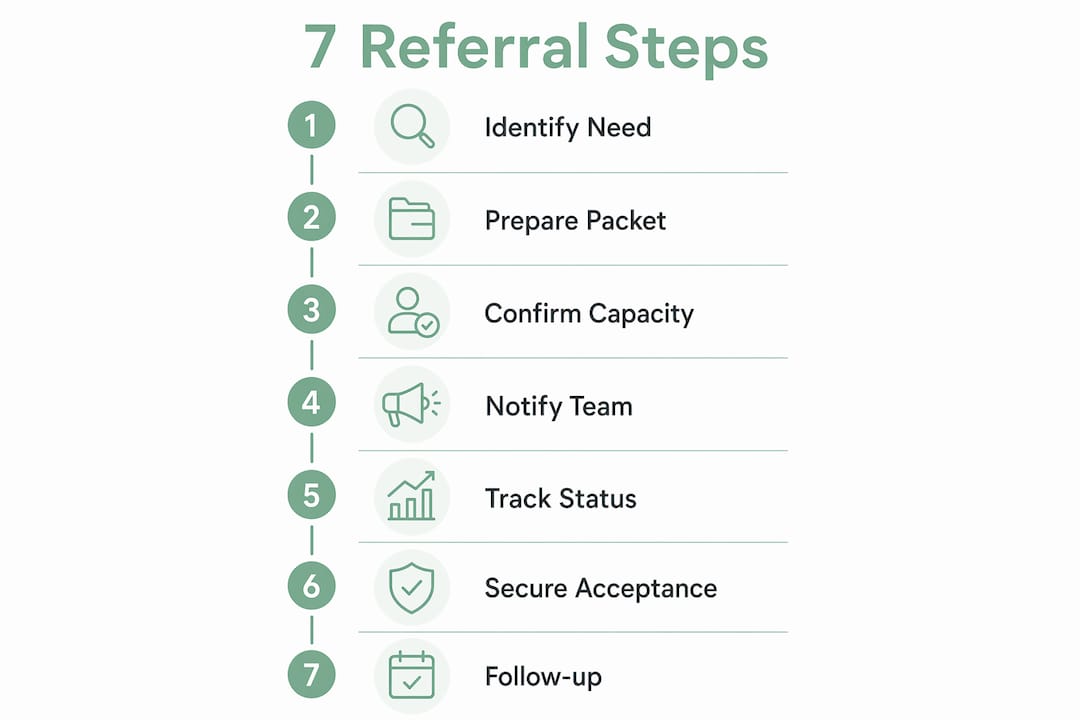
| Prerequisite | Why it matters |
|---|---|
| EMR-integrated referral platform | Eliminates duplicate data entry and surfaces clinical flags automatically |
| Complete six-element referral packet | Prevents billing delays and care start failures |
| Standardized status tracking | Creates accountability and prevents silent referral stalls |
| Written capacity confirmation | Confirms the provider can staff the patient in the correct zip code |
| Patient choice documentation | Satisfies CMS 42 CFR 482.43 and reduces refusal rates |

How do you execute the referral process step by step?
The referral process steps below reflect best practices for home health and skilled nursing transitions. Follow them in sequence. Skipping steps is the most common source of referral failure.
-
Receive and triage the referral. Log every incoming referral immediately into your centralized queue. Assign a triage status within one hour of receipt. Referrals that sit unlogged are invisible to your team and to your referral source.
-
Review the referral packet for completeness. Check all six required elements before proceeding. If any element is missing, contact the discharge planner immediately. Do not assume the packet will be completed later.
-
Verify provider capacity with written confirmation. Capacity confirmation means obtaining written acceptance that your agency can staff the patient in the correct zip code within the required timeframe. Verbal confirmation alone is not sufficient. Missing this step is one of the most overlooked risks in the referral process, and it costs facilities their discharge window.
-
Confirm patient choice per CMS regulations. CMS 42 CFR 482.43 mandates that patients receive a documented choice of providers. Discharge planners must not steer patients toward specific agencies based on hospital financial interests. Document the patient’s selection and their involvement in the decision.
-
Send verbal and written acceptance confirmation within 2 hours. Effective referral acceptance requires both verbal and written confirmation within a 2-hour window. This timing is critical to preventing delays in patient transitions. Missing this window signals unreliability to your referral sources.
-
Prepare and transmit the handoff bundle. Assemble the complete clinical summary, medication reconciliation, care plan, and insurance authorization. Transmit through your integrated platform, not by fax, to maintain a traceable record.
-
Schedule the admission and update referral status in real time. Confirm the admission date and time with the patient, the caregiver, and the receiving care team. Update the referral status to “scheduled” immediately. Track through to “started” to close the loop.
Your team should treat each status update as a clinical handoff, not an administrative checkbox. A referral marked “accepted” but never updated to “scheduled” is a referral at risk.
What common mistakes occur in the post-acute referral process?
Referral failures follow predictable patterns. Recognizing them early gives your team the chance to correct them before they affect patient care.
- Incomplete referral packets. Missing critical elements such as the physician-signed 485, medication list, or EVV confirmation prevents a clean care start. This is the single most common cause of admission delays.
- Assuming capacity without written confirmation. A verbal “yes” from a home health coordinator is not a confirmed referral. Providers who skip written confirmation risk losing the discharge window when the agency cannot staff the patient.
- Passive escalation. When a referral stalls, waiting for someone else to act is not a protocol. Escalation protocols must define who owns the barrier, what authority they have to resolve it, and the timeframe for resolution.
- Fragmented EMR data. Fragmented EMR interoperability often yields incomplete clinical records that hinder safe transitions. Hospital-SNF liaisons play a key role in coordinating across systems and building the trust that fills those data gaps.
- Bias in referral documentation. Stigmatizing language about complex patients, particularly those with behavioral health or substance use histories, reduces their access to appropriate care. Document clinical facts, not judgments.
Referral management must be treated with the same governance rigor as medication safety. That means centralized queues, standardized real-time status updates, and active daily monitoring of referral aging and barriers. A referral that ages past 24 hours without a status update is a patient at risk.
Pro Tip: Build a daily referral aging report into your morning huddle. Any referral older than 24 hours without a status change should trigger an immediate escalation call, not an email.
How can technology improve post-acute referral workflows?
Technology does not replace clinical judgment. It removes the administrative friction that slows your team down and obscures referral status. The right platform gives every stakeholder real-time visibility into where each referral stands.
Dedicated referral management software can increase monthly referral volume by an average of 46.9% for post-acute providers. That figure reflects what happens when intake workflows are structured and visible rather than fragmented across fax machines and phone calls. You can explore referral management system examples to see how different platform configurations support these outcomes.
Automated referral tools with real-time communication and AI-powered referral summaries accelerate decision-making and reduce delays. AI summarization helps intake staff quickly review patient needs without reading through pages of unstructured clinical notes. That speed matters most when your team is managing high referral volume with limited staff.
The table below maps key technology features to the workflow problems they solve.
| Technology feature | Workflow problem it solves |
|---|---|
| EMR integration | Eliminates duplicate data entry and incomplete clinical records |
| AI referral summarization | Reduces review time for complex patient cases |
| Real-time status tracking | Prevents silent referral stalls and missed follow-ups |
| Referral aging analytics | Identifies bottlenecks before they become care delays |
| Escalation workflow automation | Assigns ownership and timeframes to stalled referrals |
Beyond software features, building trusted referral partnerships with your referral sources creates the communication foundation that technology supports. Facilities with strong hospital-SNF relationships receive more complete packets and faster responses because both sides have invested in the relationship. Analytics that track referral source performance, acceptance rates, and barrier reasons give your team the data to have productive conversations with those partners.
Closed-loop referral integrity with standardized referral statuses and real-time updates reduces missed care starts and prevents referral leakage. Leakage happens when a referral is received but never converted to an admission. Every leaked referral is lost revenue and a patient who did not receive timely care. Your analytics dashboard should show leakage rates by referral source, barrier type, and time period so your team can address root causes rather than symptoms.
Key Takeaways
A well-executed post-acute referral process requires complete documentation, written capacity confirmation, patient choice compliance, and real-time status tracking to prevent care delays and referral leakage.
| Point | Details |
|---|---|
| Complete the referral packet first | All six required elements must be present before any referral proceeds to acceptance. |
| Confirm capacity in writing | Verbal confirmation is not sufficient; written acceptance prevents lost discharge windows. |
| Apply the 2-hour confirmation rule | Verbal and written acceptance within 2 hours is the standard for preventing transition delays. |
| Treat referral status as clinical data | Update statuses in real time; a stalled status is a patient safety signal, not an admin gap. |
| Use analytics to close the loop | Daily referral aging reports and leakage tracking identify problems before they affect outcomes. |
Why referral integrity is the discipline most facilities underestimate
I have reviewed referral workflows at facilities that believed their process was solid because their acceptance rate looked good on paper. What the numbers did not show was the volume of referrals that aged past 48 hours, the packets that went out missing a medication list, or the patients who ended up at a competing facility because no one confirmed capacity in writing.
The uncomfortable truth is that most referral failures are invisible until they show up as a readmission, a complaint, or a lost referral source relationship. Facilities that treat referral management as a clinical discipline, with the same daily oversight they apply to medication administration, consistently outperform those that treat it as a back-office function.
The regulations are not going to get simpler. CMS discharge planning requirements continue to tighten, and the expectation that facilities document patient choice, confirm provider capacity, and close the referral loop is already embedded in survey standards. Technology helps, but governance is the foundation. Your team needs defined ownership, escalation authority, and a daily habit of reviewing referral aging data. That combination, not any single software feature, is what separates facilities with strong census from those chasing referrals reactively.
— Harry
How Smartadmissions supports your referral workflow
Smartadmissions is built specifically for skilled nursing facilities, rehabilitation centers, and post-acute providers that need to move faster without adding administrative burden.
The platform’s AI-powered referral management assistant integrates directly with your existing EMR and insurance portals, automating eligibility verification, clinical assessments, and documentation review. Your team spends less time on manual data entry and more time on the decisions that require clinical judgment. Smartadmissions also provides real-time referral status tracking and analytics so your team can monitor aging referrals and act before delays become missed admissions. Review the referral management tools available in 2026 to see how Smartadmissions compares on the features that matter most to post-acute intake teams. You can also explore referral documentation best practices to strengthen the packet quality your team sends and receives.
FAQ
What is the post-acute referral process?
The post-acute referral process is the structured workflow that moves a patient from an acute care hospital into skilled nursing, home health, or rehabilitation services. It covers referral receipt, documentation review, capacity confirmation, patient choice compliance, and admission scheduling.
What documents are required in a post-acute referral packet?
A complete referral packet requires a physician-signed plan of care (Form 485), a clinical summary, a current medication list, emergency contacts, insurance information, and EVV activation confirmation. Missing any of these elements causes care start delays and Medicare billing complications.
How quickly should a facility confirm referral acceptance?
Effective referral acceptance requires verbal and written confirmation within 2 hours of receiving the referral. This window is the standard for preventing delays in patient care transitions.
What is closed-loop referral integrity?
Closed-loop referral integrity means tracking every referral through standardized statuses from receipt to confirmed care start, with real-time updates and active escalation when referrals stall. It prevents referral leakage and missed care starts.
How does referral management software improve outcomes?
Referral management software can increase monthly referral volume by an average of 46.9% by providing real-time visibility, EMR integration, and automated status tracking. That increase reflects the efficiency gain from replacing fragmented manual workflows with a centralized digital system.