
Clinical data extraction converts records inside EHR and EMR systems, along with scanned clinical documents, into structured, analyzable data. Teams typically rely on APIs or SQL for structured fields, and turn to OCR, NLP, or LLM-assisted methods for free-text notes and scanned reports. The right approach depends on the source format, the timeline, and how much governance oversight the project requires. Many research registries, quality improvement projects, and operational analytics initiatives combine several of these methods rather than relying on just one.
TL;DR:
- Using APIs or SQL is effective for extracting structured data but limited to fields that systems expose directly, requiring validation.
- OCR, NLP, and LLM-assisted methods unlock unstructured clinical information but add validation complexity and typically need human review for accuracy.
- Validation should occur at multiple pipeline stages, including source extraction, cleaning, normalization, and after mapping to standard vocabularies, to ensure data quality.
- Stakeholder alignment and starting with small, validated pilots are crucial for project success, avoiding costly rework and mismatched expectations.
- In cases focused solely on admissions and referral data, integrated referral management systems like Smartadmissions offer a faster, lower-cost alternative to full-scale extraction projects.
Table of Contents
- How Do You Choose the Right Clinical Data Extraction Method?
- What Do Structured and Unstructured Clinical Data Actually Look Like?
- Technical Methods for Extracting Clinical Data: A Builder’s Guide
- Building a Reliable Clinical Data Pipeline
- What Governance and Compliance Rules Apply to Clinical Data Extraction?
- Common Clinical Data Extraction Challenges and How to Fix Them
- When Should You Hire a Clinical Data Extraction Service?
- What Actually Makes Clinical Data Extraction Projects Succeed?
- A Faster Route for Intake-Specific Data Capture
- Where to Go Deeper on Clinical Data Extraction Methods
- Sources
How Do You Choose the Right Clinical Data Extraction Method?
Matching the method to the source format saves months of rework. A project that starts with the wrong extraction approach, say, trying to parse discharge summaries with simple keyword search instead of a trained NLP model, tends to produce data that looks complete but fails validation later.
Start with the access layer. If your EMR vendor offers an API (Epic’s App Orchard, Cerner’s Ignite APIs, or a FHIR-based endpoint), use it before anything else. APIs enforce structure, respect permissions, and reduce the risk of pulling unauthorized fields. When no API exists or bulk historical pulls are needed, direct SQL queries against a read-only reporting database or clinical data warehouse become the practical option.
ETL (extract, transform, load) and change data capture (CDC) pipelines matter once extraction stops being a one-time event. A research registry that needs weekly updates should build CDC-based incremental syncs rather than re-running full extracts, which strain source systems and slow refresh cycles.
Unstructured sources need a different toolkit entirely:
- OCR handles scanned faxes, handwritten orders, and legacy paper records converted to image files.
- NLP (rule-based or model-based) pulls structured facts out of typed clinical notes, such as medication mentions or symptom onset.
- LLM-assisted extraction handles complex, context-dependent questions, like determining whether a note describes a new diagnosis versus a historical one.
The trade-offs are consistent across projects: APIs and SQL are fast and reproducible but limited to whatever fields the source system exposes cleanly. OCR and NLP unlock much of the clinical information trapped in free text, but they add validation overhead and rarely reach the accuracy of structured queries without human review layered on top.
What Do Structured and Unstructured Clinical Data Actually Look Like?
Structured data lives in discrete fields: lab values in LOINC-coded rows, medication orders tied to NDC codes, vital signs logged with timestamps, and problem lists coded in ICD-10 or SNOMED CT. These fields sit in predictable tables, which means extraction is mostly a matter of writing the right query and mapping the right column.
Unstructured data is everything else, and it makes up the bulk of a typical chart:
- Physician progress notes and consult letters
- Discharge summaries and operative reports
- Scanned referral packets, faxed orders, and handwritten intake forms
- Radiology and pathology narrative reports (as opposed to their coded impressions)
The downstream implications differ sharply. A structured field, like a serum creatinine value, is analysis-ready the moment it’s extracted. An unstructured note mentioning “declining renal function” requires interpretation before it can feed a model or a registry, and that interpretation step is exactly where errors creep in if extraction methods aren’t validated carefully. Projects that skip this distinction often discover late that a sizeable portion of their “complete” dataset is actually unparsed text blobs.
Technical Methods for Extracting Clinical Data: A Builder’s Guide
Building a reliable extraction pipeline means making deliberate choices at each layer, not defaulting to whatever’s fastest to code.
API extraction requires attention to OAuth2 authentication flows, pagination limits (many FHIR servers cap responses at 50 to 100 resources per call), and incremental filters using _lastUpdated parameters so you’re not re-pulling the entire patient population every run. Build retry logic for rate limits and token expiration; EMR vendor APIs throttle aggressively during business hours.
Database extraction should always go through read-only views, never production tables directly. Work with IT to get a reporting replica or clinical data warehouse view, and schedule heavy queries during off-peak hours to avoid degrading live clinical systems.
ETL/CDC pipelines should isolate transformation logic from extraction logic, so a schema change on the source side doesn’t break your entire pipeline. Log-based CDC (reading database transaction logs) is generally more reliable than timestamp-based polling for catching every update.
For unstructured sources, here’s how the main technical options break down:
- OCR tool selection: template-based OCR works well for standardized forms (like a specific insurer’s referral packet) but breaks on format variation; general-purpose OCR engines handle variety better but need more post-processing cleanup.
- Rule-based NLP: fast and interpretable for narrow, well-defined extraction tasks like flagging smoking status mentions.
- Supervised NER models, including fine-tuned BioClinicalBERT variants, deliver the strongest accuracy when you have labeled training data, though building that training set takes real time investment.
- Prompt-based LLM extraction needs less labeled data upfront and handles semantic nuance well. One medRxiv study found that LLM-based extraction, validated with human review and automated consistency checks, substantially increased captured clinical variables including medications and oncology therapies, reaching high F1 scores on checklist-style extraction tasks.
Mapping extracted values to standard vocabularies, FHIR resources for interoperable exchange, LOINC for labs, SNOMED CT for clinical concepts, and the OHDSI OMOP common data model for research-ready normalization, is what separates a one-off data pull from a reusable dataset. Skipping this step means every downstream analysis has to re-solve the same terminology problems.
Pro Tip: Run a small validation batch (50 to 100 records) through both your automated extraction method and a manual chart review before scaling up. Comparing the two catches systematic errors while they’re still cheap to fix.
Validation itself should combine automated consistency checks (does this lab value fall in a plausible range?) with human sampling on a meaningful subset, since lexical accuracy and semantic correctness aren’t the same measurement and both matter.
Building a Reliable Clinical Data Pipeline
A dependable pipeline has distinct stages, and validation needs to happen at more than one of them, not just at the very end.
The typical sequence runs: source extraction, staging, cleaning and normalization, vocabulary mapping, validation, and load into the analytic or research dataset. Cleaning tasks include standardizing units (converting lab values reported in mixed units to one standard), normalizing timestamps across time zones and daylight saving shifts, and deduplicating records where the same encounter got pulled from two source systems.
Provenance tracking deserves its own checkpoint. Every extracted record should carry a link back to the source document, the extraction timestamp, and the extractor version used, because audits and sponsor reviews will eventually ask where a given data point came from.
Operational monitoring catches problems before they reach analysts:
- Schema drift alerts when a source field changes type or disappears
- Job failure notifications tied to row-count anomalies (a sudden 40% drop signals a broken query, not a real decline)
- Regular diffs between expected and actual field completeness rates
Institutional guides on database extraction principles emphasize that presentation-layer decisions, how fields get named, grouped, and normalized, directly affect how usable the final dataset is for downstream analysis.
For acceptance criteria, many academic medical centers validate a sample of records per extraction category before signing off on a full production run. Sourced best-practice guides recommend validating data quality at the source system level rather than catching problems only after the full load completes, since fixing a mapping error after 100,000 records have loaded costs far more than catching it at record 50.
Teams that need help structuring these pipeline stages for admissions and intake data specifically can look at how analytics transforms healthcare admissions workflows once extracted data reaches the reporting stage.
What Governance and Compliance Rules Apply to Clinical Data Extraction?
Every clinical data extraction project touching patient records needs a governance plan before the first query runs, not after.
IRB review is typically required whenever identifiable patient data leaves clinical care for research purposes, though many institutions grant waivers for retrospective, minimal-risk chart reviews. Expect to submit a protocol describing exactly which fields you’re pulling, how long you’ll retain them, and who has access.
Honest Broker patterns solve a specific problem: letting researchers get de-identified or limited datasets without ever touching raw identifiable records themselves. An Honest Broker, typically a role housed within informatics or health information management, extracts and de-identifies data on the researcher’s behalf under documented institutional protocols.
HIPAA governance rests on the minimum necessary principle: pull only the fields the protocol justifies, not every available column because it’s convenient. De-identification should follow either the Safe Harbor method (removing 18 specific identifier types) or Expert Determination, and every access event needs an audit log entry.
If you’re working with an outside vendor, check for these before signing anything:
- A signed Business Associate Agreement (BAA)
- Documented data handling and retention policies
- A defined breach notification timeline and process
- Evidence of prior HIPAA-compliant project delivery
Institutional cores like UCSF’s Academic Research Services build these safeguards into their standard extraction service, which is worth reviewing as a benchmark for what a compliant workflow should include.
Common Clinical Data Extraction Challenges and How to Fix Them
Schema drift catches most teams off guard. An EMR upgrade or a vendor-side field rename can silently break a pipeline that ran fine for months.
- Run automated schema comparison checks before every scheduled extraction job.
- Version your field mappings so a drift event triggers an alert instead of a silent failure.
- Reconcile incomplete structured fields against extracted note text; a missing structured diagnosis code often shows up correctly in the physician’s note.
- Pilot NLP and LLM extraction on a narrow, well-defined variable set before expanding scope, rather than trying to extract everything at once.
Accuracy problems with NLP and LLM extraction usually trace back to ambiguous prompts or insufficient labeled examples. Combining a prompt-based approach with a smaller set of human-reviewed examples for calibration, an approach research on extraction methodology supports, tends to improve semantic correctness without the full cost of building a supervised model from scratch.
Pro Tip: Budget for a two-week narrow pilot, one document type, one variable set, before committing to a full-scale extraction contract or build. It surfaces mapping problems while the fix is still cheap.
Staffing shortfalls sink more projects than technology limitations do. Plan for at least one informaticist who understands the source EMR’s data model and one analyst who owns validation, even for a modest pilot.
When Should You Hire a Clinical Data Extraction Service?
Building in-house makes sense when you have sustained volume, an experienced informatics team, and governance infrastructure already in place. Hiring a vendor or institutional core makes sense when timelines are tight, the data sources are unusually heterogeneous, or your team lacks FHIR and OHDSI mapping experience.
- Assess volume and timeline. A one-time pull of 500 records for a pilot study rarely justifies building custom infrastructure; a recurring registry feeding hundreds of new records monthly usually does.
- Check governance complexity. Multi-site studies requiring IRB coordination across institutions often move faster through an established core that already has Honest Broker workflows in place.
- Request concrete deliverables. Ask any vendor for validation evidence (sample accuracy rates, methodology), documented FHIR or OHDSI mapping output, and provenance metadata with every delivered dataset.
- Verify security posture. Confirm a signed BAA, encryption standards for data in transit and at rest, and a clear breach response plan before sharing any patient information.
- Clarify pricing structure. Vendors and academic cores price by data volume, source complexity, and turnaround time; get a written estimate tied to a defined scope before committing.
Typical pilots run several weeks for scope definition, IRB coordination, and initial extraction, with cost driven primarily by the number and complexity of unstructured sources involved.
What Actually Makes Clinical Data Extraction Projects Succeed?
Most failed extraction projects don’t fail on technology. They fail on stakeholder alignment. Clinical staff, IT, and research teams often have different assumptions about what “complete” data means, and nobody surfaces the mismatch until validation reveals gaps three months into the project.
The fix that works consistently: start with a narrow pilot on one document type and one variable set, get it validated end to end, then expand. Teams that try to extract everything at once almost always end up rebuilding their mapping logic halfway through.
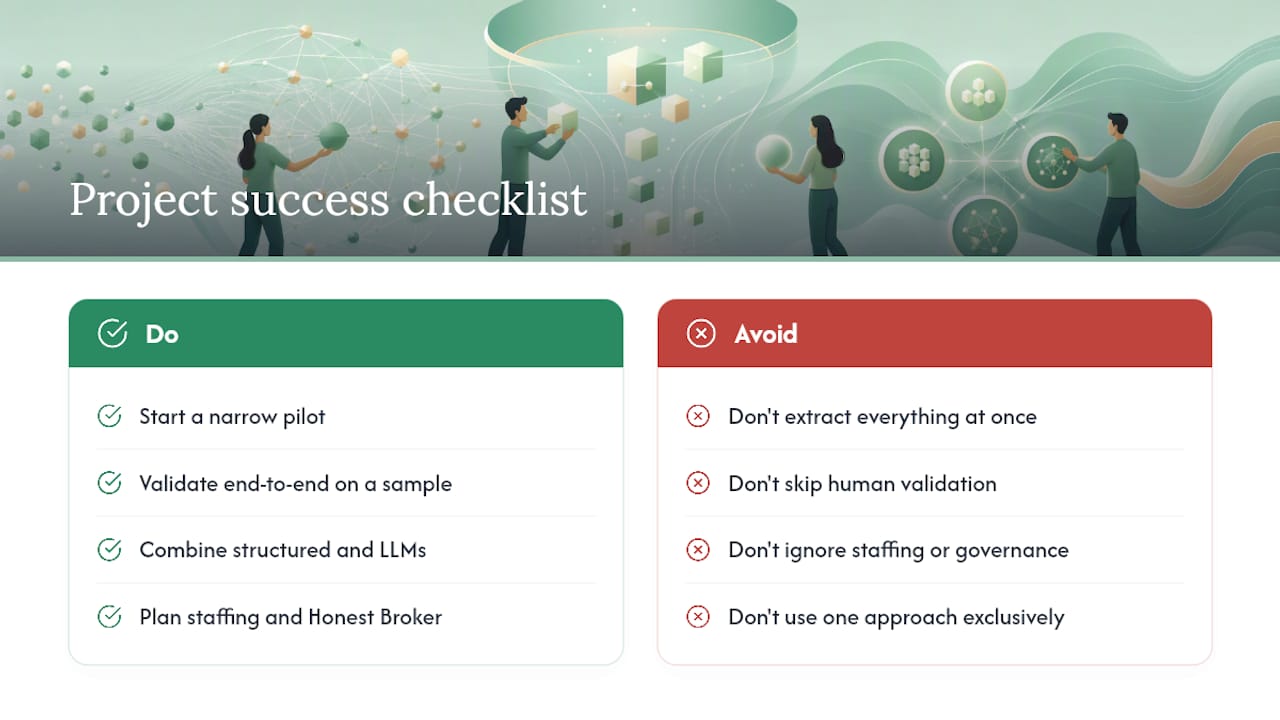
Combining structured extraction with targeted LLM pulls, rather than choosing one exclusively, tends to outperform either approach alone. Structured queries handle the fields that are already clean; LLM-assisted extraction handles the notes where the real clinical nuance lives. That combination, backed by human validation on a meaningful sample, is what the strongest recent extraction research consistently points toward.
Staffing and governance planning deserve more respect than they usually get. A part-time informaticist and a defined Honest Broker path will save more time than any additional engineering hire. And it’s worth noting that the discipline required for reliable clinical data extraction, clean field mapping, EMR integration that actually holds up under volume, audit-ready provenance, shows up in adjacent operational tools too. Platforms that integrate directly with EMR and insurance systems for admissions workflows face a smaller-scale version of the exact same extraction problem every single referral.
— Harry
A Faster Route for Intake-Specific Data Capture
Not every extraction problem needs a full research-grade pipeline. If your bottleneck is admissions and referral intake specifically, instead of building a registry or a system-wide analytics warehouse, Smartadmissions solves a narrower version of the problem without the months of mapping work a full clinical data extraction project demands.
Some platforms connect directly to existing EMR and insurance portal systems to pull structured fields admissions teams actually need: eligibility status, clinical assessment data, and referral documentation, then deliver them as ready-to-use, exportable data instead of raw records someone has to parse. For facilities evaluating referrals, that means real-time eligibility verification and clinical status review without standing up a custom extraction pipeline just to speed up bed occupancy decisions.
When your extraction need is really about referral and intake data rather than research-scale EHR mining, an integrated referral management system reduces scope dramatically. See how Smartadmissions handles EMR integration for admissions workflows and request a walkthrough of your facility’s referral pipeline.
Where to Go Deeper on Clinical Data Extraction Methods
For hands-on institutional support, ITHS and UCSF’s Academic Research Services both offer extraction help with built-in IRB and validation processes. For methodology grounding, the PMC paper on medical data extraction and presentation remains a solid technical reference for database design decisions. Developers building PHI-safe clinical AI tools should also review MedScrub’s developer resources on proxy-based architecture patterns.
Sources
- ITHS | Clinical Data Extraction
- A Scalable Method for Validated Data Extraction from Electronic Health Records with Large Language Models | medRxiv
- Strategies for Medical Data Extraction and Presentation Part 2 (PMC)
- How to extract data: Data extraction methods explained