
Referral source onboarding is the process of enrolling an external healthcare partner, such as a hospital discharge team, clinic, or home health agency, so they can send electronic patient referrals directly into your admissions system. The immediate next action is simple: schedule a kickoff meeting and start a documented onboarding checklist. Guidance from HHS and Healthit shapes the compliance and technical steps that follow, and tools like Smart Admissions can shorten the timeline considerably.
TL;DR:
- Ensuring a thorough onboarding process includes legal checks, technical testing, and training to prevent incomplete data and PHI mishandling.
- Confirming partner EHR capabilities and patient matching procedures is crucial to avoid delays or mismatched identifiers during live referrals.
- Selecting the appropriate exchange method depends on the partner’s existing systems, referral volume, and data requirements, with FHIR APIs suited for high-volume workflows.
- A clear starter kit with concise instructions and consistent follow-up reviews significantly improves referral completeness and reduces onboarding setbacks.
- Smart Admissions offers automation tools that shorten onboarding to 4-6 weeks by streamlining verification and documentation processes.
Table of Contents
- Step-by-step onboarding checklist: from outreach to first live referral
- Compliance essentials: BAAs, risk analysis, and cloud considerations
- Technical options: Direct, 360X, FHIR, and how to choose
- Partner enablement: training, SLAs, and starter kits that prevent confusion
- Measuring onboarding success and keeping partners accountable
- How Smart Admissions supports faster referral partner onboarding
- What most onboarding advice gets wrong
- Ready to cut onboarding time? See how it works and check pricing
- Sources
- FAQ
Step-by-step onboarding checklist: from outreach to first live referral
A successful onboarding sequence follows a predictable order. Skipping steps to save time usually costs more time later, when a referral partner sends incomplete data or PHI moves through an unapproved channel.
- Collect contacts, expected referral volumes, and case types during initial outreach.
- Run legal and compliance pre-checks before any protected health information changes hands.
- Map the technical exchange method, whether Direct messaging, a HL7 interface, or a FHIR-based API.
- Test the connection in a sandbox environment against clear acceptance criteria.
- Launch with a small volume of referrals before scaling up.
- Deliver training and documentation to the partner’s staff.
- Schedule check-ins for the first 30 to 60 days.
During intake, your team should gather:
- Primary and backup contact names at the referring organization.
- Expected weekly or monthly referral volume by service line.
- Common referral types (skilled nursing, rehab, long-term care) and any specialty requirements.
Compliance pre-checks come next. Confirm whether a Business Associate Agreement is required, verify the partner’s EHR vendor and version, and identify who owns the technical connection on their side. Only after these are settled should your team move to sandbox testing, where you send test referrals and confirm the receiving system parses fields correctly.
Pro Tip: Run at least five sandbox test referrals covering your most common case types before scheduling go-live, not just one clean example.
Compliance essentials: BAAs, risk analysis, and cloud considerations
Before any referral data flows between systems, your compliance groundwork needs to be in place. HIPAA requires a documented risk analysis covering all electronic protected health information, and a signed Business Associate Agreement with any vendor that creates, receives, maintains, or transmits that data, according to HHS guidance on risk analysis. Treat these as gate checks, not paperwork to finish later.
A documented risk analysis is a HIPAA requirement, per HHS, and it should specifically cover the data flows created by each new referral connection, not just your existing systems.
A BAA needs to describe permitted uses and disclosures of PHI and the contractual safeguards both parties agree to, and it extends to any subcontractor the vendor uses, according to HHS guidance on business associates. If your referral platform or the partner’s system runs on cloud infrastructure, the cloud service provider is also a business associate, and its BAA terms need to align with the service level agreement governing uptime and support, per HHS guidance on cloud computing.
Your onboarding packet should include:
- The signed BAA and a record of the risk analysis specific to this connection.
- Updated contact lists for both clinical and technical staff.
- An incident response plan naming who to call if data is misdirected.
Technical options: Direct, 360X, FHIR, and how to choose
Three exchange methods cover most referral connections today. Direct messaging works like secure email between EHRs and suits low-volume partners. HL7-based 360X specifications, a Preapproved standard, push continuity of care documents and referral identifiers so both systems can track a referral’s lifecycle, according to 360X documentation. FHIR-based APIs offer the most flexibility for high-volume partners with modern EHR platforms.
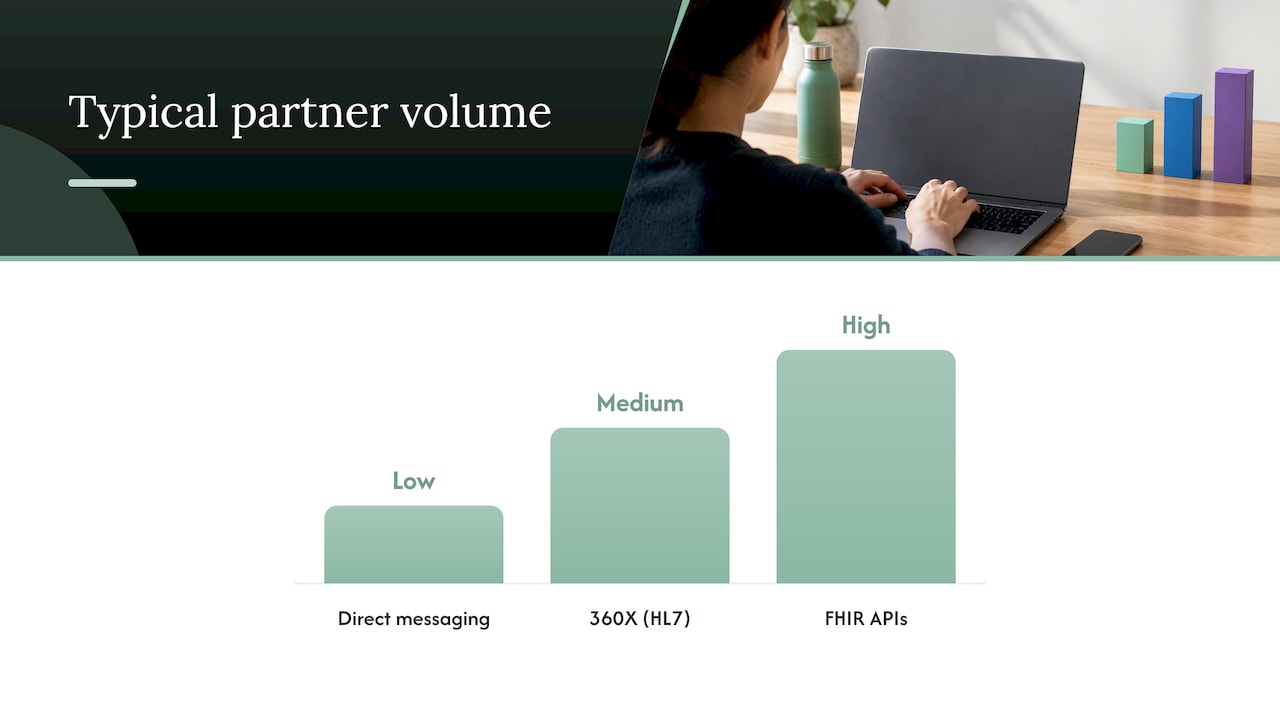
TEFCA and its Common Agreement give organizations a nationwide framework for exchange through Qualified Health Information Networks, and participation can reduce the need for separate point-to-point connections with every new partner, per HealthIT.gov. This matters most when a referral source cannot natively support FHIR.
When choosing a path, weigh:
- The partner’s existing EHR capabilities and whether they already support FHIR or 360X.
- Expected referral volume and how much manual review that volume would otherwise require.
- The specific clinical data elements each referral must carry for your admissions team to make a decision.
Pro Tip: Confirm how the partner’s system handles patient matching before go-live: mismatched identifiers cause more onboarding delays than any other technical issue.
Your testing checklist should confirm which identifiers transmit correctly, what a successful acceptance message looks like, and how failures are flagged back to the sender.
Partner enablement: training, SLAs, and starter kits that prevent confusion
A technical connection means little if the partner’s staff do not know what to send or when. A starter kit gives referral coordinators everything they need without repeated back-and-forth.
Include in the kit:
- A one-page list of required fields for a complete referral.
- Sample documents showing a properly formatted submission.
- A short reference sheet listing your admissions team’s response times.
Training works best delivered in layers:
- A live demo walking through the submission process end to end.
- A recorded version the partner’s team can revisit during staff turnover.
- A one-page cheat sheet posted near their workstation.
Service level expectations should be explicit from day one, covering referral turnaround time, minimum completeness rates, and an escalation path for urgent cases. Watch for red flags early: referrals missing insurance information, inconsistent diagnosis codes, or a spike in incomplete submissions after a partner’s staff changes. Each of these calls for a quick retraining conversation rather than silent frustration on either side.
Measuring onboarding success and keeping partners accountable
Onboarding is not finished at go-live. It is proven over the following weeks through a small set of metrics your team should track consistently.
- Time to first accepted referral, measured from kickoff to a clean submission.
- Referral completeness rate, tracking how many submissions arrive with all required fields.
- Time to admit, from referral receipt to bed placement.
- Documentation error rate, flagging recurring mistakes for targeted retraining.
Reviewing a sample of referrals weekly during the first month catches formatting or data issues before they become habits, a practice referenced in Smart Admissions’ onboarding resources.
Hold a formal performance review with each partner at 30 and 90 days, and require a corrective action plan when completeness rates fall below your facility’s threshold. Document lessons learned after every onboarding cycle and update your templates accordingly, so the next partner benefits from what the last one taught you.
How Smart Admissions supports faster referral partner onboarding
Smart Admissions integrates with existing EMR and insurance portals to verify eligibility and manage documentation in real time, which shortens the manual review work admissions teams otherwise do by hand, as described on the how it works page. The platform’s own onboarding materials describe partner enrollment completed within 4 to 6 weeks, using templates that mirror the checklist above, detailed in the referral partner onboarding guide.
Teams building enablement materials can also draw on the post-acute referral process guide and the referral sources guide for SNF admissions, which walk through partner types and documentation expectations in more depth. Admissions teams evaluating a new vendor connection can also review a general AI vendor procurement checklist to structure their own security questions, adapting it to their regulatory obligations.
What most onboarding advice gets wrong
Most guidance on this topic treats compliance and technology as separate phases: get the BAA signed, then figure out the integration. In practice, the two decisions constrain each other. A partner’s EHR capabilities determine what exchange method is even possible, and that choice affects what your risk analysis needs to cover. Sequencing them as isolated checkboxes is why onboarding timelines slip.
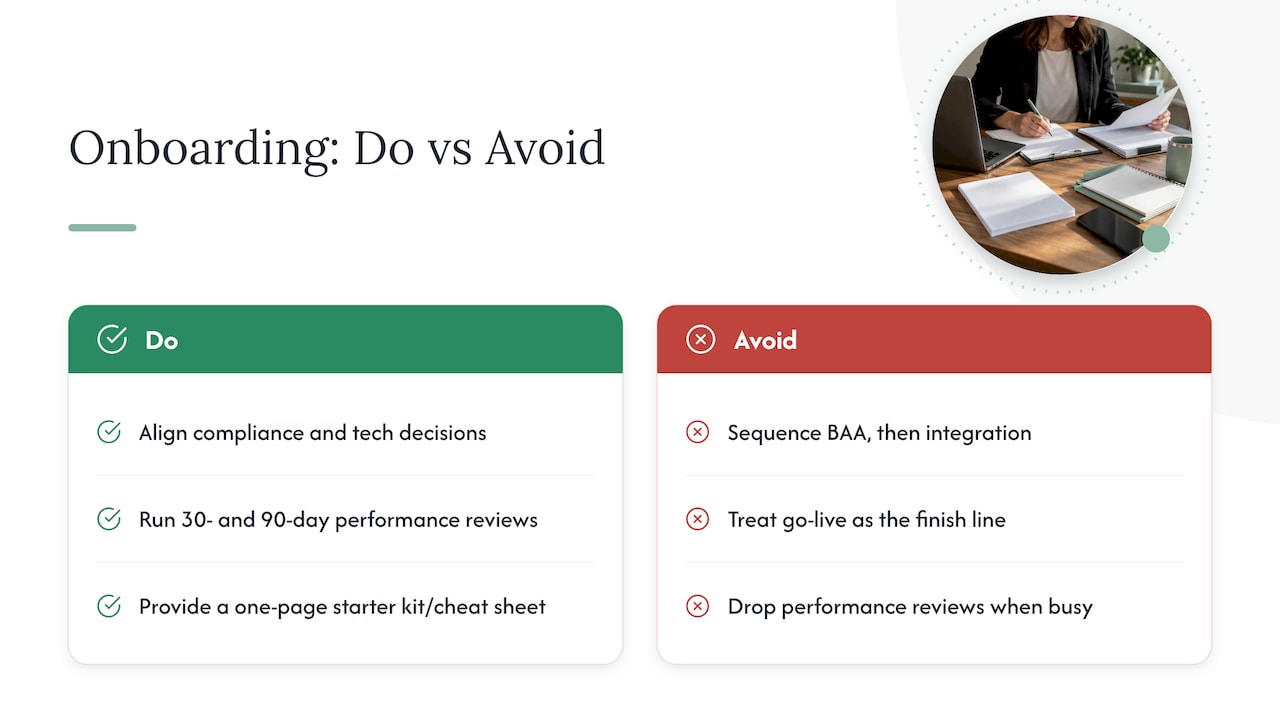
The bigger miss is treating go-live as the finish line. A referral partner who sends one clean test referral and then reverts to faxing incomplete forms two weeks later has not been onboarded, no matter what the checklist says. The 30 and 90 day performance reviews matter more than the kickoff meeting, yet they get cut first when admissions teams are busy.
If you prioritize one thing, make it the starter kit and cheat sheet. Referral coordinators at partner organizations juggle multiple facilities’ requirements at once, and the ones who send complete referrals consistently are usually the ones who were handed a clear one-page reference, not the ones who sat through the longest training session.
— Harry
Ready to cut onboarding time? See how it works and check pricing
Referral source onboarding takes real coordination, but the software layer does not have to add friction. Smart Admissions integrates with existing EMR and insurance portals to verify eligibility and manage documentation automatically, which means your team spends less time chasing paperwork and more time on the referrals that actually convert to admissions.
- See the platform’s integration details on the how it works page.
- Compare plans, including Monthly at $597 per month and Annually at $6,447 per year, on the pricing page.
Sources
FAQ
Do we always need a BAA before onboarding a referral partner?
Yes, when the partner’s platform or your vendor creates, receives, maintains, or transmits protected health information, a signed Business Associate Agreement is required before that data can flow, per HHS guidance. This applies to cloud-based tools and any downstream subcontractors as well.
What is the fastest technical path for a new referral connection?
The fastest path depends on the partner’s existing EHR: Direct messaging works well for lower-volume partners, while a FHIR-based API or TEFCA network connection avoids building a separate point-to-point integration for each new partner, according to HealthIT.gov. 360X specifications offer a middle path for partners whose EHR already supports referral document exchange.
How long does referral source onboarding typically take?
Onboarding timelines vary by technical complexity and compliance review, though Smart Admissions describes a typical range of 4 to 6 weeks for enrolling a new referral partner, detailed in its onboarding guide. Straightforward Direct messaging connections tend to move faster than custom API integrations.
Which metrics show that onboarding actually worked?
Time to first accepted referral, referral completeness rate, and time to admit are the core indicators admissions teams track during the first 30 to 90 days. A rising completeness rate combined with a shrinking time to admit suggests the partner has adopted the process rather than just completed a one-time test.
What should go in a referral partner’s starter kit?
A starter kit should include a one-page list of required referral fields, a sample completed referral document, and a quick reference sheet showing expected response times. Keeping these materials to a single page each makes them far more likely to get used during actual referral submissions.