
To reduce admission denials, your admissions team needs to combine immediate front end eligibility and documentation checks with prioritized automation of prior authorization and payer communications. The CMS Interoperability and Prior Authorization Final Rule is pushing payers toward faster, electronic decisions, and platforms like Smart Admissions are already built around that shift. Expect fewer pended requests, faster bed placement, and a measurable drop in administrative denials once these two efforts run together.
TL;DR:
- Automating prior authorization and eligibility checks can reduce pended requests by over 37% and speed up notifications by nearly a week.
- Verifying coverage at referral, confirming documentation completeness, and logging each transaction prevent most first-hour denials.
- Flagging referrals with Condition Code 04 or incomplete certifications for secondary review significantly decreases documentation-related denials.
- Using Smart Admissions’ integrated system streamlines real-time checks, documentation templates, and EMR links, enabling faster, more accurate admissions.
- Prioritizing verification, documentation completeness, and automation at intake yields the quickest reduction in denial rates and administrative burdens.
Table of Contents
- Priority checklist: 8 operational steps admissions teams should use today
- Why prior authorization automation matters now
- Fix the clinical handoff that triggers most documentation denials
- Eligibility verification and the payer portal workflow
- Appeals and resubmission: a pragmatic playbook that wins
- What admissions leaders should prioritize first
- How Smart Admissions helps reduce denials
- Sources
- FAQ
Priority checklist: 8 operational steps admissions teams should use today
Most administrative denials trace back to the first hour of intake, not the final appeal. Your team can close most of these gaps with a short, repeatable process at the point of referral.
- Front load real time eligibility and prior authorization requirement checks before the bed is held.
- Require a minimal complete clinical packet, including physician statement and recent clinical notes, before accepting the referral.
- Use payer portals or electronic PA submission whenever the payer supports it, and capture the portal case ID for every submission.
- Standardize the physician certification language your facility requests so it matches what reviewers expect to see.
- Confirm MDS assessment timing against the planned admission date before finalizing acceptance.
- Escalate any referral with uncertain eligibility or incomplete documentation to a senior reviewer before the bed is committed.
- Set internal service level agreements, such as same day verification and PA submission within 24 hours of referral.
- Log every denial with its reason code so your team can spot payer specific patterns over time.
Print this as a one-page reference for your intake desk. Teams that work from a shared checklist, rather than individual memory, catch more of these issues before they become denials. For a deeper walkthrough of verification steps, see 9 patient eligibility verification tips for admissions teams.
Pro Tip: Assign one staff member to own the denial log weekly. Patterns tied to a single payer surface faster when one person reviews the full list.

Why prior authorization automation matters now
Policy and vendor data both point in the same direction: manual prior authorization is becoming the costly exception, not the norm. The CMS final rule requires impacted payers to adopt FHIR based Prior Authorization APIs, send specific denial reasons, and meet tighter decision windows of 72 hours for expedited requests and seven calendar days for standard ones, with general compliance primarily delayed to 2027.
Automation pilots reduced pended requests by more than 37%, according to CAQH CORE pilot data, with one case study reporting notifications arriving 6.7 days faster. For a post-acute transfer, that difference often decides whether a referral turns into an admission or gets abandoned to a competing facility.
What this means for your team over the next year:
- Payers will publish clearer denial reasons, which makes targeted resubmission easier.
- Electronic PA submission will replace fax and phone based workflows at a growing share of payers, cutting the administrative burden documented by the AMA.
- Facilities that build automated, validated submissions now will adjudicate faster than those waiting for the 2027 compliance deadline to force the issue. Read more in prior authorization automation: 3 gains that cut approval time.
Fix the clinical handoff that triggers most documentation denials
A large share of administrative denials have nothing to do with medical necessity. They come from a handoff gap between the referring hospital and your intake desk, and from preventable paperwork errors that CMS documentation on skilled nursing facility reason codes flags repeatedly: Condition Code 04 misapplication, missing or late MDS assessments, and physician certifications that lack the daily skilled need language reviewers require.
Build your preadmission packet around these steps:
- Confirm a signed physician statement is attached, with daily skilled need language and a specific therapy plan.
- Check the MDS assessment schedule against your admission date before you accept the referral.
- Flag any referral marked with Condition Code 04 for a second review before intake proceeds.
- Identify the hospital case manager or discharge planner who can supply addenda quickly if anything is missing.
- Keep a short template on hand for requesting corrected certifications so the request itself never delays the timeline.
These checks map closely to the preadmission guidance in protect day 1 PDPM revenue: a 15 minute preadmission checklist and the documentation practices in how to handle referral documentation: 7 best practices.
Pro Tip: Keep a single page addenda request template ready. Asking for the right missing item on the first call saves a full day compared to a second round of back and forth.
Eligibility verification and the payer portal workflow
Coverage disputes often start as a verification gap, not a true denial. Confirming eligibility correctly, and documenting that confirmation, prevents a disagreement over coverage from turning into a lost admission.
- Run a real time eligibility check at referral, capturing plan type, effective dates, and any prior authorization requirement.
- Record the payer portal case ID, the staff member who submitted it, and a timestamp for every transaction.
- When a payer has no electronic portal, call and log the representative name, reference number, and call time.
- Note whether the plan is a Medicare Advantage HMO or PPO, since HMO products tend to carry broader prior authorization requirements than PPO products.
- Keep a simple shared log with columns for patient, payer, case ID, submission date, and status, so any team member can pick up where another left off.
This habit matters more as payers adopt electronic standards. CAQH Index data shows electronic transactions consistently cut manual steps compared to phone and fax based verification. For a fuller walkthrough, see patient eligibility verification list: 10 essential steps.
Appeals and resubmission: a pragmatic playbook that wins
Not every denial needs an appeal. Some need a faster, better documented resubmission instead, and knowing which path to take saves days.
- Read the payer’s denial reason carefully before deciding between an appeal and a resubmission. A missing document usually calls for resubmission, not appeal.
- Note the payer’s appeal window immediately. Missing the deadline forfeits the right to challenge the decision regardless of the clinical merits.
- Build the appeal packet around clinical notes, the physician certification, and a therapy plan tied directly to the coverage rule the payer cited.
- Use the payer’s own denial language to structure the resubmission, addressing each cited deficiency point by point rather than resending the full packet unchanged.
- Log the outcome of every appeal back into your denial tracker. MedPAC’s prior authorization analysis found that reconsiderations in Medicare Advantage are often approved, which makes timely, well documented appeals worth the staff time they require.
What admissions leaders should prioritize first
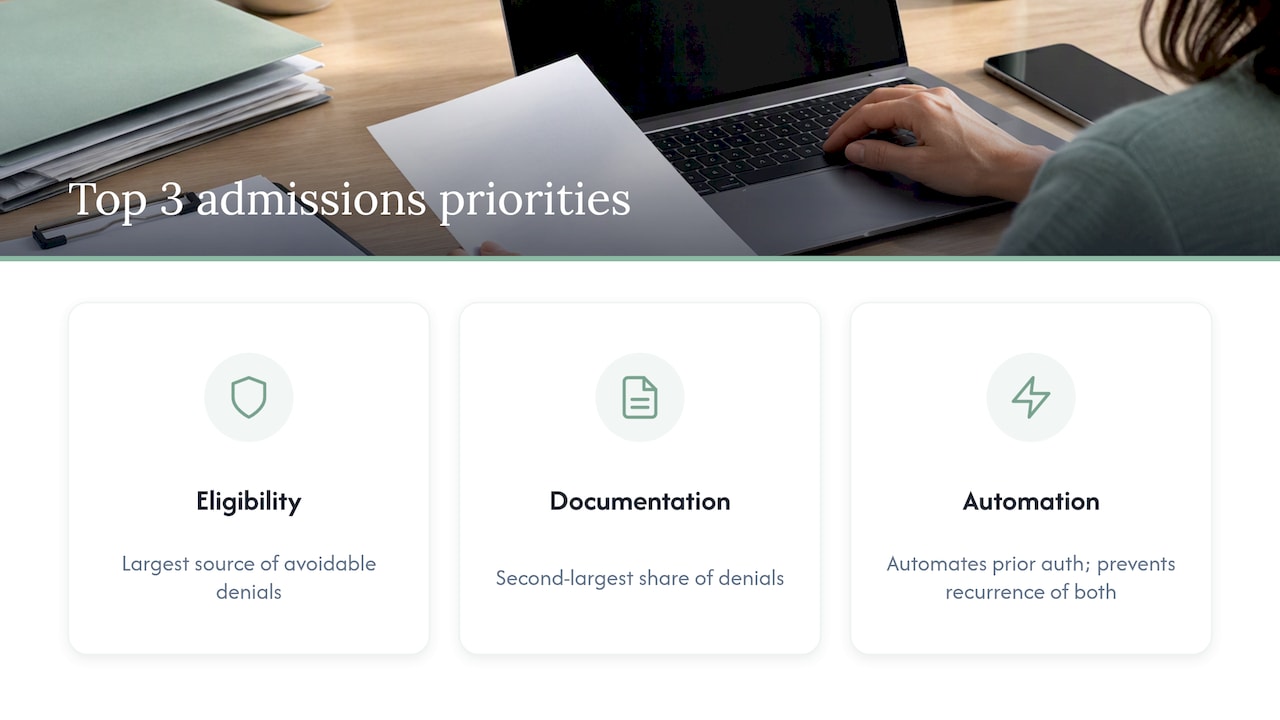
If your team can only fix three things this quarter, fix eligibility verification, documentation completeness, and prior authorization automation, in that order. Eligibility errors create the most avoidable denials, documentation gaps create the second-largest share, and automation is what keeps both from recurring once your checklist is in place.
Put your limited staffing hours into the referral intake desk first, since that is where most denials are either prevented or created. A reviewer who catches one incomplete packet before bed acceptance saves more time than any number of appeals filed afterward.
The facilities that measure pend rate, average adjudication time, and denial rate by payer tend to improve faster than those that only track overall admissions volume, because the data shows exactly where the next fix belongs.
— Harry
How Smart Admissions helps reduce denials
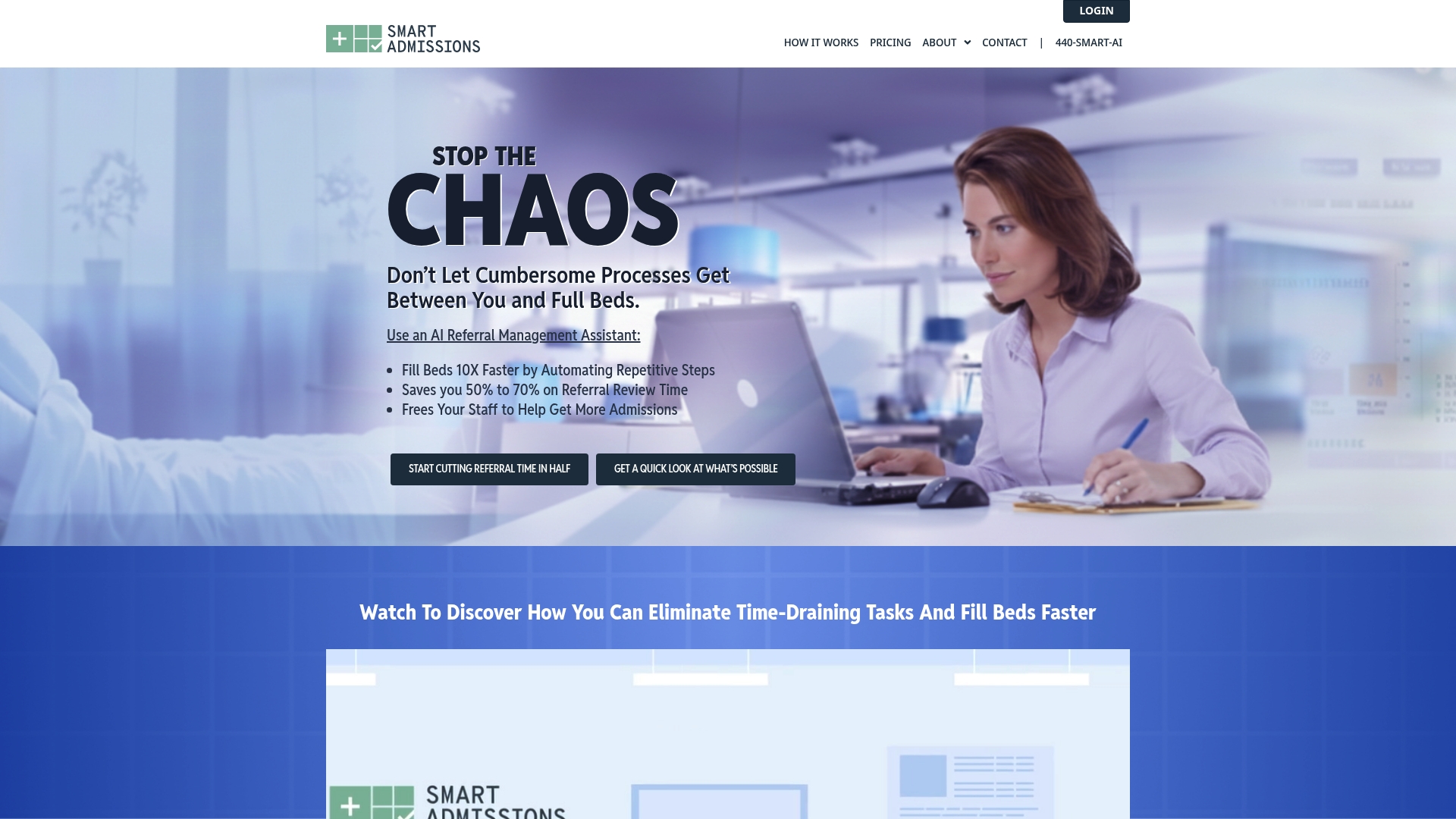
Every step in the checklist above becomes faster when it runs through one system instead of five disconnected tools. Smart Admissions combines real time eligibility verification, automated prior authorization workflows, and EMR integration into a single referral screen, so your team checks coverage, flags missing documentation, and submits PA requests without switching between payer portals and spreadsheets.
What the platform covers for your admissions desk:
- Real time eligibility and PA requirement checks at the moment a referral arrives.
- Documentation templates that match physician certification and MDS timing requirements.
- EMR and insurance portal integration, so case data does not need to be re-entered by hand.
- Analytics that track pend rate, adjudication time, and bed fill rate by payer.
Onboarding takes under an hour, support is responsive when a payer rule changes, and Smart Admissions offers a risk free guarantee that the platform pays for itself within 30 days. Plans run $597 per month or $6,447 per year, detailed on the Smart Admissions pricing page. If your team is ready to see what automated intake looks like day to day, request a trial and compare your current pend rate against what automation delivers in the first 30 days.
Sources
- CMS Finalizes Rule to Expand Access to Health Information and Improve the Prior Authorization Process
- CAQH/Case study: Prior Authorization automation pilot outcomes
- MedPAC prior-authorization analysis (2025)
- AMA on prior authorization burdens and delayed care
FAQ
What is the fastest way to reduce admission denials?
The fastest results come from pairing real time eligibility verification with complete clinical documentation at the point of referral, before the bed is held. Automating prior authorization submissions on top of that further cuts pended requests, since CAQH pilot data shows automation reduced pended requests by more than 37%.
What is Condition Code 04 and why does it cause denials?
Condition Code 04 relates to how a claim is coded when a provider believes a payer incorrectly denied coverage, and misapplying it is a recurring administrative error documented in CMS skilled nursing facility reason code guidance. Flagging any referral tagged with this code for a second review before intake prevents most related denials.
How long does a payer have to decide on a prior authorization request?
Under the CMS final rule, impacted payers must decide within 72 hours for expedited requests and seven calendar days for standard requests, with general compliance primarily delayed to 2027. Until payers fully comply, timelines can vary, so logging submission dates and case IDs remains important.
Should admissions teams appeal every denial?
No. A denial caused by a missing document is usually faster to fix through resubmission, while a denial based on a coverage rule dispute calls for a formal appeal with supporting clinical evidence. MedPAC’s analysis found that reconsiderations in Medicare Advantage are often approved, which supports pursuing timely appeals when the clinical case is strong.
Does Smart Admissions help with prior authorization specifically?
Yes, Smart Admissions automates prior authorization submissions and real time eligibility checks as part of its referral management platform, integrating with existing EMR and insurance portals. Pricing is listed on the Smart Admissions pricing page at $597 per month or $6,447 per year.