
Every admissions coordinator knows the frustration of manual paperwork slowing down patient intake. When each referral brings piles of documents, authorizations, and insurance checks, delays impact care and strain your team. For skilled nursing facilities across the United States, Canada, and Europe, efficient workflow automation means your staff spends less time on repetitive data entry and more time supporting patients. Discover which automation features actually simplify your admissions process and create measurable improvements in speed, accuracy, and staff satisfaction.
Table of Contents
- Defining Healthcare Workflow Automation In Patient Intake
- Types Of Automation In Skilled Nursing Admissions
- Core Features And Integration With EMR Systems
- Real-World Benefits For Staff And Facility Operations
- Risks, Compliance Challenges, And Common Mistakes
Key Takeaways
| Point | Details |
|---|---|
| Healthcare Workflow Automation | Automating patient intake processes saves time and reduces errors, enhancing operational efficiency in skilled nursing facilities. |
| Impact on Admissions Teams | Workflow automation allows staff to focus more on patient care rather than administrative tasks, thus improving job satisfaction and reducing burnout. |
| Types of Automation | Key automation types like data extraction and real-time insurance verification streamline admissions, significantly compressing intake timelines. |
| Importance of EMR Integration | Effective automation relies on seamless EMR integration to eliminate manual data entry and ensure consistent patient information across systems. |
Defining healthcare workflow automation in patient intake
Healthcare workflow automation means designing and automating routine tasks that happen repeatedly across your facility. Rather than having staff manually handle each step, intelligent systems take over, following predefined rules to complete work consistently and accurately.
For skilled nursing homes and rehabilitation centers, this directly impacts how quickly you can admit new patients. Manual intake processes involve dozens of individual steps—verification, documentation, compliance checks, insurance review. Each handoff between staff members creates delays and opens the door to errors.
Workflow automation eliminates these friction points. Instead of a coordinator manually entering patient data, verifying insurance eligibility, and routing paperwork across departments, the system does this work automatically, often completing in minutes what once took hours.
Why This Matters for Your Admissions Team
Patient intake in skilled nursing facilities involves more moving parts than most realize. You’re juggling clinical assessments, insurance verification, bed management, and compliance documentation simultaneously. Without automation, each referral becomes a bottleneck.
Intelligent rule-based systems replace repetitive human actions, meaning your team spends less time on data entry and more time on patient care decisions. Automation also standardizes how tasks get completed—no variation based on who’s working that day.
Key processes that benefit from automation include:
- Patient registration and eligibility verification
- Insurance coverage confirmation and authorization
- Clinical assessment routing to appropriate staff
- Documentation management and filing
- Bed availability updates and occupancy tracking
- Referral tracking through each admission stage
Think about your current process. How many times does patient information get entered into different systems? How often do coordinators wait for insurance responses before moving forward? Each delay compounds.
The Real Impact on Your Operations
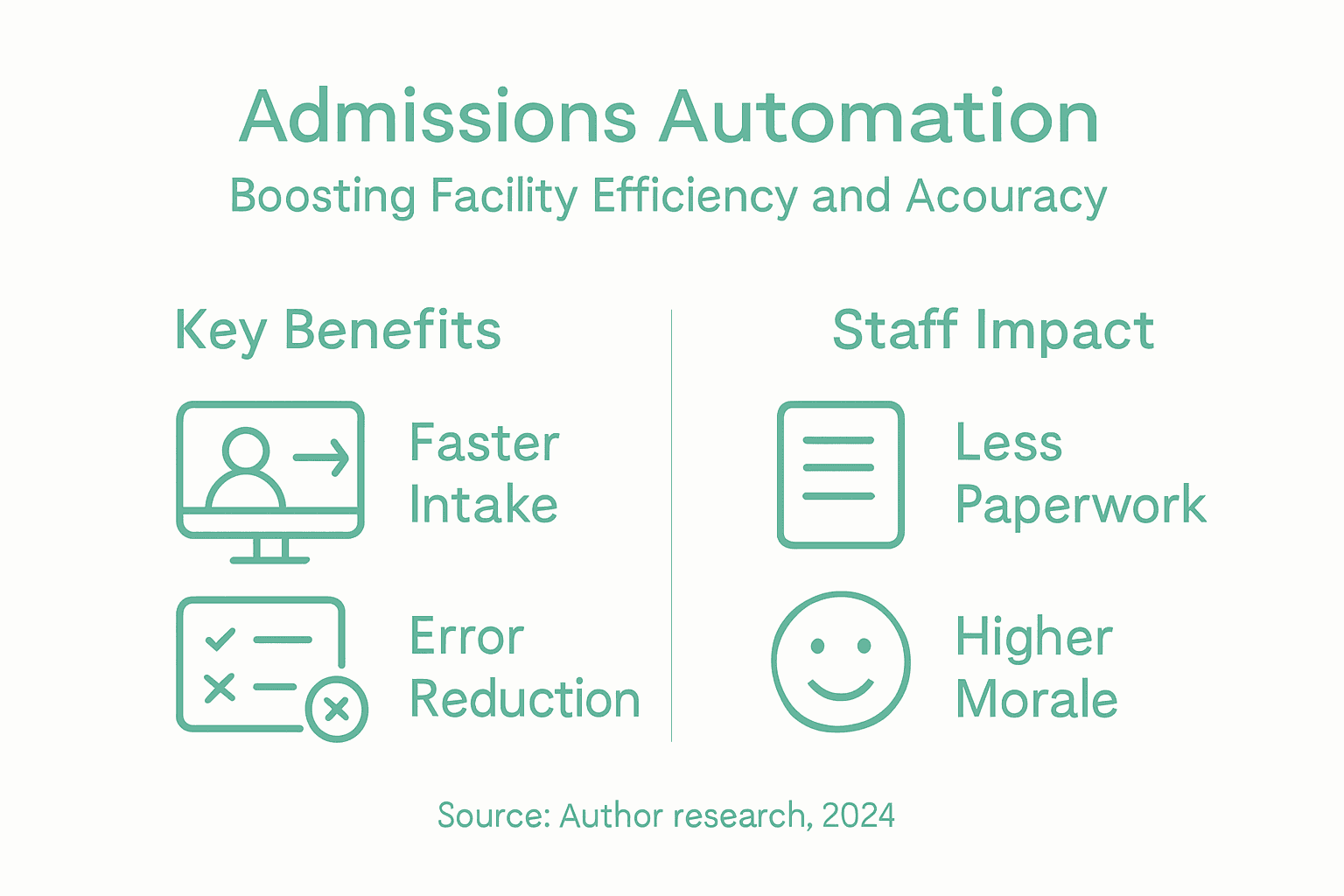
When you automate healthcare workflow automation processes, three things happen immediately. First, admission timelines compress dramatically—what took 2-3 days now takes hours. Second, your team stops repeating the same manual tasks, reducing burnout and freeing them for higher-value work. Third, errors drop because rules are applied consistently every single time.
Compliance becomes easier too. Automated workflows ensure your facility meets privacy standards and regulatory requirements without requiring manual oversight of every file.
Workflow automation standardizes admissions quality while cutting cycle times—your facility moves patients into beds faster while reducing administrative burden on your team.
For facilities managing multiple referral sources and complex insurance scenarios, automation transforms what feels chaotic into something predictable and measurable.
Pro tip: Start by mapping your current admission process from referral to occupancy, identifying which steps happen most frequently and which create the longest delays—those manual tasks are your highest-impact automation targets.
Types of automation in skilled nursing admissions
Automation in skilled nursing admissions comes in several distinct forms, each targeting different pain points in your intake workflow. Understanding these types helps you identify which solutions will deliver the biggest impact on your facility’s operations.
The most common automation types address the repetitive, high-volume tasks that consume your team’s time. Rather than replacing staff, these tools amplify what your team can accomplish by handling the manual work that slows down patient processing.
Data Extraction and Document Processing
Intelligent data extraction from referral documents eliminates manual transcription entirely. Instead of a coordinator reading through faxes and entering information line by line, automation pulls relevant patient details automatically—demographics, medical history, insurance information, clinical flags.
This single capability transforms your workflow. Referrals arrive, the system extracts key data, and your team reviews accurate information within minutes rather than hours.
Key extraction targets include:
- Patient demographics and contact information
- Insurance provider and policy details
- Primary diagnosis and relevant clinical history
- Physician orders and special care requirements
- Hospital discharge summaries and clinical notes
Real-Time Insurance Verification
Waiting for insurance responses creates unnecessary delays in admissions. Automated eligibility verification checks coverage status, benefits, and authorization requirements instantly by connecting directly to payer systems.
Your coordinator no longer makes phone calls to insurance companies and waits on hold. The system validates coverage while the patient is still being discussed with the referring physician.
Predictive Analytics and Care Routing
Predictive analytics for care needs analyze incoming patient information to anticipate staffing, equipment, and resource requirements before admission. This allows your team to prepare appropriate care plans and assign beds strategically.

Instead of discovering care complexity after admission, you know what you’re preparing for in advance. This improves both patient outcomes and operational efficiency.
Workflow Orchestration
Automation doesn’t just handle individual tasks—it coordinates entire processes. Workflow orchestration moves patient information between departments automatically, triggers required approvals, and alerts staff when action is needed.
A referral enters your system, and the workflow automatically routes it for clinical review, initiates insurance verification, updates bed availability, and notifies your admissions team when everything is ready for final approval. No manual handoffs. No forgotten steps.
Automation types work together to compress timelines and reduce errors—your facility moves from reactive processing to proactive patient preparation.
Pro tip: Prioritize automation for your highest-volume, most error-prone tasks first—usually referral data entry and insurance verification—then expand to clinical routing and predictive assignment once your team adapts to the new workflow.
Here’s how leading types of admissions automation deliver value across your workflow:
| Automation Type | Main Focus | Primary Benefit | Key Business Impact |
|---|---|---|---|
| Data Extraction | Pulls patient info from documents | Accelerates data availability | Fewer manual entry errors |
| Insurance Verification | Real-time payer checks | Shortens verification time | Faster admissions, fewer denials |
| Predictive Analytics | Forecasts care and resource needs | Optimized staff allocation | Smoother patient transitions |
| Workflow Orchestration | Coordinates steps and alerts | Reduces handoffs | Higher consistency, less oversight |
Core features and integration with EMR systems
EMR integration is the backbone of modern admissions automation. Without it, your automation tools exist in isolation, creating new data silos rather than solving the problem of disconnected systems.
When admissions automation connects directly to your electronic medical record system, patient information flows automatically between platforms. No manual data entry. No duplicate records. No waiting for information to arrive in the right place.
What EMR Integration Actually Does
Real-time syncing of patient data means information entered in your admissions workflow instantly appears in your clinical record system. A patient’s insurance verification, clinical assessment, and bed assignment all populate automatically where clinicians need to see them.
Your nursing staff starts preparing care the moment admission is approved, not hours later when someone manually transfers information from one system to another.
Core integration features include:
- Automatic patient data transfer between systems
- Real-time eligibility and insurance status updates
- Clinical assessment data flowing to care planning systems
- Bed management synchronized with occupancy records
- Compliance documentation automatically filed in appropriate locations
- Two-way communication allowing updates to flow back to admissions
Interoperability and Data Standards
Interoperability means your admissions platform speaks the same language as your EMR. Most modern systems use standards like HL7 and FHIR to ensure different software applications can exchange information reliably.
Without these standards, integration becomes a custom coding project for each connection. With them, your system works seamlessly with whatever EMR you’re using today and whatever you might switch to tomorrow.
Security and Compliance Built In
EMR integration requires robust security controls to protect patient information during transfer. Your admissions platform must encrypt data in transit, authenticate systems before sharing information, and maintain audit trails showing exactly who accessed what and when.
This isn’t optional compliance overhead. Proper integration actually protects your facility by preventing unauthorized access and creating accountability.
The Real Operational Impact
When everything connects properly, your admissions coordinator handles the patient intake conversation. The system does everything else—pulling information from the referral, updating the medical record, verifying insurance, alerting the care team, updating bed status.
One person completes work that once required five handoffs across different departments. Errors drop because data enters the system once and syncs everywhere automatically.
Proper EMR integration eliminates manual data entry and creates a single source of truth for patient information across your entire facility.
Pro tip: Before selecting an admissions automation platform, verify it integrates with your specific EMR version and confirm what data fields sync automatically versus what requires manual mapping or configuration.
Real-world benefits for staff and facility operations
The true measure of admissions automation isn’t what the system promises—it’s what actually happens to your team and your bottom line when you implement it. Real facilities see measurable improvements across multiple areas simultaneously.
Below is a comparison of outcomes before and after admissions automation implementation:
| Metric | Manual Admissions | Automated Admissions | Organizational Impact |
|---|---|---|---|
| Intake Time | 2-3 days typical | Few hours or less | Increased bed occupancy |
| Staff Burnout | High | Significantly reduced | Higher retention and morale |
| Error Rate | Frequent | Greatly minimized | Improved compliance, fewer denials |
| Administrative Costs | Substantial | Noticeably lower | Increased profit margin |
Staff experience the most immediate impact. Coordinators stop spending entire shifts on data entry and paperwork. Clinical teams get accurate information faster. Administrators see occupancy rates improve and staffing burnout decrease.
Time Freed for Patient Care
Healthcare automation reduces administrative burdens on your entire team by handling routine documentation, scheduling, and insurance work automatically. Your admissions coordinator focuses on patient conversations and relationship building rather than manual form completion.
Nurses start care preparation immediately after admission approval instead of waiting for scattered information to arrive. Physicians spend less time on paperwork and more time on clinical decisions. This shift alone improves job satisfaction across departments.
Staff time savings typically include:
- Referral processing reduced from 45+ minutes to under 5 minutes
- Insurance verification handled automatically instead of phone calls
- Clinical documentation populated from source data automatically
- Bed assignments made instantly using real-time occupancy data
- Follow-up tasks triggered and tracked automatically
Operational Efficiency and Revenue Impact
Workflow automation decreases manual data entry and improves interdepartmental communication, leading to faster patient scheduling and fewer billing errors. Your facility admits patients more quickly, occupying beds that would otherwise sit empty.
Facilities managing referrals from multiple hospitals and physicians see dramatic efficiency gains. Admission timelines compress from days to hours. This directly increases bed fill rates and revenue per admission cycle.
Accuracy and Compliance
Manual processes create errors. Someone misreads insurance information. A clinical flag gets missed. Compliance documentation lands in the wrong place. Automated workflows apply the same rules identically every time.
When insurance eligibility verification runs automatically for every referral, authorization denials disappear. When clinical data syncs automatically to care plans, nothing falls through cracks. Your facility strengthens regulatory compliance while reducing risk.
Staff Satisfaction and Retention
Automation minimizes paperwork and alleviates clinician burnout, contributing to better overall facility performance. Staff stay longer because their jobs feel manageable again. Turnover decreases. Training costs drop.
Your experienced coordinators and nurses stick around because they’re doing meaningful work instead than administrative drudgery.
Admissions automation simultaneously improves patient outcomes, staff satisfaction, and facility revenue—making it one of the highest-impact operational changes you can implement.
Pro tip: Track your current admission timeline from referral receipt to first patient treatment, then measure the same metric monthly after implementation—this concrete metric demonstrates ROI to leadership and motivates staff to embrace the new workflow.
Risks, compliance challenges, and common mistakes
Admissions automation delivers real benefits, but implementing it poorly creates new problems faster than it solves old ones. Understanding the risks upfront helps you avoid costly mistakes that undermine the entire initiative.
The biggest failures happen when facilities rush implementation without proper planning. They skip stakeholder buy-in, ignore workflow realities, or underestimate training needs. These mistakes turn a promising solution into staff frustration and operational chaos.
Data Privacy and Regulatory Compliance
Healthcare workflow automation must ensure data privacy while meeting complex regulatory requirements like HIPAA, state privacy laws, and insurance verification standards. Your system handles sensitive patient information constantly—mishandling it exposes your facility to fines, lawsuits, and patient trust erosion.
Automation systems must encrypt data in transit and at rest, authenticate every access, and maintain detailed audit trails. Inadequate security implementation negates any efficiency gains by creating liability.
Workflow Misalignment
Automation fails when it doesn’t match how your team actually works. A system designed around a generic workflow won’t fit your facility’s specific processes, referral sources, or clinical practices.
Common misalignment issues include:
- Automation routing referrals incorrectly for your clinical team structure
- System requiring data entry in fields your referrers don’t provide
- Automated decisions overriding legitimate clinical judgment
- Insurance verification rules not matching your payer network
- Bed assignment logic ignoring your facility’s unit-based care models
Insufficient Stakeholder Engagement
Your staff are the experts on what works and what doesn’t. Implementing automation without their input almost guarantees resistance and workarounds that defeat the system’s purpose.
Admissions coordinators, nurses, physicians, and IT staff all see different aspects of the workflow. Inadequate stakeholder engagement and failing to align automation with clinical workflows represents one of the most common implementation mistakes facilities make.
Involve your team early. Show them the system before full rollout. Listen to their concerns. Modify the system based on their feedback.
Underestimating Training and Change Management
Your team needs genuine training, not just a quick demo. Staff who don’t understand the system create manual workarounds, defeating automation benefits entirely.
Plan for ongoing support beyond initial training. New staff need training. Your team needs refreshers when processes change. Leadership needs to see adoption metrics and address resistance quickly.
AI Bias and Decision Quality
Automated systems making clinical or admission decisions can embed bias if not carefully designed. An algorithm trained on historical data might perpetuate past inequities in care access or bed assignment.
Successful automation requires cross-disciplinary collaboration, thorough planning, and ongoing evaluation to identify and address risks before they harm patients or operations.
Pro tip: Before full implementation, run a parallel pilot where your automation system and your current manual process run simultaneously for 2-4 weeks—compare outputs to catch misalignments before they affect real admissions.
Transform Your Healthcare Admissions with Smart Automation
The article highlights common challenges like lengthy patient intake times, manual data entry errors, and staff burnout that skilled nursing and rehabilitation centers often face. If your team struggles with coordinating insurance verification, clinical assessments, and bed management under tight deadlines, you are not alone. The key goals are clear: reduce referral review times, eliminate repetitive administrative tasks, and speed up admissions without sacrificing accuracy or compliance.
Smart Admissions offers a tailored solution to these exact pain points. Our AI-powered platform automates critical workflow components such as real-time insurance verification, intelligent data extraction, and seamless EMR integration. By centralizing your referral management, Smart Admissions turns complicated intake processes into efficient, error-free workflows—freeing your staff to focus on quality patient care.
Ready to accelerate your admission cycle and improve staff satisfaction? Visit Smart Admissions today and discover how our adaptive automation platform delivers faster bed occupancy, reduced burnout, and improved revenue. Don’t wait another day to transform your facility’s admissions efficiency with a system built specifically for healthcare providers.
Frequently Asked Questions
What is healthcare workflow automation?
Healthcare workflow automation involves designing and automating routine tasks that occur repeatedly in healthcare facilities, allowing intelligent systems to handle these processes efficiently and accurately.
How does workflow automation impact patient admissions?
By automating the patient intake process, workflow automation reduces admission timelines significantly, allowing facilities to admit patients much faster and reducing manual errors in data entry and verification tasks.
What types of tasks can be automated in skilled nursing admissions?
Common tasks that can be automated include patient registration, insurance verification, clinical assessment routing, documentation management, and bed availability updates, streamlining the entire intake process.
How does EMR integration enhance healthcare workflow automation?
EMR integration allows patient data to flow seamlessly between admissions automation tools and electronic medical records systems, eliminating manual data entry and ensuring that all relevant information is available in real-time for clinical teams.