
Every admissions coordinator knows the frustration of paperwork pileups and unclear communication slowing down patient referrals. Streamlining skilled nursing facility intake processes is vital for staying competitive and ensuring steady revenue, but outdated workflows can hold teams back. This guide breaks down proven strategies for reducing administrative burden and harnesses recent advancements in automation and analytics to help admissions leaders achieve faster, error-free patient intake.
Table of Contents
- Step 1: Assess Current Intake Workflow Challenges
- Step 2: Integrate AI-Powered Referral Management Tools
- Step 3: Automate Eligibility Verification and Documentation
- Step 4: Monitor Performance Metrics and Workflow Efficiency
- Step 5: Refine Processes Based on Real-Time Analytics
Quick Summary
| Key Message | Explanation |
|---|---|
| 1. Assess Workflow Challenges | Identify bottlenecks in current intake processes to enhance efficiency and speed for patient admissions. |
| 2. Integrate AI Technologies | Implement AI-powered referral management tools to automate tasks and reduce administrative burdens in the admissions workflow. |
| 3. Automate Documentation Processes | Utilize intelligent automation strategies to streamline eligibility verification and documentation, minimizing manual data entry errors. |
| 4. Monitor Performance Metrics | Regularly track key performance indicators to continuously optimize workflows and identify areas requiring improvement. |
| 5. Refine Processes Using Analytics | Use real-time analytics to make informed adjustments, improving overall intake efficiency on an ongoing basis. |
Step 1: Assess Current Intake Workflow Challenges
Successful admissions optimization begins with a comprehensive assessment of your current intake workflow. By systematically analyzing existing processes, skilled nursing facilities can identify critical bottlenecks and inefficiencies that hinder patient referral and admission speed.
To conduct an effective workflow assessment, start by mapping out your entire intake process using these strategic steps:
- Document each step of your current patient referral process
- Time how long each stage typically takes
- Identify points where documentation or communication delays occur
- Track the number of manual data entry tasks
- Review current technology and software integration levels
Research indicates that complex workflow management challenges significantly impact operational efficiency. By breaking down your existing system, you can pinpoint specific areas requiring improvement.
Key areas to examine include referral receipt, insurance verification, clinical documentation review, bed availability matching, and final admission confirmation. Pay special attention to manual handoff points and communication gaps between different departments.
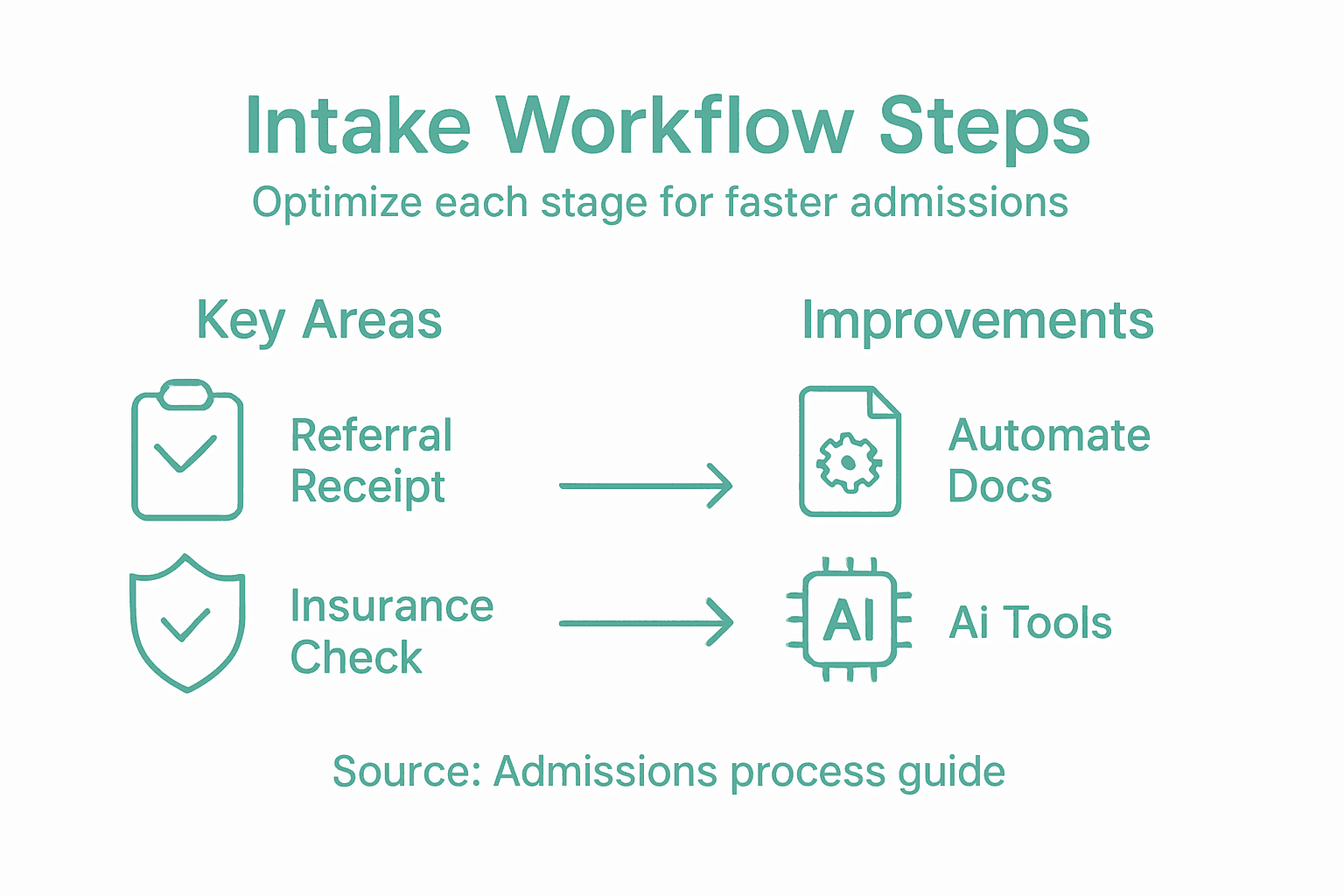
Here’s a summary of critical workflow challenges and their potential impact:
| Workflow Challenge | Potential Impact | Example Scenario |
|---|---|---|
| Manual data entry | Slower admissions, errors | Staff manually entering forms |
| Communication delays | Missed referrals, frustration | Waiting for email responses |
| Poor system integration | Duplicate work, confusion | Data entry in multiple tools |
| Unclear handoff points | Lost tasks, accountability gaps | No assigned next step owner |
| Incomplete documentation | Delayed admission decisions | Missing insurance paperwork |
Understanding your current workflow is the foundational first step toward meaningful optimization.
Pro tip: Create a visual workflow diagram to help your team easily recognize inefficiencies and potential improvement opportunities.
Step 2: Integrate AI-Powered Referral Management Tools
Transforming your skilled nursing facility’s intake process requires strategic implementation of AI-powered referral management technologies. These advanced tools can dramatically reduce administrative burden and accelerate patient admission timelines by automating complex workflow tasks.
To successfully integrate AI referral management tools, follow these critical steps:
- Assess current Electronic Medical Record (EMR) system compatibility
- Research AI solutions specifically designed for healthcare intake processes
- Evaluate tools with HIPAA compliance and robust data security features
- Schedule demonstrations with potential AI referral management vendors
- Create a phased implementation plan with clear milestone tracking
AI-powered workflow technologies offer transformative capabilities for streamlining repetitive administrative tasks. By selecting the right platform, your facility can reduce referral review times, minimize manual data entry, and enhance overall operational efficiency.
Key integration considerations include seamless system interoperability, machine learning capabilities for predictive insights, and real-time communication features. Focus on tools that can automatically verify patient eligibility and extract critical documentation with minimal human intervention.
Successful AI tool integration requires a strategic approach that balances technological innovation with practical workflow needs.
Pro tip: Involve your frontline admissions staff throughout the AI tool selection and implementation process to ensure the technology truly meets their operational requirements.
Step 3: Automate Eligibility Verification and Documentation
Streamlining patient intake requires implementing intelligent automation strategies that transform traditional manual documentation processes. By leveraging advanced technological solutions, skilled nursing facilities can dramatically reduce administrative overhead and accelerate patient admission timelines.
To effectively automate eligibility verification, consider these essential implementation strategies:
- Integrate Intelligent Document Processing (IDP) technologies
- Implement robust digital signature verification systems
- Configure automated document extraction workflows
- Establish real-time insurance and benefits validation protocols
- Create standardized digital document submission channels
Intelligent document processing techniques enable healthcare facilities to overcome traditional documentation challenges by reducing manual data entry errors and processing times. Automated systems can quickly validate patient credentials, verify insurance information, and extract critical intake documentation with unprecedented accuracy.

Key automation features should include machine learning algorithms that can recognize complex document formats, cross-reference eligibility criteria, and flag potential discrepancies in real-time. Focus on solutions that provide secure digital document management and instant verification capabilities across multiple document types.
Compare how automation and AI tools improve the admissions workflow:
| Area Improved | Before Optimization | After AI & Automation |
|---|---|---|
| Referral processing | Takes several hours or days | Completed within minutes |
| Data accuracy | Frequent manual errors | Automated validation reduces errors |
| Staff workload | High administrative burden | Lower with streamlined steps |
| Admission predictions | Reactive, based on past trends | Proactive with real-time insights |
Effective eligibility verification automation transforms administrative bottlenecks into streamlined, efficient processes.
Pro tip: Select automation tools that offer comprehensive audit trails and maintain strict HIPAA compliance to ensure both operational efficiency and patient data protection.
Step 4: Monitor Performance Metrics and Workflow Efficiency
Tracking and analyzing key performance indicators is crucial for continuously improving your skilled nursing facility’s intake process. By implementing systematic performance monitoring, you can identify bottlenecks, optimize workflows, and enhance overall operational effectiveness.
To effectively monitor workflow performance, focus on these critical metrics and strategies:
- Track patient referral processing times
- Measure documentation completion rates
- Calculate average admission cycle duration
- Monitor staffing efficiency and workload distribution
- Analyze referral acceptance and rejection percentages
Learning analytics in admissions performance provide powerful insights into workflow optimization. Advanced analytical techniques enable skilled nursing facilities to detect inefficiencies, predict potential bottlenecks, and make data-driven decisions to streamline intake processes.
Key performance monitoring should include real-time dashboards that visualize critical metrics, enabling your team to quickly identify areas requiring immediate attention. Implement predictive performance analytics that not only report current status but also forecast potential workflow challenges before they impact patient admissions.
Continuous performance monitoring transforms operational data into actionable strategic insights.
Pro tip: Schedule monthly performance review meetings to discuss metric trends and collaborate on workflow improvement strategies with your entire admissions team.
Step 5: Refine Processes Based on Real-Time Analytics
Transforming your skilled nursing facility’s intake process requires a dynamic approach that leverages continuous data-driven insights. Real-time analytics provide the critical intelligence needed to identify inefficiencies, predict potential challenges, and implement targeted improvements across your admissions workflow.
To effectively refine your processes, implement these strategic analytics-driven refinement techniques:
- Establish baseline performance metrics
- Create quarterly process improvement goals
- Develop adaptive workflow modification protocols
- Configure automatic performance alerts
- Design iterative feedback mechanisms
Real-time data analytics strategies enable healthcare facilities to transform raw operational data into actionable insights. By continuously monitoring key performance indicators, your team can make precise, incremental improvements that compound over time to significantly enhance overall intake efficiency.
Successful process refinement requires a holistic approach that combines quantitative metrics with qualitative team feedback. Implement dynamic dashboard visualization tools that provide instant visibility into workflow performance, allowing your admissions team to quickly identify and address potential bottlenecks before they impact patient intake.
Continuous improvement is not a destination, but an ongoing journey of incremental enhancements.
Pro tip: Rotate team members through different analytics review roles to ensure diverse perspectives and prevent potential blind spots in your process improvement strategies.
Accelerate Your Skilled Nursing Facility Admissions with Smart Admissions
The article highlights critical challenges such as manual data entry, communication delays, and inefficient eligibility verification that slow down skilled nursing facilities’ intake workflows. These pain points cause frustration, increase staff burnout, and delay bed occupancy—all obstacles standing between your facility and operational success. Concepts like AI-powered referral management and automated document processing are essential for transforming these bottlenecks into streamlined, effective workflows.
At Smart Admissions, we understand these specific challenges. Our SaaS platform is designed to seamlessly integrate with your existing EMR and insurance portals to automate repetitive tasks, provide real-time eligibility verification, and deliver actionable analytics. This helps you reduce referral review times, decrease administrative errors, and enhance decision-making. By adopting advanced AI solutions that align perfectly with the intelligent automation and workflow optimization strategies detailed in the article, your facility can increase bed fill rates, lower staff burnout, and improve overall financial outcomes.
Ready to transform your intake process and achieve faster admissions success with cutting-edge technology?
Streamline your patient referral management today with Smart Admissions and experience the future of healthcare admissions.
[Image:cta_image]
Explore how our AI-powered referral assistant can revolutionize your admissions workflow. Visit Smart Admissions to get started and take the first step toward operational efficiency and sustainable growth.
Frequently Asked Questions
What steps can I take to assess my current intake workflow challenges?
Start by mapping out your entire intake process, documenting each step and timing how long each stage takes. Identify areas with communication delays and manual data entry tasks to pinpoint specific inefficiencies you can address immediately.
How can AI-powered referral management tools improve my admissions process?
AI-powered referral management tools can automate many administrative tasks, reducing manual data entry and speeding up the referral review process. Implement these tools to potentially decrease admission times from several hours to just minutes.
What strategies should I follow to automate eligibility verification?
To automate eligibility verification, consider integrating Intelligent Document Processing technologies and establishing real-time validation protocols. Implement standardized digital document submission channels to streamline the process and enhance accuracy.
How can I monitor performance metrics to improve my intake process?
Tracking key performance indicators, such as patient referral processing times and documentation completion rates, is essential. Set up real-time dashboards to visualize these metrics, allowing your team to make informed adjustments based on performance trends.
What best practices can I use to refine my intake processes based on real-time analytics?
Implement baseline performance metrics and develop quarterly improvement goals to continually enhance your intake processes. Utilize dynamic dashboard visualization to quickly identify areas for improvement and make iterative adjustments as needed.
How often should I review and adjust my admissions intake workflow?
Schedule monthly performance review meetings with your admissions team to discuss metric trends and collaboratively identify areas for improvement. Regular adjustments ensure that your workflow remains efficient and responsive to changes.