
If you've ever squinted at a faded, coffee-stained DD214 from 1952 trying to figure out where the discharge type is hiding, you're not alone. Veterans SNF facilities deal with DD214 forms spanning eight decades of military history, and let's just say the Department of Defense wasn't thinking about your admissions team when they redesigned the form every few years.
The good news? AI-powered DD214 verification is changing the game. No more guessing, no more Googling "where is re-enlistment code on 1970s DD214," and definitely no more accidentally admitting someone whose eligibility is… questionable.
Let's break down why DD214 format variations are such a headache and how modern veterans SNF software takes the pain out of the process.
The DD214: A Brief (and Messy) History
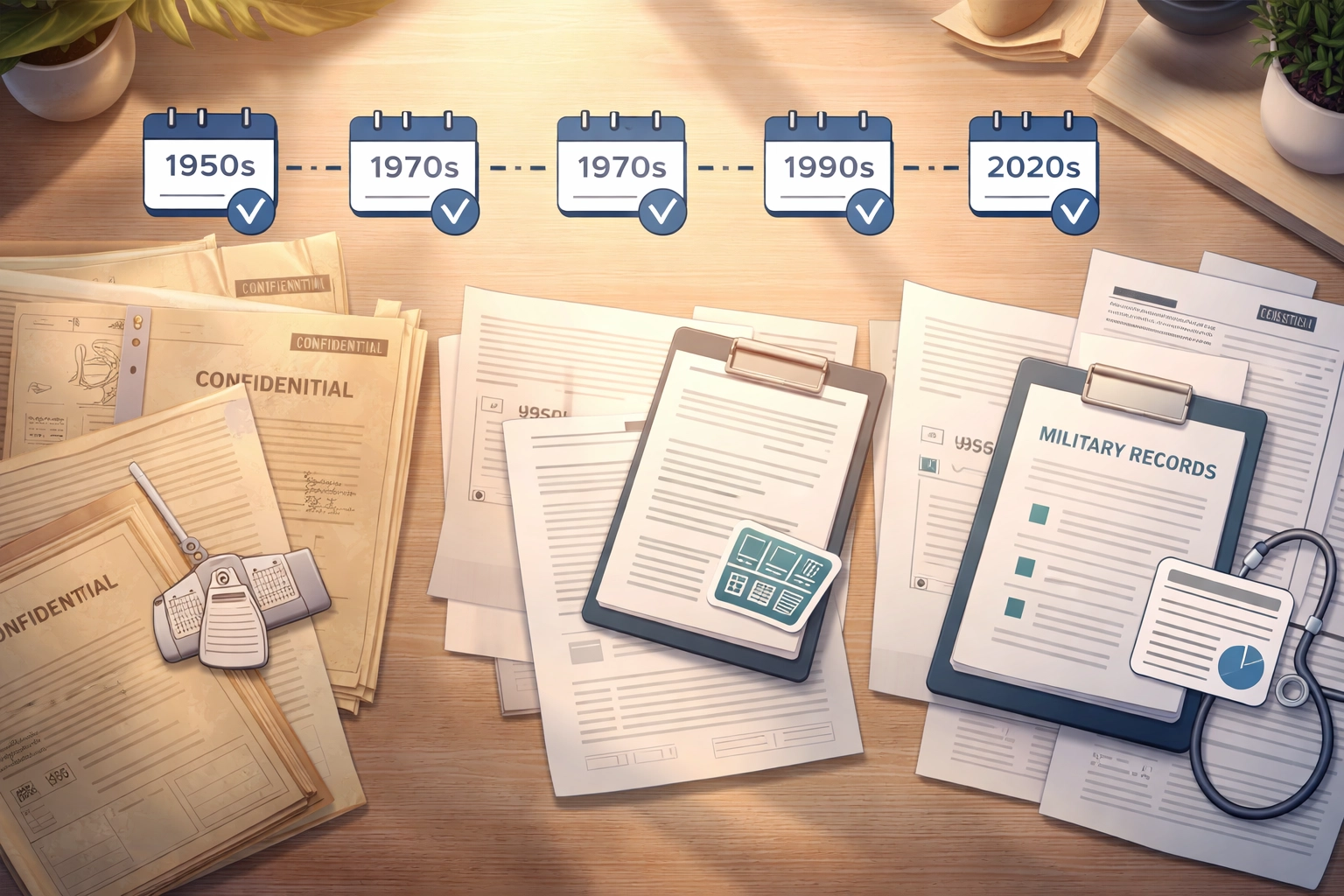
The DD214 has been the official military discharge document since 1950, replacing the older WD AGO forms from World War II. But here's the thing, it hasn't stayed the same. Not even close.
Over the decades, the form has undergone numerous revisions:
- 1950s–1960s: Early versions with different block layouts and terminology
- 1970s–1980s: Significant reformatting with new data fields
- 1990s–2000s: Standardization efforts (that still left plenty of variation)
- 2022 and beyond: Recent updates to comply with DODI 1336.01, changing block numbering and naming conventions
And that's just the official revisions. Factor in the difference between Member 1 (short form) and Member 4 (long form) copies, plus the various service branch variations, and you've got a document identification nightmare on your hands.
Why Format Variations Matter for Veterans SNF Admissions
When a veteran referral comes in, your admissions team needs to verify eligibility quickly. That means confirming:
- Discharge status (Honorable, General, Other Than Honorable, etc.)
- Service dates for VA benefit calculations
- Character of service for state veterans home eligibility
- Re-enlistment eligibility code for certain programs
The problem? These critical data points live in different locations depending on when the veteran separated from service. A discharge type that's clearly labeled in Block 24 on a 2020 DD214 might be buried in a completely different spot on a 1965 version.
Your admissions coordinator isn't a military records historian. They're trying to process referrals efficiently while juggling a dozen other tasks. Expecting them to memorize every DD214 format variation since Truman was president is… unrealistic.
The Eight Copies Problem
Here's another curveball: there are actually eight different copies of every DD214, and not all of them contain the same information.
| Copy | Recipient | Contains Full Info? |
|---|---|---|
| Member 1 (Short) | Service Member | No, missing discharge type, separation reason |
| Member 4 (Long) | Service Member | Yes, the gold standard |
| Service 2, 7, 8 | Military Departments | Yes |
| VA Copy 3 | Department of Veterans Affairs | Yes |
| Member 6 | State VA Director | Yes |
| DOL Copy 5 | Department of Labor | Yes |
When a veteran (or their family) submits paperwork, they might unknowingly provide the Member 1 short form. This edited version deliberately omits the Characterization of Service, Reason for Separation, and Authority for Separation: exactly the information you need for eligibility verification.
An experienced admissions coordinator might catch this. But when you're processing dozens of referrals and the form looks "official enough," mistakes happen.
How AI Handles What Humans Can't (Efficiently)
This is where AI-powered DD214 verification comes in. Modern veterans SNF software doesn't just scan documents: it actually understands them.
Here's how it works:
1. Automatic Format Recognition
AI systems trained on thousands of DD214 variations can instantly identify which version they're looking at. Whether it's a crisp 2024 digital copy or a barely-legible 1958 photocopy, the system knows where to find the relevant data fields.
No more manual cross-referencing. No more searching "DD214 block 24 equivalent 1972" at 4:47 PM on a Friday.
2. Short Form Detection
Remember that Member 1 vs. Member 4 problem? AI catches it immediately. If someone submits an edited short form, the system flags it and requests the complete version before your team wastes time on an incomplete verification.
3. Data Extraction Regardless of Quality
Let's be honest: some of these documents have seen better days. Faded ink, creased folds, scanner artifacts, handwritten corrections… AI-powered optical character recognition (OCR) has gotten remarkably good at extracting accurate data from less-than-perfect source material.
4. Instant Eligibility Assessment
Once the AI pulls the relevant information, it can cross-reference against your facility's specific eligibility criteria. State veterans homes often have particular requirements beyond just "honorable discharge," and automated systems can check all the boxes in seconds.

Real-World Impact on Your Admissions Workflow
Let's talk numbers. Manual DD214 verification typically takes 15–30 minutes per document when you factor in:
- Identifying the form version
- Locating relevant data fields
- Deciphering handwriting or poor-quality scans
- Double-checking against eligibility requirements
- Documenting findings
With AI-powered veterans SNF software, that drops to under a minute. For a facility processing 50+ veteran referrals per month, we're talking about saving 12–25 hours of administrative time. Every single month.
That's time your admissions team can spend on what actually matters: building relationships with referral sources, supporting families through difficult transitions, and ensuring smooth admissions experiences.
Common DD214 Verification Mistakes (And How AI Prevents Them)
Even experienced admissions staff make errors when dealing with DD214 variations. Here are the most common pitfalls:
Accepting incomplete forms: The short form looks official, so it gets processed. Eligibility issues surface weeks later.
Misreading discharge characterization: Older forms used different terminology. "Under Honorable Conditions" isn't the same as "Honorable," and the distinction matters.
Missing re-enlistment codes: These codes (RE-1 through RE-4) affect certain benefit eligibilities but are easy to overlook on unfamiliar form versions.
Date calculation errors: Service dates formatted differently across eras lead to miscalculated benefit periods.
AI doesn't get tired at 3 PM. It doesn't get confused by unfamiliar layouts. It processes every document with the same consistent accuracy, flagging anomalies for human review rather than letting them slip through.
For more on verification mistakes that cost facilities money, check out our deep dive on 7 DD214 verification mistakes that cost veterans SNF facilities thousands.
The Bottom Line
DD214 format variations aren't going away. As long as you're serving veterans who separated anywhere from 1945 to yesterday, you'll encounter documents that look nothing alike. The question is whether you want your admissions team burning hours deciphering historical military paperwork: or whether you'd rather let AI handle the heavy lifting.
Modern DD214 verification technology isn't about replacing your team. It's about freeing them from the tedious, error-prone work that machines genuinely do better, so they can focus on the human side of admissions.
Want to see AI-powered DD214 verification in action? Visit us at the NASVH Conference Booth #6: we'd love to show you how it works with your actual referral documents. Or dive deeper into the technology with our article: How Veterans SNF Facilities Can Verify DD214 Eligibility in Seconds, Not Minutes.