

What are the main types of referral marketing strategies?
The most effective types of referral marketing strategies fall into eight distinct structures: single-sided, double-sided, tiered or milestone, mystery, gamified, advocacy or VIP, charitable, and cash payout programs. Each one solves a different business problem, and choosing the wrong type for your audience is one of the most common reasons programs underperform.
Here is a quick breakdown of all eight:
- Single-sided: Only the referrer receives a reward. Simple to run, but conversion rates are lower because the new customer has no incentive to act.
- Double-sided: Both the referrer and the new customer get a reward. This is the default structure and outperforms single-sided in nearly every published test.
- Tiered or milestone: Rewards scale with the number of referrals made. Harry’s pre-launch program used multiple tiers of referrals, with progressively better gifts at higher levels.
- Mystery rewards: The referrer receives a randomized reward, such as a spin-the-wheel or scratch card result. Surprise mechanics drive curiosity and repeat participation.
- Gamified: Leaderboards, progress bars, and badges create visible competition and social proof among referrers.
- Advocacy or VIP: Top referrers earn status, early product access, or invitations to exclusive events rather than cash or discounts.
- Charitable: Each successful referral triggers a donation to a partner nonprofit. This works particularly well in B2B contexts where the relationship matters more than a discount.
- Cash: Direct cash payouts appeal to high-lifetime-value verticals like fintech and insurance, where the reward feels proportional to the ask.
The right structure depends on your business model, your customer base, and what motivates your audience. A SaaS company targeting enterprise buyers will get more traction from a charitable or advocacy program than from a scratch card. A consumer subscription brand often sees the fastest results from a double-sided cash or discount offer.

1. How cash and monetary reward programs actually work
Cash and monetary referral programs are the most straightforward to explain and the hardest to calibrate correctly. The mechanics are simple: a customer refers someone, and one or both parties receive money, a credit, or a discount. The challenge is setting the reward at a level that motivates action without destroying your margins.
Rewards should be proportional to the gross margin of the referred customer, not to the sale price. A high reward relative to product margin leaves little profit, while a lower reward proportional to the subscription value maintains sustainable unit economics and feels meaningful to the referrer.
Single-sided cash programs reward only the referrer. They are cheaper to run but produce lower conversion rates because the new customer has no financial reason to act on the referral. Double-sided programs cost more per acquisition but consistently outperform single-sided models because the referrer is sharing a deal, not asking a favor.
Common pitfalls with cash programs include:
- Rewarding on signup rather than on a qualifying purchase, which attracts low-intent participants
- Setting rewards so small they are not worth the conversation
- Attracting reward-hunters who churn after collecting the incentive
Pro Tip: Set a minimum qualifying action before any reward is paid out. A purchase, a contract signature, or a completed onboarding step filters out fraud and keeps your program economics intact.
2. Points-based and tiered referral structures
Points-based and tiered programs add a layer of progression that flat cash programs lack. Instead of a one-time payout, participants accumulate points or unlock escalating rewards as they refer more people. That progression keeps them engaged well beyond their first referral.
How points accumulate and get redeemed
- A customer makes a referral that meets the qualifying milestone (purchase, signup, or contract).
- Points are credited to their account automatically.
- Points are redeemable for discounts, free products, gift cards, or account credits at defined thresholds.
- A progress indicator shows how close they are to the next reward level, creating natural urgency.
How tiered rewards work
- Tier 1 (1 referral): A small reward, such as a $10 credit or a free month of service.
- Tier 2 (5 referrals): A mid-level reward, such as a free product or a larger discount.
- Tier 3 (10+ referrals): A premium reward, such as exclusive merchandise, early access, or a significant account credit.
Harry’s pre-launch program is the most cited example of tiered referral mechanics done well. Participants who referred 5 friends received free shaving cream; those who referred 50 received a full year of free blades. The escalating stakes turned casual sharers into active advocates before the product even launched.
Tiered programs consistently outperform flat programs because the reward for referring five friends feels worth the effort in a way that a single flat reward does not. The progress bar mechanic alone, showing “you are 2 referrals away from your next reward,” drives re-engagement without any additional marketing spend.
3. Non-monetary incentives: free products, VIP access, and mystery rewards
Not every customer is motivated by cash. For many audiences, especially in premium or community-driven brands, status and exclusivity outperform discounts. Free product rewards, VIP access programs, and mystery mechanics each tap into different psychological drivers.
Free product and service rewards
Free product rewards work best when the item being offered is something the referrer already values. Dropbox’s early growth was built almost entirely on this mechanic: refer a friend, get extra storage. The reward was directly tied to the product’s core value, which made it feel natural rather than transactional.
- The reward must be something the referrer actually wants, not a low-value promotional item.
- Free service extensions (an extra month, an upgraded tier) work well for subscription businesses.
- The cost to the business is often lower than cash because the marginal cost of a digital reward is near zero.
VIP and advocacy programs
VIP programs reward top referrers with status rather than money. Early product access, invitations to private events, a dedicated account manager, or a public “ambassador” title all signal that the referrer is valued beyond their transaction history. These programs work particularly well in B2B, where the relationship between buyer and vendor carries more weight than a discount.
Mystery reward mechanics
Mystery rewards, such as spin-the-wheel or scratch card mechanics, introduce an element of surprise that drives participation even when the average reward value is lower than a flat cash offer. The unpredictability is the point. Participants share more frequently because each referral feels like a chance to win something bigger.
- Define a reward pool with a mix of high-value and standard prizes.
- Set the probability distribution so the program remains economically viable.
- Reveal the reward immediately after the qualifying milestone is met to maximize the emotional payoff.
- Cap the number of mystery reward entries per participant to prevent gaming.
4. When and how to ask for referrals for maximum results
Timing the referral ask correctly is as important as the reward itself. A well-designed program with a poorly timed ask will underperform a simpler program that catches customers at the right moment.

Embedding referral touchpoints into ongoing customer journeys with automated triggers yields higher sustained engagement than periodic email blasts. The moments that convert best are post-purchase, immediately after a positive support interaction, and at the point when a customer first experiences the product’s core value.
The channel you use to deliver the ask matters as much as the timing. Direct email outperforms social media for referral conversion because it reaches a specific person with a personal message rather than broadcasting to a general audience. Social posts generate awareness; a pre-written email to a specific friend generates action.
Effective referral messaging shares three qualities. It is specific about what the new customer receives. It makes the referral feel like a gift the sharer is giving, not a sales pitch they are delivering. And it removes friction by providing a pre-written message and a one-click share option.
Pro Tip: Do not treat the referral ask as a one-time campaign. Build it into your post-purchase email sequence, your NPS follow-up, and your customer success check-ins so it surfaces consistently without feeling like a blast.
5. What are the real benefits of referral marketing?
Referral marketing consistently delivers a lower cost per acquisition than paid advertising, and the customers it brings in tend to stay longer and spend more. The underlying reason is trust: a recommendation from a known contact carries more weight than any ad.
Referral programs carry a conversion rate advantage of up to 15% or more over standard acquisition channels. That gap reflects the difference between a cold prospect and someone who arrived pre-sold by a person they trust.
The loyalty effect compounds over time. Referred customers tend to refer others at higher rates than customers acquired through paid channels, which means a well-run program creates a self-reinforcing growth loop rather than a one-time acquisition spike. For businesses with tight acquisition budgets, that compounding effect is the most practical argument for investing in referral infrastructure before scaling paid spend.
6. Referral marketing best practices and performance metrics
The difference between a referral program that grows and one that stalls usually comes down to measurement. Most teams track link clicks and call it a day. The programs that actually improve track the metrics that connect referral activity to revenue.
| Metric | What it measures | Threshold to watch |
|---|---|---|
| Participation rate | Share of existing customers enrolled in the program | A low rate signals the program is hard to find or the incentive is weak |
| Referral rate | Percentage of participants who make at least one referral | Under 5% means the incentive or share flow needs work |
| Conversion rate | Percentage of referred prospects who become customers | Low conversion points to a landing page or sales follow-up problem |
| Revenue per referral | Average revenue generated by each referred customer | Compare against acquisition cost from paid channels |
Tracking these four metrics enables continuous optimization: low participation means improving the incentive or visibility; low conversion means fixing the sales handoff or landing page.
For B2B programs, Net Promoter Score (NPS) is the most reliable tool for identifying who to ask. Promoters, those who score 9 or 10 on an NPS survey, are your highest-probability referrers. Targeting your entire customer base with a referral ask wastes effort and dilutes the program’s credibility. Targeting only promoters through a personal outreach from their account manager produces a fundamentally different response rate.
Rewarding referrals only after qualified milestones such as a purchase or contract signature is the most effective fraud prevention measure available. Programs that reward on signup attract low-intent participants and inflate metrics without generating real revenue.
7. How to choose and implement the right referral strategy
Choosing the right referral structure starts with three questions: What motivates your customers? What is your average customer lifetime value? And what resources do you have to manage the program ongoing?
Factors that shape the decision:
- Business type: Retail and e-commerce businesses tend to see strong results from double-sided discount or cash programs. B2B companies generally perform better with charitable donations, exclusive access, or account credits.
- Customer lifetime value: High-LTV customers justify larger rewards and more personalized outreach. Low-LTV customers require tighter reward economics.
- Customer base size: A small, highly engaged customer base supports a VIP or advocacy program. A large, transactional base is better served by an automated double-sided program with minimal friction.
- Available resources: A fully automated program requires upfront investment in software and email sequences. A manually managed program works for early-stage businesses but does not scale.
Steps to implement a referral program:
- Define the qualifying milestone (purchase, contract, completed onboarding).
- Set the reward structure and confirm it is sustainable against your gross margin.
- Build the share flow: a unique tracking link, pre-written message, and one-click share options.
- Configure automated email triggers for welcome, reminder, milestone, and re-engagement messages.
- Set up fraud protection rules: block self-referrals, require verified email addresses, and flag duplicate IP entries.
- Define a sales handoff SLA so referred leads are followed up quickly before they go cold.
- Launch to your existing customer base first, then embed the program into your onboarding and post-purchase flows.
Continuous testing matters as much as the initial setup. Run A/B tests on reward amounts, messaging, and timing. Review your four core metrics monthly and make one change at a time so you can isolate what is working.
8. Referral marketing examples across different industries
The structure that works in one industry often fails in another. Looking at real programs across sectors shows why the choice of incentive and channel is so context-dependent.
Retail and e-commerce: Double-sided discount programs are the standard. A referrer receives a $20 credit; the new customer gets $20 off their first order. The reward is tied directly to a purchase, which filters out low-intent participants and keeps the economics clean.
SaaS and subscription software: Free product extensions are the most common reward. Dropbox’s extra storage model is the canonical example. The reward costs the company almost nothing to deliver, scales with usage, and reinforces the product’s core value proposition.
Fintech and banking: Cash payouts are the norm because the audience is financially sophisticated and the lifetime value is high enough to justify a larger reward. Programs in this category typically require a qualifying action such as a first transaction or a minimum deposit before the reward is paid.
Healthcare: Referral programs in healthcare operate differently from consumer contexts. Patient referrals between providers are governed by the Stark Law and Anti-Kickback Statute, which prohibit financial incentives for patient referrals. The focus shifts to referral partner relationships built on clinical quality, communication, and trust rather than monetary rewards.
B2B professional services: Charitable donations and exclusive access consistently outperform cash in high-relationship B2B contexts. A donation to a charity of the customer’s choice signals that the vendor values the relationship, not just the transaction.
9. How digital and social media channels amplify referral programs
Digital channels give referral programs reach that offline word-of-mouth cannot match, but not all channels convert equally. Understanding where your audience actually shares, and where they actually act, determines how you build your share flow.
Email remains the highest-converting referral channel. A pre-written email to a specific contact feels personal and targeted. The recipient knows who sent it, which means the trust transfer is immediate. Social posts reach a broader audience but convert at lower rates because the message is generic and the audience is diffuse.
SMS performs well for B2C products because it feels direct and personal. A one-click “share via text” option in your referral flow captures the moment when a customer is most enthusiastic, typically right after a positive experience or a purchase confirmation.
Social media works best as a secondary amplification channel rather than a primary conversion driver. LinkedIn is the right platform for B2B referrals; Instagram and Facebook work for consumer brands. Neither should be the first option in your share flow. Build the email and SMS path first, then add social sharing as an additional option for customers who prefer it.
Embedding referral prompts into digital touchpoints, such as post-purchase confirmation pages, onboarding checklists, and in-app notifications, keeps the program visible without requiring a separate marketing push. Programs that rely on periodic email blasts to remind customers about the referral option consistently underperform programs that surface the ask at natural moments in the product experience.
10. How employee referral programs work and why they matter
Employee referral programs are one of the most underutilized forms of compensation and benefits in any industry. They ask employees to recommend qualified candidates or customers from their personal networks, typically in exchange for a cash bonus, extra time off, or a charitable donation.
In recruiting contexts, employee referrals consistently produce faster hires, lower turnover, and better cultural fit than candidates sourced through job boards or agencies. The employee’s personal endorsement pre-qualifies the candidate in a way that a resume alone cannot.
In marketing contexts, employees can serve as brand advocates who share referral links through their own networks. This works particularly well for companies with strong internal cultures, where employees are genuinely enthusiastic about the product or service they work on.
The key design principles for employee referral programs are the same as for customer programs: define a qualifying milestone before the reward is paid, make the referral process frictionless, and track participation and conversion separately. A program that pays out on application rather than on hire or on first purchase will attract low-quality referrals and erode trust in the program over time.
11. How partner and affiliate referral strategies generate scalable growth
Partner and affiliate programs extend your referral reach beyond your existing customer base by recruiting third parties, such as complementary businesses, industry influencers, or content publishers, to refer new customers in exchange for a commission or revenue share.
The distinction between a partner program and an affiliate program is primarily structural. Affiliate programs typically pay a percentage commission on each sale generated through a unique tracking link. Partner programs often involve a deeper relationship: co-marketing, joint sales efforts, and shared customer success resources.
For B2B companies, partner programs built on complementary service relationships tend to produce the highest-quality referrals. A healthcare IT vendor partnering with an EMR implementation firm, for example, reaches decision-makers at the exact moment they are evaluating new technology. The referral arrives with context and credibility that a cold outreach cannot replicate.
Affiliate programs scale faster but require more active management. Commission fraud, low-quality traffic, and misaligned incentives are common problems. Setting a qualifying milestone (a completed purchase, a signed contract, a minimum usage threshold) before any commission is paid addresses most of these issues. Tracking at the conversion level rather than the click level keeps your data clean and your economics predictable.
12. How influencer referral programs differ from standard affiliate models
Influencer referral programs use individuals with established audiences, typically on social media or in niche communities, to refer new customers through personalized endorsements. The difference from a standard affiliate program is the nature of the relationship between the influencer and their audience.
An affiliate publisher drives traffic through content and SEO. An influencer drives action through trust and personal recommendation. That distinction matters for how you structure the program and what you ask the influencer to do.
Effective influencer referral programs share three characteristics. The influencer’s audience genuinely overlaps with your target customer profile. The referral offer is specific and exclusive, such as a discount code unique to that influencer, rather than a generic link. And the influencer has creative freedom to present the product in their own voice rather than reading a script.
The Federal Trade Commission (FTC) requires influencers to disclose paid partnerships clearly and conspicuously. “Ad,” “Sponsored,” or “Paid partnership” labels are required on any post where the influencer received compensation, including free products. Failing to disclose is a legal risk for both the influencer and the brand.
Micro-influencers, those with audiences in the 10,000–100,000 range, often produce better conversion rates than macro-influencers because their audiences are more engaged and the recommendation feels more personal. The cost per referral is also lower, which makes micro-influencer programs more accessible for businesses that are not yet operating at scale.
13. Legal and ethical considerations every referral program must address
Referral marketing operates within a legal framework that varies by industry and jurisdiction. Ignoring these requirements exposes your business to regulatory penalties and damages the trust your program depends on.
FTC disclosure requirements: Any referral program that compensates participants, including with discounts, free products, or cash, requires clear disclosure when those participants promote your brand publicly. This applies to influencers, affiliates, and customers who post about your product in exchange for a reward.
Healthcare-specific regulations: In the United States, the Stark Law and the Anti-Kickback Statute prohibit financial incentives for patient referrals between healthcare providers. These laws apply to skilled nursing facilities, rehabilitation centers, hospitals, and any provider billing Medicare or Medicaid. Violations carry significant civil and criminal penalties. Healthcare referral programs must be built on clinical relationships and communication quality, not financial incentives.
Data privacy: Referral programs that collect contact information for referred friends must comply with applicable privacy laws, including the California Consumer Privacy Act (CCPA) and, for programs with international reach, the General Data Protection Regulation (GDPR). Collecting a friend’s email address through a referral form without their consent is a compliance risk.
Fraud prevention: Rewarding self-referrals, fake accounts, or bot-generated entries is both an economic problem and an ethical one. Programs that do not actively prevent fraud create incentives for participants to game the system, which inflates your metrics and undermines the program’s credibility. Requiring verified email addresses, blocking duplicate IP entries, and setting qualifying milestones before reward payout are the minimum controls every program should have in place.
Ethical program design goes beyond legal compliance. Referral programs that pressure customers to share, obscure the reward terms, or make it difficult to opt out erode the trust that makes referral marketing effective in the first place. Transparency about what participants earn, how the program works, and how their data is used is not just a legal requirement. It is the foundation of a program that customers actually want to participate in.
Key Takeaways
The most effective referral marketing programs combine the right incentive structure with precise timing, clear metrics, and a qualifying milestone that protects program economics from fraud.
| Point | Details |
|---|---|
| Choose the right structure | Double-sided programs outperform single-sided in nearly every published test; match the structure to your audience’s motivations. |
| Protect your margins | Set rewards as a proportion of gross margin on the referred customer, and pay only after a qualifying milestone such as a purchase. |
| Prioritize email over social | Direct email is the highest-converting referral channel because it reaches a specific person with a personal message. |
| Track conversion, not clicks | Participation rate, referral rate, conversion rate, and revenue per referral are the four metrics that drive program improvement. |
| Smartadmissions for healthcare | Smartadmissions automates referral intake workflows for skilled nursing and post-acute care facilities, replacing manual review with AI-driven eligibility verification and clinical assessment. |
Referral marketing in 2026: what the data is actually telling us
The conventional wisdom on referral marketing says “build a program, offer a reward, and watch it grow.” The reality in 2026 is more specific than that, and the gap between programs that compound and programs that plateau comes down to one thing: whether the referral ask is embedded in the customer experience or bolted on as a separate campaign.
The programs generating consistent results are not running quarterly referral pushes. They are surfacing the ask at post-purchase, after a positive support interaction, and at the moment a customer first experiences the product’s core value. Those are the moments when a customer’s enthusiasm is highest and their willingness to share is real. A periodic email blast to your entire list asking for referrals catches most people at the wrong moment and produces a fraction of the engagement.
The shift toward NPS-based targeting in B2B is the most underappreciated development in referral strategy right now. Asking your entire customer base to refer is not just inefficient. It signals to your best customers that you do not know who they are. Targeting only promoters, those who score 9 or 10, through a personal outreach from their account manager produces a fundamentally different response. The ask feels earned rather than automated.
The data on channel preference is also clearer than most programs reflect. Email converts. Social amplifies. SMS converts for B2C. Most programs invert this by leading with social share buttons and treating email as an afterthought. Reversing that order, building the email and SMS path first and adding social as a secondary option, is one of the simplest structural changes a program manager can make with an immediate impact on conversion rate.
What I keep coming back to is this: referral marketing is not a campaign. It is an operational process that runs continuously, surfaces at the right moments, and improves based on four measurable metrics. The businesses that treat it as a campaign will keep seeing campaign-level results. The ones that embed it into their customer journey will see it compound.
Smartadmissions brings automated referral management to healthcare admissions
Healthcare admissions teams face a version of the referral challenge that is more complex than any consumer program. Patient referrals arrive from hospitals, physicians, and discharge planners, each with different documentation requirements, insurance profiles, and clinical criteria. Managing that volume manually means slower intake decisions, higher staff burden, and beds that stay empty longer than they should.
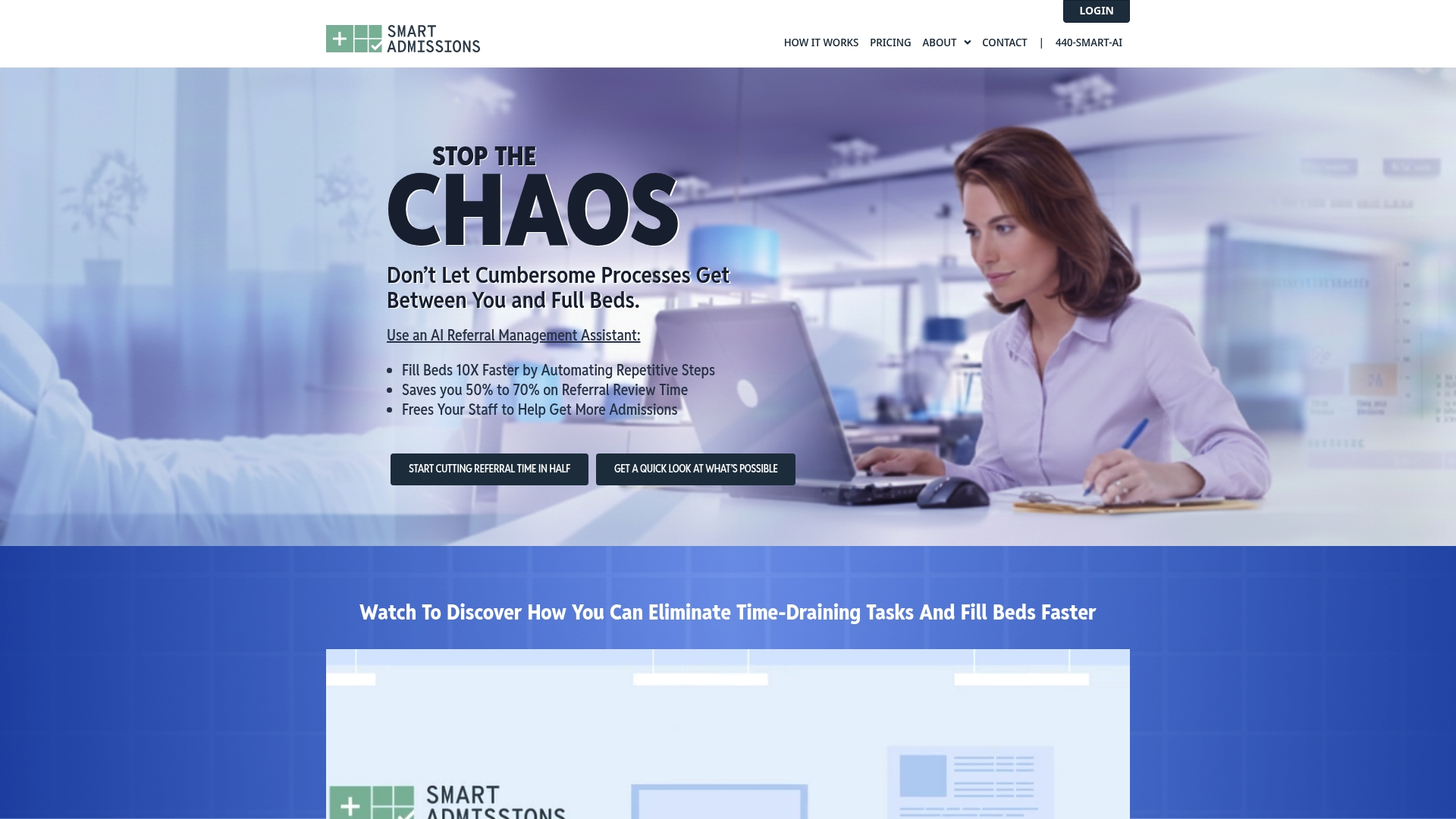
Smartadmissions is built specifically for skilled nursing facilities, rehabilitation centers, and post-acute care providers who need to process referrals faster without adding headcount. The platform’s AI-powered assistant integrates with existing EMR systems and insurance portals to deliver real-time eligibility verification, clinical status assessments, and documentation management in a single workflow. Admissions teams that previously spent 45 minutes reviewing each referral manually can complete the same review in a fraction of the time.
The result is faster bed occupancy, reduced administrative burden on your staff, and better data for tracking which referral sources produce the highest-quality admissions. If you are evaluating referral management systems for your facility, Smartadmissions offers a purpose-built alternative to generic intake software. Explore the top referral management tools for 2026 to see how automated intake compares to your current process.