
TL;DR:
- Care coordination is the organized management of patient care across providers to meet health needs at the right time. It improves outcomes, reduces hospitalizations, and lowers overall costs through continuous relational, informational, and managerial continuity. Scaling effective programs depends on governance, shared accountability, and technology, supported by new Medicare billing codes for independent practices.
Care coordination is defined as the intentional organization and management of patient care activities across multiple providers and settings to meet patient needs at the right time. The Agency for Healthcare Research and Quality (AHRQ) and the Centers for Medicare and Medicaid Services (CMS) both recognize it as a foundational component of high-quality, value-based care. A 2026 primary care scoping review describes care coordination as a dynamic process linking care over time across multiple professionals and teams through clinical, administrative, and managerial actions. For healthcare administrators and clinical leaders, understanding what care coordination involves is not optional. It directly determines whether your patients receive safe, connected care or fall through the gaps between providers.
What is care coordination and why does it matter for patient outcomes?
Care coordination improves patient outcomes by reducing hospitalizations, preventing complications, and lowering total care costs, particularly for patients managing chronic conditions. The 2026 scoping review links higher continuity and coordination directly to better patient-reported outcomes, fewer hospitalizations, and reduced utilization. That finding carries a clear operational implication: facilities that invest in structured coordination programs see measurable returns in both quality scores and cost performance.
The benefits of care coordination extend across the full care continuum:
- Reduced readmissions: Coordinated follow-up after discharge catches deterioration before it requires rehospitalization, especially for cardiovascular and diabetic patients.
- Improved medication safety: Shared medication reconciliation across providers reduces adverse drug events at transitions of care.
- Higher patient satisfaction: Patients who experience consistent communication between their care team report greater confidence in their treatment plans.
- Lower total cost of care: Fewer duplicated tests, fewer avoidable emergency visits, and shorter inpatient stays all contribute to cost reduction.
- Better chronic disease management: Care coordination services that include proactive monitoring and community resource connections keep high-risk patients stable between encounters.
The importance of care coordination becomes most visible at care transitions. When a patient moves from a hospital to a skilled nursing facility, or from a specialist back to a primary care physician, communication failures are the leading cause of adverse events. Structured coordination closes those gaps before they become clinical crises.
What are the key components of care coordination in healthcare systems?

Effective care coordination operates at three distinct levels, and failing at any one of them undermines the entire system. The 2026 scoping review identifies these as individual-level relational continuity, organizational informational continuity, and system-level managerial continuity.
Here is how each level functions in practice:
- Individual-level relational continuity: This is the ongoing therapeutic relationship between a patient and their primary care team. It requires stable provider assignments, consistent communication, and patient trust built over repeated encounters.
- Organizational informational continuity: This level depends on shared records, care plans, and communication tools that allow any provider in the network to access relevant patient history. EHR systems, care management platforms, and structured handoff protocols all operate here.
- System-level managerial continuity: This is governance. It includes financing structures, accountability frameworks, and interoperable IT systems that connect primary, secondary, and community care settings.
The most common barriers to effective coordination appear at the boundaries between these levels. Fragmentation occurs when individual providers deliver excellent relational care but organizational systems fail to share that information upstream. Limited information sharing between hospitals and post-acute providers is one of the most persistent and costly examples of this breakdown.
| Level | Focus | Common barrier |
|---|---|---|
| Individual | Relational continuity between patient and provider | Provider turnover, inconsistent assignment |
| Organizational | Information sharing across care team | Siloed EHR systems, poor handoff protocols |
| System | Governance, financing, interoperable IT | Misaligned incentives, fragmented accountability |
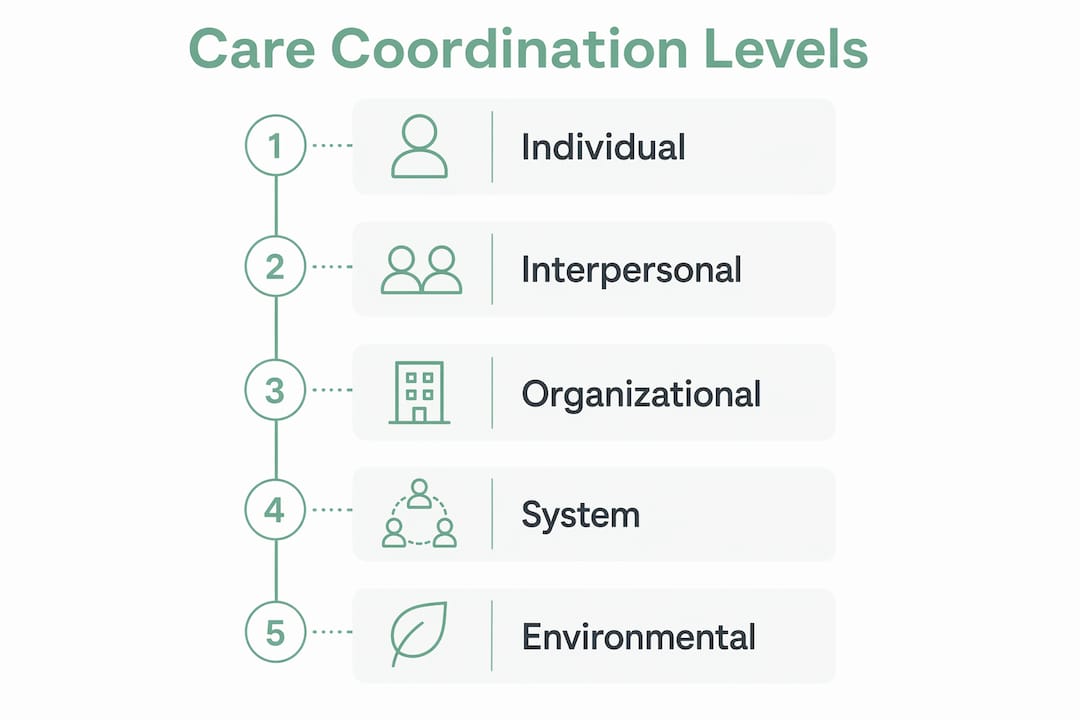
Addressing all three levels simultaneously is what separates high-performing care coordination models from programs that produce short-term results and then stall.
How do staffing models affect care coordination delivery?
The composition of your care coordination team directly shapes what coordination activities actually happen. A 2025 study of 317 clinics found that clinics with integrated social workers have care coordinators who are 10 to 30 percent more likely to assess social needs and engage in referral processes compared to nursing-based models. That is not a marginal difference. It reflects a fundamental shift in how coordination is practiced.
Key differences between integrated social worker models and nursing-based models include:
- Social needs assessment: Social worker-integrated teams conduct structured screening for housing instability, food insecurity, and transportation barriers as a standard part of care planning.
- Referral engagement: Social workers maintain active relationships with community-based organizations, making referral completion rates significantly higher than in models where nurses manage referrals alongside clinical tasks.
- Communication channels: Integrated social worker teams use more diverse communication methods, including community health worker outreach and peer support networks, rather than relying solely on clinical messaging systems.
- Panel size and workload: Nursing-based coordinators typically carry larger patient panels, which limits the depth of social needs assessment and follow-up they can realistically provide.
The practical implication for your facility is that the staffing model you choose determines the scope of coordination your team can deliver. If your patient population carries significant social determinants of health burden, a nursing-only model will leave those needs unaddressed regardless of how skilled your nurses are.
Pro Tip: Before redesigning your care coordination staffing model, audit your current patient population for social determinants of health risk. If more than 30 percent of your patients screen positive for housing or food insecurity, an integrated social worker model will produce measurably better outcomes than adding more nursing FTEs.
What systemic and technological factors sustain scalable care coordination?
The most common failure mode in care coordination programs is over-reliance on exceptional individual performers. When your best care coordinator leaves, the program degrades. A 2026 McKnight’s analysis identifies five structural levers that make coordination durable: explicit patient journey ownership, aligned incentives, measurement of engagement behaviors, enabling technology, and institutionalized relationships.
Each lever addresses a specific vulnerability:
Explicit ownership means every patient has a named accountable coordinator, and that accountability is documented in the care plan, not assumed informally. Coordination often fails at handoff boundaries precisely because no one owns the transition.
Aligned incentives connect coordinator performance metrics to outcomes that matter, such as loop closure rates and follow-up completion, rather than volume metrics that reward activity without ensuring results.
Measurement of leading indicators is where most programs fall short. Tracking readmission rates tells you what already went wrong. Tracking engagement behaviors such as proactive outreach frequency, handoff quality scores, and cross-team communication rates tells you whether your program will succeed next month.
Pro Tip: Build a weekly dashboard that tracks three leading indicators: percentage of high-risk patients contacted within 48 hours of discharge, percentage of care plan updates completed within 24 hours of a clinical change, and referral loop closure rate. These three metrics predict readmission risk weeks before the outcome data appears.
Technology plays a supporting role, not a leading one. Interoperable information systems and shared electronic records reduce communication delays at transitions, but they only work when governance structures define who acts on the information they surface. Technology without accountability is just faster fragmentation.
How do Medicare billing codes support care coordination in independent practices?
CMS introduced dedicated Medicare reimbursement codes for care coordination services in January 2024, creating a financial framework that makes structured coordination programs viable for independent practices. The 2026 Physicians Practice framework covers three primary billing pathways: Chronic Care Management (CCM), Community Health Integration (CHI), and Principal Illness Navigation (PIN).
Here is how each pathway applies:
- Chronic Care Management (CCM): Applies to patients with two or more chronic conditions expected to last at least 12 months. Requires a minimum of 20 minutes of non-face-to-face care management per month. HCPCS codes 99490 and 99491 are the primary billing codes, with add-on codes for complex cases.
- Community Health Integration (CHI): Targets patients with social determinants of health needs that affect their clinical outcomes. This pathway funds coordination activities like housing navigation, food access referrals, and transportation support. It directly funds the social work integration model described in the staffing section above.
- Principal Illness Navigation (PIN): Designed for high-risk patients with serious conditions such as cancer, heart failure, or advanced COPD. PIN codes fund dedicated navigation services that guide patients through complex treatment pathways and specialist referral networks.
Documentation requirements across all three pathways are specific and time-sensitive. Key operational considerations include:
- Obtaining written patient consent before billing any CCM, CHI, or PIN code
- Documenting time spent in the EHR with sufficient clinical detail to support the billed code
- Assigning a single billing provider per patient per month to avoid duplicate claims
- Training care coordinators on the distinction between billable care management time and general administrative tasks
The financial case for building these billing workflows is strong. A practice with 200 qualifying CCM patients billing at the standard rate generates meaningful recurring revenue that directly funds the coordinator positions delivering the service.
Key takeaways
Effective care coordination requires aligned action at individual, organizational, and system levels, with technology and governance supporting, not replacing, structured human accountability.
| Point | Details |
|---|---|
| Care coordination definition | The intentional organization of patient care across multiple providers to meet needs at the right time. |
| Multi-level implementation | Coordination requires relational, informational, and managerial continuity across individual, organizational, and system levels. |
| Staffing model impact | Integrated social worker models increase social needs assessment and referral engagement by 10 to 30 percent. |
| Systemic durability | Scalable programs depend on explicit ownership, aligned incentives, and leading-indicator measurement, not individual heroics. |
| Medicare billing support | CMS CCM, CHI, and PIN codes fund care coordination services and create sustainable revenue for independent practices. |
Why coordination systems outlast coordination heroes
I have spent years working with post-acute care facilities and skilled nursing operators, and the pattern I see most often is this: a facility builds a strong care coordination program around one or two exceptional people, those people leave or burn out, and the program collapses. The administrators are then surprised, as if the departure of a single person should not have mattered that much.
The uncomfortable truth is that most care coordination programs are not programs at all. They are individuals performing heroics inside a system that was never designed to support them. The research on institutionalizing workflows confirms what I have observed directly: durable coordination requires governance, protected time, and shared accountability, not just talented staff.
What I recommend to every administrator I work with is to start by mapping your patient journey and identifying every handoff point where accountability is currently informal. Those are your failure points. Then assign explicit ownership to each one, build a measurement system around leading behaviors rather than lagging outcomes, and connect your technology to that accountability structure. The post-acute care process steps that top-performing facilities use are not complicated. They are consistent.
The social work integration findings from the 2025 clinic study also deserve more attention than they typically receive. Most facilities treat social determinants of health as a compliance checkbox rather than a clinical lever. Facilities that embed social workers directly into care coordination teams see different behaviors, different referral patterns, and ultimately different outcomes. That is not a soft finding. It is a structural one.
— Harry
How Smartadmissions supports your care coordination workflows
Care coordination depends on fast, accurate information moving between providers at every transition point. When referral data is incomplete, delayed, or trapped in disconnected systems, coordination breaks down before it starts.
Smartadmissions is built specifically for skilled nursing facilities, rehabilitation centers, and post-acute providers who need referral and admissions workflows that match the speed and accuracy that care coordination demands. The platform integrates with your existing EHR and insurance portals to deliver real-time eligibility verification, clinical assessments, and documentation management in one place. If you want to understand how referral management connects directly to care coordination outcomes, that is the right place to start. You can also explore referral management tools that fit the operational scale of your facility.
FAQ
What is the care coordination definition used by CMS?
CMS defines care coordination as the deliberate organization of patient care activities between two or more participants to facilitate appropriate delivery of healthcare services. The goal is to meet patient needs and preferences while improving safety, effectiveness, and efficiency.
What does care coordination involve on a daily basis?
Daily care coordination involves proactive patient outreach, care plan updates, referral management, medication reconciliation, and cross-team communication at transition points. The specific activities vary by staffing model and patient population risk level.
What are the main benefits of care coordination for skilled nursing facilities?
The primary benefits include reduced hospital readmissions, improved patient satisfaction scores, lower total cost of care, and better chronic disease management. A 2026 scoping review links higher coordination directly to fewer hospitalizations and reduced utilization costs.
How do you improve care coordination across care settings?
Improving care coordination requires assigning explicit accountability for patient journeys, measuring leading engagement behaviors rather than only readmission rates, and deploying interoperable technology that connects providers across primary, post-acute, and community settings.
Which Medicare billing codes apply to care coordination services?
CMS supports care coordination billing through Chronic Care Management (CCM) codes 99490 and 99491, Community Health Integration (CHI) codes for social determinants-focused services, and Principal Illness Navigation (PIN) codes for high-risk serious illness patients, all effective since January 2024.