
TL;DR:
- Data helps healthcare facilities identify workflow bottlenecks and improve operational efficiency through process mapping and real-time analysis.
- Integrating data systems enables proactive decision-making and significantly reduces referral review and admission times.
The role of data in operational efficiency is defined as the systematic use of structured information to identify waste, reduce cycle times, and align resources with actual patient demand. Healthcare facilities that analyze their operational data report 47% more efficient processes or cost savings compared to just 14% of non-analyzers. That gap is not theoretical. For skilled nursing facilities and post-acute care providers, it translates directly into bed fill rates, referral response times, and staff workload. This article explains exactly how data-driven decision making produces those gains, where most facilities go wrong, and what your team can do about it starting now.
How data analytics identifies bottlenecks in healthcare operations
Operational efficiency in healthcare is defined as delivering the right level of care at the lowest necessary cost, with the fewest delays and errors in the process. Data analytics is the primary mechanism for achieving it. Without structured data, your team is diagnosing workflow problems by intuition, which is slow and frequently wrong.
Process mapping combined with data collection is the standard method for uncovering where patient intake slows down. When you overlay actual timestamps from your EHR system onto a value stream map, you can see precisely where referrals stall, where clinical assessments pile up, and where documentation errors create rework. These are not abstract findings. They are specific, addressable failure points.
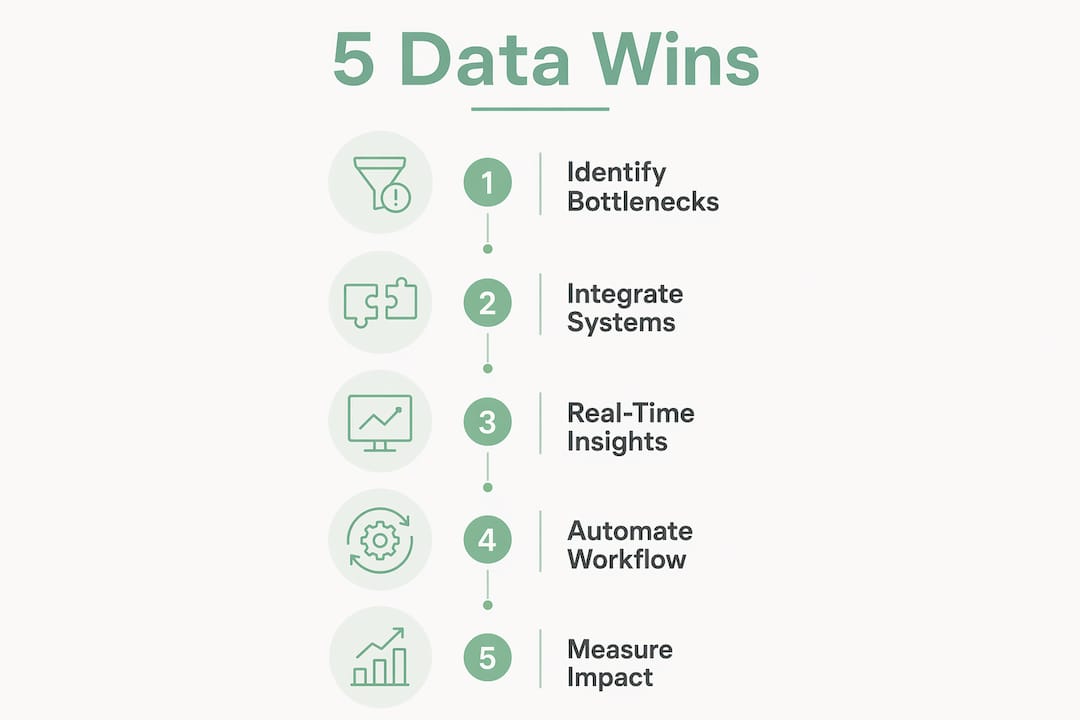
Here is a four-step sequence your team can follow to identify and address bottlenecks using data:
- Map the current process end to end. Document every step from referral receipt to bed assignment, including who owns each task and what system records it.
- Attach time and volume data to each step. Pull cycle time data from your EMR, referral portal, and scheduling tools to quantify where delays accumulate.
- Rank bottlenecks by frequency and impact. Not every delay is equal. Prioritize the steps that affect the most referrals or carry the highest cost per delay.
- Redesign before automating. Targeted process redesign and automation reduce defects by 15 to 25%, with measurable results in 8 to 16 weeks when process ownership is clearly assigned.
Pro Tip: Assign a named process owner to every redesigned workflow step before you deploy any automation. Accountability is what separates a successful improvement cycle from one that quietly reverts to old habits within 90 days.
The importance of data analytics at this stage is not just in finding problems. It is in giving your team a shared, objective picture of where the facility actually stands, which makes change management significantly easier.
How integrated data systems improve real-time decision-making
Connecting your data sources is where the role of data in business operations shifts from reactive to proactive. Most healthcare facilities operate with fragmented systems: one platform for referrals, another for clinical documentation, a separate tool for insurance verification. Each system holds a piece of the patient picture, but no one sees the whole thing in real time.

Unified data architectures solve this directly. Integrated data systems reduce data integration time by 80% and decision cycle time by 40%. For an admissions coordinator reviewing five referrals simultaneously, that compression in decision time is the difference between accepting a patient before a competitor does and losing the census opportunity entirely.
The table below shows the practical difference between traditional and integrated data environments in a post-acute care setting:
| Dimension | Traditional data environment | Integrated data environment |
|---|---|---|
| Referral review time | 4 to 8 hours, manual document review | Under 30 minutes with automated eligibility checks |
| Clinical assessment | Paper forms, delayed physician sign-off | Real-time structured data entry with EMR sync |
| Bed availability visibility | Updated once daily or on request | Live occupancy dashboard updated continuously |
| Decision trigger | Lagging report reviewed weekly | Leading indicator alert triggered by threshold breach |
| Error rate | High, due to manual transcription | Reduced through automated data validation |
Real-time data also enables a shift from lagging to leading indicators. Weekly monitoring of cycle times and throughput prevents service disruptions before they affect patient care. Tracking how long each referral stage takes, rather than reviewing monthly admission totals, gives your team the ability to intervene before a bottleneck becomes a census problem.
Pro Tip: Two-thirds of enterprises report improved data visibility and trust when they adopt a data fabric approach, which layers business context onto raw data rather than treating all data as equally meaningful. Apply this principle to your intake data by tagging each record with payer type, acuity level, and referral source.
Integrating patient management and real-time tracking systems boosts operational efficiency by 20 to 35%. That range reflects the difference between facilities that connect systems and those that also redesign the workflows those systems support.
Common pitfalls when leveraging data for healthcare efficiency
The gap between wanting to use data and actually doing so is wider than most administrators expect. Only 26% of organizations successfully convert data collection into actionable insights, despite 91% stating that data-driven decision making is a priority. This means the majority of facilities are collecting data without extracting value from it.
The most common reasons for this failure are predictable and avoidable:
- Automating a broken process. Applying automation before process redesign produces faster failure, not faster success. If your referral intake workflow has three redundant approval steps, automating it locks in the inefficiency at higher speed.
- Prioritizing data volume over data quality. More data is not always better. Business context and a proper data fabric add the meaning and trust that make data usable. A spreadsheet with 10,000 rows of uncontextualized admission records is less useful than a structured dashboard showing referral conversion rates by payer and acuity.
- Relying on lagging indicators. Monthly reports tell you what went wrong. Weekly or daily cycle time tracking tells you what is going wrong now, while you can still act.
- No named process owner. Data findings without accountability produce recommendations that no one implements. Every workflow improvement requires a specific person responsible for execution and measurement.
- Testing one solution at a time. Success in improving operational efficiency depends on testing multiple hypotheses in parallel rather than sequentially, which shortens the time to a working solution.
Your team’s ability to move from data collection to measurable improvement depends on addressing these pitfalls before deploying new tools. The technology is the easy part. The organizational discipline is where most facilities fall short.
Practical applications of data-driven automation in patient intake
The most direct application of data in healthcare operations is automating the clinical assessment and referral management process. Automation can cut admissions time by up to 90%, which is not a marginal gain. It means a process that previously consumed most of a coordinator’s day can be completed before the first morning rounds.
Here is how data-driven automation applies across the patient intake cycle:
- Referral triage and scoring. Automated systems pull clinical data from referral documents, score patient acuity against your facility’s admission criteria, and flag high-priority cases without manual review. This reduces the time your team spends on referrals that will never convert.
- Real-time insurance eligibility verification. Integrating with payer portals through FHIR and HL7 standards allows your system to verify coverage at the moment a referral arrives, eliminating the back-and-forth that delays admission decisions.
- Clinical documentation management. Structured data entry tools that sync with your EMR reduce transcription errors and ensure that every admission record is complete before the patient arrives. Incomplete documentation is one of the most common causes of delayed bed assignment.
- Bed occupancy forecasting. When your intake data connects to your census management system, you can predict bed availability 48 to 72 hours out and align referral acceptance with actual capacity.
- Workflow analytics for continuous improvement. The data impact on productivity becomes visible when you track which steps in your intake process consume the most time and which staff members are carrying disproportionate workloads.
Selecting the right tools requires matching system capabilities to your existing infrastructure. Platforms that integrate with your current EMR through standard APIs require less implementation time and carry lower HIPAA compliance risk than custom-built solutions. Prioritize tools with pre-built connectors for major EMR systems and transparent audit trails for every data transaction. The healthcare workflow efficiency gains from well-integrated tools compound over time as your team builds confidence in the data and reduces manual verification steps.
Key takeaways
Data-driven operational efficiency in healthcare requires integrated systems, redesigned workflows, and named accountability before automation delivers measurable results.
| Point | Details |
|---|---|
| Data analytics finds bottlenecks | Map intake workflows with timestamp data to locate and rank the highest-impact delays. |
| Integration multiplies efficiency | Unified data systems cut decision cycle time by 40% and boost overall efficiency by 20 to 35%. |
| Most facilities fail at conversion | Only 26% of organizations turn collected data into actionable decisions; process discipline closes the gap. |
| Automate after redesign | Applying automation to an unredesigned process accelerates failure rather than fixing it. |
| Leading indicators beat lagging reports | Weekly cycle time monitoring prevents census problems before they appear in monthly summaries. |
Why data culture matters more than data technology
After working with healthcare administrators across skilled nursing and post-acute care settings, the pattern I see most often is this: facilities invest in the right technology and still see modest results. The reason is almost never the software. It is the absence of a data culture.
A data culture means your admissions team trusts the numbers enough to act on them without waiting for a supervisor to confirm the decision. It means your clinical staff enters structured data consistently because they understand how it affects downstream decisions, not because compliance requires it. And it means your leadership reviews leading indicators weekly rather than pulling a monthly census report and reacting to what already happened.
The facilities that achieve the largest efficiency gains are not the ones with the most sophisticated tools. They are the ones where cross-functional teams, including admissions, nursing, and finance, share a single view of operational performance and hold each other accountable to it. Building that shared view starts with small wins: pick one metric, measure it weekly, and make the improvement visible to the whole team. Momentum follows visibility.
The uncomfortable truth is that data does not improve operations on its own. People who trust the data and act on it do.
— Harry
See how Smartadmissions puts data to work for your facility
Smartadmissions is built specifically for skilled nursing facilities, rehabilitation centers, and post-acute care providers that need to move faster on referrals without adding administrative headcount. The platform connects directly to your existing EMR and insurance portals, automates clinical assessments, and gives your admissions team a real-time view of referral status, patient eligibility, and bed availability. If your team is ready to put the principles in this article into practice, start by exploring referral management for healthcare and see how structured data transforms your intake process. For a broader view of what automation delivers in practice, the guide on admissions workflow automation covers implementation steps your team can follow immediately.
FAQ
What is the role of data in operational efficiency?
The role of data in operational efficiency is to convert raw operational information into specific decisions that reduce waste, shorten cycle times, and align resources with demand. In healthcare, this means using intake and workflow data to accelerate referral decisions and improve bed utilization.
How does data-driven decision making improve patient intake?
Data-driven decision making improves patient intake by replacing manual document review with automated eligibility verification, acuity scoring, and real-time EMR documentation. Automation supported by structured data cuts admissions time by up to 90%.
Why do so many healthcare facilities struggle to use data effectively?
Only 26% of organizations successfully convert collected data into actionable insights. The most common barriers are poor data quality, no named process owner, and applying automation before redesigning the underlying workflow.
What metrics should healthcare administrators track for operational efficiency?
Track leading indicators such as referral-to-decision cycle time, documentation completion rate at admission, and bed availability forecast accuracy. Weekly monitoring of these metrics prevents disruptions before they affect census or care quality.
How does integrating EHR and referral data improve operations?
Integrating EHR and referral data into a unified system reduces decision cycle time by 40% and overall operational delays by 20 to 35%, because your team acts on a complete, real-time patient picture rather than fragmented records from disconnected platforms.
Recommended
- How to Cut Referral Processing Time from 45 to 5 Minutes | AI Admissions Automation for Skilled Nursing Facilities
- Why Manual DD214 Checks are Costing You Thousands in Hidden Staff Time – Smart Admissions
- The First-Responder Advantage: Why Speed Wins Competitive Referrals – Smart Admissions
- Stop Wasting 45 Minutes on Each Referral: Try These 5 Post-Acute Care Automation Hacks – Smart Admissions