
TL;DR:
- Streamlining medical admissions involves optimizing workflows to reduce delays and improve patient throughput across healthcare settings.
- Evidence shows that AI decision-support, patient streaming, and digital records integration significantly accelerate admission processes and improve care efficiency.
Streamlining medical admissions is defined as the systematic optimization of patient intake and admission workflows to reduce delays, improve clinical throughput, and enhance care quality across healthcare settings. For hospital administrators and post-acute care leaders, the importance of streamlined admissions has never been more measurable: a 2026 JMIR AI retrospective study found that AI decision-support reduced median admission decision time from 151 minutes to just 20 minutes for correctly identified patients. That is not a marginal gain. It is a structural shift in how your facility moves patients from presentation to placement. This article breaks down the evidence, the methods, and the operational factors that determine whether your admissions process works for your team or against it.
Why streamline medical admissions: the measurable case
The benefits of efficient medical admissions are no longer theoretical. Quantitative evidence from 2025 and 2026 studies across multiple hospital systems confirms that targeted interventions produce consistent, measurable gains in throughput, length of stay, and emergency department capacity.
A 2024 to 2025 health system quality initiative tracked outcomes across multiple hospitals and found that a coordinated length-of-stay reduction program cut ED boarding hours from 14.1 to 10.4 hours while simultaneously lowering the observed-to-expected LOS ratio from 1.07 to 0.99. That shift in boarding hours alone represents thousands of recovered patient hours annually across a multi-hospital system.
“Aligning admission information flow tightly with clinical decision-making markedly improves throughput and alleviates crowding.” — JMIR AI, 2026
Emergency department streaming interventions show similarly strong results. A 2026 BMC Emergency Medicine meta-analysis measured the effect of separating low-acuity patients into dedicated care tracks and found standardized LOS reductions of 0.85 standard deviations for GP-led streaming and 0.39 for ED-led streaming. Lower-acuity patients move faster, which frees clinical bandwidth for higher-complexity cases.
| Intervention | Key Metric | Outcome |
|---|---|---|
| AI decision-support model | Median admission decision time | Reduced from 151 min to 20 min |
| System-wide LOS initiative | ED boarding hours | Reduced from 14.1 to 10.4 hours |
| ED patient streaming | LOS standardized mean difference | GP streaming: −0.85; ED streaming: −0.39 |
| ERAS surgical protocols | Average length of stay | Approximately 3 days with 87.5% compliance |
Enhanced Recovery After Surgery (ERAS) protocols extend these gains into surgical admissions. A 2026 MDPI study found that ERAS compliance at 87.5% achieved an average length of stay of approximately 3 days with zero readmissions. That is roughly a 50% reduction compared to traditional surgical admission pathways, with direct implications for bed availability and cost per case.
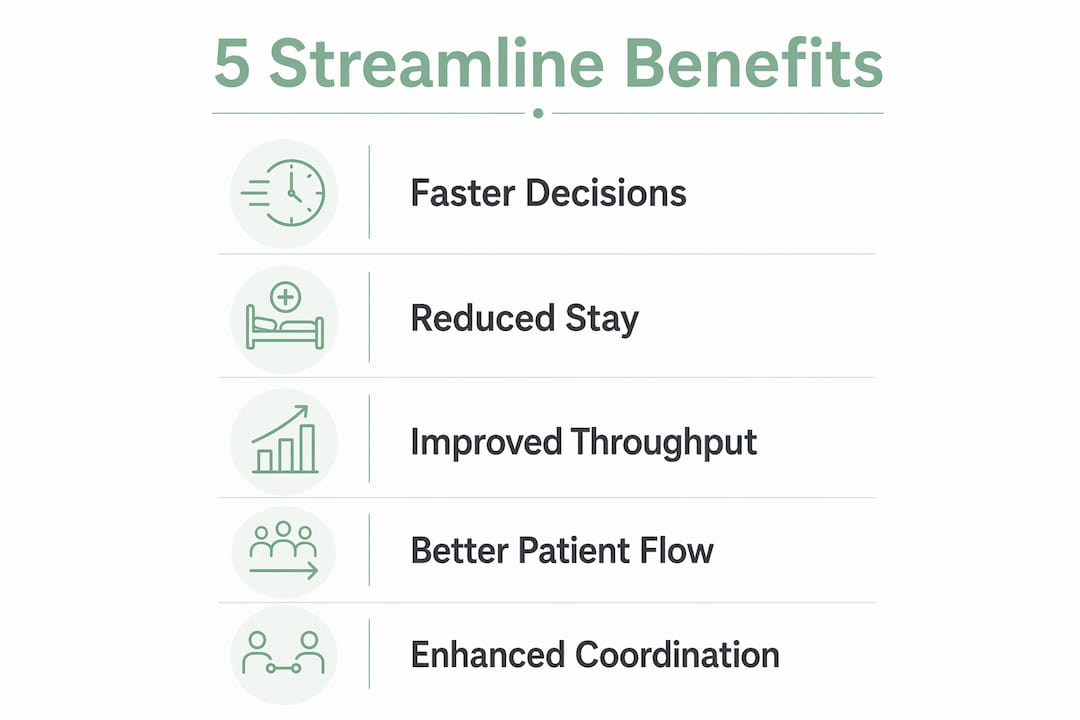
How do AI, patient streaming, and digital records compare?
Three primary approaches define how facilities improve medical admissions today: AI-powered clinical decision support, patient streaming protocols, and digital records integration. Each operates differently and suits different operational contexts.
AI clinical decision support
AI models for admission decisions work by processing clinical data in iterative cycles, often updating every 10 minutes as new information arrives. The JMIR AI 2026 study described a model that analyzed triage notes, vital signs, and lab results to generate admission recommendations before the attending physician completed their assessment. The speed advantage is significant, but the model’s value depends on tight integration with your existing EMR and a clear protocol for how clinicians act on its outputs.
Patient streaming and track assignment
Patient streaming separates patients by acuity at triage, routing lower-complexity cases to a fast-track or GP-led area. The 2026 BMC meta-analysis confirmed this approach improves safety outcomes alongside LOS reductions, though it requires clear acuity criteria and continuous safety monitoring. Streaming works best when your facility has defined thresholds for track assignment and staff trained to apply them consistently.

Digital records integration and biometric identification
A 2026 Scientific Reports study demonstrated that hybrid cloud EMR sharing combined with fingerprint authentication reduced manual registration delays and improved patient throughput in emergency settings. Automated demographic retrieval eliminates the bottleneck of manual data entry at intake, which is one of the most common sources of admission delay that does not involve a physician at all.
| Approach | Primary benefit | Key challenge | Best use case |
|---|---|---|---|
| AI decision support | Faster admission decisions | EMR integration complexity | High-volume EDs with structured data |
| Patient streaming | Reduced LOS for low-acuity | Requires clear acuity criteria | Mixed-acuity EDs and urgent care |
| Digital records + biometrics | Eliminates manual registration | Biometric infrastructure cost | Multi-site systems with repeat patients |
Pro Tip: Before deploying any AI decision-support tool, confirm it includes safety guardrails that flag edge cases for mandatory human review. Speed without oversight creates liability, not efficiency.
What operational factors determine success?
Knowing why medical admissions need efficiency is only part of the equation. The harder question is what separates facilities that realize sustained gains from those that see short-term improvements followed by regression. The answer consistently comes back to operational alignment, not technology alone.
A 2026 operational analysis of hospital admission and discharge coordination found that faster decisions alone do not guarantee improved throughput without coupling bed management, scheduling, and discharge operations into a unified workflow. If your admissions team approves a patient faster but the bed management team is not notified in real time, the time savings evaporate in the handoff.
The following factors consistently appear in successful multi-pronged admissions initiatives:
- Bed management integration: Admission decisions must trigger automatic bed assignment workflows, not manual phone calls or paging sequences.
- Discharge coordination: Throughput gains at admission are neutralized if discharge processes are not equally optimized. Facilities that reduced LOS in the 2024 to 2025 health system study did so by addressing both ends of the patient stay simultaneously.
- Automated identity verification: Biometric or digital ID systems eliminate the manual registration step that creates upstream bottlenecks before any clinical decision is made.
- Selective record retrieval: Pulling only clinically relevant records at intake, rather than full chart dumps, reduces review time without sacrificing clinical context.
- Local safety monitoring: The 2026 BMC systematic review explicitly cautions that cost-effectiveness evidence varies by setting. Your facility needs its own measurement framework, not borrowed benchmarks.
Pro Tip: Assign a dedicated admissions coordinator to monitor your throughput metrics weekly during any new workflow rollout. Early detection of bottlenecks prevents small inefficiencies from compounding into systemic delays.
Multidisciplinary coordination is the connective tissue of all these factors. Physicians, nurses, bed managers, and administrative staff need shared visibility into patient status. Platforms that provide interoperability in healthcare admissions give each team member a real-time view of where every patient stands in the intake process, which eliminates the redundant status checks that consume staff time throughout the day.
Why is efficient admissions critical for capacity and patient experience?
The strategic importance of efficient medical admissions extends beyond operational metrics. Facilities that move patients through intake faster can serve more patients with the same physical infrastructure. That is a direct revenue and capacity argument that every administrator understands.
From a patient-centered perspective, the benefits are equally concrete:
- Reduced waiting times lower patient anxiety and improve satisfaction scores, which affect both CMS star ratings and referral volume from discharge planners.
- Faster access to treatment is clinically significant for time-sensitive conditions where delays worsen outcomes.
- Shorter lengths of stay reduce exposure to hospital-acquired conditions, which carry both clinical and financial consequences.
- Smoother transitions from ED to inpatient or post-acute settings reduce the likelihood of care gaps that lead to readmissions.
The ERAS data reinforces this point. When surgical admission protocols are standardized and followed consistently, patients recover faster, leave sooner, and return less often. The same logic applies to medical admissions broadly: standardized, well-coordinated intake processes produce better outcomes than ad hoc workflows, regardless of how skilled your clinical staff is.
For skilled nursing facilities and post-acute care providers specifically, the referral-to-admission window is where revenue is won or lost. A referral that sits unreviewed for 24 hours is a referral that goes to a competitor. Learning how to improve medical admissions at the intake stage directly affects your bed fill rate, your payer mix, and your ability to accept higher-acuity patients who generate stronger reimbursement.
Key takeaways
Efficient medical admissions require coordinated technology, aligned workflows, and continuous measurement to produce sustainable throughput gains.
| Point | Details |
|---|---|
| AI cuts decision time dramatically | AI decision-support reduced median admission decisions from 151 minutes to 20 minutes in 2026 research. |
| Streaming reduces LOS for low-acuity patients | GP-led streaming achieved a standardized LOS reduction of 0.85 in a 2026 meta-analysis. |
| Bed management must align with admissions | Faster decisions without integrated bed management do not translate into throughput gains. |
| Digital intake eliminates upstream bottlenecks | Hybrid cloud EMR sharing with biometric ID removes manual registration delays before clinical review begins. |
| Local measurement is non-negotiable | Cost-effectiveness and safety outcomes vary by setting; facilities must track their own metrics continuously. |
The part most administrators overlook
When I look at facilities that struggle to sustain admissions improvements, the pattern is almost always the same. They invest in a technology solution, see an initial improvement in decision time or LOS, and then watch the gains erode over the following quarter. The reason is rarely the technology. It is that the upstream bottlenecks were never addressed.
The largest delays in most admissions processes do not happen when a physician is deciding whether to admit. They happen while the team waits for a bed to be flagged as available, for records to be retrieved from a prior facility, or for insurance verification to clear. An AI model that cuts decision time by 131 minutes is genuinely impressive. But if your bed assignment process still runs on phone calls and whiteboards, you will not see that time savings reflected in your throughput numbers.
My recommendation is to map your admissions workflow before you select any technology. Identify where time actually accumulates. In most facilities, you will find that 60% or more of total admission delay sits in administrative and logistics steps, not clinical ones. That is where your first investment should go.
I also want to push back on the instinct to treat streaming or AI as a complete solution. The 2026 BMC meta-analysis is clear that safety outcomes require continuous local monitoring. Speed is not the goal. Safe, efficient routing of the right patient to the right level of care is the goal. Those are related but not identical objectives, and keeping that distinction clear protects both your patients and your facility.
— Harry
See how Smartadmissions accelerates your intake process
Smartadmissions is built specifically for skilled nursing facilities, rehabilitation centers, and post-acute care providers that need faster, more reliable admissions without adding administrative burden to their teams.
The platform automates referral review, integrates directly with your EMR and insurance portals for real-time eligibility verification, and gives your admissions staff a single dashboard to manage documentation and clinical assessments. Facilities using Smartadmissions report 20% faster bed occupancy and significantly reduced manual workload per admission. If you are evaluating where automation fits in your workflow, the breakdown of manual vs. automated admissions is a practical starting point for that conversation.
FAQ
Why streamline medical admissions at all?
Streamlining medical admissions reduces decision time, shortens length of stay, and increases patient throughput. A 2026 JMIR AI study found AI decision-support cut median admission decision time from 151 minutes to 20 minutes, directly improving ED capacity.
What is the fastest way to reduce ED boarding times?
System-wide LOS initiatives that coordinate bed management, admissions, and discharge simultaneously produce the strongest results. A 2024 to 2025 multi-hospital study reduced ED boarding hours from 14.1 to 10.4 hours through this coordinated approach.
How does patient streaming improve admissions efficiency?
Patient streaming separates low-acuity patients into dedicated care tracks, reducing their length of stay without compromising safety. A 2026 meta-analysis found GP-led streaming achieved a standardized mean LOS reduction of 0.85.
Does digital records integration actually speed up intake?
Yes. A 2026 Scientific Reports study found that hybrid cloud EMR sharing with biometric identification reduced manual registration delays and improved overall patient throughput in emergency department settings.
What is the biggest mistake facilities make when improving admissions?
The most common mistake is focusing on clinical decision speed while ignoring upstream administrative bottlenecks. Research consistently shows that bed assignment delays, record retrieval, and insurance verification cause more total delay than physician decision time.