
TL;DR:
- EMR integration connects healthcare systems to streamline real-time data exchange, improving operational efficiency and care quality. It enhances physician productivity, reduces referral wait times, and supports compliance through centralized data governance. Treating integration as ongoing infrastructure rather than a one-time project yields the highest clinical and financial benefits.
EMR integration is defined as the process of connecting electronic medical record systems with other healthcare applications, devices, and platforms to enable real-time, secure data exchange across clinical and administrative workflows. For healthcare administrators and clinical staff at skilled nursing facilities, rehabilitation centers, and post-acute care providers, understanding EMR integration meaning goes well beyond a technical definition. It determines how fast your team can access patient data, how accurately referrals are processed, and how confidently you can meet HIPAA compliance requirements. This guide covers how EMR system integration works, what it involves technically, and why it directly affects your facility’s care quality and operational performance.
What is EMR integration and how does it work?
EMR integration connects your electronic medical record platform to external systems such as laboratory information systems, radiology platforms, billing software, insurance portals, and IoT medical devices. The goal is a unified, accurate patient record that updates in real time across every touchpoint in your care delivery process. Without integration, your clinical staff manually re-enters data between systems, which creates delays, errors, and duplicated effort.
The technical foundation of EMR integration relies on three core components:
- APIs using FHIR and HL7 standards: Fast Healthcare Interoperability Resources (FHIR) and Health Level Seven (HL7) are the communication protocols that define how data is formatted and transmitted between systems. FHIR is the current standard favored by CMS and ONC for modern interoperability.
- Integration engines and middleware: These act as central translators between systems that speak different technical languages. Platforms like Mirth Connect and Rhapsody route, transform, and deliver data between your EMR and connected applications.
- Data mapping and standardized terminologies: Connecting systems technically is only half the work. Successful integration requires rigorous upfront data mapping and established audit trails to maintain data integrity. Terminologies like LOINC (for lab results) and SNOMED CT (for clinical findings) create a shared vocabulary across systems.
One distinction worth clarifying: EMR integration focuses on data exchange within a single provider’s system, while EHR integration spans multiple provider organizations. This distinction matters when you are planning your integration strategy and deciding which systems need to communicate with each other.
Pro Tip: Before selecting an integration vendor, confirm they support FHIR R4 as a baseline. Vendors still operating exclusively on older HL7 v2 messaging will create compatibility problems as federal interoperability mandates continue to expand.
What are the clinical and operational benefits of EMR integration?
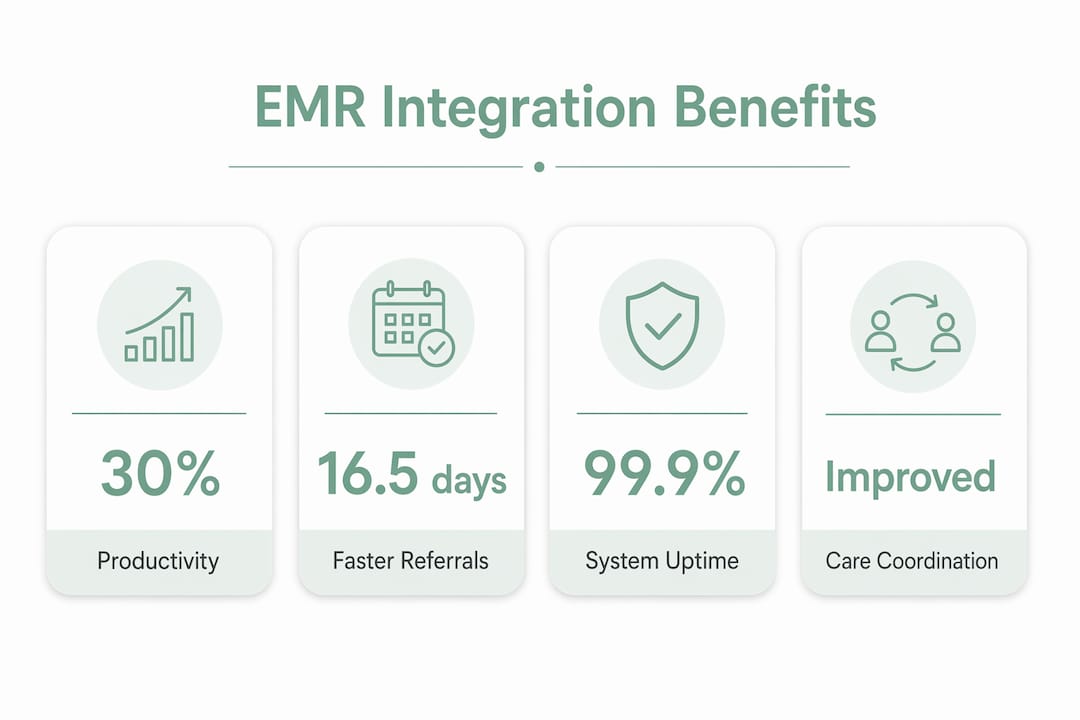
The benefits of EMR integration reach every layer of your organization, from the physician reviewing a patient chart to the admissions coordinator processing a referral. The most direct impact is on physician productivity. EMR adoption increases physician productivity by approximately 30% by eliminating redundant manual tasks like duplicate data entry and faxing. That productivity gain translates directly into more time for patient care and faster throughput in your facility.

Care coordination between primary and specialist providers also improves measurably. Integrating primary and specialist care EMRs reduces diagnostic redundancy and shortens specialist wait times by an average of 16.5 days. For post-acute care facilities managing complex patient transitions, that reduction in wait time means faster bed occupancy and fewer care gaps.
| Benefit | Operational impact |
|---|---|
| Reduced duplicate data entry | 30% increase in physician productivity |
| Faster specialist coordination | Average 16.5-day reduction in wait times |
| Unified patient records | Fewer medication errors and care gaps |
| Remote patient monitoring support | Enables value-based and personalized care models |
| Automated billing data flow | Reduced claim denials and faster reimbursement |
Beyond productivity and coordination, EMR integration enables advanced care models like remote patient monitoring and population health management by providing unified data views across your clinical ecosystem. For skilled nursing facilities moving toward value-based care contracts, this unified data view is not optional. It is the infrastructure that makes those care models possible.
Pro Tip: Map your highest-volume manual workflows before integration. Facilities that identify their top three data bottlenecks in advance consistently see faster ROI from integration projects than those that deploy broadly without a priority focus.
How does EMR integration impact data governance and compliance?
Data governance is where many healthcare administrators underestimate the complexity of EMR integration. Every data exchange involving protected health information (PHI) must comply with HIPAA in the United States and, for facilities serving international patients, GDPR. Each system connection you add creates a new potential point of exposure if not properly secured.
Managed EMR integration platforms address this by centralizing compliance into a single layer. Managed platforms simplify data governance by providing centralized encryption, authentication, audit logging, and a single Business Associate Agreement (BAA) that covers all connected systems. That single BAA dramatically reduces the legal and administrative burden on your compliance team.
Here is how managed integration compares to building in-house:
- Centralized audit logs: Managed platforms generate audit-ready documentation automatically. In-house builds require your IT team to configure and maintain logging separately for each connection.
- Encryption and authentication: Managed providers apply consistent encryption standards across all data flows. In-house teams often apply these inconsistently as systems are added over time.
- Compliance certification maintenance: Managed providers maintain SOC 2, HIPAA, and HITRUST certifications on your behalf. In-house teams must pursue and renew these independently.
- Incident response: Managed platforms monitor connections proactively and resolve issues before they escalate. In-house teams typically respond reactively after a failure is reported.
“Modern EMR integration is a set of interrelated use cases involving numerous clinical and operational systems to build an intelligent healthcare ecosystem.” — Abbacus Technologies
Managed integration providers also deliver system uptime of 99.9% or higher, a threshold that is extremely difficult to achieve with in-house infrastructure without significant capital investment. For a facility where downtime means delayed admissions or inaccessible patient records, that reliability level is a direct patient safety consideration.
What are the practical challenges of implementing EMR integration?
Understanding EMR integration also means understanding where implementations fail. The most common failure point is not technical. It is scope underestimation. Healthcare administrators frequently approve integration projects based on the cost of the initial connection, without accounting for the ongoing maintenance, field mapping updates, and version upgrades that follow.
In-house EMR integration efforts often suffer from significant delays. Building integrations in-house can result in a six-month delay per new client connection, with compounding technical debt that slows every subsequent project. That delay has a direct financial cost in your facility: slower onboarding of referral partners, delayed bed fills, and staff time consumed by manual workarounds.
When evaluating EMR integration solutions, assess vendors on these criteria:
- FHIR roadmap: Does the vendor have a published plan for FHIR R4 and R5 support?
- Compliance documentation: Can they provide a single BAA and evidence of HIPAA and SOC 2 certification?
- Scalability model: How does pricing change as you add new system connections or data volume increases?
- Monitoring and remediation: Do they resolve integration failures proactively, or do you need to report issues first?
- Implementation timeline: What is their average time-to-live for a new EMR connection?
Partnering with a managed integration provider converts your integration costs from unpredictable capital expenditure to predictable operational expenditure. For facilities operating on tight margins, that cost predictability alone justifies the managed service model.
Pro Tip: Request a reference from any integration vendor that specifically comes from a post-acute care or skilled nursing facility. Integration complexity in long-term care settings differs significantly from acute hospital environments, and vendor experience in your specific setting matters.
How can EMR integration improve patient intake and referral processes?
Patient intake and referral management are where EMR integration delivers some of its most visible operational gains. When your EMR connects directly to referring physician systems, insurance portals, and clinical documentation tools, your admissions team receives complete patient information at the point of referral rather than chasing records by phone and fax.
The table below shows the difference between a disconnected and an integrated referral workflow:
| Workflow stage | Without EMR integration | With EMR integration |
|---|---|---|
| Referral receipt | Fax or phone, manual entry | Automated data pull from referring EMR |
| Insurance verification | Manual portal checks | Real-time eligibility verification |
| Clinical assessment | Paper or separate system | Pre-populated from patient record |
| Bed assignment decision | Delayed by incomplete data | Faster with complete clinical picture |
| Documentation compliance | Manual compilation | Automated audit trail |
For skilled nursing facilities and rehabilitation centers, the referral-to-admission timeline directly affects revenue. Faster, more accurate referral processing means higher bed fill rates and reduced time your admissions staff spends on administrative tasks. Connecting your EMR with referral workflows creates a direct line between clinical data and admissions decisions, removing the manual steps that slow your team down.
Platforms that optimize patient intake through EMR integration give your admissions coordinators a single interface for reviewing referrals, verifying eligibility, and confirming clinical fit, without toggling between multiple systems or waiting for faxed documents to arrive.
Key takeaways
EMR integration is a business necessity for healthcare facilities that want to deliver coordinated care, maintain compliance, and operate efficiently at scale.
| Point | Details |
|---|---|
| Core definition | EMR integration connects your EMR to labs, billing, devices, and referral systems for real-time data flow. |
| Productivity impact | Integrated EMR systems increase physician productivity by approximately 30% through reduced manual tasks. |
| Compliance advantage | Managed integration platforms provide a single BAA, centralized audit logs, and 99.9% uptime guarantees. |
| Referral efficiency | Integration eliminates fax-based referral workflows and enables real-time insurance verification at intake. |
| Implementation risk | In-house builds average a six-month delay per new connection; managed providers reduce that risk significantly. |
Why I think most facilities are still underestimating EMR integration
After working closely with healthcare administrators across post-acute and long-term care settings, the pattern I see most often is this: facilities treat EMR integration as an IT project rather than an operational strategy. They approve a budget for the initial connection, celebrate when systems technically communicate, and then discover six months later that data mapping errors are generating incorrect billing codes or that a new referral partner cannot connect because the integration does not support their EMR version.
The facilities that get the most from integration are the ones that treat it as ongoing infrastructure, not a one-time deployment. They assign an internal owner, they review integration performance quarterly, and they choose managed providers who monitor connections proactively. Managed providers resolve issues before clients are even aware of them. That level of reliability is simply not achievable with a stretched internal IT team managing multiple priorities.
My honest recommendation: if your facility is processing more than 20 referrals per week and still relying on fax-based intake, EMR integration is not a future consideration. It is the single highest-return operational investment available to your admissions team right now. The interoperability outcomes are measurable, the compliance benefits are real, and the cost of not integrating compounds every month you delay.
— Harry
See how Smartadmissions puts EMR integration to work for your facility
Smartadmissions is built specifically for skilled nursing facilities, rehabilitation centers, and post-acute care providers that need EMR integration to work directly within their admissions process. The platform connects to your existing EMR and insurance portals to automate referral intake, verify patient eligibility in real time, and generate clinical assessments without manual data entry. Your admissions team spends less time on paperwork and more time on decisions that fill beds faster. To understand how referral management fits into your integration strategy, or to explore the top referral management tools available in 2026, Smartadmissions has the resources your team needs to move forward with confidence.
FAQ
What is EMR integration in simple terms?
EMR integration is the process of connecting your electronic medical record system to other healthcare software and devices so that patient data flows automatically between them. This eliminates manual data entry and gives your clinical and administrative teams a complete, real-time view of each patient.
What does EMR integration involve technically?
EMR integration involves APIs built on FHIR or HL7 standards, integration engines that translate data between systems, and rigorous data mapping to maintain accuracy. Standards like LOINC and SNOMED CT create a shared clinical vocabulary across connected platforms.
Why integrate with EMR systems at all?
Integrating with EMR systems reduces duplicate data entry, shortens specialist wait times by an average of 16.5 days, and increases physician productivity by approximately 30%. For post-acute care facilities, it also accelerates referral processing and improves bed fill rates.
How does EMR integration support HIPAA compliance?
Managed EMR integration platforms centralize encryption, authentication, and audit logging under a single Business Associate Agreement, making compliance documentation faster to produce and easier to maintain during audits.
What is the difference between EMR and EHR integration?
EMR integration connects systems within a single provider’s environment, while EHR integration spans multiple provider organizations. The distinction matters when planning which external partners your system needs to exchange data with.