
TL;DR:
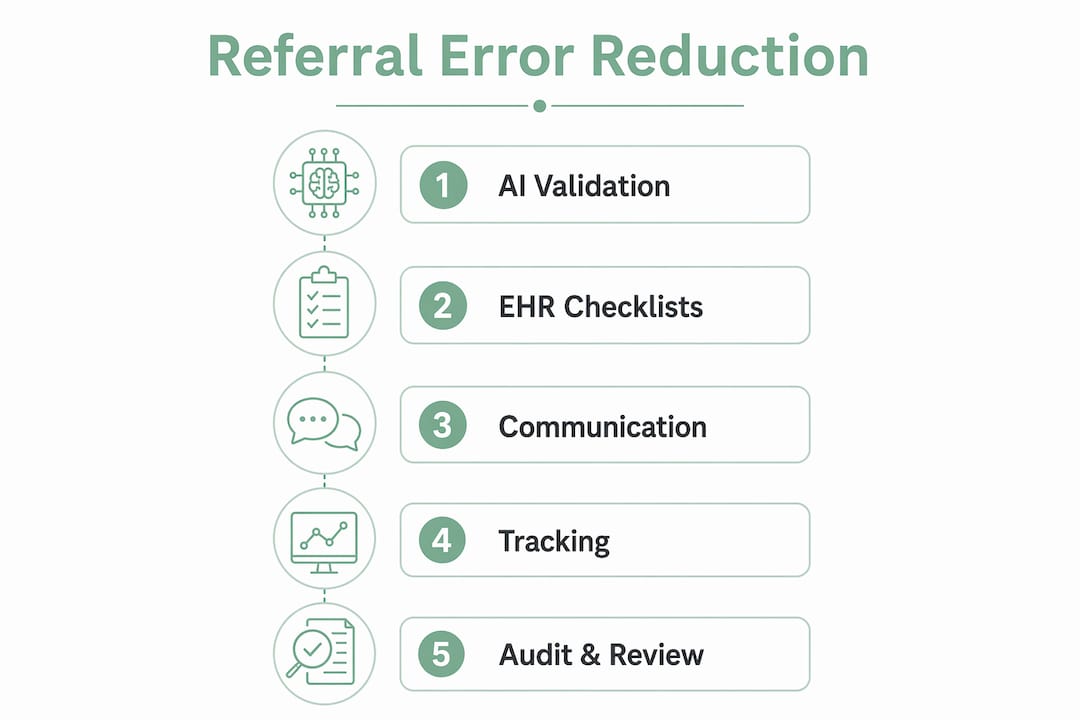
- Referral errors happen when clinical information fails to transfer properly, causing delays and increased costs. Improving accuracy involves AI validation, embedded checklists, and real-time tracking to reduce mistakes and leakage. Proper communication protocols and governance sustain quality improvements across healthcare facilities.
Referral errors are defined as failures in the transfer of clinical information, patient data, or care instructions between referring providers and receiving facilities. These failures directly delay patient admissions, increase operational costs, and create compliance risks across skilled nursing facilities, rehabilitation centers, and post-acute care settings. Knowing how to minimize referral errors is not optional for your admissions team. It is a clinical and financial priority. The most effective approach combines AI-powered validation, standardized EHR-embedded checklists, and centralized tracking protocols. Smartadmissions is built specifically to address each of these failure points within a single, integrated platform.
What are the main causes of referral errors in patient admissions?
Referral errors originate from a small set of recurring, preventable problems. Identifying them precisely is the first step toward reducing referral mistakes across your facility.
The most common causes include:
- Incomplete clinical documentation. Referring providers often believe they have sent sufficient information. Specialists frequently disagree. This expectation gap is a fundamental referral failure cause that delays care and forces follow-up calls that consume staff time.
- Manual and fax-based workflows. Fax transmissions drop pages, lose context, and create no audit trail. Manual data entry introduces transcription errors at every handoff point.
- Miscommunication between providers. When referring clinicians and receiving teams use different documentation formats, critical details fall through the gaps. Medication lists, diagnostic results, and insurance information are the most frequently omitted items.
- No referral tracking system. Without real-time status visibility, referrals go unacknowledged. Patients disengage, seek care elsewhere, or miss appointments entirely. This is called referral leakage, and it directly reduces your facility’s census.
Each of these problems compounds the others. A fax-based workflow with no tracking and inconsistent documentation creates a system where errors are not exceptions. They are the default outcome. Addressing them requires both process change and technology support.
How can AI-driven validation reduce referral errors?

AI-powered document intelligence is the most direct technology solution for reducing referral mistakes before they reach your clinical team. AI systems achieve over 95% accuracy in extracting and validating referral data from handwritten notes, multi-page faxes, and mixed-format documents. That accuracy level means your team spends time on clinical decisions, not data correction.
The core capabilities that drive this accuracy include:
- Automated completeness checks. The system flags missing fields before a referral moves forward. Your staff sees exactly what is absent, rather than discovering gaps after a patient is already in transit.
- Real-time eligibility screening. AI tools verify insurance coverage and clinical criteria against payer requirements at the moment of intake. This prevents admissions that later result in claim denials.
- Automated routing. Validated referrals route directly to the appropriate department or care team without manual intervention. Automated routing reduces wait times and lowers referral leakage across the network.
- Reduced manual workload. When extraction and validation are automated, your admissions coordinators shift from data entry to relationship management and clinical coordination.
Smartadmissions integrates AI validation directly with existing EMR systems using FHIR and HL7 standards. This means your team does not manage a separate platform. The validation layer works within the workflow your staff already uses.
Pro Tip: Set your AI validation system to flag referrals missing three or more required fields as high-priority exceptions. This prevents incomplete referrals from advancing while keeping low-risk cases moving without delay.
What are best practices for EHR-embedded referral checklists?
The most effective single strategy for improving referral accuracy is embedding diagnostic checklists directly into EHR order workflows and requiring completion before submission. This approach removes the expectation gap between referring providers and receiving specialists by making completeness a structural requirement, not a professional assumption.
Effective EHR-embedded referral tools share four characteristics:
- Brevity. Checklists with fewer than ten required fields see higher completion rates. Long forms create workarounds. Clinicians skip fields or copy forward outdated information when the burden is too high.
- Evidence-based prompts. Prompts should reflect specialty-specific documentation standards. A referral to a rehabilitation center requires different fields than one to a cardiology practice. Generic checklists produce generic, incomplete referrals.
- Specialty routing alerts. Intelligent alert systems suggest the correct specialty based on diagnosis codes and clinical notes. This reduces misdirected referrals, which waste specialist time and delay appropriate care.
- Alert fatigue mitigation. Alert fatigue occurs when providers receive too many low-value notifications and begin ignoring all of them. The solution is precision: alerts should fire only when a specific, correctable gap exists in the referral record.
Pro Tip: Audit your EHR alert logs quarterly. If more than 30% of referral alerts are overridden without action, your prompts are too frequent or too generic. Narrow the trigger criteria to restore their clinical value.
Facilities that embed referral documentation best practices into EHR workflows report fewer wasted specialist visits and faster admission decisions. The checklist does not slow the process. It removes the rework that slows it.
How can communication workflows improve referral accuracy?
Standardized communication protocols are the operational backbone of accurate referral management. Without them, even well-documented referrals get lost, delayed, or misrouted. The following steps build a communication framework that supports consistent referral accuracy:
- Define referral initiation roles. Assign a specific staff member or role responsible for initiating each referral type. Ambiguity about who owns the referral at each stage is a primary source of dropped handoffs.
- Use secure messaging within shared EHR platforms. Secure, documented messaging between referring and receiving providers creates an auditable communication trail. It also reduces the phone tag that delays referral confirmation.
- Implement automated appointment reminders. Automated referral tracking tools confirm scheduling, send patient reminders, and alert your team when an appointment has not been booked within a defined window. This directly reduces no-shows and lost referrals.
- Track referral status in real-time. Centralized referral tracking gives your admissions team a single view of every active referral, its current status, and any outstanding actions. Without this visibility, follow-up depends on memory and manual checks.
- Establish follow-up protocols. Define a specific timeframe, such as 48 hours, after which an unacknowledged referral triggers an automatic follow-up task. This prevents referrals from aging without action.
Standardized referral protocols that include clear role definitions, communication expectations, and tracking reduce missed referrals and patient leakage. The protocol itself is not complex. The discipline to apply it consistently is where most facilities fall short.
What challenges arise when reducing referral errors, and how do you address them?
Implementation barriers are predictable. Knowing them in advance lets your team plan around them rather than react to them after rollout.
- Staff resistance to new workflows. Admissions coordinators and clinical staff often resist changes to established routines, even when those routines produce errors. Structured training sessions and early involvement of frontline staff in protocol design reduce this resistance significantly.
- Alert fatigue from poorly configured EHR tools. Alerts that fire too frequently lose their effect. Design referral alerts to trigger only on high-impact gaps, and review override rates regularly to recalibrate thresholds.
- Inconsistent adoption across departments. A referral protocol that works in one unit but not another creates new gaps at the handoff points between them. Governance structures, including a designated referral quality lead, maintain consistency across the facility.
- Lack of data for quality improvement. Without measurement, you cannot identify where errors concentrate. Continuous monitoring with dashboards and stakeholder engagement sustains referral process improvements over time.
“Referral quality improvement is not a one-time project. It is an ongoing governance function that requires data, accountability, and regular review cycles to produce lasting results.”
HIPAA compliance adds another layer of governance. Every communication channel, tracking system, and AI tool in your referral workflow must meet HIPAA requirements for data handling and access control. Verify compliance before deployment, not after.
Key Takeaways
Minimizing referral errors requires AI-powered validation, EHR-embedded checklists, and standardized communication protocols working together as a single, governed system.
| Point | Details |
|---|---|
| AI validation accuracy | AI systems extract and validate referral data with over 95% accuracy, preventing errors before submission. |
| EHR checklist design | Embed concise, evidence-based checklists in EHR order workflows and require completion before a referral advances. |
| Centralized tracking | Real-time referral status visibility reduces lost referrals, no-shows, and patient leakage across the facility. |
| Alert fatigue management | Audit EHR alert override rates quarterly and narrow trigger criteria to maintain clinical value. |
| Continuous governance | Assign a referral quality lead and review dashboard data regularly to sustain accuracy improvements over time. |
Why I think most facilities are solving the wrong referral problem
After years of working with healthcare admissions teams, the pattern I see most often is this: facilities invest in documentation tools while ignoring the communication layer. They build better forms but leave the handoff process unchanged. The result is a well-documented referral that still gets lost between departments.
The real leverage point is not the form. It is the moment between submission and acknowledgment. That window, often 24 to 72 hours, is where most referral leakage happens. Automated tracking and defined follow-up protocols close that window faster than any checklist redesign.
I also think the healthcare industry underestimates how much alert fatigue undermines referral quality programs. Clinicians who see 40 low-value alerts per shift stop reading them. When a genuinely critical referral gap triggers an alert, it gets dismissed with the rest. Precision in alert design is not a technical detail. It is the difference between a system that works and one that gets ignored.
The facilities that reduce referral errors most effectively treat it as a governance issue, not a technology issue. They assign ownership, measure outcomes, and adjust protocols based on data. Technology accelerates that process. It does not replace the discipline required to sustain it.
— Harry
How Smartadmissions supports referral accuracy across your facility
Referral error reduction requires a platform built for the specific demands of skilled nursing facilities and post-acute care providers. Smartadmissions centralizes referral intake, AI-powered validation, EMR integration, and real-time tracking within a single system designed for admissions teams.
Your team can verify patient eligibility, review clinical documentation, and track every referral from submission to bed placement without switching between systems. Smartadmissions connects directly with existing EMR platforms using FHIR and HL7 standards, so onboarding does not require a technical overhaul. For facilities ready to move beyond manual workflows, referral management explained is a strong starting point. Teams looking at the full intake picture will find the step-by-step admissions workflow guide directly applicable to their current process.
FAQ
What is a referral error in healthcare?
A referral error is any failure in transferring complete, accurate clinical or administrative information between a referring provider and a receiving facility. Common examples include missing diagnostic results, incorrect insurance details, and unacknowledged referral submissions.
How do you minimize referral errors in a skilled nursing facility?
Minimizing referral errors in a skilled nursing facility requires AI-powered intake validation, EHR-embedded completion checklists, and real-time tracking protocols that flag unacknowledged referrals within a defined timeframe.
What role does EHR integration play in reducing referral mistakes?
EHR integration embeds referral checklists and alert systems directly into the clinical workflow, requiring documentation completion before submission and reducing the expectation gap between referring and receiving providers.
How does automated tracking improve referral accuracy?
Automated tracking confirms appointment scheduling, sends reminders, and provides real-time referral status to your admissions team. This reduces no-shows and prevents referrals from aging without follow-up action.
What is alert fatigue and how does it affect referral quality?
Alert fatigue occurs when providers receive too many low-value EHR notifications and begin overriding them without review. It undermines referral quality programs by causing clinicians to dismiss critical gap alerts alongside routine ones.