
TL;DR:
- A referral conversion funnel turns satisfied patients and partners into advocates who guide new prospects to admission. It involves four stages: awareness, share, reach, and conversion, with each stage needing active promotion and tracking. Building and managing this funnel reduces patient acquisition costs and increases bed occupancy efficiency.
A referral conversion funnel is a structured marketing framework that turns satisfied patients or partners into active advocates who guide new prospects through a defined journey to become admitted patients. For healthcare administrators and marketing professionals, this framework is the difference between a passive word-of-mouth hope and a repeatable, measurable patient intake system. Customer acquisition costs have surged 222% over the last eight years. That number alone explains why skilled nursing facilities, rehabilitation centers, and post-acute care providers are turning to referral funnels to fill beds faster and at lower cost.

What is a referral conversion funnel and how does it work?
A referral conversion funnel is the end-to-end process that moves a referral from first awareness to confirmed patient admission. The industry also calls this a referral marketing funnel or referral acquisition funnel. Both terms describe the same structured path, and understanding it is the first step toward building one that actually fills beds.
Successful referral funnels have two distinct journeys: the advocate journey and the referred prospect journey. Both must be optimized at the same time. Neglecting either one creates a leak in the funnel that no incentive budget can fix.
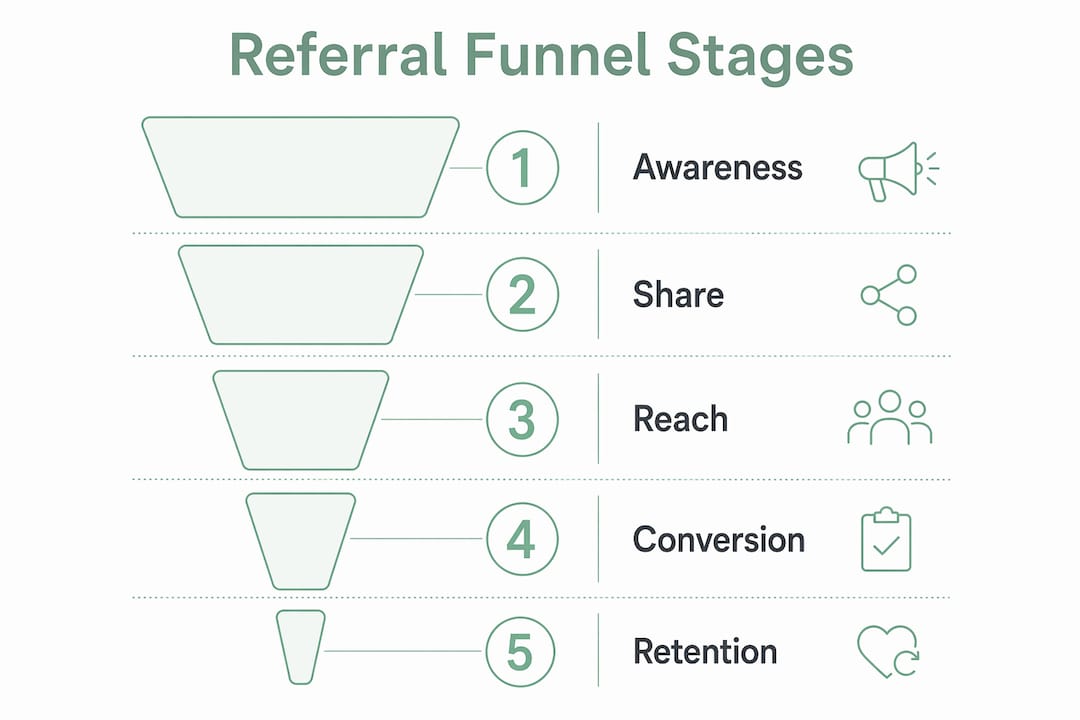
The 4 core stages of a referral funnel
| Stage | Who It Affects | Key Activity | Success Metric |
|---|---|---|---|
| Awareness | Advocate | Learns the referral program exists | Program enrollment rate |
| Share | Advocate | Sends a referral link or message | Share rate per advocate |
| Reach | Referred prospect | Receives and engages with the referral | Click-through rate on referral link |
| Conversion | Referred prospect | Completes intake or admission | Referral conversion rate |
Each stage has its own friction points. At the Awareness stage, your admissions team must actively promote the program rather than burying it in a patient portal menu. At the Share stage, the ease of sharing determines volume. At the Reach stage, the landing page experience determines trust. At the Conversion stage, your intake speed determines whether the referred prospect follows through or chooses another facility.
Pro Tip: Track drop-off at each stage separately. A low share rate points to an advocate problem. A low conversion rate points to a prospect experience problem. Treating them as one issue leads to the wrong fix.
How to build a referral funnel for healthcare organizations
Building a high-converting referral funnel for a healthcare organization requires more than a “Tell a Friend” button on your website. The process involves deliberate design across incentives, timing, technology, and the patient experience.
Step-by-step referral funnel build for healthcare
-
Define your advocate pool. Identify which patients, family members, or discharge coordinators are most likely to refer. Satisfied patients at discharge and case managers at partner hospitals are your highest-value advocates.
-
Design two-sided incentives. Give both the referrer and the referred prospect a reason to act. Two-sided incentives generate up to 10x ROI compared to generic paid advertising. In healthcare, incentives can include care-related gifts, priority scheduling, or service credits where regulations permit.
-
Time your referral ask correctly. The highest-converting referral requests happen just after positive clinical milestones such as patient discharge or a completed intake assessment. Asking at the peak of satisfaction produces far better results than a static email sent weeks later.
-
Build advocate toolkits. Give advocates pre-written messages, shareable links, and clear instructions. Providing advocates with toolkits increases sharing activity by up to 3x. Your admissions team should not expect advocates to craft their own outreach from scratch.
-
Set up tracking and attribution before your first invite. Without proper tracking built before the first invite, programs risk overpaying for referrals or losing momentum when referrals go uncredited. Use referral management software that assigns unique tracking links to each advocate.
-
Optimize the referred prospect’s landing page. Tailoring landing pages for referred traffic with a visible referral source increases trust and conversion compared to sending prospects to a generic admissions page. Include the referrer’s name or organization where appropriate.
-
Automate follow-ups. Set automated messages to re-engage referred prospects who clicked but did not complete intake. A single follow-up touchpoint recovers a meaningful share of near-conversions.
Pro Tip: Reducing friction through one-click mobile sharing drives more referral volume than increasing the incentive size. If sharing takes more than two taps on a phone, you will lose advocates before they act.
Platforms like Smartadmissions integrate with your existing EMR system to automate referral tracking, attribution, and follow-up communications. This removes the manual work from your admissions staff and keeps the funnel moving without added headcount. You can also review ways to reduce referral times to see how faster processing directly improves conversion at the final funnel stage.
What metrics measure referral funnel success in healthcare?
Measuring a referral conversion funnel requires tracking specific key performance indicators at each stage. Generic website analytics will not show you where referrals drop off or which advocates drive the most admissions.
| Metric | Definition | Benchmark | What It Tells You |
|---|---|---|---|
| Referral participation rate | % of eligible advocates who make at least one referral | Varies by program | Shows program awareness and advocate motivation |
| Share rate | Referrals sent per active advocate | Program-dependent | Indicates toolkit and incentive effectiveness |
| Referral conversion rate | % of referred prospects who complete intake | 4%–8% (vs. ~2% for paid traffic) | Measures prospect experience and intake speed |
| Cost per acquisition (CAC) | Total program cost divided by new patients acquired | Aim for 30%–70% below paid channel CAC | Tracks financial efficiency of the funnel |
| Referred patient retention | How long referred patients stay vs. non-referred | Typically higher for referred patients | Indicates quality of referred patient fit |
Referral programs that are actively nurtured and tracked at key lifecycle moments consistently outperform passive programs. Referral programs need active nurturing and tracking at key lifecycle moments to move prospects from awareness to conversion. A referral funnel left unmonitored will stall within weeks of launch.
Use cohort analysis to compare referred patients against non-referred patients on length of stay, readmission rates, and payer mix. This data justifies continued investment in the referral program to your leadership team. For a deeper look at how analytics supports this process, the Smartadmissions guide on healthcare analytics for skilled nursing covers eight specific efficiency benefits.
Pro Tip: Set a monthly funnel review cadence. Pull data on share rate, conversion rate, and CAC together. If share rate drops, revisit your advocate toolkit. If conversion rate drops, audit your landing page and intake response time.
Referral marketing strategies that increase funnel performance
The most effective referral marketing strategies for healthcare combine the right timing, the right message, and the right technology. Each element reinforces the others.
-
Use two-sided incentives consistently. Programs that reward both the referrer and the referred prospect outperform one-sided programs. The referred prospect needs a reason to choose your facility over a competitor, and the advocate needs recognition for their effort.
-
Be present at every patient milestone. Referral asks placed at discharge, at the 30-day follow-up call, and at care plan reviews reach advocates when satisfaction is highest. A single ask at one moment misses the majority of your referral opportunity.
-
Equip your admissions team with shareable toolkits. Pre-written email templates, text message scripts, and printed cards for family members all reduce the cognitive load on advocates. The easier you make sharing, the more sharing happens.
-
Tailor your messaging to the healthcare context. Referral language in healthcare must emphasize trust, clinical quality, and patient outcomes. Generic marketing copy about “great deals” undermines the credibility your facility has built.
-
Integrate your referral program with your EMR and admissions platform. When referral data flows directly into your Electronic Health Records system, your team sees the full patient picture from the first contact. This integration also prevents duplicate data entry and reduces the risk of referrals falling through the cracks. Smartadmissions supports EMR integration for referral intake to connect these workflows without requiring custom development.
-
Avoid the three most common pitfalls. Poor timing (asking for referrals before a positive outcome), inadequate tracking (no attribution system), and ignoring the referred prospect’s experience are the top reasons referral programs fail to scale.
The referral prioritization strategies used by high-performing post-acute care facilities show that structured advocate management consistently outperforms ad hoc word-of-mouth programs.
Key Takeaways
A referral conversion funnel is the most cost-efficient patient acquisition system available to healthcare facilities, provided it is built with clear stages, tracked metrics, and active management at every step.
| Point | Details |
|---|---|
| Define the funnel stages | Map Awareness, Share, Reach, and Conversion to identify where referrals drop off. |
| Optimize both journeys | The advocate experience and the referred prospect experience must be designed and measured separately. |
| Time your referral ask | Request referrals immediately after positive clinical milestones for the highest conversion rates. |
| Track before you launch | Build attribution and tracking systems before sending the first referral invite to protect program ROI. |
| Measure CAC and retention | Referral programs can reduce acquisition costs by 30%–70% and typically produce higher-retention patients. |
Why most healthcare referral programs never reach their potential
Working closely with healthcare admissions teams over the years, I have seen the same pattern repeat itself. A facility launches a referral program with good intentions, sends one email to past patients, and then waits. When nothing happens, the program gets labeled as ineffective and quietly abandoned.
The problem is never the concept. The problem is the execution. Most programs treat referrals as a passive outcome rather than an active acquisition channel. They bury the referral ask in a patient portal that nobody visits. They skip tracking entirely, so when a referral does convert, nobody knows which advocate to credit or reward. And they design the program around the referrer while completely ignoring the experience of the referred prospect.
The dual-journey model changes this. When your team designs the advocate path and the prospect path as two separate but connected systems, the funnel becomes something you can actually manage and improve. You stop guessing and start reading the data.
The other shift I would encourage is around timing. Healthcare administrators often feel uncomfortable asking patients for referrals. That discomfort leads to delayed asks, buried links, and vague messaging. The data is clear: the best moment to ask is right after a positive outcome. That is not exploitation. That is meeting a satisfied patient at the moment they are most willing to help others find the same care.
Technology makes this manageable. Platforms that integrate with your EMR and automate follow-up communications remove the burden from your admissions staff. The funnel runs in the background while your team focuses on clinical intake decisions.
— Harry
Smartadmissions and your referral conversion funnel
Smartadmissions is built for skilled nursing facilities, rehabilitation centers, and post-acute care providers that need a faster, more reliable patient intake process.
The platform’s AI-powered referral management tools connect directly with your EMR system to automate eligibility verification, track referral attribution, and reduce the manual review time that slows your funnel at the conversion stage. Facilities using Smartadmissions report faster bed occupancy and reduced administrative burden on admissions staff. If you are ready to move from a passive referral hope to a structured intake system, the referral management systems guide is a practical starting point. You can also explore how admissions automation drives faster bed occupancy to see the full operational picture.
FAQ
What is a referral conversion funnel in simple terms?
A referral conversion funnel is a step-by-step process that turns existing patients or partners into advocates who bring new patients through a defined path to admission. It tracks every stage from initial awareness to completed intake.
How many stages does a referral funnel have?
Most referral funnels have four stages: Awareness, Share, Reach, and Conversion. Each stage has distinct metrics and requires separate optimization for both the advocate and the referred prospect.
What is a good referral conversion rate for healthcare?
A referral conversion rate of 4%–8% is a strong benchmark for referral programs, compared to approximately 2% for paid traffic channels. Higher rates are achievable with optimized landing pages and fast intake response times.
When is the best time to ask for a referral in healthcare?
The best time to request a referral is immediately after a positive clinical milestone such as patient discharge or a completed care assessment. Satisfaction is highest at these moments, which produces the strongest referral response.
How does EMR integration support a referral funnel?
EMR integration connects referral data directly to patient records, eliminating duplicate data entry and giving your admissions team a complete clinical picture from the first contact. This speeds up the conversion stage and reduces the risk of referrals being lost in manual handoffs.
Recommended
- How to Cut Referral Processing Time from 45 to 5 Minutes | AI Admissions Automation for Skilled Nursing Facilities
- How to Track Referral Outcomes: 5 Proven Methods for SNFs
- Stop Wasting 45 Minutes on Each Referral: Try These 5 Post-Acute Care Automation Hacks – Smart Admissions
- What Is Referral Management and Why It Matters