
How outcomes data drives referral growth in healthcare
Outcomes data is the single most credible tool your facility has for growing its referral network. When physicians, Employee Assistance Programs (EAPs), and specialist groups see measurable evidence of treatment effectiveness, they refer with confidence rather than guesswork. That shift from anecdotal reputation to evidence-based trust is what separates facilities with stagnant referral volumes from those with consistently growing networks.
Referral outcomes data refers to the structured, clinical, and operational information collected at every stage of the patient referral process. This includes treatment results, appointment completion rates, time-to-treatment, and patient progress metrics tracked across care episodes. For skilled nursing facilities, rehabilitation centers, and post-acute care providers, this data is the foundation of every referral relationship worth building.
The benefits of using outcomes data for referrals are concrete, including building referrer confidence, supporting value-based care contracts, improving care coordination, sustaining referral networks, and enabling targeted outreach.

The organizations most effectively using outcomes measurement in growth are those that treat data not as a compliance requirement, but as a communication tool. When your facility can show a referring physician exactly how their patients progressed under your care, the next referral becomes a much easier decision.
Core metrics your team should track in referral analytics
Effective referral analytics depends on tracking the right indicators consistently. Electronic Health Records (EHR) systems and dedicated referral analytics tools are the infrastructure that makes this possible, capturing data at each touchpoint and feeding it into dashboards your team can act on.
The metrics that matter most fall into two categories: volume and quality. Volume metrics tell you how many referrals are entering your system and how quickly. Quality metrics tell you what happens to those referrals once they arrive.
- Referral volume: Total referrals received per week or month, segmented by source. This is your baseline for growth tracking.
- Referral completion rate: The percentage of referrals that result in a scheduled appointment or same-day access. A 73.5% completion rate is achievable with structured electronic referral processes.
- Time-to-first contact: How quickly your team reaches a referred patient after the referral is entered. Contacting 80% of patients within nine minutes of referral entry is a documented benchmark from quality improvement research.
- Referral conversion rate: The proportion of referrals that convert to admitted or enrolled patients, directly tied to revenue impact.
- Patient follow-through rate: Whether referred patients actually attend their appointments, which reflects both patient engagement and referral quality.
- Referral source attribution: Which providers, facilities, or programs are generating referrals, enabling personalized relationship management.
- Time-to-treatment: The interval between referral entry and the start of care, a key indicator of operational efficiency.
| Metric | Definition | Why it matters |
|---|---|---|
| Referral volume | Total referrals received per period | Measures network growth and outreach effectiveness |
| Completion rate | Referrals resulting in a next care step | Indicates referral loop closure and process reliability |
| Time-to-first contact | Minutes from referral entry to patient contact | Reflects operational responsiveness |
| Conversion rate | Referrals that become admitted patients | Directly tied to bed occupancy and revenue |
| Patient follow-through | Patients who attend scheduled appointments | Signals patient engagement and referral quality |
| Source attribution | Referrals mapped to specific providers or programs | Enables targeted, personalized outreach |
| Time-to-treatment | Referral entry to care start interval | Measures end-to-end process efficiency |
EHR integration is what connects these metrics into a usable picture. When your referral management system pulls data directly from your EMR, your team gets real-time visibility rather than end-of-month reports that are already outdated. For a practical look at referral management systems that support this kind of integration, the options available in 2026 range from basic tracking tools to fully automated platforms.
Pro Tip: Set up statistical process control (SPC) charts for your weekly referral volume. SPC charts distinguish genuine performance changes from normal variation, so your team responds to real trends rather than noise.
How outcomes data improves patient care and accelerates referral growth
Transparency in clinical outcomes directly influences both care quality and referral volume. A meta-analysis covering over 5.5 million clinical events found that public reporting of performance data was associated with an overall mortality risk ratio of 0.85, indicating a meaningful reduction in mortality linked to outcomes transparency. That is not a marginal finding. It reflects how accountability built into the reporting process pushes facilities to improve, and how that improvement is visible to the referrers who matter most.
A systematic review of public performance reporting (PPR) across 45 studies found that most reported positive effects on provider selection by patients and peers, quality improvement activities, and clinical outcomes. One study within that review found that general practitioners slightly increased referrals to hospitals that scored higher on medical effectiveness indicators. The relationship between reported quality and referral behavior is measurable, not theoretical.
For your facility, this means that outcomes data does two jobs simultaneously. First, it creates internal pressure to maintain and improve care standards because your team knows the numbers are being tracked and shared. Second, it gives referring physicians a concrete reason to choose your facility over one that offers only a brochure and a handshake. Facilities that can show documented symptom score reductions, functional improvement rates, or readmission avoidance data are speaking the language that clinical referrers trust.
The connection between outcomes measurement in growth and referral network expansion is clearest when data is shared proactively. Waiting for a referrer to ask is a missed opportunity. Sending a quarterly outcomes summary to your top ten referring physicians, formatted for clinical readers rather than administrators, keeps your facility visible and credible between patient placements.
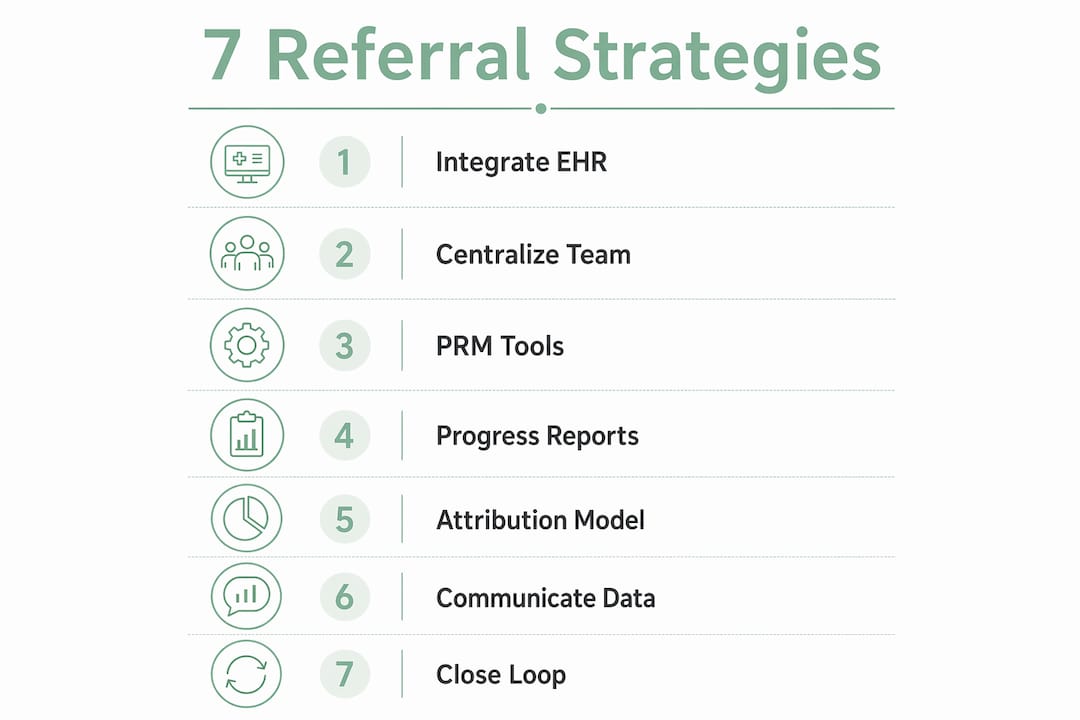
7 practical ways to use outcomes data to improve referral workflows
1. Integrate your EHR with an electronic referral management system
EHR integration with referral management platforms is the operational foundation of data-driven referral programs. When referral orders are embedded directly in the EMR, your coordination team receives real-time alerts and can act immediately. Quality improvement research shows that this approach can take documented referrals from fewer than 2 per week to over 800 per week, sustained over nine months. The key is embedding the referral order at the point of visit closure, so that disposition planning becomes a standard step rather than an afterthought.
2. Build a centralized referral coordination team
Technology alone does not close referral loops. A dedicated coordination team that monitors incoming referrals, contacts patients promptly, and tracks outcomes at each stage is what converts system capability into actual results. The same quality improvement study cited above achieved patient contact within nine minutes for 80% of referred patients, a result driven by a coordination team covering approximately 90% of outpatient operational hours.
3. Use provider relationship management (PRM) tools informed by outcomes data
Data-driven provider relationship management lets your team understand which referring providers send the highest-value patients, what clinical interests drive their referral decisions, and how to tailor outreach accordingly. Rather than sending the same newsletter to every physician on your list, PRM tools segment your referral sources by specialty, volume, and patient profile, so each touchpoint is relevant. This approach reduces wasted outreach and deepens relationships with the providers who matter most to your census.
4. Share longitudinal progress reports, not raw data
Pro Tip: Send referring physicians a structured, one-page outcomes summary showing patient progress over a defined care episode, such as functional improvement scores at 30 and 60 days, rather than a spreadsheet of raw metrics. Validated progress reports build clinical trust far more effectively than unformatted data exports.
Presenting outcomes data in a clinical narrative format, with context and trend lines, makes it usable for the physician receiving it. The Centers for Medicare and Medicaid Services (CMS) recommends closing the referral loop with real-time updated outcome reports as a best practice for sustaining referral streams. Referrers who receive this kind of feedback are more likely to continue sending patients.
5. Apply attribution modeling to prioritize high-value referral sources
CRM-linked attribution modeling maps each referral back to its source, tracks the patient’s journey through your care episode, and calculates the revenue and outcome value generated by each referring provider. This tells your team exactly where to invest relationship-building time. Facilities that use attribution data to guide outreach avoid the common mistake of spreading effort evenly across all referrers, which dilutes impact and misses the providers generating the most consistent volume.
6. Communicate outcomes data to EAPs and insurance panels
Outcomes data strengthens your position in value-based care negotiations. Providers that can document measurable clinical improvements are better positioned to secure EAP partnerships and insurance panel contracts. This is a direct path from outcomes measurement in growth to new referral channels. Your outcomes reports become a business development tool, not just a clinical record.
7. Close the referral loop consistently
Every referral that enters your system should generate a follow-up communication to the referring provider confirming the patient’s status, care plan, and initial outcomes. This loop closure is what converts a one-time referral into an ongoing relationship. Facilities that track referral outcomes systematically and report back to referrers consistently build the kind of reputation that generates repeat referrals without additional marketing spend.
How to measure referral program success using outcomes data
Measuring the success of your referral program requires more than counting incoming referrals. Your team needs a set of performance indicators that connect operational activity to clinical and financial outcomes.
The most reliable success measures are:
- Referral completion rate: Track the percentage of referrals that result in a scheduled appointment or same-day access. A completion rate above 70% indicates a well-functioning referral loop.
- Patient contact timeliness: Measure the average time from referral entry to first patient contact. Faster contact correlates with higher follow-through and lower cancellation rates.
- Referral conversion rate: Calculate the proportion of referrals that convert to admitted patients. This metric connects directly to bed occupancy and revenue.
- Revenue impact per referral source: Attribute revenue to specific referring providers to identify your highest-value relationships and justify outreach investment.
- Referral source retention rate: Track whether your top referring providers are sending patients consistently month over month, or whether volume is declining.
Real-time dashboards that pull data from your EHR and referral management system are the practical tool for monitoring these indicators. Dashboards built on SPC methodology distinguish genuine performance shifts from normal variation, so your team acts on real trends. For facilities looking to improve referral tracking as a path to higher bed occupancy, the connection between data visibility and census performance is direct.
Best practices for performance monitoring and stakeholder reporting include:
- Review referral volume and completion rates weekly, not monthly, so your team can course-correct quickly.
- Segment referral data by source, specialty, and patient type to identify patterns that aggregate numbers hide.
- Present outcomes summaries to clinical leadership and referring partners quarterly, using trend data rather than point-in-time snapshots.
- Audit referral documentation regularly to confirm that referral reasons and supporting clinical information are complete, which affects both data quality and compliance.
- Synchronize data across your EHR, referral management platform, and CRM so that every team member is working from the same information.
Research-backed insights on transforming referral growth with outcomes data
The evidence base for using outcomes data to drive referral growth has grown considerably in recent years. The core finding across multiple study designs is consistent: facilities and providers that make their performance data visible attract more referrals and improve care quality in the process.
Outcomes data replaces anecdotal reputation with evidence-based trust. A referring physician who has seen your facility’s 30-day readmission rate, functional improvement scores, and patient contact times has a clinical basis for the referral decision. That is a fundamentally different relationship than one built on familiarity or proximity.
Personalized outreach informed by attribution modeling is one of the most underused applications of outcomes data. CRM-linked attribution identifies which referring providers generate the highest patient volume and the best clinical outcomes, allowing your team to concentrate relationship-building where it produces the most return. Spreading outreach evenly across all referrers is a resource allocation problem that outcomes data can solve directly.
Data privacy and HIPAA compliance are real constraints on how outcomes data can be shared with referral sources. De-identified aggregate outcomes reports, shared through secure messaging platforms or provider portals, are the standard approach for maintaining compliance while keeping referrers informed. Your team should work with your compliance officer to establish a data-sharing protocol that satisfies HIPAA requirements without creating so much friction that reports never get sent. The virtual care outcomes evidence from employer-sponsored programs offers a useful model for how de-identified data can be packaged to demonstrate ROI to referral partners.
Challenges in collecting usable outcomes data are real and worth naming directly:
- Incomplete documentation: Referral reasons and clinical context are often missing from referral orders, degrading data quality downstream.
- System fragmentation: When EHR, referral management, and CRM platforms do not communicate, data silos form and metrics become unreliable.
- Referrer engagement: Not all referring providers will read outcomes reports, especially if they are formatted for administrators rather than clinicians.
- Attribution complexity: Multi-touch referral journeys, where a patient is influenced by several providers before arriving at your facility, are difficult to attribute accurately without a purpose-built CRM.
Overcoming these challenges requires both technology investment and process discipline. Embedding referral documentation requirements directly in the EMR workflow, as the quality improvement research demonstrates, is the most reliable way to ensure complete data capture. Platforms that support EMR integration with referral management address the fragmentation problem at the system level, rather than relying on manual data entry to bridge the gap.
How Smartadmissions helps you act on outcomes data
Smartadmissions is built for skilled nursing facilities, rehabilitation centers, and post-acute care providers that want to turn outcomes data into referral growth. The platform’s AI-powered referral management assistant integrates directly with your existing EMR and insurance portals, giving your team real-time eligibility verification, clinical status assessment, and documentation management in a single workflow.
The referral management systems that Smartadmissions supports are designed to close the referral loop automatically, track completion rates, and surface the analytics your team needs to report outcomes to referring partners. If your facility is ready to move from manual tracking to a data-driven referral program, Smartadmissions provides the infrastructure to make that transition without disrupting your existing staff workflows.
Key Takeaways
Outcomes data is the most reliable foundation for referral growth because it replaces reputation-based referrals with evidence that referring providers can act on with clinical confidence.
| Point | Details |
|---|---|
| Completion rate benchmark | A structured electronic referral process can achieve a 73.5% referral completion rate, per quality improvement research. |
| Speed of patient contact | Contacting 80% of referred patients within nine minutes of referral entry is a documented, achievable benchmark. |
| Mortality risk reduction | Public reporting of outcomes data was associated with an overall mortality risk ratio of 0.85 across more than 5.5 million clinical events. |
| Attribution modeling | CRM-linked attribution identifies high-value referral sources, enabling focused outreach rather than diluted, broad-based engagement. |
| Loop closure drives retention | Sending longitudinal outcomes reports to referring providers after each care episode sustains referral streams and builds long-term relationships. |