
PASRR requirements obligate every Medicaid-certified nursing facility to complete a Level I screen before admitting any applicant, regardless of payer source. A positive Level I screen triggers a Level II evaluation before admission proceeds, and both steps must follow your state’s submission timeline. Start Level I the moment a hospital or community referral surfaces, and confirm your state portal’s turnaround window immediately, since a delayed screen stalls admission and payment alike.
TL;DR:
- Starting Level I screening early, immediately after a referral surfaces, ensures timely evaluation and prevents delays in admission and payment processing.
- A positive Level I screen or significant clinical change triggers a Level II evaluation, which must be completed within your state’s specified time frame to avoid retroactive requirements.
- Federal regulations mandate that Level II assessments include personalized, culturally and linguistically appropriate evaluations, with recommendations integrated into the resident’s care plan.
- State-specific differences, such as California’s requirement to submit evaluations within three days or Texas’s expedited pathways, impact the speed of the PASRR process.
- Maintaining detailed, up-to-date documentation and a shared tracking system helps prevent audit issues, delays, and non-compliance penalties.
Table of Contents
- Federal PASRR Overview and Regulatory Foundation
- Level I Screening: Who Completes It and When
- Level II Evaluation and Determination: Triggers and Clinical Criteria
- Resident Review: When Current Residents Need Reassessment
- State Implementation Differences You Need to Verify
- Operational Checklist for PASRR Compliance
- Common Pitfalls and How to Correct Them
- Practitioner Tips for Audit-Ready PASRR Documentation
- Why Proactive PASRR Timing Protects Care and Operations
- How Referral Automation Eases the PASRR Burden
- Sources
Federal PASRR Overview and Regulatory Foundation
PASRR traces back to the Omnibus Budget Reconciliation Act, and its operational rules now live in 42 CFR Part 483, Subpart C. That regulation spells out evaluator responsibilities, report contents, and how determinations get distributed to facilities and state authorities.
CMS built PASRR around a two-part structure: a Level I screen that flags suspected serious mental illness (SMI), intellectual disability (ID), or a related condition, followed by a Level II evaluation when that flag turns up positive, according to Medicaid’s PASRR guidance. The program also ties back to the Olmstead principle, meaning determinations must weigh whether a community-based setting fits the person better than institutional care. The outcome isn’t just a yes or no on admission. It’s a set of specialized service recommendations that follow the resident into the care plan.
Level I Screening: Who Completes It and When
Level I screening responsibility depends on the admission path. Hospital discharge planners typically initiate the screen for patients moving straight from an acute stay, while admissions coordinators handle it for community referrals coming from home or another non-hospital setting. Either way, PASRR is required before discharge to a Medicaid-certified nursing facility, no matter the payer.
Start the screen as early as possible in the referral window. Waiting until the day before a planned discharge creates unnecessary friction with prior authorization and bed-hold negotiations.
Expect these portal behaviors once you submit:
- Instant negative results for straightforward cases with no SMI/ID indicators
- A PASRR confirmation or CID number generated for tracking
- A pending status when the system needs additional clinical detail before returning a result
Documentation should include diagnosis history, current medications, recent hospitalization records, and any behavioral health treatment notes. Thin documentation is the fastest way to get bounced back for resubmission.
Level II Evaluation and Determination: Triggers and Clinical Criteria
A positive Level I screen triggers Level II, and so does a Resident Review that flags a significant clinical change. Evaluators assess against the criteria in 42 CFR §483.128, which covers SMI, intellectual disability, and related conditions.
Two paths exist for a determination:
- Categorical determinations cover situations like convalescent care, terminal illness, or provisional admissions pending assessment for delirium, where states can set short time limits without requiring a full evaluation up front.
- Individualized evaluations dig into diagnosis, functional status, and treatment needs to decide whether the nursing facility, a specialized service package, or a community placement fits best.
Pro Tip: Don’t assume a categorical determination means you’re off the hook for follow-up. Provisional admissions carry state-specific time limits, and missing that window can trigger a full Level II requirement retroactively.
Results go to the facility, the referring hospital or agency, and the resident or legal representative. The CFR requires that evaluations adapt for language and culture, and that the individual and family participate in the process. Recommendations from Level II don’t sit in a file. They belong in the person-centered care plan, with specialized services scheduled and documented from day one.
Resident Review: When Current Residents Need Reassessment
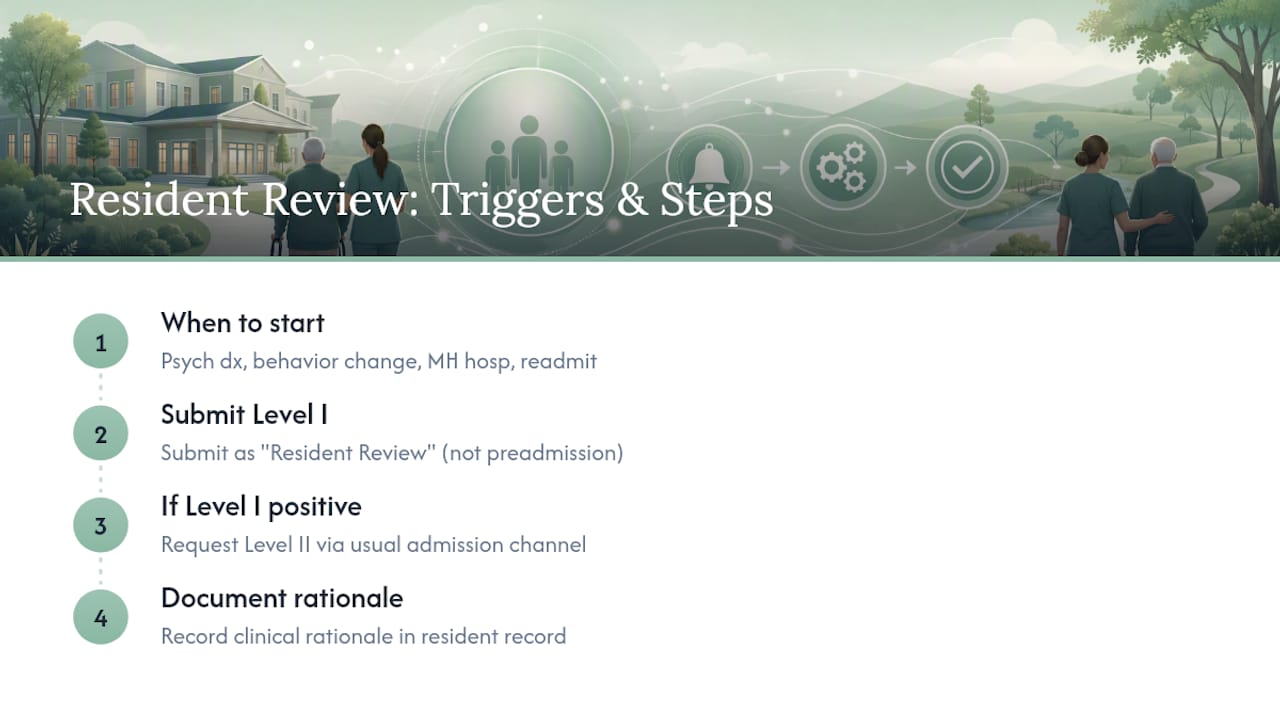
Resident Review, or RR, differs from preadmission screening in one key way: it applies to people already living in your facility. An RR gets triggered by a significant change in condition, not by a routine care plan update.
Concrete triggers include a new psychiatric diagnosis, a marked behavioral shift, a hospitalization for a mental health crisis, or a readmission after a stay elsewhere that involved treatment for SMI or ID symptoms.
Once you identify an RR trigger, submit a Level I screen coded as a Resident Review rather than a preadmission screen. If that screen comes back positive, request Level II through the same channel you’d use for a new admission, and document the clinical rationale for initiating the review in the resident’s record.
State Implementation Differences You Need to Verify
Federal rules set the floor, but your state PASRR program sets the operational reality. Three examples show how much variation exists:
- California ties PASRR directly to managed care prior authorization. Hospitals and SNFs must submit the Level II evaluation letter to the managed care plan within three calendar days of issuance, or the prior authorization for SNF placement stalls.
- Texas structures admissions into distinct categories, including expedited admission types that let facilities move faster on urgent placements while still meeting Level I obligations.
- Ohio and other states run their own PL1/Level I submission portals with distinct turnaround expectations, so confirm your state’s specific workflow rather than assuming it mirrors a neighboring state.
Before every admission, confirm your state’s required submission fields, MCP prior-auth linkage, and expected turnaround window directly with your state PASRR program.
Operational Checklist for PASRR Compliance
A workable PASRR process comes down to timing, documentation, and communication working together.
- Start Level I as soon as a referral or hospital discharge plan surfaces, not after the bed is confirmed.
- Gather hospital discharge notes, treatment history, and MDS data before submission so the screen isn’t returned for missing information.
- If Level I comes back positive, assemble a referral packet for Level II that includes diagnosis history, current treatment plan, and any prior specialized service records.
- Keep written notices to the resident and legal representative on file, along with dated notes on interdisciplinary team discussions.
- Log the clinical rationale whenever your team disagrees with a determination, since COE-NF guidance flags undocumented disagreements as a recurring audit gap.
- Coordinate with managed care plans early on prior authorization so the PASRR CID number and Level II letter reach them inside the required window.
Pro Tip: Build a shared tracking sheet between admissions and clinical staff that logs Level I submission date, CID number, and Level II status. Most delays happen when that information lives in someone’s inbox instead of a shared record your admissions decision-making guide can reference at handoff.
Common Pitfalls and How to Correct Them
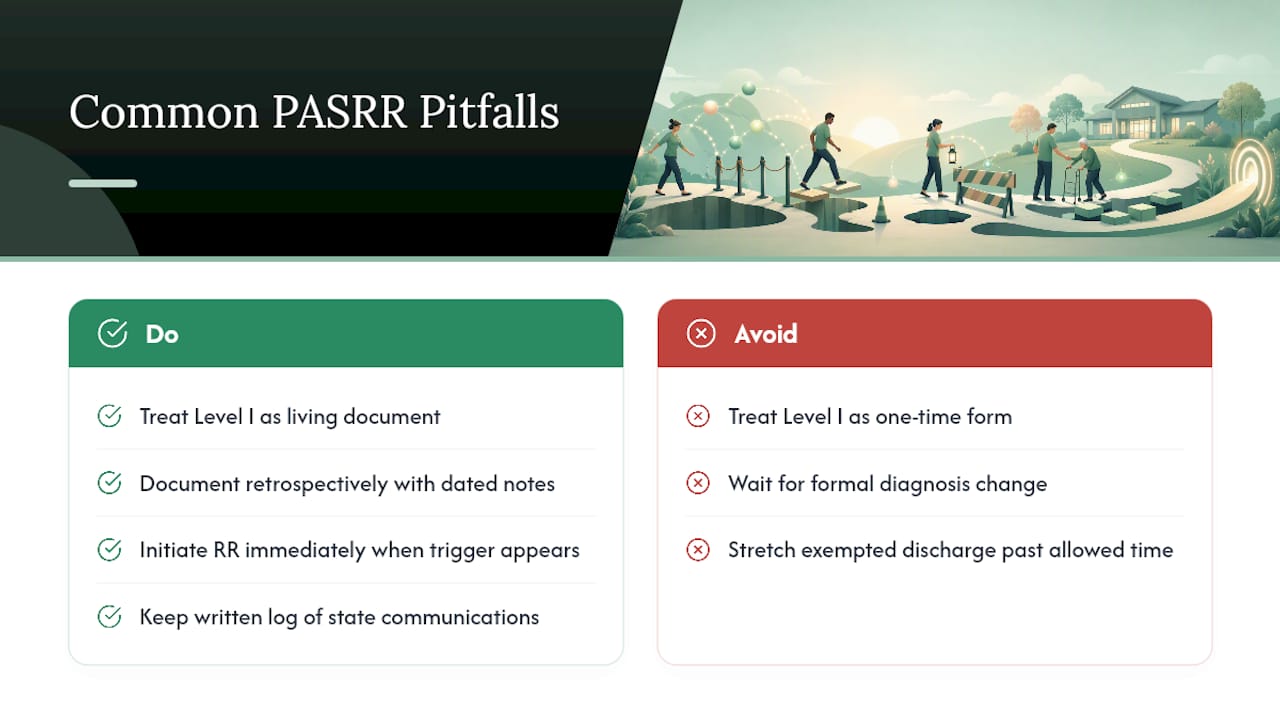
Three mistakes cause most PASRR audit findings: treating Level I as a one-time form instead of a living document, waiting for a formal diagnosis change before initiating an RR, and stretching an exempted hospital discharge past the state’s allowed time limit.
Each carries a real cost. Incomplete PASRR can delay Medicaid payment, jeopardize Federal Financial Participation for days without a completed screen, and draw state survey citations.
Correct course fast: document retrospectively with dated notes, initiate the RR the moment a trigger appears, update the care plan to reflect new recommendations, and keep a written log of every communication with your state PASRR authority.
Practitioner Tips for Audit-Ready PASRR Documentation
Treat the Level I form as an active clinical record, not paperwork you file and forget. Annotate it whenever new clinical information emerges. Interpret “significant change” broadly rather than waiting for a formal diagnosis update, and document interdisciplinary coordination so Level II recommendations show up clearly in the person-centered care plan.
Why Proactive PASRR Timing Protects Care and Operations
PASRR done early isn’t just a compliance box. It clarifies care planning before a resident ever moves in, which cuts down on crisis-driven Resident Reviews later. Admissions teams that treat PASRR timing as part of the clinical handoff, not an afterthought, see fewer readmission-driven scrambles and cleaner documentation when survey season arrives.
— Harry
How Referral Automation Eases the PASRR Burden
Some referral automation platforms provide admissions teams a faster path to Level I initiation than manual referral intake, by pulling hospital notes, treatment history, and MDS data into one record the moment a referral lands.

That matters most when a positive Level I screen puts you on the clock for a Level II referral packet. Instead of chasing documents across fax machines and portals, your team works from a consolidated clinical history that’s already organized for submission. Such platforms can also surface significant-change flags that often precede a Resident Review, helping teams catch RR triggers before they become audit findings. Explore how automation cuts admissions time or review referral documentation best practices to see where Smart Admissions fits into your current PASRR workflow, then request a demo to walk through your state’s specific portal requirements.
This article is general information, not a substitute for advice from a qualified doctor. Consult a qualified healthcare professional about your own circumstances before acting on anything here.
Sources
- Preadmission Screening and Resident Review | Medicaid
- 42 CFR Part 483 Subpart C – Preadmission Screening and Resident Review | eCFR
- PASRR Essentials: Federal Requirements and State-Specific Navigation for Nursing Facilities | COE‑NF
- Preadmission Screening and Resident Review | DHCS
- PASRR for Nursing Facilities | Texas Health and Human Services