
Admissions coordinators at skilled nursing and rehabilitation centers face mounting pressure to fill beds quickly while managing overwhelming paperwork. Manual referral reviews create bottlenecks that delay patient placements and drain staff energy. Admissions automation efficiency transforms these workflows, cutting review times and boosting revenue through faster occupancy. Automation isn’t just about speed—it’s about reclaiming time for patient care while strengthening your facility’s financial performance.
Table of Contents
- Introduction To Admissions Challenges In Skilled Nursing And Rehabilitation
- How Automation Speeds Up Patient Intake
- AI Integration For Referral Management And Documentation
- Common Misconceptions About Admissions Automation
- Comparison Of Manual Vs Automated Admissions Workflows
- Financial And Operational Benefits Of Admissions Automation
- Driving Data-Driven Decision-Making With Automation
- Conclusion And Next Steps For Implementing Admissions Automation
- Streamline Your Admissions With Smart Admissions Solutions
Key takeaways
| Point | Details |
|---|---|
| Time savings | Automation reduces referral review time by up to 50% and achieves 20% faster bed occupancy. |
| Error reduction | AI integration cuts manual verification errors by 30% and duplicate data entry by 35%. |
| Financial impact | Facilities see up to 15% higher bed occupancy rates and 40% fewer repetitive tasks. |
| Staff benefits | Automation decreases compliance risk by 18% while significantly reducing burnout. |
| Scalability | Solutions work for facilities of all sizes with minimal technical expertise required. |
Introduction to admissions challenges in skilled nursing and rehabilitation
Admissions staff juggle multiple tasks simultaneously: reviewing referrals, verifying insurance eligibility, coordinating with hospitals, and managing mountains of paperwork. This manual approach creates significant delays that ripple through your entire operation.
Manual admissions workflows involve high administrative burden leading to staff burnout; automation reduces repetitive tasks by over 40%, easing workload and improving staff satisfaction. When coordinators spend hours on data entry instead of patient care coordination, everyone suffers.
Referral review bottlenecks directly impact your bottom line. Every day a bed sits empty represents lost revenue, yet rushed decisions can lead to inappropriate placements or compliance issues. Staff burnout compounds these problems as experienced coordinators struggle under mounting pressure.
Consider these common pain points:
- Duplicate data entry across multiple systems wastes valuable time
- Insurance verification delays hold up admissions decisions for hours or days
- Missing documentation requires multiple follow-up calls to referring hospitals
- Manual tracking of referral status creates confusion and lost opportunities
Healthcare admissions automation addresses these challenges head-on. By streamlining repetitive tasks, facilities free coordinators to focus on relationship building and patient care rather than paperwork.
Workflow automation in healthcare admissions eliminates bottlenecks that slow patient placement. Intake process optimization creates smoother handoffs between departments and external partners.
Pro Tip: Prioritize automating the most repetitive and time-consuming tasks first to ease staff workload effectively. Start with insurance verification and eligibility checks, which typically consume the most coordinator time.
How automation speeds up patient intake
Automation transforms sluggish referral reviews into streamlined processes that move patients from referral to bed assignment in record time. The technology handles routine verification tasks instantly, allowing your team to focus on clinical decision-making.
Facilities using automated admissions processes experienced a 20% faster time-to-bed occupancy, significantly improving patient flow and revenue cycles. This speed advantage compounds over time, filling more beds and generating substantially higher monthly revenue.

AI-powered systems verify insurance eligibility in minutes rather than hours. Automated workflows pull real-time data from payer portals, flagging potential coverage issues before they delay admissions. This proactive approach prevents surprises that derail placements at the last minute.
Referral prioritization becomes smarter with automation. Systems analyze clinical acuity, insurance coverage, and bed availability simultaneously to match patients with appropriate units. Your coordinators receive ranked referral lists that highlight the best candidates for immediate placement.
Key speed improvements include:
- Referral review time cut by up to 50% through automated data extraction
- Eligibility verification completed in minutes instead of hours
- Bed assignment recommendations generated instantly based on clinical criteria
- Documentation automatically organized and flagged for missing items
The cumulative effect transforms your facility’s capacity to respond to referral opportunities. Manual vs automated patient intake differences become evident within weeks of implementation.
Pro Tip: Use automation to prioritize referrals by urgency to maximize bed utilization efficiently. Configure your system to flag high-acuity patients who need immediate placement, ensuring critical beds fill quickly while maintaining appropriate care matches.
AI integration for referral management and documentation
AI technology bridges the gap between disparate healthcare systems, creating seamless data flow that eliminates redundant work. Integration with existing Electronic Medical Records and insurance portals means coordinators access complete patient information without toggling between screens.
Real-time data synchronization prevents the errors that plague manual processes. When AI pulls patient demographics, clinical assessments, and coverage details directly from source systems, accuracy improves dramatically. AI tools pull real-time data from EMRs and insurance portals, minimizing duplicate entries and cutting manual verification errors by 30%.
Duplicate data entry drops by 35% when systems communicate automatically. Coordinators no longer re-type information from faxed referrals or scanned documents. Instead, AI extracts relevant details and populates admission forms automatically, requiring only quick verification.
EMR integration with referrals creates bidirectional information flow. Clinical updates from your facility flow back to referring hospitals, strengthening partnerships and improving future referral quality. This transparency builds trust with referral sources who appreciate timely communication.
Integration benefits extend beyond speed:
- Automated clinical assessment scoring identifies appropriate care levels
- Insurance portal connections verify coverage limits and authorization requirements
- Documentation workflows track missing items and trigger follow-up requests
- Compliance checks flag potential regulatory issues before admission
The technology adapts to your existing systems rather than forcing disruptive replacements. Modern integration uses APIs and secure data connections that maintain HIPAA compliance while enabling smooth information exchange.
Common misconceptions about admissions automation
Many facility administrators hesitate to adopt automation based on outdated assumptions about complexity and cost. These misconceptions prevent organizations from realizing significant efficiency gains available through modern platforms.
The belief that automation requires extensive technical expertise stops many facilities from even exploring options. Today’s platforms feature intuitive interfaces designed for busy healthcare professionals, not IT specialists. Most coordinators become proficient within days of training.
Smaller facilities often assume automation only benefits large healthcare systems with dedicated IT departments. Reality proves otherwise: facilities with 50 beds see proportionally larger gains than 200-bed centers because automation eliminates the same bottlenecks regardless of scale. The technology scales to match your volume.
Concerns about lengthy implementation timelines and delayed ROI don’t match current capabilities. Modern platforms deploy in weeks, not months. Many facilities report measurable improvements within 30 days of going live.
Common myths debunked:
- Automation doesn’t replace human judgment; it enhances decision-making by providing complete information faster
- Platforms integrate with legacy systems without requiring expensive overhauls
- Subscription pricing models make automation accessible regardless of facility size
- Vendors provide comprehensive training and ongoing support to ensure success
Resistance often stems from fear of change rather than legitimate technical barriers. Staff who initially worry about learning new systems quickly appreciate the reduced workload and clearer workflows. Early adopters become automation champions who help train colleagues.
Comparison of manual vs automated admissions workflows
Side-by-side examination reveals stark differences between traditional and modern approaches to patient intake. Understanding these contrasts helps administrators make informed decisions about technology investments.
Manual admissions workflows result in a 25% higher risk of referral mismanagement and documentation errors compared to automated workflows. This elevated risk translates directly to compliance vulnerabilities and potential revenue loss from denied claims.
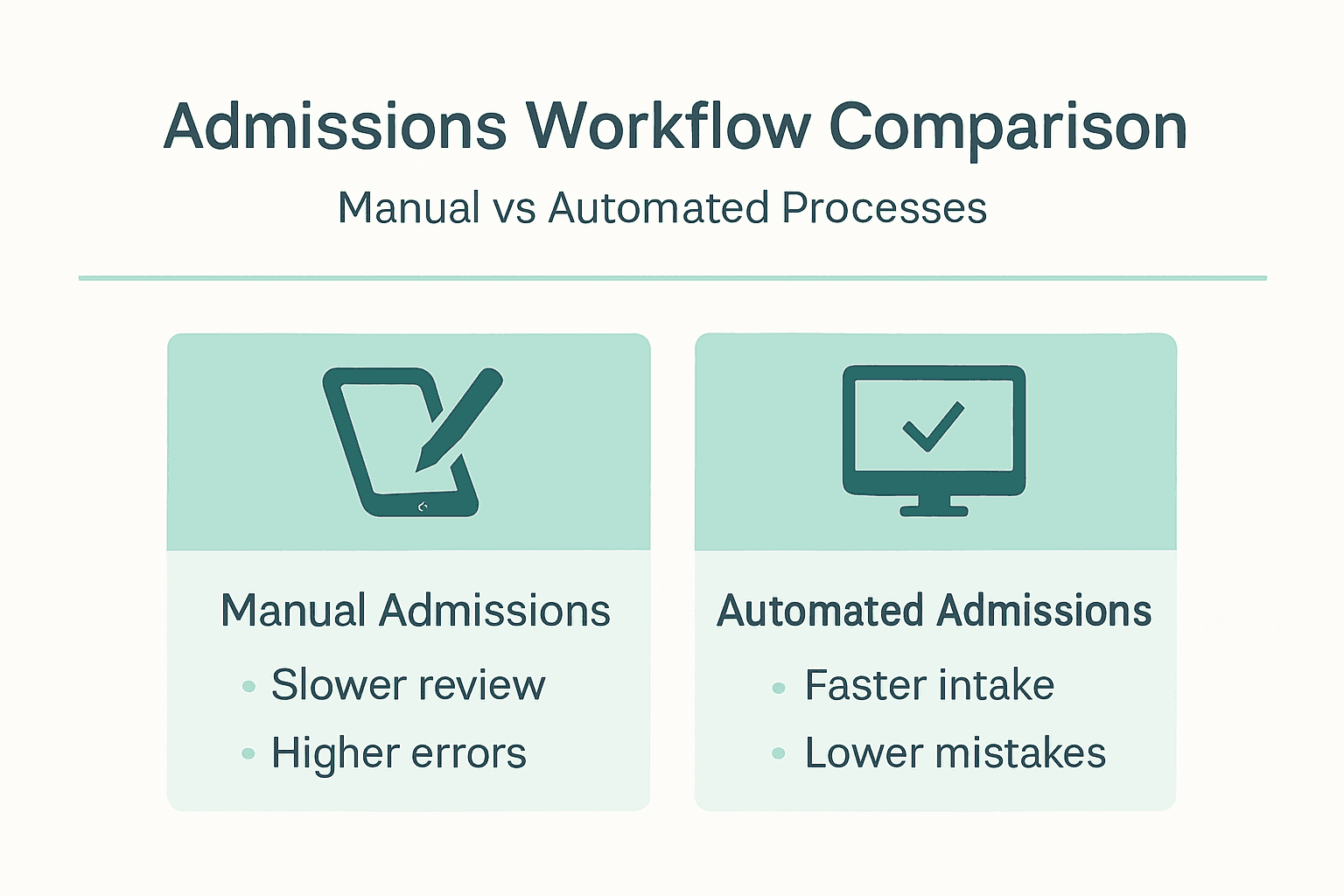
| Aspect | Manual Process | Automated Process |
|---|---|---|
| Referral review time | 45-90 minutes average | 15-30 minutes average |
| Data entry errors | 25% higher error rate | Baseline accuracy |
| Insurance verification | 2-4 hours typical | 10-15 minutes typical |
| Documentation completion | 60% complete on admission | 95% complete on admission |
| Compliance risk | Elevated due to gaps | Reduced through automated checks |
| Staff workload | High repetitive tasks | Focus on clinical decisions |
Manual workflows create multiple opportunities for information to slip through cracks. Referrals arrive via fax, email, and phone calls, making centralized tracking nearly impossible. Coordinators rely on memory and paper notes to follow up on pending items.
Automated systems provide complete audit trails that document every step of the admission process. This transparency protects facilities during regulatory reviews and payer audits. When questions arise about admission decisions, you have timestamped records showing proper verification.
Key performance differences:
- Automated platforms maintain consistent quality regardless of coordinator experience level
- Manual processes suffer when experienced staff members are absent or leave
- Automation scales effortlessly during high-volume periods
- Manual workflows buckle under surge demand, creating backlogs
Pro Tip: Use data from workflow comparisons to make your case to stakeholders for automation. Document current processing times, error rates, and staff overtime hours to quantify the opportunity cost of maintaining manual systems.
Financial and operational benefits of admissions automation
The business case for automation rests on quantifiable improvements that directly impact your facility’s financial health. These aren’t theoretical benefits but measurable gains documented across hundreds of implementations.
Automation reduces repetitive tasks by over 40%, decreases compliance risk by 18%, and increases bed occupancy by up to 15%. Each percentage point of occupancy improvement adds thousands of dollars monthly to facility revenue.
Consider a 100-bed facility with an average daily rate of $350. Increasing occupancy from 85% to 90% means five additional occupied beds daily. That translates to $1,750 per day or $638,750 annually in additional revenue. Automation costs pale in comparison to this revenue lift.
Staff retention improves when burnout decreases. Replacing an experienced admissions coordinator costs $15,000 to $30,000 when you factor in recruiting, training, and lost productivity. Automation that prevents turnover pays for itself through retention alone.
Compliance risk reduction protects against costly penalties and claim denials. An 18% decrease in documentation errors means fewer denied claims and smoother regulatory surveys. The financial protection extends beyond immediate revenue to reputation preservation.
Measurable benefits include:
- Reduced overtime costs as staff complete work within regular hours
| Higher coordinator satisfaction scores leading to better retention - Faster cash flow from quicker admissions and complete documentation
- Improved payer relationships through accurate, timely claims submission
Operational efficiency gains compound over time. As your team becomes proficient with automation tools, they identify additional optimization opportunities. Continuous improvement becomes embedded in your admission culture.
Driving data-driven decision-making with automation
Automation platforms generate actionable intelligence that transforms how administrators manage admission operations. Real-time dashboards replace guesswork with concrete metrics that guide strategic decisions.
You gain visibility into bottlenecks that previously remained hidden within manual processes. Analytics reveal which referral sources send the most appropriate candidates, which insurance types create verification delays, and which staff members need additional training.
Facilities achieve 10-15% efficiency gains through continuous optimization enabled by robust data analysis. When you measure every step of the admission process, you identify specific improvement opportunities rather than implementing broad changes hoping for results.
Predictive analytics help forecast admission volume and staffing needs. Historical patterns combined with current referral pipelines allow proactive scheduling that prevents both understaffing and overstaffing. Resource allocation becomes strategic rather than reactive.
Key analytical capabilities:
- Referral source performance tracking identifies your most valuable hospital relationships
- Time-to-admission metrics highlight specific delays requiring process improvements
- Staff productivity comparisons reveal training needs and best practices
- Payer mix analysis guides contracting decisions and marketing focus
Referral data analysis for bed occupancy optimization enables proactive capacity management. You spot declining referral trends early enough to address underlying issues before they impact census.
Dashboards provide executive teams with high-level performance summaries while offering coordinators detailed task lists. This multi-level view ensures everyone accesses relevant information without overwhelming detail.
Conclusion and next steps for implementing admissions automation
Admissions automation delivers transformative benefits that extend far beyond simple time savings. Faster bed occupancy, reduced errors, and improved staff satisfaction create competitive advantages that strengthen your facility’s market position.
Addressing remaining implementation concerns helps move organizations from consideration to action. Modern platforms minimize disruption through phased rollouts that allow gradual adoption. Your team doesn’t face overwhelming change management challenges.
Successful implementation follows a structured approach:
- Evaluate current workflows to identify highest-impact automation opportunities
- Select a platform that integrates with your existing EMR and matches your facility size
- Engage frontline admission staff in planning to build buy-in and gather practical insights
- Implement core features first, adding advanced capabilities as proficiency grows
- Train staff thoroughly with hands-on practice using real referral scenarios
- Monitor performance metrics weekly during the first month to catch issues early
- Gather user feedback continuously and adjust workflows based on coordinator input
- Expand automation to additional admission tasks as confidence builds
The transition requires change management but not technical expertise. Vendors provide implementation support that guides facilities through each phase. Your team focuses on learning new workflows rather than configuring technology.
Timing matters when planning automation adoption. Starting during a slower census period allows staff to master the system before high-volume seasons. However, urgent operational challenges may justify immediate implementation despite temporary learning curves.
Pro Tip: Engage frontline admissions staff early to foster adoption and gather user feedback for adjustments. Coordinators who help shape implementation become champions who accelerate team-wide acceptance and identify practical improvements vendors might miss.
Streamline your admissions with Smart Admissions solutions
Ready to transform your facility’s admission process and capture the revenue opportunities waiting in faster bed occupancy? Smart Admissions provides purpose-built automation tools designed specifically for skilled nursing and rehabilitation centers facing the challenges we’ve discussed.
Our platform reduces coordinator workload while improving placement speed and accuracy. You’ll see measurable improvements in referral processing time, staff satisfaction, and census performance within your first month. Learn more about admissions automation capabilities tailored to your facility’s needs.
Explore referral management system examples that demonstrate real-world applications across different facility types and sizes. Our intake automation solutions integrate seamlessly with your existing systems, providing immediate value without disruptive implementations.
Frequently asked questions
What are the common challenges in manual admissions workflows?
Manual workflows struggle with referral review delays, high error rates from duplicate data entry, and staff burnout from repetitive tasks. Coordinators spend excessive time on insurance verification and documentation tracking instead of patient care coordination.
How quickly can facilities see results from admissions automation?
Most facilities report measurable improvements within 30 days of implementation. Referral processing time decreases immediately, while occupancy rate gains become evident within the first quarter as faster intake consistently fills beds more efficiently.
Does automation work for smaller skilled nursing facilities?
Automation benefits facilities of all sizes, often providing proportionally larger gains for smaller centers. The technology eliminates the same bottlenecks regardless of bed count, and subscription pricing scales to match facility volume and budget.
How does AI integration improve referral management accuracy?
AI pulls real-time data directly from EMRs and insurance portals, eliminating manual transcription errors. Automated verification catches missing documentation and coverage issues before they delay admissions, reducing compliance risk by 18% while cutting manual errors by 30%.
What training do staff members need to use automation platforms?
Most coordinators become proficient within days of hands-on training. Modern platforms feature intuitive interfaces designed for healthcare professionals without technical backgrounds. Vendors provide comprehensive onboarding support and ongoing assistance to ensure success.