
Waitlist management for admissions is the process of triaging incoming referrals, verifying insurance coverage before acceptance, reconciling clinical data at transfer, and closing the communication loop with referral sources. Done well, it produces three results: faster bed placement, fewer denied claims, and safer transitions. The teams that get this right share three capabilities: consistent referral triage, real-time EMR and payer integrations, and disciplined medication reconciliation. This article walks through a 30 to 90 day playbook, plus a look at how a platform like Smart Admissions applies these components in daily admissions work.
TL;DR:
- Automated eligibility and prior authorization checks can prevent delays by verifying coverage before acceptance, reducing denied claims and unnecessary admissions.
- Establishing a unified referral pool and a simple triage scoring system ensures consistent prioritization based on clinical fit, payer certainty, and medication flags.
- Integrations with hospital EMRs and payer systems, especially FHIR-based APIs, significantly cut manual follow-up, fast-tracking referral acceptance and bed placement.
- Implementing a two-hour SLA for coverage verification and a four-hour SLA for medication review keeps referrals moving efficiently and reduces patient safety risks.
- Starting with basic intake forms and phased integrations allows small facilities to automate without lengthy IT projects, leading to measurable operational improvements within weeks.
Table of Contents
- What Does Waitlist Management Look Like in Post-Acute Admissions?
- What Five Components Should Every Waitlist Process Include?
- How Do You Set Triage Rules Your Team Can Apply Today?
- Which Integrations Actually Eliminate Admissions Delays?
- How Does Smart Admissions Apply These Components?
- What Does a 30 to 90 Day Implementation Playbook Look Like?
- What’s the One Move That Actually Changes Outcomes Here?
- Ready to Put This Playbook on Autopilot?
- Sources
- FAQ
What Does Waitlist Management Look Like in Post-Acute Admissions?
This is not about consumer-facing waitlists for restaurants or events. For a skilled nursing facility, rehabilitation center, or other post-acute provider, waitlist management means handling a queue of referrals arriving by fax, hospital portal, payer feed, and direct phone call, then deciding who gets a bed and how fast.
Get this wrong operationally and the costs stack up fast:
- Referrals sit unanswered long enough that hospital discharge planners send them elsewhere.
- Beds stay empty longer than they should, which shows up directly in lost revenue.
- Admissions staff burn hours chasing paperwork instead of making placement decisions.
- Coverage gets discovered too late, after a patient has already arrived.
The safety stakes matter just as much as the operational ones. Medication discrepancies between hospital discharge summaries and SNF admission orders are common, and they frequently involve high-risk drugs like opioids, anticoagulants, and hypoglycemics, according to AHRQ’s review of transition-related medication errors. A slow or sloppy referral process does not just cost you a bed. It can cost a patient a safe transition.
What Five Components Should Every Waitlist Process Include?
Whether you are building a manual workflow or evaluating software, the same five components separate a functioning waitlist process from a chaotic one.
- Referral aggregation. Every referral, whether it arrives by fax, hospital EMR portal, or payer feed, needs to land in a single queue. Split systems are where referrals get lost.
- Automated eligibility and prior authorization checks. Verifying coverage before acceptance, not after, avoids the classic scenario of admitting a patient only to learn the claim was denied. The CMS Interoperability and Prior Authorization final rule is projected to save an estimated $15 billion over ten years by pushing payers toward faster electronic prior-auth decisions, which makes automated checks on your end far more useful than they were even a few years ago.
- Triage and scoring. Rank referrals by clinical fit, payer certainty, length-of-stay risk, and reimbursement potential, rather than working strictly first-come, first-served.
- Clinical reconciliation at intake. Cross-check medication lists and diagnoses against the discharge summary before the patient arrives, not after.
- Bidirectional, closed-loop status updates. Referral sources need to know where their patient stands. The 360X interoperability framework recommends assigning a unique referral ID to every case so accept, decline, and transfer-confirmation statuses can be matched automatically instead of tracked by phone calls.
Pro Tip: Assign one owner to each component above. When “everyone” is responsible for eligibility checks, no one actually runs them consistently.
How Do You Set Triage Rules Your Team Can Apply Today?
Scoring referrals consistently means agreeing on dimensions and weights before the next fax arrives, not while you are reading it.

Adjust the weights to match your facility’s payer mix and case mix, but write them down.
From there, a simple rule set keeps decisions consistent:
- Accept immediately: verified coverage, moderate acuity, no high-risk medications flagged.
- Flag for pharmacist review: any referral involving anticoagulants, opioids, or insulin regimens with unclear dosing.
- Decline or redirect: acuity beyond your facility’s clinical capability, or coverage that cannot be confirmed within your SLA window.
Assign roles explicitly: one person verifies coverage within a two-hour SLA, a pharmacist or clinical lead reviews flagged medications within four hours, and an admissions coordinator owns the final accept or decline call. Ambiguity here is where referrals stall. A structured prioritization approach makes the difference between a queue that moves and one that backs up by Friday afternoon.
Which Integrations Actually Eliminate Admissions Delays?
Not every integration delivers equal value. API-first, bidirectional connections to hospital EMRs and payer systems remove the most manual work, because they replace phone tag and fax chasing with structured, real-time data exchange.
Direct secure messaging and FHIR-based prior authorization workflows come next in priority. CMS has been pushing payers toward FHIR-based prior auth APIs, with enforcement discretion encouraging faster adoption, which means eligibility answers that used to take days can increasingly arrive in minutes.
A closed-loop referral lifecycle looks like this in practice:
- Hospital sends a referral request with a unique referral ID.
- Your team accepts, declines, or requests more information within an agreed window.
- On acceptance, you confirm the transfer date and time.
- You close the loop by sending discharge information back once the patient is admitted.
If your facility has limited IT resources, do not wait for a full integration build. Start with a hospital-facing intake form and a dedicated intake coordinator managing documents through a basic secure messaging workflow, then layer in discrete API integrations in a second phase. No universal electronic standard governs acute-to-post-acute transitions yet, so even partial automation delivers outsized returns compared to an all-fax process.
How Does Smart Admissions Apply These Components?
Smart Admissions builds its platform around the five components above, giving you a concrete picture of how the checklist translates into daily use.
- AI-driven triage scores incoming referrals against clinical fit, payer signals, and length-of-stay risk, so your team sees a ranked queue instead of a pile of faxes.
- Real-time eligibility verification connects to insurance portals to confirm coverage before you commit a bed, cutting the guesswork out of acceptance decisions.
- EMR and payer integrations pull referral and clinical data directly into one workflow, reducing the manual re-entry that eats admissions staff time.
- Documentation and analytics tools track referral response time and bed fill trends, giving your admissions director data to act on rather than a gut feeling.
Smart Admissions positions onboarding to take under an hour, with responsive human support during setup, so a pilot can start without a lengthy IT project attached to it.
What Does a 30 to 90 Day Implementation Playbook Look Like?
Rolling out waitlist management for admissions works best as a phased sprint, not a single launch date.
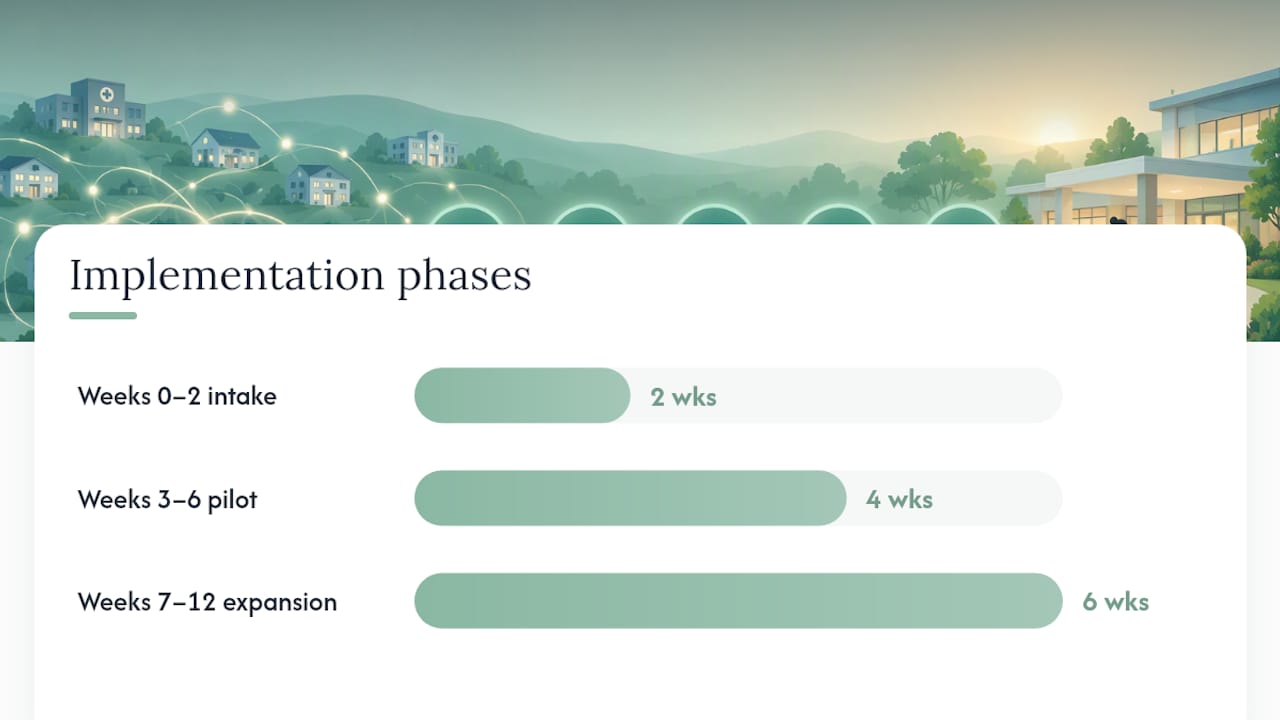
- Weeks 0 to 2: Map every current intake channel, fax, portal, email, phone, and consolidate them into one unified intake queue. Name a single point of contact for eligibility checks and another for clinical reconciliation.
- Weeks 3 to 6: Configure your triage scoring rules and pilot automated eligibility checks on a subset of referrals. Stand up one hospital or EMR integration rather than trying to connect everything at once.
- Weeks 7 to 12: Expand integrations to additional referral sources, and start tracking admit time, readmission rates, and bed fill weekly. Revisit your triage weights based on what the data shows.
Weekly case-based check-ins matter here. Pilot programs modeled on AHRQ’s ECHO-Care Transitions approach used designated points of contact and structured weekly calls to reconcile medications and care plans, and saw statistically significant drops in readmissions (P = 0.034) and SNF length of stay (P = 0.01).
Pro Tip: Track referral response time and percent of referrals with coverage verified before acceptance from week one. Those two numbers alone will tell you whether your pilot is working.
Track four metrics through the full 90 days: referral response time, percentage of referrals verified before acceptance, time-to-bed, and staffing hours saved. An admission workflow guide can help you build the templates behind each step.
What’s the One Move That Actually Changes Outcomes Here?
If you take one thing from this: build the single unified intake queue and one working integration before you touch anything else. Every other improvement, better triage rules, tighter reconciliation, faster eligibility checks, works better once referrals stop scattering across five inboxes.
Measure one safety number (medication reconciliation accuracy) and one operational number (referral response time) from day one. Then run a two-week intake mapping sprint with named owners. That is the whole unlock.
— Harry
Ready to Put This Playbook on Autopilot?
Everything in this playbook, unified intake, automated eligibility checks, medication reconciliation, closed-loop status updates, is exactly what Smart Admissions was built to run for you. Instead of assembling triage rules, eligibility workflows, and EMR connections from scratch, you get AI-driven referral triage and real-time insurance eligibility verification in one platform, with onboarding designed to take under an hour.
Smart Admissions offers a guarantee that their software aims to pay for itself within 30 days. Plans run $597 per month or $6,447 annually, and every plan includes the EMR and payer integrations, documentation tools, and analytics dashboards described above. If your team is ready to stop chasing faxes and start running a real waitlist management for admissions workflow, book a demo and see how a pilot could look at your facility within the first two weeks.
Sources
For deeper reading on the standards and evidence behind this playbook: the CMS Interoperability and Prior Authorization final rule covers upcoming prior-auth timeline requirements. The ECHO-Care Transitions program documents readmission and length-of-stay results from structured care-transition communication. The 360X initiative outlines closed-loop referral data standards for long-term care transfers.
- CMS finalizes rule to expand access to health information, improve prior authorization process
- Medication discrepancies upon hospital to skilled nursing facility transitions
FAQ
What Is Waitlist Management for Admissions?
It’s the process of triaging incoming patient referrals, verifying insurance eligibility, reconciling clinical data, and tracking referral status until a bed placement is confirmed. Facilities that automate this with tools like Smart Admissions typically move referrals through the queue faster because eligibility and clinical checks happen earlier.
How Long Should Referral Response Take?
There’s no single universal standard, but building your process around a two-hour coverage-verification SLA and a four-hour clinical review SLA for flagged medications keeps most referrals moving without unnecessary delay. Track your own response time weekly and tighten the SLA as your team’s capacity allows.
Why Does Medication Reconciliation Matter for Waitlist Decisions?
Medication discrepancies between hospital discharge paperwork and SNF admission orders are common and often involve high-risk drugs like anticoagulants and opioids, according to AHRQ. Catching these mismatches during triage, before the patient arrives, prevents last-minute admission cancellations and reduces readmission risk.
What Does Smart Admissions Cost?
Smart Admissions is priced at $597 per month or $6,447 billed annually. Both plans include AI-driven referral triage, real-time eligibility verification, and EMR and payer integrations.
Can a Small Facility With Limited IT Staff Still Automate This?
Yes. A phased approach works well: start with a hospital-facing intake form and a dedicated intake coordinator, then add discrete integrations once that workflow is stable. This avoids a disruptive all-at-once rollout while still delivering measurable time savings early on.