
Patients who need prolonged mechanical ventilation, daily physician-level management, or complex multi-system support belong in an LTACH. Patients who need rehabilitation or short-term skilled nursing after a qualifying hospital stay belong in an SNF. The right call depends on acuity, expected length of stay, and Medicare rules that determine whether the placement will even be paid for. The checklists below turn that distinction into a repeatable referral process for your admissions team.
TL;DR:
- Most inappropriate LTACH transfers are driven by wound care, IV infusion needs, or facility preference rather than genuine clinical acuity.
- A complete referral package with detailed documentation and real-time eligibility checks markedly speeds up authorization and reduces denials.
- Patients requiring ventilator weaning, daily physician management, or complex wound care are strong LTACH candidates, while stable post-surgical cases suit SNFs.
- payer rules, such as Medicare’s 3-day inpatient stay requirement and site-neutral payment policies, critically influence referral eligibility.
- Building relationships with multiple, high-acuity SNFs and automating eligibility verification are key operational priorities to optimize placement decisions.
Table of Contents
- Operational definitions: LTACH vs SNF and what each setting provides
- Clinical appropriateness: screening criteria and common pitfalls
- Medicare and payer rules that change the referral decision
- Referral workflow and the documentation package that secures faster authorizations
- Decision framework and priority checklist admissions coordinators can use
- Evidence summary admissions teams need: outcomes, costs, and utilization patterns
- Eligibility differences beyond Medicare: Medicaid and private insurance
- How geography and facility availability shape referral decisions
- Weighing patient and family preferences in the referral decision
- Regulatory and accreditation gaps that affect quality and compliance
- Risks of getting the referral wrong in either direction
- Three operational priorities for the quarter ahead
- How Smart Admissions helps automate eligibility checks and referral packages
- Sources
- FAQ
Operational definitions: LTACH vs SNF and what each setting provides
Before your team can triage a referral correctly, everyone needs to agree on what each setting is actually built to do. A Long-Term Acute Care Hospital is a certified hospital delivering inpatient, physician-led care to medically complex patients whose average length of stay exceeds 25 days, according to Medicare’s LTACH coverage guidance. Patients arrive from ICUs or step-down units still requiring daily physician oversight, not just nursing supervision.
A Skilled Nursing Facility, by contrast, delivers Medicare Part A skilled nursing and rehabilitation services, but only after a qualifying inpatient hospital stay of at least 3 consecutive days, per the same Medicare guidance. SNF care is nurse-directed with periodic physician visits, built around therapy goals and functional recovery rather than daily intensive management.
The patient profiles diverge accordingly:
- LTACH patients typically need prolonged ventilator weaning, complex wound debridement, multi-drug IV regimens, or ongoing hemodynamic monitoring.
- SNF patients typically need post-surgical rehabilitation, short-term IV antibiotics, standard wound dressing changes, or restorative therapy after a stroke or joint replacement.
- Shared cases exist too: some ventilator-weaning patients and moderate wound care cases can succeed in either setting depending on staffing and physician coverage.
The Patient Driven Payment Model has also reshaped what SNFs are willing and able to accept. Since PDPM shifted SNF reimbursement toward nursing and ancillary need rather than therapy minutes, more facilities now compete for medically complex patients they once declined, which changes the calculus for your team when a case sits at the boundary between settings. Our overview of what skilled nursing facilities are and who they serve breaks down the current SNF population in more detail.
Clinical appropriateness: screening criteria and common pitfalls
Getting the clinical call right the first time saves your team a denial, a delay, and a frustrated discharge planner on the other end of the phone. Certain markers reliably support an LTACH transfer, while others are frequently manageable in a well-prepared SNF if the documentation supports it.
- Prolonged mechanical ventilation with an unresolved weaning plan almost always points to LTACH.
- Daily physician management needs, such as unstable renal function requiring frequent dosing adjustments, favor LTACH over SNF’s periodic physician visits.
- Complex IV infusion regimens with multiple concurrent drips or frequent titration lean LTACH, while single daily antibiotic infusions are routinely handled in SNFs.
- High-acuity respiratory support short of full ventilation, like high-flow oxygen with close monitoring, can go either way depending on the receiving facility’s respiratory therapy coverage.
- Advanced wound care with surgical debridement needs leans LTACH, while standard dressing changes and wound vacs are SNF-appropriate when nursing staff are trained.
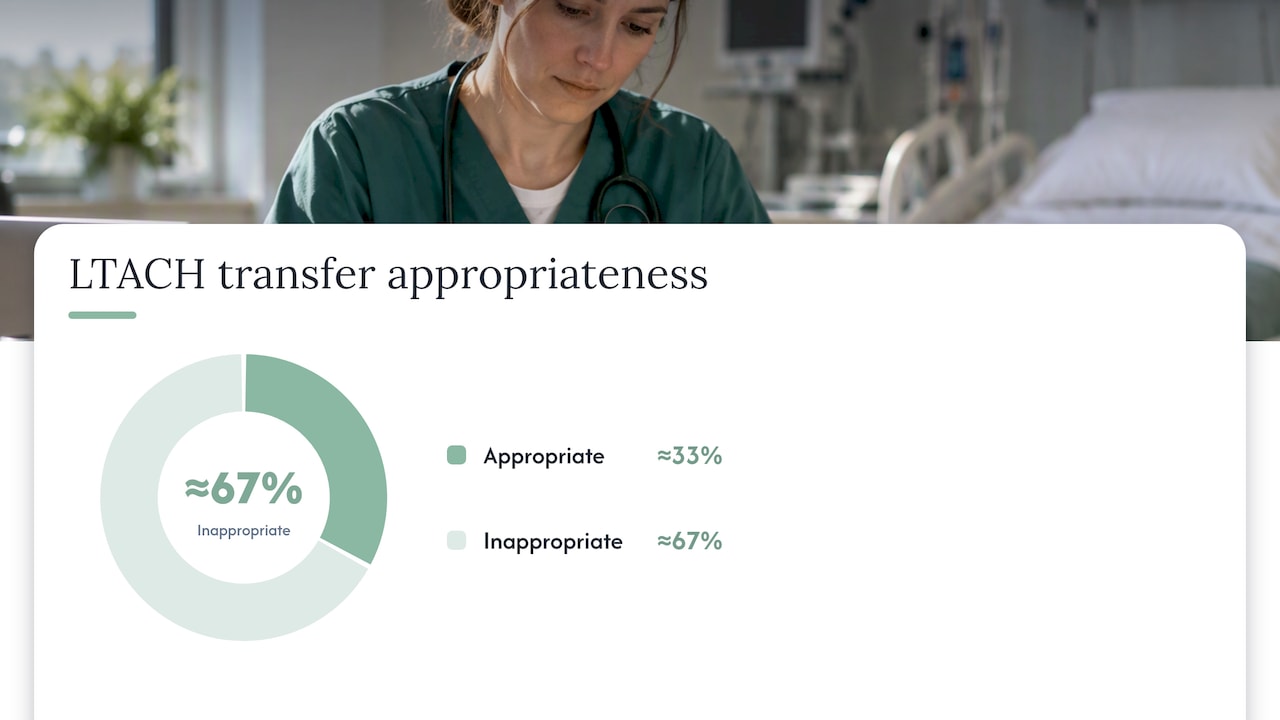
A comparative study of Medicare Advantage ACO beneficiaries found that only about one-third of LTACH transfers met criteria for clinical appropriateness, and inappropriate transfers were frequently driven by wound care, IV infusions, or plain preference rather than genuine acuity. Financial denial from a preferred SNF is another common driver: a facility declines the case on paper, and the patient defaults to LTACH by process of elimination rather than clinical necessity.
Pro Tip: Route every borderline case through a multidisciplinary screening huddle (physician, case manager, admissions coordinator) before defaulting to LTACH, and keep a short list of preferred SNFs known to accept higher-acuity cases.
Medicare and payer rules that change the referral decision
Clinical fit only matters if the payer rules allow the placement to happen. Medicare Part A SNF coverage requires a 3-day consecutive inpatient qualifying stay, with the discharge day excluded from the count, and Medicare Advantage plans frequently add their own network and pre-admission notification requirements on top of that baseline, per Medicare’s coverage documentation. Missing or miscounting that 3-day window is one of the most avoidable reasons a SNF referral gets rejected before it reaches clinical review.
LTACH admissions carry their own payment complexity. CMS applies a site-neutral payment policy that reduces reimbursement for LTACH stays that do not meet ICU-level or prolonged-ventilation criteria, and an interrupted-stay policy governs what happens when a patient leaves and returns to the LTACH within a defined window.
One key figure: CMS’s interrupted-stay policy applies a 3-day-or-less interruption rule, along with fixed-day thresholds (for example 9, 27, or 45 days depending on the receiving provider), to decide whether a return counts as a continuation of the same stay or a new admission for payment purposes. Getting this wrong can turn a clean discharge into a payment dispute weeks later.
Before sending any referral, your team should verify:
- The 3-day inpatient qualifying stay for SNF placement, counted correctly.
- Whether the patient’s Medicare Advantage plan requires pre-admission notification or uses a narrow SNF network.
- Whether the case meets site-neutral criteria for full LTACH payment.
- Whether a prior LTACH stay falls inside an active interrupted-stay window.
Our guide to Medicare SNF eligibility tests walks through the documentation that typically prevents denials tied to the 3-day rule.
Referral workflow and the documentation package that secures faster authorizations
A complete referral packet is the single biggest lever your team has over authorization speed, and it costs nothing but process discipline to fix. Payers and receiving facilities reject weak referrals not because the patient is inappropriate, but because the packet does not prove it.
- Assemble the clinical core: a current history and physical, vital sign trends over the last 48 to 72 hours, ventilator flow sheets where applicable, and a physician stabilization note confirming the patient is safe to transfer.
- Document therapy history and goals: prior therapy minutes, functional status changes, and a realistic rehabilitation goal that matches the receiving setting’s capabilities.
- Detail wound and infusion specifics: exact dressing schedules, wound measurements and staging, and IV medication orders with full dosing schedules rather than summary statements.
- Log prior referral attempts: if a SNF already declined the case, record the stated reason. A documented denial reason lets the next receiving facility see exactly what to address, and it protects your team from repeating the same rejected packet.
- Prefill EMR fields for reuse: vitals, medication lists, and therapy notes that update automatically save your staff from re-entering the same data on every subsequent referral attempt.
- Run eligibility checks in real time: confirming Medicare Part A days remaining, Medicare Advantage network status, and Medicaid or private payer authorization requirements before the packet goes out avoids a rejection that only surfaces the plan status after the fact.
Turnaround expectations vary by payer, but a packet missing ventilator flow sheets or weaning-trial documentation is one of the most common reasons authorization stalls past the expected window. When a payer requests more information, escalate immediately to a named utilization review contact rather than resubmitting the same incomplete packet and waiting again.
Pro Tip: Build a standing referral template with required fields flagged as mandatory before submission. It closes the exact documentation gaps that cause the longest authorization delays.
Our patient eligibility checklist and documentation management guide both offer templates your team can adapt directly.
Decision framework and priority checklist admissions coordinators can use
When a discharge planner calls with a complex case, your team needs a sequence, not a debate. Work through acuity first, then daily physician need, then respiratory status, then expected length of stay, then payer criteria, and only then bed availability.
- Step 1, acuity: does the patient need hospital-level monitoring, or is nursing-level care sufficient?
- Step 2, physician need: does the case require daily physician management, or periodic visits?
- Step 3, respiratory status: is the patient ventilator-dependent or weaning, versus stable on room air or low-flow oxygen?
- Step 4, expected length of stay: does the clinical picture suggest a stay beyond 25 days, consistent with LTACH-level care?
- Step 5, payer criteria: does the case satisfy the 3-day SNF rule or LTACH site-neutral criteria?
- Step 6, bed availability: which setting has capacity today, and does that change the near-term plan?
Five red flags should push a case toward LTACH regardless of bed pressure: unresolved ventilator weaning, multiple concurrent IV drips requiring titration, unstable renal or cardiac status needing daily physician adjustment, surgical-level wound debridement needs, and a documented pattern of prior SNF denials for the same acuity profile. Everything short of those flags belongs in the conversation with your preferred SNF network first, escalating to utilization management only when a legitimate payer or capacity barrier appears. Our piece on evaluating referral quality offers five criteria for building that preferred network.
Evidence summary admissions teams need: outcomes, costs, and utilization patterns
The research on LTACH versus SNF transfers delivers a clear message for value-based planning: outcomes look similar, but spending does not. A comparative effectiveness study of Medicare beneficiaries found that LTACH transfer produced similar clinical outcomes to SNF transfer, while Medicare spent notably more per patient over one year for those routed to LTACH, indicating higher costs compared to SNF transfers.
That gap matters for referral strategy even when a single patient’s outcome looks the same either way. It also reinforces why appropriateness screening carries financial weight, not just clinical weight: the multicenter appropriateness study found roughly one-third of LTACH transfers met appropriateness criteria, with the remainder often traceable to wound care needs, IV infusion logistics, or preference rather than acuity that genuinely required hospital-level care.
For a facility managing throughput and payer relationships, the implication is direct. Every inappropriate LTACH transfer represents a patient who likely could have recovered just as well, at lower cost, in a well-prepared SNF, and every one of those cases adds friction to future utilization review conversations with payers who track these patterns closely.
Eligibility differences beyond Medicare: Medicaid and private insurance
Medicare’s 3-day rule and LTACH criteria dominate the referral conversation, but Medicaid and commercial payers layer on their own requirements that your team has to check separately. Medicaid eligibility for SNF or LTACH placement varies by state program, and many states require prior authorization or a specific level-of-care assessment before approving either setting, independent of what Medicare would require for the same patient.
Private insurance plans frequently impose narrower network restrictions than Medicare Advantage, sometimes limiting SNF placement to a short list of contracted facilities regardless of clinical fit. Some commercial plans also apply their own medical necessity criteria for LTACH admission that differ from CMS’s site-neutral standards, which means a case that clears Medicare’s bar for LTACH payment might still face a separate utilization review under a commercial plan.
Dual-eligible patients add another layer, since Medicaid may need to coordinate as secondary payer once Medicare Part A benefit days are exhausted. Confirming payer type and specific plan rules before submitting a referral, rather than assuming Medicare rules apply universally, prevents a clean clinical case from stalling on an avoidable authorization technicality.
How geography and facility availability shape referral decisions
Clinical appropriateness and payer rules set the boundaries, but geography often decides the outcome in practice. Rural regions frequently have limited or no LTACH capacity within a reasonable transfer distance, which pushes complex cases toward SNFs equipped with enhanced nursing ratios or telemedicine physician coverage, even when an LTACH would be the textbook fit.
Urban markets present the opposite pressure: more LTACH beds exist, but competition for high-acuity SNF beds can be intense, and preferred SNFs may fill quickly during seasonal surges. When your first-choice facility lacks a bed, the fallback should still start with an appropriateness review rather than defaulting to whichever LTACH answers the phone first.
Building relationships with multiple SNFs across a service area, including facilities that accept higher-acuity ventilator-weaning or complex wound patients, gives your team more real options when the closest facility is full. That kind of preferred network, discussed in our guide to referral sources for SNF admissions, reduces how often geography alone forces an LTACH placement that clinical criteria did not actually require.
Weighing patient and family preferences in the referral decision
Clinical criteria and payer rules define what is possible, but patients and families still have to live with the choice, and their input shapes whether a placement succeeds. A family’s preference for proximity, so they can visit daily, sometimes conflicts with the closest appropriate LTACH being hours away while a nearby SNF is a shorter drive but a less clinically ideal fit.
Your admissions team’s role is to present the clinical tradeoffs honestly rather than letting preference alone override an acuity mismatch. A patient who needs daily physician management is not well served by an SNF chosen purely for its location, and families generally respond well to a clear explanation of why a higher level of care matters for a specific condition.
At the same time, when a case sits genuinely at the boundary between settings, family input on quality of life, distance, and prior experience with a facility is a legitimate factor in the final decision. Documenting that the family was informed of both options and the clinical reasoning behind the recommendation also protects your team if the placement is later questioned during utilization review.
Regulatory and accreditation gaps that affect quality and compliance
LTACHs and SNFs answer to different regulatory frameworks, and those differences show up in daily compliance work. LTACHs are certified as hospitals and must meet the Medicare Conditions of Participation for hospitals, which include more intensive physician staffing and infection control standards than SNFs typically carry.
SNFs operate under a separate set of Medicare Conditions of Participation specific to long-term care facilities, with survey cycles, staffing ratio requirements, and quality reporting obligations tailored to a nursing-led model rather than a hospital model. Accreditation bodies like The Joint Commission survey both settings, but the standards applied differ by facility type, and a facility’s accreditation status is worth confirming as part of due diligence when adding a new SNF or LTACH to your referral network.
These regulatory differences are not just paperwork. A facility operating outside its certified scope, such as an SNF managing a patient whose acuity exceeds what its Conditions of Participation anticipate, creates both a compliance exposure for that facility and a genuine safety risk for the patient. Confirming a receiving facility’s certification and survey history before building a referral relationship is a due diligence step worth the extra few minutes.
Risks of getting the referral wrong in either direction
An inappropriate referral carries real consequences whichever direction it goes. Sending a patient to an LTACH who could have thrived in a well-staffed SNF adds unnecessary cost, exposes the patient to a hospital-level environment with its own infection and complication risks, and, as the appropriateness research shows, often reflects preference or missing documentation rather than genuine need.
The reverse error carries sharper clinical stakes. Placing a ventilator-dependent or physician-management-dependent patient in an SNF that lacks the staffing or physician coverage to manage that acuity risks readmission, delayed complication recognition, and outcomes worse than either setting would have produced with a correct match. Some provider reports have linked delayed transfer decisions after intubation to reduced odds of successful ventilator weaning, underscoring why timeliness matters as much as setting choice for these patients.
Both failure modes trace back to the same root cause: incomplete clinical screening or a documentation gap that hides the true acuity picture from whoever makes the placement call. A referral process built around consistent screening criteria and a complete documentation packet, the frameworks covered above, is the most reliable safeguard against either kind of error.
Three operational priorities for the quarter ahead
If your team adopts only three changes this quarter, prioritize standardized referral templates, formal preferred-SNF network agreements, and automated real-time eligibility checks. Together they address the three most common failure points: incomplete documentation, inconsistent facility relationships, and payer rule mistakes discovered too late.
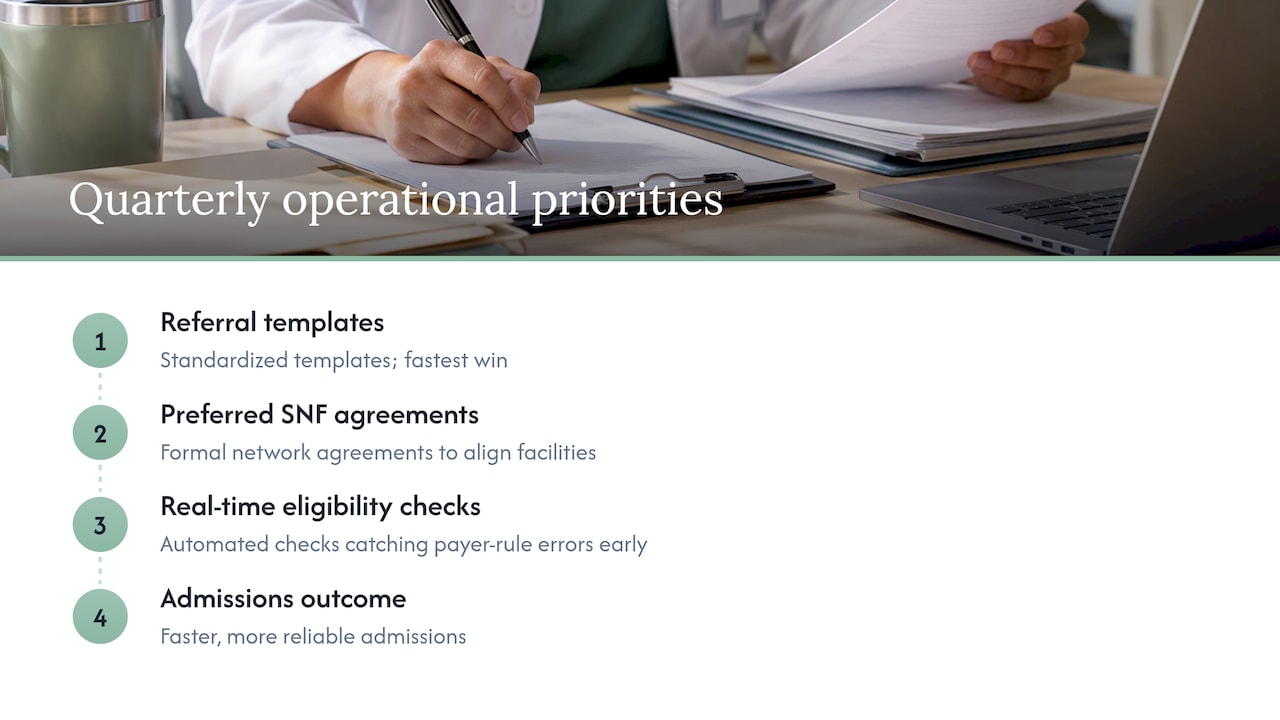
Track first-pass authorization rate, referral turnaround time, and bed fill time as your core KPIs. A rising first-pass rate tells you the templates are working; a shrinking turnaround time tells you the eligibility checks are catching problems before submission rather than after.
Start with the templates. They are the fastest win and the foundation everything else builds on.
— Harry
How Smart Admissions helps automate eligibility checks and referral packages
Admissions teams lose more time to manual eligibility checks and inconsistent referral packets than to any single clinical decision described above. Smart Admissions is built specifically for skilled nursing facilities, rehabilitation centers, and post-acute providers to close that gap through automation that plugs into your existing systems rather than replacing them.
The platform automates real-time insurance eligibility verification against Medicare, Medicaid, and commercial payer rules, standardizes referral packages using templates built by healthcare documentation specialists, and integrates directly with your EMR and insurance portals so data does not need to be re-entered by hand.
- Real-time eligibility verification flags Medicare Part A days remaining, MA network status, and Medicaid authorization requirements before a referral goes out.
- Standardized templates capture ventilator flow sheets, wound documentation, and therapy history consistently across every referral.
- EMR integration pulls existing clinical data automatically instead of requiring manual transcription.
| Referral step | Manual process | With Smart Admissions |
|---|---|---|
| Eligibility check | Phone calls and portal lookups | Real-time automated verification |
| Referral packet | Assembled by hand each time | Prefilled standardized templates |
| Data entry | Re-typed from EMR notes | Pulled directly via EMR integration |
Smart Admissions states that its automation leads to faster bed fill rates and fewer denials, with onboarding typically completed in under an hour. Facilities can review Monthly or Annually pricing and see which plan fits their referral volume.
Sources
- Appropriateness of Long-Term Acute Care Hospital Transfer: A Multicenter Study
- CMS fact sheet: LTCH interrupted stay policy
FAQ
Is an LTAC considered a SNF?
No. An LTAC, or Long-Term Acute Care Hospital, is certified as a hospital under Medicare’s Conditions of Participation, while a Skilled Nursing Facility operates under separate nursing-facility standards. LTACHs deliver hospital-level, physician-led care for medically complex patients, while SNFs deliver nursing and rehabilitation services after a qualifying hospital stay.
What is the 60% rule in rehab?
The 60% rule applies to inpatient rehabilitation facilities, not SNFs or LTACHs, and requires that at least 60% of admitted patients have one of a specified list of qualifying conditions to maintain IRF classification. It does not govern SNF or LTACH admissions, so it should not be used as a screening criterion for those referral decisions.
Are acute rehab and SNF the same?
No. Acute inpatient rehabilitation facilities provide intensive, multi-discipline therapy for at least three hours a day under close physician supervision, while SNFs typically provide less intensive therapy alongside skilled nursing care. Medicare treats them as distinct facility types with different coverage rules and certification standards.
Is LTAC considered critical care?
LTACHs are certified as hospitals and manage medically complex patients who no longer need ICU-level critical care but still require hospital-level, physician-directed management, such as prolonged ventilator weaning or complex wound care. They are a step down from critical care, not critical care itself, with an average length of stay exceeding 25 days.