
Readmission risk at intake is your estimate, made before a patient arrives, of how likely that person is to return to the hospital during the stay. You build it from the referral packet: the hospital course, ICU time, comorbidities, recent ED visits, function, and high-acuity needs such as IV medications. A score does not make the accept-or-decline decision for you. It tells your team where to plan harder on day one.
This guide walks admissions coordinators, directors, and administrators through what research says drives skilled nursing facility (SNF) readmissions, seven checks to run on every referral, and how to turn the result into care planning your clinical team can use.
TL;DR
- Readmission risk at intake combines hospital-stay data (ICU care, length of stay, abnormal labs), recent utilization, comorbidity, function, and acuity.
- A published 30-day SNF readmission model reached an AUC of 0.69, so treat any score as a prompt for review, not a verdict.
- Run seven checks on every referral, then pass flagged patients to your daily interdisciplinary stand-up.
- Federal quality programs still measure 30-day readmissions, so intake decisions reach your payment and public ratings.
- Smart Admissions is designed to read each referral and score it against your own capabilities, staffing, payer mix, and beds.
Table of Contents
- Why readmission risk at intake matters now
- What readmission risk means at SNF intake
- Risk factors to look for in the referral packet
- 7 checks to run on every referral
- Turn the score into a care plan
- How accurate are readmission risk scores?
- Connect intake risk to the quality measures you are judged on
- Our perspective
- Build readmission risk review into your workflow
- See it on your own referrals
- FAQ
- Sources
Why readmission risk at intake matters now
Unplanned hospital returns from SNFs remain a high-priority quality focus because of their cost and their link to patient complications, according to an academic review of quality improvement initiatives. The same review notes that readmission is not always avoidable in this population, but diagnoses and geographic variation in rates suggest room to improve.
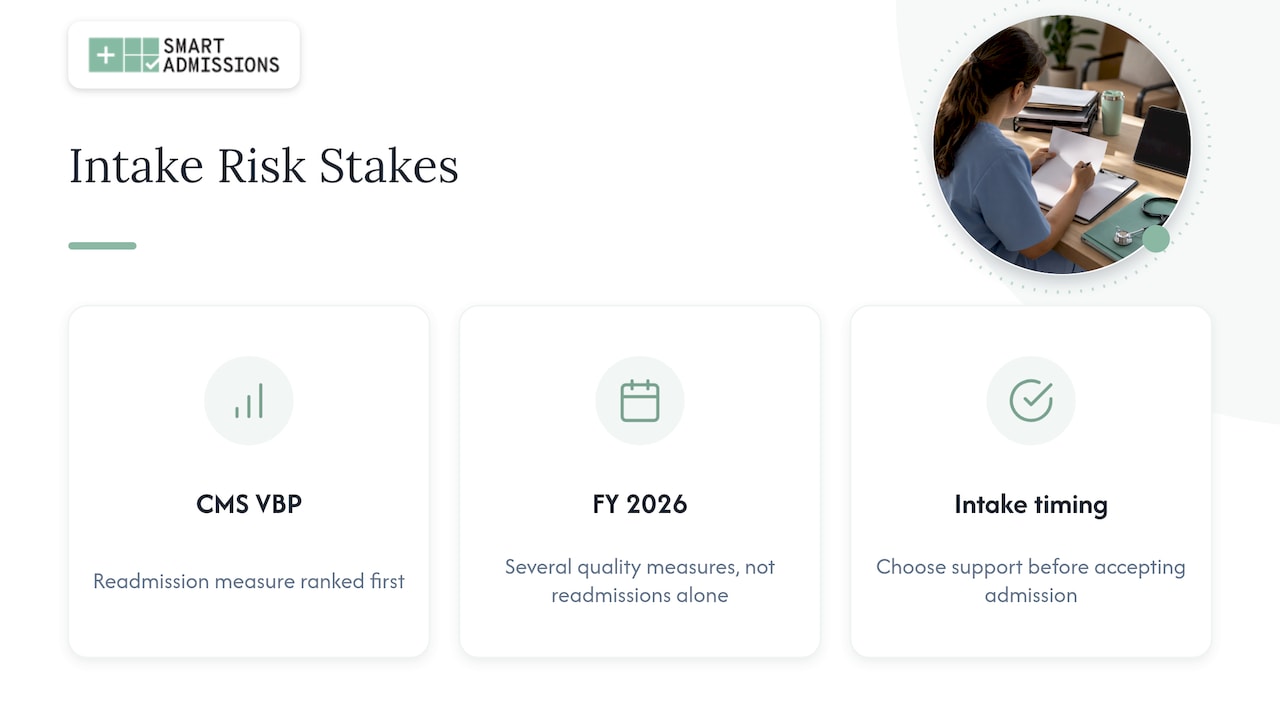
For your facility, the stakes are both clinical and financial. CMS lists the SNF 30-Day All-Cause Readmission Measure first among the quality measures in its SNF Value-Based Purchasing Program, which awards incentive payments based on performance. Beginning with the FY 2026 program year, the program expanded to assess several quality measures instead of readmissions alone. Readmissions are one input among several now, but still a visible one.
The practical point: the cheapest time to prevent a hospital return is before the admission is accepted, when your team can still decide what support the patient needs, or whether your building is the right fit.
What readmission risk means at SNF intake
At intake, readmission risk is a structured judgment about the likelihood of an unplanned return to the hospital. It is different from the outcome measures CMS publishes.
The CMS nursing home quality measure counts short-stay residents who came to a nursing home from a hospital and were readmitted within 30 days for an unplanned stay, with planned readmissions excluded. That is a rear-view measure of your facility. Readmission risk at intake is forward-looking and patient-specific.
A useful intake view answers three questions:
- What in this patient’s history predicts a return to the hospital?
- Which of those factors can your team change with staffing, monitoring, or early intervention?
- Does your facility have the clinical capability to manage what remains?
The Alliant Health Solutions QIN-QIO SNF Rehospitalization Risk Assessment Tool frames this as a basis for interdisciplinary review, discussion, and individualized care planning that identifies risks and mitigation strategies early.
Risk factors to look for in the referral packet
Most of what you need is already in the referral. The skill is knowing which details matter.
Hospital stay factors
A study of Medicare beneficiaries discharged to SNFs found that ICU care during the index hospitalization, longer hospital length of stay, greater comorbidity, and more ED visits or hospital stays in the prior six months were associated with 30-day readmission. ICU-level care was a strong predictor regardless of the reason for the original admission.
The same model also drew on abnormal laboratory parameters. The authors found that comorbidity alone may not be enough to identify the highest-risk patients, and that length of stay, ICU care, and abnormal labs improved the model.
Patient and facility factors
A separate review of readmissions from post-acute facilities reported that common risk factors include impaired functional status, markers of high acuity such as the need for intravenous medications, for-profit ownership, and pre-existing comorbidities. Ownership is not something you change at intake, but the other factors show up in the referral and can guide your plan.
Quick reference
| Referral detail | Why it matters | Where to find it |
|---|---|---|
| ICU stay during the hospitalization | Strong predictor of 30-day readmission in SNF patients | Hospital course, discharge summary |
| Long hospital length of stay | Associated with higher readmission risk | Admit and discharge dates |
| ED visits or stays in prior 6 months | Signals unstable course | History, hospital portal records |
| Abnormal lab values | Added predictive value in the published model | Recent lab results |
| Multiple comorbidities | Raises baseline risk | Problem list |
| IV medication needs | Marker of high acuity | Medication orders |
| Impaired function | Common risk factor in post-acute readmissions | Therapy and nursing notes |
7 checks to run on every referral
These checks fit inside a normal referral review. They are designed to be repeatable, so any coordinator on your team reaches the same flags.
1. Check the ICU and length-of-stay history
Look for any ICU time and the total days in the hospital. Record both in the same place every time. These two items carry more weight in the published model than diagnosis alone.
2. Count recent utilization
Count ED visits and hospital stays in the six months before the index admission. A patient with several recent returns has a pattern worth discussing before acceptance, not after.
3. Review labs and vitals at discharge
Flag abnormal laboratory values in the final days of the hospital stay. If the packet lacks recent labs, request them from the hospital before you answer. Missing data is itself a reason to ask a question.
4. List comorbidities and acuity markers
Note the conditions that stack together, plus IV medications and other high-acuity needs. Your clinical team should confirm whether you can deliver this care with current staffing and equipment.
5. Assess function and support at home
Impaired function raises risk, and so do gaps in what happens after discharge from your building. Capture who the patient lives with and what the likely discharge destination is.
6. Review the medication list for cost and complexity
High-cost drugs and complex regimens affect both clinical monitoring and margin. Reviewing them before acceptance keeps surprises out of the first week. Our PDPM preadmission checklist covers how to fit this into a 15-minute review.
7. Document the decision and the plan
Write down why you accepted, what risk flags you saw, and what you will do about each. A defensible yes or no is only defensible if the reasoning is on file. The clinical record management steps show one way to keep that record clean.
Turn the score into a care plan
Flagging risk accomplishes nothing if it stays in the admissions office. The Alliant tool recommends that teams flag residents for targeted interventions, integrate assessment results into EHR reports, and discuss risks during daily interdisciplinary stand-ups. It also advises regular monitoring of residents with multiple risk factors.
A simple handoff works well:
- Before arrival: send the flagged risks and your plan to the nursing supervisor and therapy lead.
- Day one: confirm the first-48-hour monitoring plan, including which vitals and symptoms trigger a call to the provider.
- Daily stand-up: review every resident with multiple flags until the risk has settled.
- Care plan: write interventions that match the specific clinical and social vulnerabilities you identified.
Standardized communication tools help here. Comagine Health’s SNF best practices guide names INTERACT’s Stop and Watch and SBAR as documentation tools that help staff identify early changes in a resident’s condition.
The review of quality improvement programs also points to a barrier many teams recognize: tracking and implementation were the most frequently discussed obstacles to reducing 30-day readmissions. Assigning an owner for each flagged resident and measuring follow-through addresses both.
How accurate are readmission risk scores?
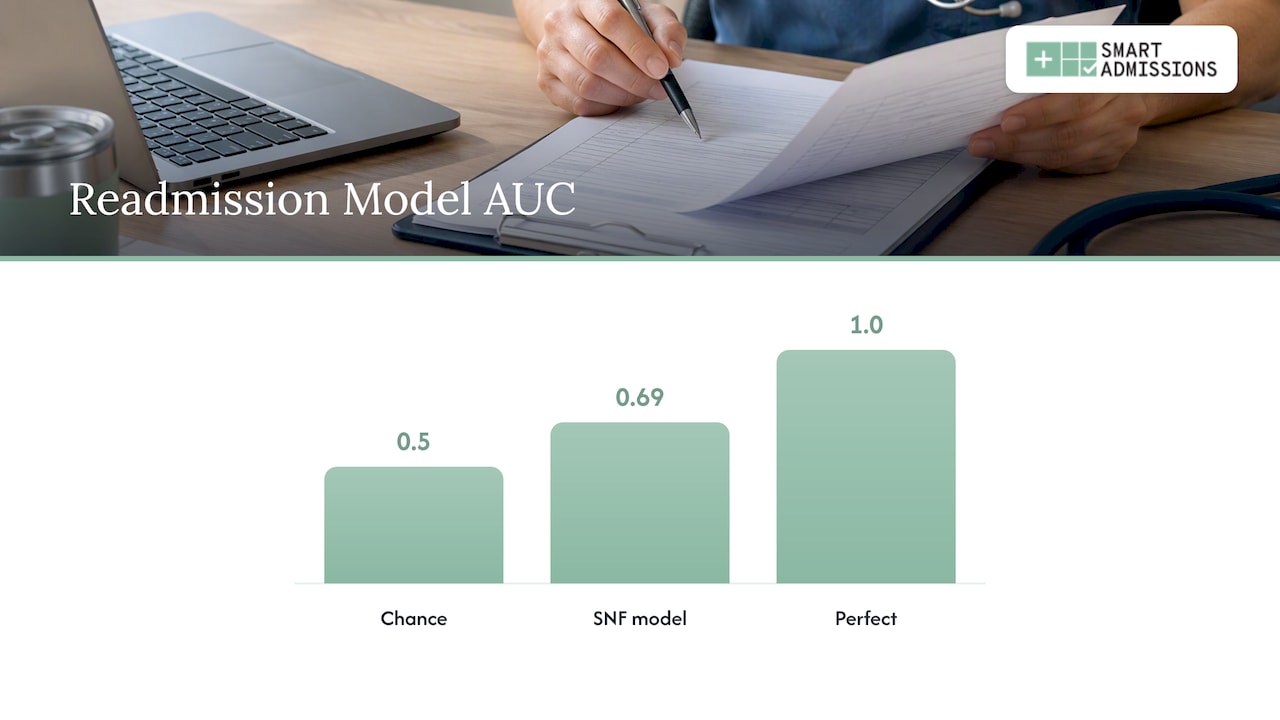
No score is a crystal ball. The 30-day readmission model for SNF discharges in the 2019 PMC study had an AUC of 0.69, and the authors called for further validation in other SNF settings and geographic areas. An AUC of 0.5 is chance and 1.0 is perfect, so 0.69 shows a useful but modest ability to separate higher-risk patients from lower-risk ones.
What that means for your team:
- Use a score to prioritize attention, not to automatically accept or decline.
- Combine the score with clinical judgment from your director of nursing and medical director.
- Track your own results. Compare flagged patients against actual returns over a few months and adjust your thresholds.
- Look at the specific drivers behind a score, because the drivers tell you what to do.
This is why a facility-specific approach helps. A patient who is high risk for one building may be a good fit for another with different staffing, IV capability, or therapy depth.
Connect intake risk to the quality measures you are judged on
The CMS data on nursing home quality describes a baseline period of 10/01/2021 to 09/30/2022 and a performance period of 10/01/2023 to 09/30/2024 for the FY 2026 SNF 30-Day All-Cause Readmission Measure. Patients you admit today will count in later performance periods, so your intake habits show up in future results.
CMS also lists additional measures in the SNF VBP Program, including a within-stay potentially preventable readmission measure, on its measures page. Check that page for the current list and specifications, since they change from year to year.
The takeaway for admissions leaders: you do not need to avoid every complex patient. You need to accept patients you are equipped to care for, with a plan written before the ambulance arrives. Our admissions decision-making guide goes deeper on that balance.
Our perspective
Speed is table stakes. Hospitals expect an answer in minutes, and every admissions team can learn to answer fast. The harder job is answering correctly, and that means judging each referral against your own building.
A generic risk score does not know your nurse staffing on weekends, whether you can manage IV therapy, what your payer mix looks like this month, or which beds are open. We built Smart Admissions as a facility-specific decision engine for exactly that reason. It reads every referral, whether it arrives by hospital portal, fax, or email, and evaluates it against your clinical capabilities, staffing, payer mix, PDPM reimbursement, and bed availability.
That puts the factors that matter at intake in front of your team in one summary: the clinical picture, the reimbursement story, and med cost alerts for high-cost drugs before you accept. Your director can say a confident yes or a defensible no in minutes, and the reasoning is on record.
We came from admissions, MDS, and reimbursement work, so we designed this around how your team actually reviews referrals. The goal is more right admissions and fewer costly mistakes, with less paperwork between you and your hospital relationships.
Harry
Build readmission risk review into your workflow
If you are starting from a blank page, take it in phases.
- Define your flags. Start with the factors in the table above and add any your clinical team has seen drive returns in your building.
- Standardize the form. Use one intake worksheet or digital summary so every coordinator records the same items. The admissions checklist is a good starting point.
- Pair with eligibility checks. Confirm coverage alongside clinical risk, using the patient eligibility checklist.
- Set the handoff. Decide who receives flagged referrals and how they reach the daily stand-up.
- Review monthly. Compare flags to actual transfers and refine.
If you want to see how automation fits, the AI referral screening steps and the AI referral management implementation checklist lay out the sequence.
See it on your own referrals
Smart Admissions summarizes and scores each incoming referral against your facility’s rules, flags high-cost medications, matches patients to beds, and passes accepted referrals into PointClickCare without duplicate entry. Pricing is published: $597 per month or $6,447 per year. See how the platform works or review plans and pricing.
FAQ
What is readmission risk at intake?
It is the likelihood that a patient will return to the hospital during the SNF stay, estimated from the referral before you accept. Inputs typically include ICU care, length of stay, recent ED visits, comorbidities, labs, function, and acuity. The result guides care planning and the accept-or-decline decision.
What is an unplanned readmission score?
It is a measure of the share of short-stay residents who came to a nursing home from a hospital and returned to a hospital within 30 days for an unplanned stay. CMS excludes planned readmissions from the calculation. It describes a facility’s results, while intake risk estimates an individual patient’s chance.
Should a high readmission risk mean we decline the referral?
Not automatically. A high score is a reason to review what drives it and whether your staff and services can address those drivers. If they can, accept with a written plan. If they cannot, a documented decline protects both the patient and your facility.
How often should we review residents with multiple risk factors?
The Alliant Health Solutions tool advises regular monitoring and interdisciplinary review, including in daily stand-up meetings. Many teams keep flagged residents on the stand-up agenda until the risk has settled. Your medical director and director of nursing should set the timeline for your building.
Sources
- SNF Rehospitalization Risk Assessment Tool, Alliant Health Solutions QIN-QIO
- Risk of 30-Day Hospital Readmission Among Patients Discharged to SNFs, PMC
- Hospital readmission from post-acute care facilities: risk factors, PMC
- An investigation of quality improvement initiatives in SNFs, PMC
- Nursing homes including rehab services: quality measures, CMS
- FY 2025 SNF VBP Program Performance Score Report User Guide, CMS
- SNF VBP measures, CMS
- SNF Shared Best Practices to Reduce Potentially Preventable Readmissions, Comagine Health