
Referral source analytics is the practice of tracking where every referral comes from, how fast your team answers it and what happens next, so you can see which hospitals, discharge planners and channels produce admissions you can care for and afford to serve. For a skilled nursing facility, it turns a pile of faxes, portal messages and emails into a clear picture of your pipeline.
This guide is for admissions coordinators, admissions directors, administrators and owners. It covers what to measure, how to capture the data, what privacy rules apply and what to look for in software.
TL;DR
- Referral source analytics links each referral to its source, response time, decision and outcome, so you can see which relationships deserve more of your time.
- Start with seven metrics: volume, response time, acceptance rate, conversion to admission, denial and lost-opportunity reasons, payer mix and clinical fit.
- Capture every channel (portal, fax, email) in one place. Data scattered across channels produces unreliable reports.
- If your analytics touch protected health information, follow HIPAA: permitted disclosures, minimum necessary, a business associate agreement and technical safeguards.
- Choose software that reads referrals against your own capabilities, payer mix and beds, and that fits your EHR workflow.
Table of Contents
- What referral source analytics means in post-acute care
- Why your hospital partners decide on more than speed
- 7 metrics every admissions team should track by source
- How to capture the data across portals, fax and email
- Turning source data into better hospital relationships
- Privacy and HIPAA basics for referral analytics
- What to look for in referral analytics software
- Our perspective: a decision engine, not just a report
- See your referral sources in one place
- A simple 30-day plan to get started
- FAQ
- Sources
What referral source analytics means in post-acute care
In web marketing, a referral source is a website that sends visitors to another site. That is not what this article covers. In skilled nursing, a referral source is the hospital, physician practice, discharge planner or other contact that sends a patient referral to your facility. Referral sources are usually organizations, but they can also be individual people or practices.
Referral source analytics measures the full path of those referrals: who sent it, through which channel, when it arrived, how long your team took to respond, whether you accepted it and whether the patient was admitted. Federal data reflects the same idea. The CMS limited data set file for skilled nursing facilities includes a claim source inpatient admission code and a claim admission date, because where a stay begins is part of understanding it.
The clinical side matters as much as the business side. AHRQ’s patient safety network notes that SNFs serve short-stay post-acute patients discharged from hospitals as well as long-stay residents, and that post-acute patients increasingly challenge a facility’s ability to provide safe care. Good analytics helps you see which referral sources send patients your team is well equipped to serve.
For a deeper look at the sources themselves, see our guide to SNF referral sources.
Why your hospital partners decide on more than speed
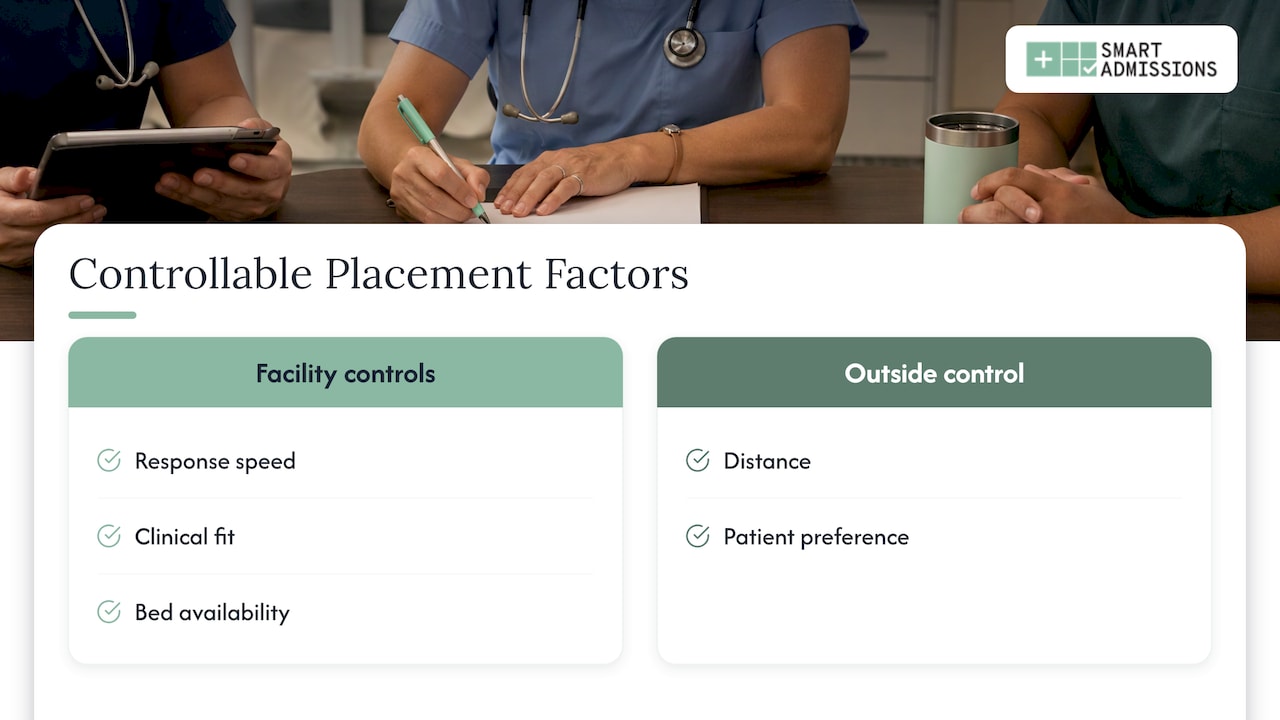
Hospital discharge planners are juggling many facilities at once. MedPAC interviews with acute care discharge planners found that planners make one or more referrals to inpatient rehabilitation facilities or SNFs, and that placement decisions weigh patient condition and functional capacity, bed availability, coverage, patient and caregiver preferences, and distance and travel time.
That list tells you what your analytics should reflect. You control response speed, clinical fit and bed availability. You do not control distance or patient preference. When you review your numbers by source, look for patterns you can change.
Quality also shapes the relationship. MedPAC reports that quality varies widely among post-acute care providers and that hospitals are increasingly accountable for expenditures related to readmissions during post-acute care. Hospitals have reasons to track which facilities perform well. Your own source-level data lets you have that conversation with evidence.
7 metrics every admissions team should track by source
Each metric below should be viewable per referral source and per channel, then rolled up for your facility or network.
1. Referral volume
Count referrals received per source per week and per month. Volume alone does not tell you value, but it shows which relationships carry your pipeline and which are dormant. Our article on the referral volume report walks through seven key metrics for this view.
2. Response time
Measure the minutes or hours from receipt to your answer. Hospitals expect quick replies, so slow response is one of the most fixable reasons a source stops sending. Track the median and the slowest 10 percent, since averages hide the referrals that sat overnight. For ideas on shrinking this number, read top ways to reduce referral times.
3. Acceptance rate
Divide accepted referrals by reviewed referrals for each source. A low rate is not automatically a problem. It may mean that source sends patients outside your clinical capabilities. That is a conversation to have with the hospital, not a flaw to hide.
4. Conversion to admission
Acceptance is not admission. Patients choose another facility, change plans or are discharged elsewhere. Track how many accepted referrals become admissions, and how many days pass between acceptance and arrival.
5. Denial and lost-opportunity reasons
Record why each referral was declined or lost: no bed, clinical needs beyond your capabilities, payer, high-cost medication, late response. Reason codes turn a “no” into data. They also give you a defensible answer when a hospital asks why you declined.
6. Payer mix by source
See which sources send Medicare Part A, Medicare Advantage, Medicaid, managed care or other payers. Pair this with reimbursement under PDPM so you can see the revenue profile each source brings, not just the census count. Our PDPM preadmission checklist explains what to confirm before a patient arrives.
7. Clinical fit
Track the diagnoses, therapy needs and care complexity that each source typically sends, and compare them with your staffing and services. This metric shows where a source is a natural fit and where you may need to adjust capabilities or expectations.
| Metric | Question it answers | Typical action |
|---|---|---|
| Referral volume | Who fills my pipeline? | Prioritize relationship visits |
| Response time | Are we fast enough? | Adjust review workflow or staffing |
| Acceptance rate | Do referrals match our capabilities? | Share your clinical criteria with the source |
| Conversion to admission | Do accepted patients arrive? | Tighten bed holds and follow-up |
| Denial reasons | Why do we say no? | Fix recurring, fixable causes |
| Payer mix | Is the revenue profile sustainable? | Balance outreach by payer |
| Clinical fit | Can we serve these patients well? | Align services and messaging |
How to capture the data across portals, fax and email
Most reporting problems begin at intake. If a referral arrives by fax and the source is never recorded, it cannot appear in any report. Use this checklist to build a clean foundation.
- Define a source record. Store the organization, the individual contact, their role and contact details.
- Use consistent names. One hospital should not appear under four spellings. Standardize names and merge duplicates.
- Add searchable tags. Care types, insurance accepted and relationship owner make filtering far easier.
- Log every channel. Portal, fax and email referrals all need the same required fields at intake.
- Timestamp twice. Record when the referral arrived and when your team responded.
- Require a decision reason. Make accept, decline and lost reasons mandatory fields, not free text.
- Close the loop. Record whether the patient was admitted, and when.
Our step-by-step intake process shows how to structure these steps so the data is captured as part of the work, not as extra paperwork.
Turning source data into better hospital relationships
Numbers matter when they change what you do on Monday morning. Here are practical ways to use each report.
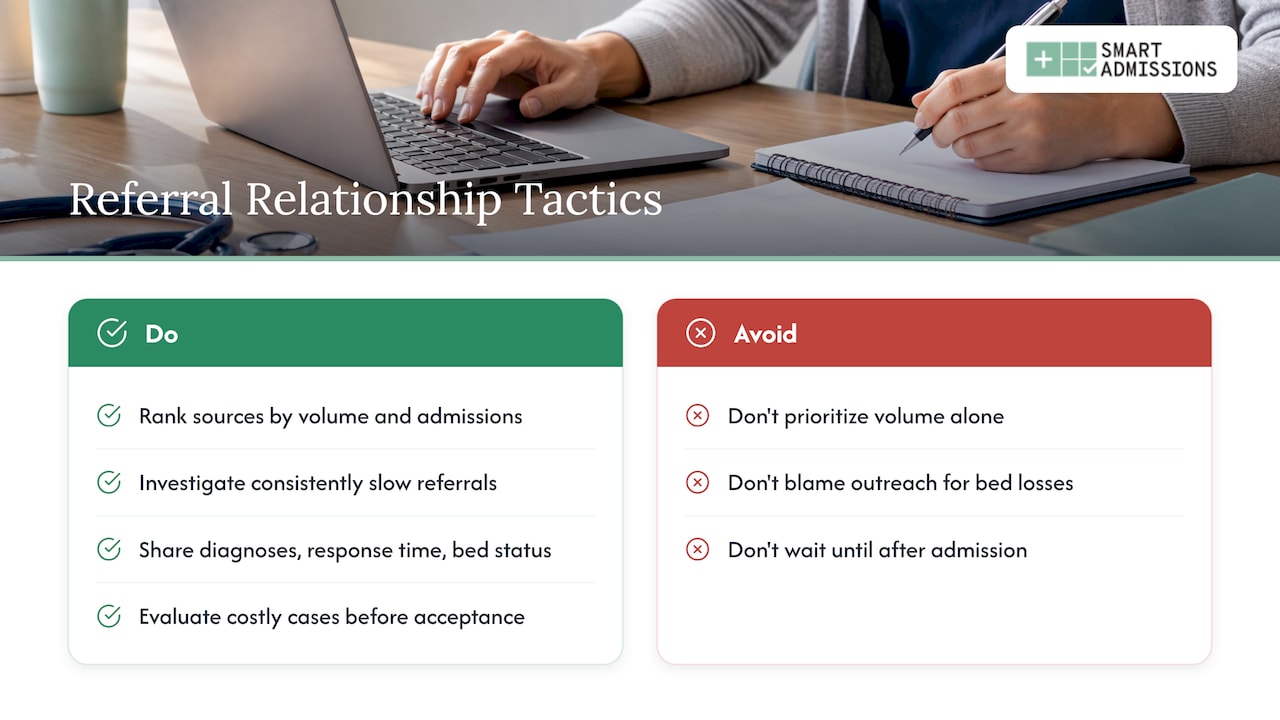
Rank your sources, then plan visits. Sort by volume and by admissions. Spend relationship time where referrals are plentiful and where fit is strong. A source with moderate volume and high conversion may deserve more attention than a high-volume source that rarely converts.
Find the slow referrals. If one source’s referrals consistently take longer to decide, look at why. The cause may be incomplete clinical information, missing insurance details or a hard-to-read fax format. Ask the hospital’s team what would help, and share what you need in return.
Show your fit. Bring a one-page summary to hospital partners: the diagnoses you serve well, your typical response time and your bed availability. This makes it easier for discharge planners to send the right patients your way.
Watch lost opportunities. If many referrals are lost to “no bed available,” that points to capacity or bed management rather than outreach. Our bed management overview covers that side.
Protect margin. When source data shows a pattern of high-cost medications or low-reimbursing case types, you can plan how to evaluate them before acceptance rather than after admission.
For more tactics, see our guide to winning more hospital-to-SNF referrals and the article on outcomes data in referral growth.
Privacy and HIPAA basics for referral analytics
Referral records contain patient information, so your analytics approach has to respect HIPAA. HHS guidance on online tracking technologies explains that when analytics involve protected health information, the disclosure must be permitted under HIPAA, the minimum-necessary rule applies where relevant, and a business associate agreement is needed when the vendor is a business associate. The same guidance says a notice or cookie banner alone is not sufficient, and calls for risk analysis and safeguards such as authentication, access controls, encryption and audit controls.
In practice, ask these questions before you adopt any tool:
- Will the vendor sign a business associate agreement?
- Who inside your facility can see patient-level data, and who sees only summary reports?
- Is data encrypted, and are access events logged?
- Can you build reports on sources and outcomes without exposing more patient detail than the task needs?
If your marketing team also uses web tracking on your facility site, review these rules together. This overview of HIPAA-compliant marketing rules is a good starting point for the web side. Your compliance officer and legal counsel should confirm how the rules apply to your facility.
What to look for in referral analytics software
Searching for the best referral analytics software often returns web traffic tools or generic CRMs. A skilled nursing admissions team needs something different. Use these criteria.
- Reads every channel. The tool should handle referrals from hospital portals, fax and email, not just one of them.
- Evaluates fit, not only speed. Look for scoring against your clinical capabilities, staffing, payer mix, PDPM reimbursement and bed availability.
- Flags cost risks early. High-cost medication alerts before acceptance protect margin.
- Works with your EHR. Accepted referrals should flow into your existing workflow without duplicate entry. Check the integration with your system, such as PointClickCare.
- Reports across sites. Leadership should see referral sources, response times, acceptance rates and lost opportunities for one facility or an entire network.
- Supports your compliance program. Confirm business associate agreement terms and access controls.
- Fits your team. Configuration should match your facility’s rules, and onboarding should not stall your daily work.
If you want to compare approaches, our overview of referral management systems and the roundup of AI referral management platforms describe the main types. Our post on referral dashboard design covers what a useful reporting view contains.
Our perspective: a decision engine, not just a report
We built Smart Admissions after seeing how much of an admissions director’s day goes to reading referrals, not building relationships. Analytics that only describe last month’s numbers arrive too late to help with today’s referral.
That is why we treat referral source analytics as the output of a decision engine. Smart Admissions reads each referral, whether it arrives through a hospital portal, fax or email, and evaluates it against your own clinical capabilities, staffing, payer mix, PDPM reimbursement and bed availability. Each referral is summarized and scored, so your team can give a confident yes or a defensible no in minutes.
Because every decision is captured as it is made, the reporting follows naturally: referral sources, response times, acceptance rates and lost opportunities, for one facility or a whole network. Med cost alerts flag high-cost medications before acceptance, and referral-to-bed matching helps place the right patient in the right bed.
Our team has worked in admissions, MDS and reimbursement, and we designed the platform to free you to focus on hospital relationships instead of paperwork.
Harry
See your referral sources in one place
Smart Admissions is EHR-independent and integrates with PointClickCare, so accepted referrals move into your existing workflow. Plans are published on the pricing page: $597 per month or $6,447 per year. You can start with a free trial or see how the platform works before you decide.
A simple 30-day plan to get started
You do not need a complete overhaul to begin. A staged approach keeps the work manageable.
Week 1: Define. List your top ten referral sources. Agree on the required intake fields and the decision reason codes your team will use.
Week 2: Capture. Start logging source, channel, arrival time, response time and decision for every referral. Review a sample at the end of the week to catch gaps.
Week 3: Review. Build your first source report with the seven metrics. Look for one source with high volume and slow response, and one with low volume and strong fit.
Week 4: Act. Schedule conversations with two hospital partners. Share what you learned and what you can offer. Set a target for response time and revisit it monthly.
For related process improvements, see how teams reduce referral review time and how data analytics supports post-acute admissions.
FAQ
What is the difference between a referral source and referral traffic?
Referral traffic is a web analytics term for visitors who arrive on a website by clicking a link on another site. A referral source in skilled nursing is the hospital, physician or discharge planner who sends a patient referral to your facility. This article covers the second meaning.
Which referral source metrics should a SNF track first?
Start with volume, response time, acceptance rate and conversion to admission by source. Add denial reasons, payer mix and clinical fit once your intake captures them consistently. Together they show where your pipeline is strong and where it leaks.
Is referral analytics data protected by HIPAA?
It can be, when it includes protected health information. HHS guidance says disclosures must be permitted, the minimum-necessary rule applies where relevant, and a business associate agreement is needed when the vendor is a business associate. Your compliance officer should confirm how this applies to your setup.
How often should we review referral source reports?
Review response time and open referrals daily or weekly, since they affect decisions now. Review source-level volume, acceptance and conversion monthly, and use quarterly reviews for relationship planning with hospital partners.
Can referral analytics help with payer mix?
Yes. When each referral is tied to its source and payer, you can see which sources send the payer types that fit your census goals. Pairing this with PDPM reimbursement scoring lets you evaluate referrals before acceptance.
Sources
- LDS Skilled Nursing Facility Data Dictionary, CMS
- Long-term Care and Patient Safety, AHRQ PSNet
- Interviews with Acute Care Hospital Discharge Planners, MedPAC
- Encouraging Medicare beneficiaries to use higher quality post-acute care providers, MedPAC
- Use of Online Tracking Technologies by HIPAA Covered Entities, HHS
- HIPAA Compliant Marketing: Rules Every Marketer Must Know