
Hospital-to-SNF referrals are the main way skilled nursing facilities fill beds, and they are harder to convert than they used to be. Hospitals now send more referrals per patient, acceptance rates are low, and every referral you answer slowly or incorrectly goes to the next facility on the list. This guide walks admissions coordinators, directors and administrators through seven practical ways to review referrals faster, avoid denials and build the hospital relationships that keep your census steady.
TL;DR
- Hospitals sent an average of 6.6 post-acute referrals per patient in 2024, so speed and fit decide who gets the admission.
- Verify the Medicare 3-day rule, or the TEAM waiver, before you say yes. Most denials start with a status error you could have caught at intake.
- Formal, high-volume hospital-SNF linkages are associated with fewer readmissions, which gives hospitals a reason to refer to you again.
- Structured data exchange and automated eligibility checks replace the phone-and-fax loop that slows your response.
- Track response time, acceptance rate and denial reasons by referral source every month.
Table of Contents
- What hospital-to-SNF referrals look like in 2026
- 1. Respond to the first request quickly
- 2. Check Medicare eligibility before you accept
- 3. Use a screening checklist the whole team follows
- 4. Build formal linkages with your top referring hospitals
- 5. Replace the phone-and-fax loop with structured data
- 6. Automate the repetitive checks, keep people on the judgment calls
- 7. Measure referrals by source and by outcome
- Our perspective: speed without accuracy is a trap
- How Smart Admissions helps with hospital-to-SNF referrals
- Where to start this month
- FAQ
- Sources
What hospital-to-SNF referrals look like in 2026
A hospital case manager or discharge planner usually starts with a short request that goes to several facilities at once. The request carries minimal patient data and exists to find out who has a bed and the right capabilities. Only after a facility is selected does the full clinical package follow, including reconciled medications and complex equipment needs. ONC’s 360X work on long-term care transfers describes this two-step handshake and the “red flags” a receiving facility needs early, such as specialized pain management or expensive drugs.
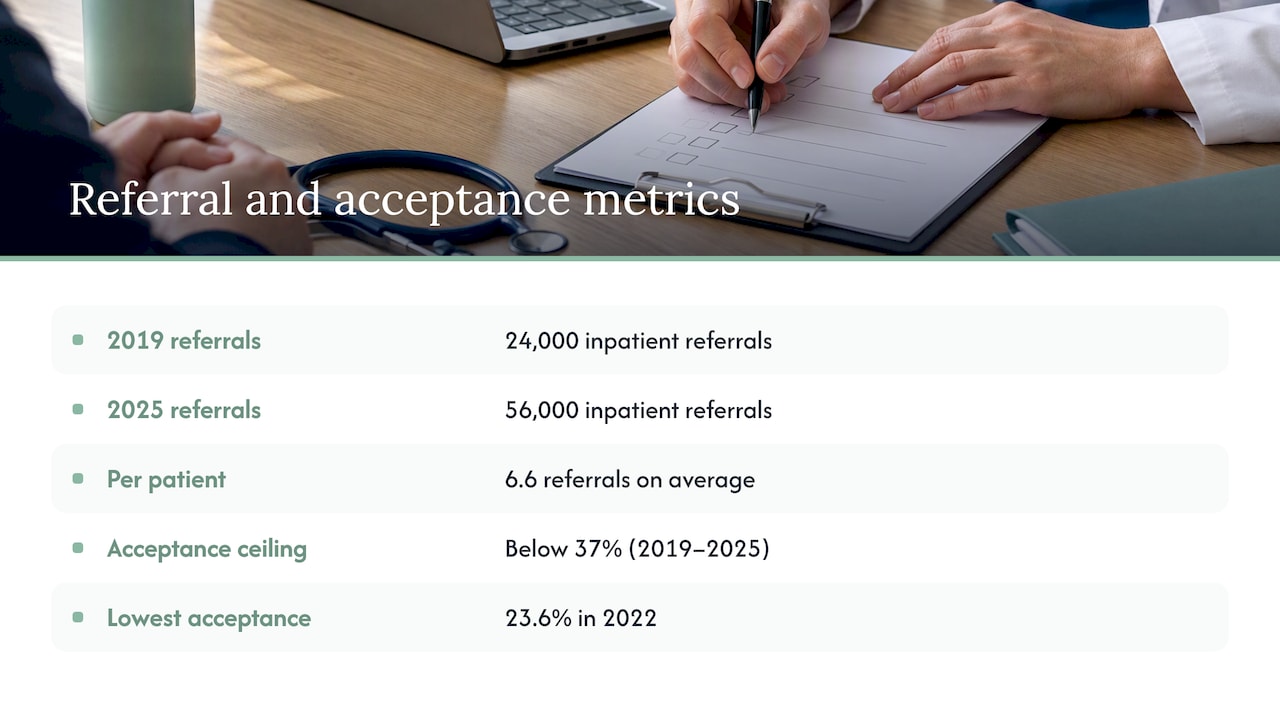
The volume side is getting heavier. A Skilled Nursing News report on WellSky data found that inpatient discharge post-acute referrals reached 56,000 in 2025, up from 24,000 in 2019. Providers submitted an average of 6.6 referrals per patient, and the acceptance rate never climbed above 37% between 2019 and 2025. It fell as low as 23.6% in 2022.
For your team, that means a large share of the referrals in your queue will never become admissions, whatever you do. The goal is not to say yes to everything. It is to reach a confident, accurate yes or no quickly, and to be the facility the hospital remembers when a hard case needs placing.
1. Respond to the first request quickly
Because the first request goes to many facilities at once, the first complete answer often wins. A slow reply tells the discharge planner nothing, and they have to move on. A fast decline is still useful, because it lets them redirect the patient and makes your team a reliable partner for the next referral.
Set a written internal standard for your first response and measure it. A workable structure looks like this:
- Acknowledge every referral within a fixed window that your team agrees on, even if the full review takes longer.
- Triage into three groups: clear fit, needs review, and clear mismatch.
- Assign one owner per referral so nothing sits in a shared inbox.
- Close the loop with an explicit accept, decline or pending message, plus the reason.
If your admissions team still works from faxes, shared inboxes and phone calls, much of the response time is lost to retyping and chasing. Our guide on manual versus automated admissions compares where the hours go in each model.
2. Check Medicare eligibility before you accept
A fast yes that turns into a denial costs more than a slow, correct one. The most common trap in hospital-to-SNF referrals is the Medicare 3-day rule.
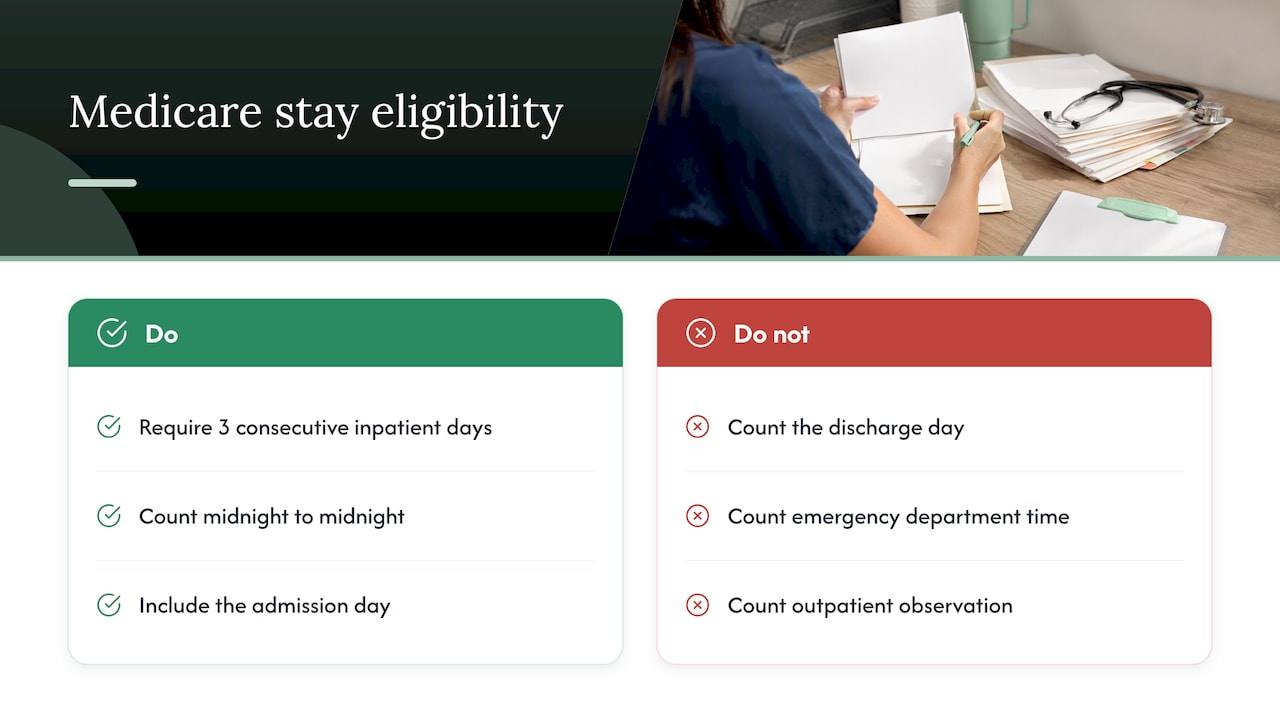
Under standard rules, Part A coverage of SNF care requires a prior inpatient hospital stay of at least 3 consecutive days. CMS’s billing guidance explains that days are counted midnight to midnight, starting with the day of admission and excluding the day of discharge. Time in the emergency department or under outpatient observation does not count.
That last point catches teams out. A patient who spent four days in the hospital may have spent two of them in observation. If your team reads the referral packet and sees “four days,” you could accept a patient who does not qualify. If you want a refresher on how Medicare qualifies a stay, our article on the three tests for Medicare SNF eligibility covers it, and three eligibility checks that prevent SNF denials turns it into an intake routine. For a billing-side view of Medicare skilled nursing coverage and care coordination programs, this care coordination resource is a useful reference.
Know when the TEAM waiver applies
Since January 1, 2026, the Transforming Episode Accountability Model (TEAM) allows a waiver of the 3-day rule for eligible episodes. According to CMS’s implementation instructions, patients discharged from participating TEAM hospitals for one of five specified episode categories may be admitted to a qualified SNF without a prior 3-day inpatient stay. The SNF must have held an overall rating of 3 stars or better for at least 7 of the last 12 months. The waiver runs from January 1, 2026 through December 31, 2030.
Add two questions to your intake screen:
- Is the referring hospital a TEAM participant, and does the patient’s episode fall in a covered category?
- Does your facility meet the star-rating condition right now?
If both answers are yes, a patient with a short stay may still be a covered admission. If either is no, the standard 3-day count applies.
3. Use a screening checklist the whole team follows
Inconsistent review is a quiet cause of both lost admissions and bad admissions. When each coordinator weighs a referral differently, you accept patients you cannot serve and turn down patients you could. A shared checklist fixes that, and it gives your director something concrete to coach against.
A useful pre-acceptance checklist covers:
- Payer and eligibility: payer source, active coverage, qualifying stay status, and any authorization requirement.
- Clinical fit: diagnosis, therapy needs, wound care, IV therapy, respiratory needs, and behavioral health considerations.
- Equipment and medications: specialty beds, bariatric needs, high-cost drugs and anything on the hospital’s red-flag list.
- Capacity: bed type, gender and room match, and staffing for the acuity level.
- Discharge goal: the likely length of stay and the safe discharge destination.
We have published ready-to-use versions: an admissions checklist for efficient intake and a patient admission checklist for skilled nursing intake. Adapt either to your own clinical capabilities, then keep the standard stable so you can measure results over time.
4. Build formal linkages with your top referring hospitals
The strongest argument for a hospital to refer to you repeatedly is evidence that it works for the hospital too. Research supports that argument. A study of Medicare surgical patients estimated that a 10-percentage-point increase in the share of a hospital’s surgical discharges going to a particular SNF is associated with a 4% reduction in the 30-day readmission rate. A related study of referral linkages and rehospitalization found that stronger linkages were tied to lower rehospitalization regardless of hospital ownership.
Those are associations from older Medicare data, so present them as such. They do not promise a result for your building. They do explain why many hospitals now look for consistent partners rather than whoever answers first.
What a linkage looks like in practice
Research on preferred SNF networks describes forming a network as deepening existing relationships more than simply picking partners. Hospitals that do it well invest in educating SNF staff on specific care protocols and in getting data to the bedside reliably. You can offer the same things:
- A named clinical liaison who answers the hospital’s questions about fit.
- Shared care protocols for the conditions the hospital sends most, such as joint replacement, heart failure or stroke.
- Regular review of readmissions with the case management team, with specific cases rather than averages.
- Clear communication about what you can and cannot accept, so the hospital sends you better-matched referrals.
Patient choice stays in force. The CMS discharge planning rules require hospitals to offer patients a choice among qualified post-acute providers, and CMSA’s summary of the rules notes that the list must include quality data from CMS Compare. You cannot ask a hospital to steer a patient. You can make sure your quality data, your outcomes and your responsiveness are strong when the patient and family look at the list.
5. Replace the phone-and-fax loop with structured data
Many referrals still travel by fax and phone, and that delays decisions and increases the chance that critical clinical context gets lost. An ONC blog on standards for transitions of care points to the 360X framework as a way to automate the exchange of clinical data and to formalize accept and decline notifications. It matters to the hospital, which has quality metrics to meet, and to the SNF, which needs the information to accept a patient safely.
You may not control how the hospital sends referrals, but you control how you receive and process them. Practical steps:
- Ask your top five referral sources how they send referrals today and what they would prefer.
- Make sure referral documents land in one queue, not several.
- Extract the same core fields from every referral: payer, diagnosis, therapy needs, medications and equipment.
- Connect your admissions workflow to your EMR so accepted patients do not have to be re-entered.
Our guides on how to integrate your EMR with referrals and what EMR integration is explain the pieces. For the documentation side, see how to handle referral documentation.
6. Automate the repetitive checks, keep people on the judgment calls
Eligibility verification, document sorting and data entry take up time that your coordinators could spend talking to case managers and families. When teams rely on manual verification, status problems are easier to miss until an admission is already underway. Automated, real-time checks against the EMR and insurance portals can flag those issues before anyone commits a bed.
Keep the division of labor clear:
- Automate: insurance eligibility lookups, document capture, missing-information alerts and status tracking.
- Keep human: clinical fit decisions, conversations with hospital case managers, and exceptions that do not match the checklist.
The point is not to remove your team from the decision. It is to hand them a complete, verified picture sooner. Our article on real-time insurance verification shows how that plays out for admissions time, and the patient eligibility verification list gives you the steps to standardize.
7. Measure referrals by source and by outcome
You cannot improve what you do not track. Most facilities know their occupancy but not why a referral failed. Build a simple monthly report with these measures, split by referring hospital:
| Measure | Why it matters |
|---|---|
| Referrals received | Shows which hospitals send volume |
| Time to first response | Shows whether you are competitive on speed |
| Acceptance rate | Shows how well referrals match your capabilities |
| Decline reasons | Reveals gaps you could close, such as a service you could add |
| Denials after admission | Points to eligibility checks that failed upstream |
| 30-day rehospitalizations | The number hospitals care about most |
Review the report with your director and share the relevant parts with each hospital partner. Compare against the broader market carefully: the 37% ceiling in the WellSky data is an industry-wide figure, not a target for your building. Your own trend by source is more useful.
Our perspective: speed without accuracy is a trap
We built Smart Admissions for admissions teams because we see the same pattern. A coordinator receives a referral, opens three systems and a PDF, and starts calling the payer. By the time the picture is clear, the hospital has moved on. The reverse also happens: a fast yes goes out on incomplete information, and the facility absorbs a denial or a poor-fit admission.
We think the answer is neither to work faster by hand nor to automate everything. It is to take the repetitive work, such as eligibility verification, clinical assessment support and document management, off your coordinators so they spend their time on the decisions only they can make. That is also how you keep staff from burning out on manual work, which is a real cost in a department that never gets a quiet day.
We also believe hospital relationships are built on reliability. A hospital that gets a clear, accurate answer every time learns to send you the patients you can serve well. That is better for the patient, better for the hospital’s readmission numbers and better for your census.
— Harry
How Smart Admissions helps with hospital-to-SNF referrals
Smart Admissions is an AI-powered referral management platform for skilled nursing facilities, rehabilitation centers and post-acute providers. It integrates with your existing EMR and insurance portals to support real-time eligibility verification, clinical assessments and documentation management, with analytics to show where referrals are won and lost. Onboarding is designed to take under an hour, and we back it with a guarantee that the software pays for itself within 30 days.
Plans are $597 per month or $6,447 per year. You can see the details on our pricing page, or start from the Smart Admissions homepage to see how it fits your admissions workflow.
Where to start this month
You do not need to change everything at once. A sensible order is:
- Write down your current response time and acceptance rate for your top three referral sources.
- Add the TEAM waiver and observation-status questions to your intake screen.
- Adopt one shared screening checklist.
- Schedule a case-level review with your highest-volume hospital.
- Choose which repetitive steps to automate first.
For a fuller picture of the process, our admission workflow guide and our guide on coordinating patient transfers are good next reads.
FAQ
What is the SNF 3-day rule?
Under standard Medicare rules, Part A covers SNF care only after a qualifying inpatient hospital stay of at least 3 consecutive days, counted midnight to midnight. Emergency department and observation time do not count. CMS explains the counting method in its billing guidance.
Can a hospital send a patient to a nursing home?
Yes. A hospital discharge planner can refer a patient to a skilled nursing facility when the patient needs skilled care after the stay. The hospital must give the patient a choice among qualified providers rather than choosing for them. The SNF still decides whether it can accept the patient.
Why do so many hospital-to-SNF referrals not result in admissions?
Hospitals often send the same request to several facilities at once to see who has capacity and fit. Industry data show an average of 6.6 referrals per patient in 2024, so most requests go to a facility that is not ultimately chosen. Mismatched clinical needs, payer issues and slow responses add to the gap.
Can a hospital steer patients to a preferred SNF?
Not directly. Hospitals must present patients with a list of qualified providers and respect their choice. Many hospitals do build preferred networks by educating patients about partners with strong outcomes, so your quality data and track record matter.
Sources
- Hospital-Skilled Nursing Facility Referral Linkage Reduces Readmission Rates Among Medicare Patients Receiving Major Surgery
- Effect of Hospital-SNF Referral Linkages on Rehospitalization
- Reducing Hospital Readmissions Through Preferred Networks Of Skilled Nursing Facilities
- CMS MLN: Skilled Nursing Facility 3-Day Rule Billing
- CMS MM14098: TEAM Skilled Nursing Facility 3-Day Rule Waiver
- Skilled Nursing News: Hospital to Skilled Nursing Facility Referral Rate Stable, Admission Rate Rises
- ONC: 360X and Long Term Care Transfers
- HealthIT.gov: Using Standards to Focus on Transitions of Care
- CMSA: Discharge Planning in Hospitals, Two Important Clarifications