
Data retention in healthcare means keeping resident and patient records for the period the law or your own policy requires, and protecting them until they are destroyed. For a skilled nursing facility, the number of years is usually set by your state, with a federal floor of five years from discharge when state law is silent. HIPAA adds the safeguards that apply the whole time you hold the records. This guide gives admissions and administrative leaders the rules in the order you will use them.
TL;DR
- HIPAA does not set a general retention period for medical records. HHS says state law generally controls how long you keep them.
- For nursing facilities, federal rules require records to be kept for the state-law period, or five years from discharge if state law has none. For a minor, it is three years after the resident reaches legal age.
- HIPAA’s six-year rule covers required compliance documentation such as policies, not clinical charts.
- Disposal is regulated: no dumpsters, trained staff, and media sanitized or destroyed.
- A written retention schedule by record type, built on your state’s rule, is the document surveyors and auditors expect you to follow.
Table of Contents
- What data retention means in a nursing home
- Rule 1: HIPAA does not set the retention years for medical records
- Rule 2: HIPAA’s six-year rule applies to compliance documents
- Rule 3: For nursing facilities, state law sets the years, with a federal backstop
- Rule 4: Write a retention schedule by record type
- Rule 5: Protect records while you hold them and destroy them properly
- What changed recently
- A practical 30-day checklist
- Where referral data fits, and how Smart Admissions helps
- Our view on data retention in healthcare
- FAQ
- Sources
What data retention means in a nursing home
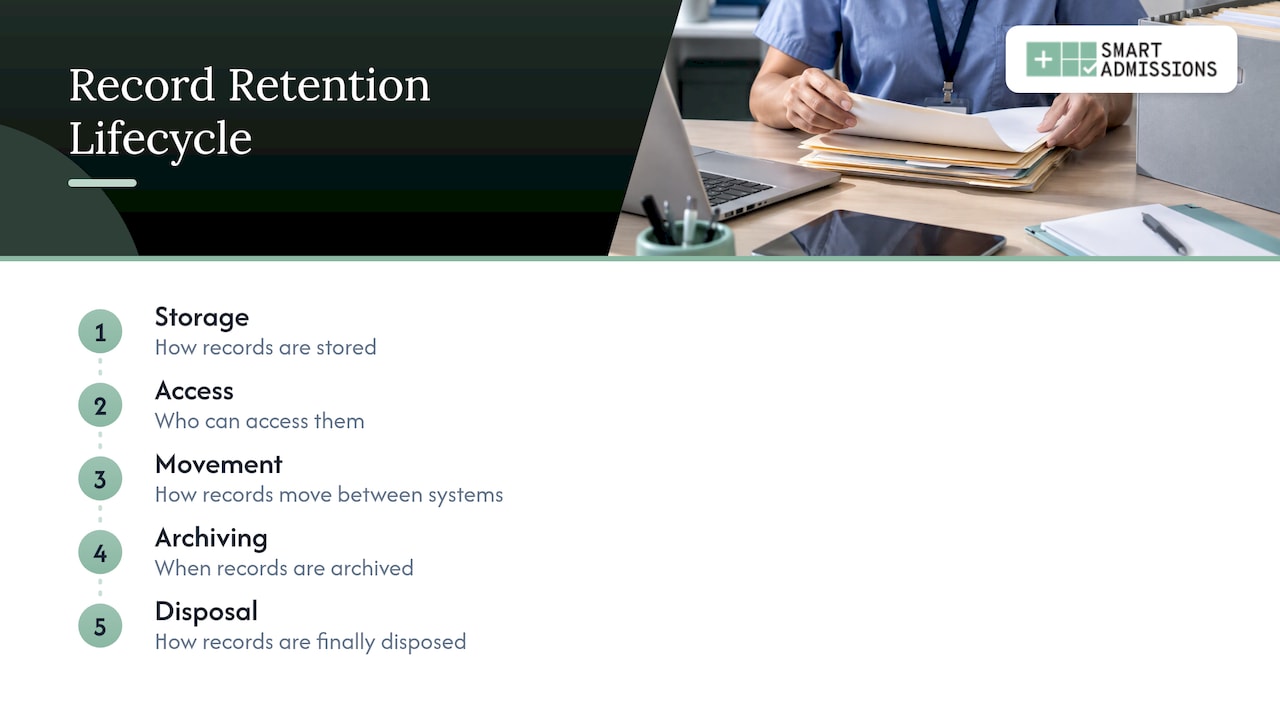
Retention is more than storage. It covers the full life of a record: how it is stored, who can access it, how it moves between systems, when it is archived and how it is finally disposed of. The clock matters, but so does the protection around it.
The records in scope are broader than the chart. HIPAA’s Privacy Rule protects protected health information (PHI) in electronic, written and oral form, meaning any individually identifiable health information a covered entity holds. The designated record set includes medical and billing records kept by or for a provider, plus any other record containing PHI that is used to make decisions about an individual.
For a nursing home, federal regulation lists what the medical record must contain. According to 42 CFR 483.70, that includes information identifying the resident, the resident’s assessments, the comprehensive plan of care and the services provided. Your MDS assessment data, progress notes and diagnostic reports belong in that set.
The referral packet that arrives before admission is also PHI. Whether it came by hospital portal, fax or email, treat it under your retention policy from the day you receive it, including referrals you decline.
Rule 1: HIPAA does not set the retention years for medical records
This is the most common misunderstanding. HHS states that the Privacy Rule does not require covered entities to keep medical records for any particular period. State law generally controls. HIPAA’s role is confidentiality and safeguards for as long as you keep PHI, including at disposal.
If a vendor or article tells you that “HIPAA requires seven years,” it is blending the six-year documentation rule (Rule 2) with typical state periods. Build your schedule on the state requirement and treat HIPAA as the security layer on top. For a plain-language look at how the two interact, see this overview of HIPAA compliance apps for U.S. healthcare teams.
Rule 2: HIPAA’s six-year rule applies to compliance documents
HIPAA does contain a six-year retention requirement, but it covers a different category. CMS guidance explains that administrative simplification rules require covered entities to keep required documentation for six years from the date it was created or last in effect, whichever is later. That is separate from retaining clinical medical records.
The Security Rule works the same way. Its preamble confirms that security documentation is kept six years and that the rule does not set clinical-record time frames.
In practice, keep these for at least six years from their last effective date:
- Privacy and security policies and procedures, including every superseded version
- Risk analyses and risk management plans
- Workforce training records
- Business associate agreements
- Records of how you handled access requests and complaints
One more clock is worth knowing. HIPAA protects a decedent’s information for 50 years after death. After that, the information is no longer PHI. That does not shorten your state retention period, and it does not mean you should keep records that long. It means that anything you still hold on a deceased resident stays protected for decades.
Rule 3: For nursing facilities, state law sets the years, with a federal backstop
The federal requirement for long-term care facilities sits in 42 CFR 483.70. Medical records must be retained for the period required by state law, or five years from discharge when state law has no requirement. For a minor, the period is three years after the resident reaches legal age under state law.
The CMS hospital Conditions of Participation have their own five-year rule, but that is not your rule. Use the nursing facility language above.
States then set their own periods, and they differ. Three examples show the range:
| State | Nursing facility retention rule | Minors |
|---|---|---|
| Arizona | Six years after discharge | Three years after age 18, or six years after discharge, whichever is later |
| New York | Six years from discharge or death | Three years after age 18 |
| Maryland | At least five years from discharge | Three years after reaching adulthood or five years, whichever is longer |
These are floors for the record type named, and they are not the whole picture. Maryland, for example, also has general medical-record rules requiring at least five years from the date the record is made, or until the patient is 21, whichever is longer. A facility that also runs an outpatient therapy program or a hospital-based unit can fall under more than one rule.
The Joint Commission states that retention is generally determined by state and federal law and that organizations should seek state-specific legal and risk-management advice. Your state health department regulations and your facility’s attorney are the final word. Check them at least once a year, because states amend these rules.
When the clock starts
For resident clinical records, the clock in the examples above starts at discharge or death, not at admission or at the last note. For a resident who is readmitted, confirm with your attorney whether you treat each stay as its own record or one continuous record. Many facilities choose the safer approach: keep everything for the longest period that could apply.
A pending audit, investigation, claim or lawsuit should pause scheduled destruction for the records involved. Write that hold step into your policy before you need it.
Rule 4: Write a retention schedule by record type
A schedule turns the legal rule into a task your team can follow. Build one table with these columns: record type, legal basis, retention period, start event, storage location and destruction method.
Start with the records your admissions and clinical teams generate:
- Resident medical record: state period or five years from discharge, whichever applies to you; minors extend to three years after legal age.
- MDS and assessment data: keep with the medical record, since assessments are named as part of it.
- Billing and eligibility records: these are part of the designated record set; confirm payer-specific and state periods with your compliance advisor.
- Referral packets and decline decisions: set a period in your policy and apply it consistently.
- HIPAA documentation: six years from creation or last effective date.
- Operational logs: temperature logs, meeting records and sign-in sheets may sit outside the permanent medical record, as the Joint Commission notes. Decide which of them you keep and for how long.
Long-term-care accreditation guidance follows the same principle: the state-law period governs, with five years from discharge as the default when no state requirement exists.
Two habits make the schedule work. Assign one named owner, usually the administrator or compliance lead, and review it every year. Then make sure every system that holds the data follows it: the EHR, shared drives, email, fax archives and paper storage. A schedule that covers only the chart leaves referral emails and faxed packets sitting indefinitely.
More on keeping files in order is in our guide on how to organize patient files and on patient record compliance steps.
Rule 5: Protect records while you hold them and destroy them properly
Retention ends with disposal, and disposal is where facilities most often slip.
Safeguards during storage
CMS guidance for nursing homes requires facilities to protect resident record information against loss, destruction and unauthorized use, whatever the storage method. Some states add specifics. Maryland requires restricted access, passwords or encryption on computers, and protection from damage, loss and deterioration.
If your facility handles substance use disorder program records covered by 42 CFR Part 2, section 2.16 requires formal written policies. For paper records those must address transfer and removal, destruction and sanitization, locked rooms or cabinets and access controls.
An audit trail shows who opened or changed a record and when. Our summary of audit trail requirements and the guide to patient data security in admissions cover that layer.
Destruction
HHS expects covered entities to apply reasonable administrative, technical and physical safeguards when disposing of PHI and to train workforce members who handle disposal. Covered entities may not simply abandon PHI or put it in dumpsters or other containers accessible to the public or unauthorized people.
For paper, that means a documented method such as shredding, pulping or incineration, using staff or a contracted vendor under a business associate agreement. For electronic records, HHS says that media can be reused only after ePHI is removed, or the media is destroyed. Clearing or purging may be used, and destruction is appropriate where circumstances warrant it. Copiers, fax machines and old laptops hold data too.
After each destruction event, record what was destroyed, the date, the method and who approved it. Keep that log for at least six years, since it is HIPAA documentation.
If a program closes or is acquired
For Part 2 programs that discontinue operations, 42 CFR 2.19 generally requires removal of identifying information, or destruction with media sanitization. Exceptions apply for transfers with written consent, records that must be kept under another law and a specified statutory transfer. Records that must be retained are sealed, labeled with the legal authority and the retention deadline, and held under Part 2 restrictions. Involve your attorney early in any sale or closure.
What changed recently
The retention rules above are stable. The federal nursing-facility language in 42 CFR 483.70 and HHS’s position that retention is a state matter remain the reference points. What is moving is cybersecurity. The Office for Civil Rights proposed an update to the HIPAA Security Rule in 2025, and as of this writing it has not been finalized. Watch the HHS and Federal Register pages for the final text. Your state rules can change on their own schedule, so recheck them annually.
A practical 30-day checklist
- Find your state’s nursing facility record retention regulation and note any separate rules for billing and outpatient services.
- List every place resident and referral data lives, including EHR, email, fax, shared drives and paper rooms.
- Draft the schedule table with record type, legal basis, period, start event and destruction method.
- Add a legal hold step for audits, investigations and claims.
- Confirm vendor agreements cover storage, return and destruction of PHI.
- Train the staff who handle disposal and log each destruction event.
- Have your attorney review the schedule and set a yearly review date.
Where referral data fits, and how Smart Admissions helps
In many facilities, referral data is the least controlled data. Packets arrive in multiple channels, get reviewed by several people and then sit in inboxes. Smart Admissions reads every incoming referral, whether it arrives through a hospital portal, fax or email, and evaluates it against your facility’s clinical capabilities, staffing, payer mix, PDPM reimbursement and bed availability. It integrates with PointClickCare, so accepted referrals flow into your existing workflow without duplicate entry. Leadership can see referral sources, response times, acceptance rates and lost opportunities in one place, which gives you a clear record of what came in and what was decided.
That puts the referral side of your data in one organized system, instead of scattered across inboxes and fax queues, before you apply your schedule. Plans are $597 per month or $6,447 per year, and you can see the details on the pricing page. To see the workflow first, read how it works.
Our view on data retention in healthcare
Most retention problems we see described in post-acute settings start before admission, not after discharge. A referral comes in by fax, another by email, a third through a hospital portal, and each one lands in a different place with a different owner. By the time the facility needs a retention schedule, the data is already scattered.
We built Smart Admissions as a facility-specific decision engine because admissions directors need a confident yes or a defensible no in minutes, and they need a clean record of how each decision was made. When every referral is read, summarized and scored in one platform, and accepted referrals move into PointClickCare without re-keying, your team has fewer copies to track and fewer places for PHI to hide.
Our advice: put the legal rule at the top of your schedule, put one owner beside it, and make your systems follow it. Get the intake side organized first, and the rest of the lifecycle gets easier to manage.
Harry
FAQ
How long do nursing homes have to keep medical records?
Federal rules require the period set by state law, or five years from discharge if state law sets none. For a minor, it is three years after reaching legal age. Many states require six years or more, so confirm your state’s regulation.
Does HIPAA require a seven-year retention period?
No. HHS states that HIPAA does not set a general medical-record retention period. HIPAA does require six years of retention for compliance documentation like policies and risk analyses, which is separate from clinical charts.
What does retention mean in healthcare?
It means keeping records for the legally or operationally required period and protecting them through storage, access, transfer, archiving and disposal. It applies to paper, electronic and oral PHI.
How should we destroy old resident records?
Use a documented method with trained staff, such as shredding for paper and clearing, purging or destroying electronic media. Never put PHI in dumpsters or public containers. Log each destruction event and keep that log.
Sources
- HHS: Does the HIPAA Privacy Rule require covered entities to keep medical records for any period?
- HHS: Your Rights Under HIPAA
- eCFR: 45 CFR Part 164 Subpart E
- eCFR: 42 CFR 483.70 Administration
- CMS: Medical Record Retention and Media Formats
- HIPAA Security Rule, 68 Fed. Reg. 8334
- HHS: Health Information of Deceased Individuals
- Arizona A.R.S. 12-2297
- New York 10 NYCRR 415.22
- Maryland COMAR 10.07.02.32
- Maryland COMAR 10.01.16.04
- Joint Commission: Records and Documentation Retention
- AHIMA: Retention of Health Information
- CMS State Operations Manual, F842
- 42 CFR 2.16
- HHS: HIPAA disposal requirements
- HHS: Reuse or disposal of computers and electronic media
- eCFR: 42 CFR 2.19