
Referral queue management is the routine that decides which referrals your team reads first, who reviews them, and how fast the hospital hears yes or no. The strongest queues share three traits: every referral lands in one place whether it came by portal, fax or email, every referral gets scored against your own clinical, staffing and payer rules, and every step has a named owner. This guide walks through seven steps to build that queue, the metrics to watch, and where software takes work off your admissions director’s desk.
TL;DR
- Hospitals often send one patient to several facilities at once, so a slow answer usually costs you the admission and can weaken the referral relationship. Research on SNF admission decisions describes this pattern.
- A good queue sorts every referral by insurance and cost, medical documentation, and fit with your resources before anyone makes a decision.
- Give each step (triage, clinical review, insurance verification) one named owner, so no referral waits on an unclear handoff.
- Track referral turnaround time and referral response time separately, plus acceptance, denial and lost-referral rates.
- Smart Admissions reads referrals from portals, fax and email, scores them against your facility’s rules, and flows accepted referrals into PointClickCare.
Table of Contents
- Why the referral queue decides your census
- Referral turnaround time vs. referral response time
- The 7 steps of referral queue management
- Metrics that show where your queue is stuck
- Common referral queue mistakes
- What software changes about referral queue management
- Promo: Run your referral queue on one platform
- Perspective: speed is only the starting point
- FAQ
- Sources
Why the referral queue decides your census
Occupancy in a skilled nursing facility depends on two flows: residents leaving and referrals you accept. Researchers who studied admission decisions found that occupancy depends on accepted referrals and resident outflow, and that facilities weigh their resources and capacities against each patient’s needs when deciding whether to offer a bed. The same study identifies financial, clinical and operational considerations as the reasons a facility offers or denies a bed.
That means the queue is not clerical work. Each referral carries a decision about clinical fit, reimbursement and bed availability, and the person making it is usually reading a fax packet at the same time the phone rings.
The pressure comes from hospital behavior. According to the same research, hospitals commonly send a patient to several facilities simultaneously or in quick succession. Whoever answers with a clear, confident offer first is usually the facility the discharge planner calls back. If you want the longer argument, see our piece on why improving referral response times matters in skilled nursing.
Referral turnaround time vs. referral response time
Teams use these two terms loosely, and mixing them hides problems. Define them once and measure them the same way every month.
- Referral response time: the time from the moment a referral arrives in any channel to the moment the hospital receives your answer (accept, decline, or a request for missing information).
- Referral turnaround time: the time from arrival to a final outcome, usually the admission itself or a documented non-admit.
Response time tells you how your team looks to the hospital. Turnaround time tells you how well the whole chain works: clinical review, insurance verification, bed assignment and the paperwork after the yes.
The clock should start when the referral reaches your facility, not when someone opens it. A fax that sat in a tray for two hours is a two-hour delay, even if the review took ten minutes. This is why a single intake point matters so much, and it is the first step below.
Federal rules do not hand you a response clock, but they do shape the process. Under 42 CFR § 483.15, a skilled nursing facility must establish and implement a formal admissions policy, and it may not require a third-party guarantee of payment as a condition of admission. Your queue procedure belongs inside that written policy, so staff, auditors and hospital partners all see the same process.
The 7 steps of referral queue management
Step 1: Bring every channel into one queue
Referrals reach you through hospital portals, fax and email. If each channel has its own inbox and its own person checking it, your fastest channel sets the pace for some referrals and your slowest for others.
What the step takes: one shared list where every referral has a timestamp, a source, a patient identifier and a status. Where it goes wrong: a faxed packet is printed, placed on a desk and never logged, so the clock is invisible.
Smart Admissions reads every incoming referral whether it arrives through a hospital portal, fax or email, so your team starts from one queue instead of three inboxes.
Step 2: Confirm receipt immediately
An acknowledgment takes seconds and tells the discharge planner you have the referral and are working it. It also buys you the time to review properly. Set a standard acknowledgment for each channel and assign who sends it.
The common failure is silence while the review happens. The hospital cannot tell a referral in review from a referral nobody opened, so it moves on to the next facility on the list.
Step 3: Screen on the same criteria every time
Screening differs widely between facilities. A qualitative study of SNF screening found that facilities screen for insurance coverage, expected cost, medical documentation, cognition, behaviors, discharge plans, rehabilitation goals, motivation, medical acuity and fit with facility resources. The same study notes that the quality of documentation, the understanding between hospital and facility, and payment pressure all influence the outcome.
Write your criteria down and apply them in the same order each time. A practical sequence follows the research: insurance coverage and cost first, then medical documentation, then the patient’s needs against your resources.
The admissions decision-making guide goes deeper on how to document those criteria so a no is as defensible as a yes.
Step 4: Triage into lanes
Not every referral needs the same reviewer. The SNF screening study describes one facility that used green for liaison review, yellow for nursing review, and red for referrals that failed minimum safety criteria, with complex cases referred for further review.
You can borrow the idea and set your own lanes:
- Fast lane: the referral clearly fits your capabilities, payer sources and open beds. An admissions coordinator can move it toward an offer.
- Clinical review lane: the packet raises questions about acuity, behaviors or treatments. A nurse or clinical leader reviews it.
- Escalation lane: high-cost treatments, unusual payer situations or safety concerns that need a leadership or multidisciplinary decision.
- Decline lane: the referral fails a minimum criterion you have already written down. The answer goes out quickly, with the reason documented.
Sending a clear decline fast is part of good queue management. It frees your team and tells the hospital to look elsewhere without waiting, which protects the relationship.
Our article on admissions queue prioritization with scoring shows how scoring turns these lanes into a ranked list.
Step 5: Assign an owner to every step
Depending on the facility, a liaison, nursing or clinical leaders, or a multidisciplinary team may screen the referral and make the admission decision. Any of those models can work if the roles are explicit.
Write a short responsibility chart:
| Step | Owner | Done when |
|---|---|---|
| Log and acknowledge | Admissions coordinator | Hospital has confirmation |
| Insurance and eligibility check | Admissions coordinator or business office | Coverage and expected cost noted |
| Clinical review | Nurse liaison or director of nursing | Needs and capabilities match documented |
| Bed and staffing check | Admissions director | Specific bed identified |
| Decision and communication | Admissions director | Offer or decline sent |
The usual failure is two people each assuming the other has the referral. Naming one owner per step removes that ambiguity.
Step 6: Check coverage rules before you offer
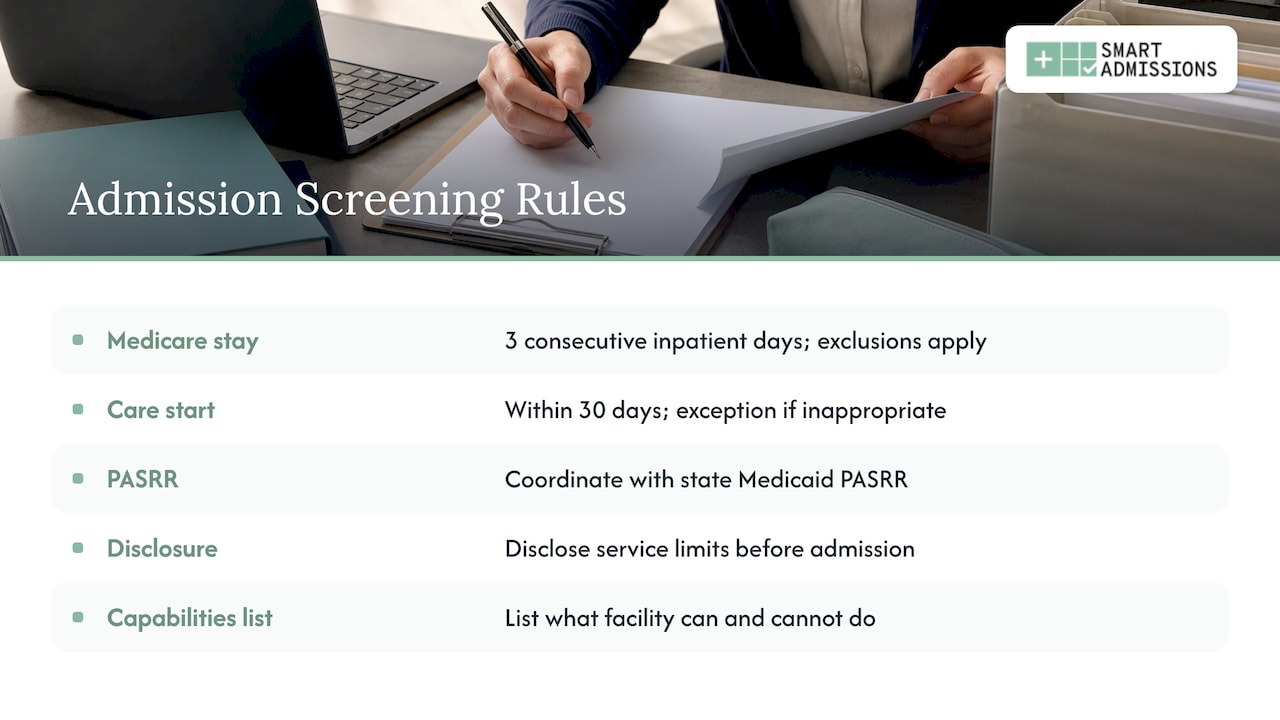
Financial screening is where many referrals stall, so know the rules that apply. For Medicare, CMS explains that SNF coverage generally requires a medically necessary inpatient stay of three consecutive calendar days, excluding the discharge day and any time in the emergency department or outpatient observation. Care must generally begin within 30 days of hospital discharge, unless starting within that window is medically inappropriate.
For patients with serious mental illness or intellectual disability, CMS guidance on PASRR says facilities must coordinate assessments with the state Medicaid PASRR program to the maximum extent practicable and use the report to identify specialized services.
On disclosure, 42 CFR § 483.15 requires you to tell potential residents about any special characteristics or service limitations before admission. A written capabilities list also helps hospitals send referrals that fit. Comagine’s pre-admission best practices describe a capabilities list as a way for hospitals to know what a facility can and cannot do.
For a stepwise version, use the patient eligibility checklist and the 15-minute PDPM preadmission checklist.
Smart Admissions evaluates each referral against your facility’s clinical capabilities, staffing, payer mix, PDPM reimbursement and bed availability, and its med cost alerts flag high-cost medications before acceptance.
Step 7: Decide, hand off and close the loop
A decision is not finished when you send the offer. The accepted referral needs to move into your records, the bed needs assigning, and a declined referral needs its reason logged so you can learn from it later.
Duplicate entry is the hidden delay here. Smart Admissions is EHR-independent and integrates with PointClickCare, so accepted referrals flow into existing workflows without being typed in twice. For matching, the platform’s referral-to-bed matching places the right patient in the right bed. The referral-to-bed process guide covers that handoff.
Metrics that show where your queue is stuck
A queue you do not measure drifts. Start with a small set you can pull every week:
- Response time by channel (portal, fax, email) and by hour of day.
- Turnaround time from arrival to admission or documented non-admit.
- Acceptance rate by referral source.
- Decline reasons, grouped into clinical, financial and capacity.
- Lost opportunities: referrals that went unanswered or were withdrawn by the hospital.
- Aging: how many referrals are still open past your internal target.
Split response time by source and you will usually see which hospitals get slow answers and which channels cause the lag. Group decline reasons and you will see whether your criteria are too tight, or whether hospitals keep sending referrals you cannot serve because they do not know your capabilities.
Smart Admissions gives leadership visibility into referral sources, response times, acceptance rates and lost opportunities across one facility or an entire network. For a method, see our guides on analyzing referral data and enhancing referral tracking.
Common referral queue mistakes
Treating every referral as equal. Without lanes, a clear fit waits behind a complicated case. Sorting by fit and urgency gets the easy yeses out first.
Letting financial review start late. If insurance and cost checks happen after the clinical review, the facility can spend an hour reviewing a referral it cannot afford to accept. Run them early, or in parallel.
Slow forms. One consulting practice’s blog describes a facility whose seven-page financial application delayed answers while census stayed near 81% despite a five-star rating. Whatever the exact numbers in your building, long forms that sit between the referral and your answer cost beds.
No decline discipline. A no that arrives late is worse than a no that arrives quickly. Document the reason and send it fast.
Unwritten rules. If criteria live in one director’s head, the queue stalls when that person is out. Our piece on signs your admissions process is costing you referrals lists the symptoms to look for.
What software changes about referral queue management
Everything above can be run with a whiteboard and a disciplined team. The difficulty is volume: when referrals arrive in bursts, reading each packet, checking payer rules and matching beds by hand takes hours, and the hospital will not wait.
An AI-based referral intelligence platform changes the first pass. It reads the referral, summarizes it, scores it against your rules and shows the reimbursement picture before a person spends time on it. Your admissions director then reviews a ranked, summarized queue and decides, instead of sorting paper.
For veterans homes, the platform also supports DD214 review to speed eligibility decisions. And it is built to match each facility’s own configuration, so your rules, not generic ones, drive the score. How Smart Admissions works shows the flow from intake to bed.
Promo: Run your referral queue on one platform
Smart Admissions is built for skilled nursing facilities, rehabilitation centers, state veterans homes and other post-acute providers. Each referral is summarized and scored so your team can answer with a confident yes or a defensible no in minutes instead of hours.
Plans are listed on the pricing page: $597 per month, or $6,447 per year.
Perspective: speed is only the starting point
Every admissions director we talk to already knows speed matters. The harder question is speed toward what. A fast yes to a referral your building cannot staff, or cannot afford to serve, is a costly mistake with a quick turnaround.
That is why we built Smart Admissions as a facility-specific decision engine. It reads every referral, across portal, fax and email, and weighs it against your clinical capabilities, payer mix, PDPM reimbursement and open beds. The result is a ranked queue where the right admissions come first.
We built it with people who have run admissions and know MDS and reimbursement. Our aim is that your admissions director spends the day on hospital relationships, not on paperwork, and that your leadership can see response times, acceptance rates and lost opportunities in one place.
Harry
FAQ
What is referral queue management in a skilled nursing facility?
It is the process of receiving, sorting, reviewing and answering every incoming referral so that the right patients are admitted quickly. It covers intake across channels, screening on insurance, documentation and clinical fit, assignment to reviewers, and the final decision. A good process produces fast answers and a record of why each decision was made.
What is a good referral response time for a skilled nursing facility?
Federal rules do not set a single deadline, so set your own target by channel and track it weekly. Because hospitals often send one patient to several facilities at once, a response measured in minutes gives you the best chance of being chosen. Start by measuring your current average, then lower it step by step.
How do you measure referral turnaround time?
Start the clock when the referral reaches your facility in any channel and stop it at the final outcome, either admission or a documented non-admit. Report it by referral source and by decision type. Track response time separately, because a quick answer followed by a slow admission points to a different problem.
How should a facility prioritize referrals?
Sort by fit and urgency. Clear fits with open beds and acceptable payer sources go first, referrals needing clinical judgment go to a nurse or clinical leader, and those failing minimum criteria get a fast, documented decline. Written criteria applied the same way every time keep the order consistent.
Can software handle referrals that arrive by fax?
Smart Admissions reads referrals whether they arrive through a hospital portal, fax or email, then summarizes and scores each one against your facility’s rules. Accepted referrals flow into PointClickCare without duplicate entry.
Sources
- Factors Influencing Admission Decisions in Skilled Nursing Facilities (PMC)
- Variability in skilled nursing facility screening (PMC)
- 42 CFR § 483.15, Admission, transfer, and discharge rights (Cornell LII)
- CMS MLN: Skilled Nursing Facility 3-Day Rule Billing
- CMS SNF guidance on PASRR coordination
- Comagine: Pre-admission and Admission Best Practices