
Every day, skilled nursing admissions teams juggle urgent patient requests and complex referral paperwork while trying to maintain smooth care transitions. The challenge of managing multiple referral types makes efficient review more important than ever for American facilities. By understanding the components of effective referral management, professionals can improve intake speed and accuracy while ensuring patients get the right level of care. This article highlights practical strategies to help streamline processes, reduce delays, and strengthen collaboration within skilled nursing environments.
Table of Contents
- Defining Referral Review In Healthcare Settings
- Types Of Referral Review In Skilled Nursing
- The Step-By-Step Referral Review Process
- Automation’s Role In Modern Referral Review
- Risks, Mistakes, And What To Avoid
Key Takeaways
| Point | Details |
|---|---|
| Referral Review Importance | Referral review is essential for ensuring efficient patient care coordination across healthcare systems. |
| Types of Referrals | Skilled nursing facilities must adapt their referral processes to handle urgent, elective, follow-up, specialist, and electronic referrals effectively. |
| Automation Benefits | Implementing automation in referral processes enhances efficiency and reduces error, allowing for quicker and more accurate patient care. |
| Risks to Avoid | Common mistakes include data entry errors and poor communication; healthcare facilities should maintain robust documentation and secure information transfer protocols. |
Defining Referral Review in Healthcare Settings
Referral review represents a critical administrative and clinical process within healthcare systems that enables seamless patient care coordination. Healthcare professionals conduct systematic assessments to ensure patients receive appropriate medical attention across different care levels and facilities.
At its core, referral review involves a comprehensive evaluation of patient transfer requests between healthcare providers. This process encompasses multiple key components:
- Detailed patient medical history assessment
- Verification of clinical documentation
- Evaluation of care urgency and complexity
- Determination of appropriate care facility or specialist
- Ensuring continuity of patient treatment pathways
The primary objective of referral review is to optimize patient care while efficiently managing healthcare system resources. Effective referral management requires careful consideration of patient needs, available medical expertise, and institutional capabilities. High-quality referrals balance thoroughness with usability, preventing potential treatment delays and improving overall patient outcomes.
Healthcare facilities typically engage in referral review through structured workflows that involve multiple professional stakeholders. These may include primary care physicians, specialist clinicians, administrative staff, and intake coordinators who collaboratively assess and route patient referrals.
Pro tip: Develop standardized referral review checklists to ensure consistent and comprehensive patient information evaluation across your healthcare team.
Types of Referral Review in Skilled Nursing
Skilled nursing facilities encounter multiple referral review types that address diverse patient care needs and clinical scenarios. Referral classifications vary based on clinical context and require specialized assessment strategies to ensure optimal patient placement and care continuity.
The primary types of referral reviews in skilled nursing settings include:
- Urgent Referrals: Require immediate assessment and expedited processing
- Elective Referrals: Planned transfers with more flexible timeline requirements
- Follow-up Referrals: Focused on continued care and treatment progression
- Specialist Referrals: Involving transfer to specific medical expertise
- Electronic Referrals: Digital submissions with comprehensive patient documentation
Referral types reflect broader healthcare system needs, incorporating multiple evaluation criteria such as patient clinical characteristics, resource availability, and institutional capabilities. Comprehensive referral review demands a systematic approach that considers patient medical history, current condition, and potential treatment requirements.
Healthcare professionals must adapt their referral review processes to accommodate different patient scenarios, ensuring that each referral receives appropriate scrutiny and timely response. The complexity of referral reviews necessitates collaborative workflows involving multiple stakeholders, including physicians, specialists, administrative staff, and intake coordinators.
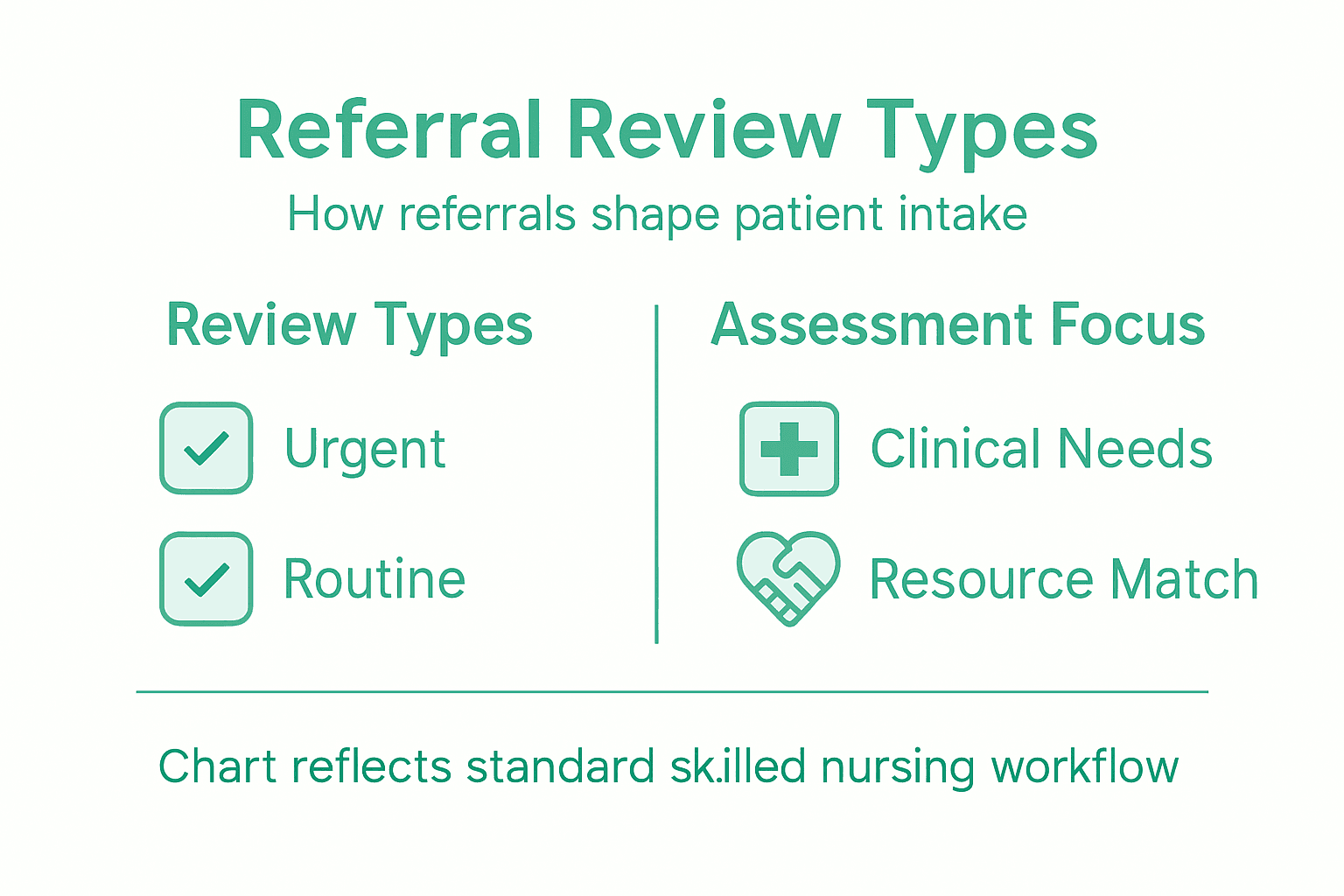
This table highlights differences between the main types of skilled nursing referral reviews:
| Referral Type | Typical Timeline | Assessment Focus |
|---|---|---|
| Urgent | Hours to 1 day | Acute care and stabilization |
| Elective | Days to weeks | Planned transition and suitability |
| Follow-up | Ongoing | Progress monitoring and adjustments |
| Specialist | Variable | Matching expertise to condition |
| Electronic | Instant submission | Documentation completeness and clarity |
Pro tip: Implement a standardized digital referral tracking system to streamline communication and reduce processing delays across different referral types.
The Step-by-Step Referral Review Process
Comprehensive referral review requires systematic documentation and strategic assessment to ensure patient needs are accurately matched with facility capabilities. The process involves multiple critical stages that demand precision and collaborative input from healthcare professionals.
The typical referral review process includes the following key steps:
- Initial Referral Intake
- Receive patient referral documentation
- Verify patient demographic and clinical information
- Check insurance and eligibility details
- Clinical Evaluation
- Review medical history and current health status
- Assess clinical complexity and care requirements
- Determine appropriateness for facility placement
- Documentation Verification
- Validate completeness of medical records
- Cross-reference clinical documentation
- Identify potential information gaps
Electronic health record integration streamlines the referral management workflow, enabling faster and more accurate patient intake decisions. Multidisciplinary collaboration plays a crucial role in ensuring comprehensive patient assessment, with input from physicians, specialists, and administrative staff.

Successful referral review demands a structured approach that balances thoroughness with efficiency. Healthcare facilities must develop robust protocols that enable quick yet comprehensive patient evaluation, minimizing processing delays while maintaining high standards of clinical assessment.
Pro tip: Develop a standardized digital checklist that guides staff through each referral review stage, ensuring consistent and comprehensive patient intake.
Automation’s Role in Modern Referral Review
Artificial Intelligence transforms healthcare referral processes, enabling unprecedented efficiency and accuracy in patient intake management. Automation represents a revolutionary approach that addresses longstanding challenges in referral review workflows.
Key advantages of automation in referral review include:
- Rapid data analysis and processing
- Standardized patient information evaluation
- Reduced human error potential
- Real-time communication across healthcare networks
- Enhanced decision-making support
Electronic health record integration plays a critical role in streamlining referral management. AI-driven platforms support seamless data transfer and enable more sophisticated patient routing strategies, dramatically reducing administrative burdens.
Modern healthcare facilities leverage automation to create intelligent referral systems that adapt dynamically to changing patient needs. These advanced technologies enable predictive analytics, workflow optimization, and more personalized care pathways, transforming traditional referral management into a sophisticated, data-driven process.
Here’s a summary of how automation enhances referral review processes in modern healthcare facilities:
| Automation Advantage | Operational Impact | Patient Care Benefit |
|---|---|---|
| Real-time data analysis | Speeds up referral decisions | Reduces wait time for care |
| Standardized evaluation | Ensures consistent screening | Improves care accuracy |
| Error reduction | Limits manual mistakes | Protects patient safety |
| Immediate communication | Connects providers instantly | Supports timely treatment |
| Predictive analytics | Optimizes resource allocation | Anticipates patient needs |
Pro tip: Implement machine learning algorithms that continuously analyze referral patterns to improve future routing efficiency and reduce processing times.
Risks, Mistakes, and What to Avoid
Common referral management mistakes can significantly undermine healthcare delivery and compromise patient care quality. Understanding these potential pitfalls is crucial for skilled nursing facilities seeking to optimize their referral review processes.
Top risks and mistakes in referral management include:
- Manual data entry errors
- Inconsistent communication between providers
- Lack of standardized tracking mechanisms
- Unsecured patient information transmission
- Incomplete or delayed referral documentation
Referral tracking failures can lead to substantial operational challenges. Unsecured messaging channels pose significant privacy risks, potentially exposing patient information and creating legal vulnerabilities for healthcare providers.
Healthcare facilities must develop comprehensive strategies to mitigate these risks. This involves implementing robust electronic systems, establishing clear communication protocols, and creating standardized workflows that prioritize patient data security and seamless information transfer.
Pro tip: Conduct quarterly audits of your referral management system to identify and proactively address potential communication and documentation gaps.
Streamline Your Referral Review Process with Smart Admissions
Referral review in healthcare demands precision, speed, and collaboration. The challenges of managing diverse referral types, preventing documentation gaps, and reducing manual errors can overwhelm skilled nursing facilities. If you are seeking to reduce referral review times, improve clinical assessment accuracy, and ensure timely patient placement, Smart Admissions offers a tailored solution that fits your needs. Our AI-powered referral management assistant integrates seamlessly with your Electronic Medical Records and insurance portals to automate verification, support comprehensive clinical evaluations, and eliminate communication bottlenecks.
Experience the difference of transforming your patient intake workflows with Smart Admissions. Visit Smart Admissions today to discover how our platform can help you increase bed occupancy rates, minimize staffing burnout, and enhance decision-making with real-time insights. Don’t wait to optimize your referral review process—explore AI-powered referral management and take control of your admissions efficiency now.
Frequently Asked Questions
What is referral review in healthcare?
Referral review is a systematic process in healthcare that assesses patient transfer requests between providers to ensure appropriate medical attention and care coordination.
Why is referral review important for patient intake?
Referral review is crucial as it optimizes patient care, ensuring that patients are matched with suitable healthcare facilities and specialists, thus improving overall treatment outcomes and continuity of care.
What are the main types of referral reviews in skilled nursing facilities?
Main types of referral reviews include urgent referrals, elective referrals, follow-up referrals, specialist referrals, and electronic referrals, each addressing different patient care needs and timelines.
How can automation enhance the referral review process?
Automation can improve the referral review process by enabling rapid data analysis, reducing errors, standardizing assessments, and enhancing communication, which ultimately leads to more efficient patient intake and care pathways.