
Every Admissions Director knows how tedious patient intake can become when paperwork piles up and manual data entry slows everything down. With increasing demands on skilled nursing facilities across North America, finding ways to reduce errors and save time has become urgent. Artificial intelligence offers a path forward by automating complex administrative tasks, improving data accuracy, and driving more efficient workflows—making patient intake not just faster but truly smarter.
Table of Contents
- Defining AI’s Role In Patient Intake Systems
- Automation And Workflow Improvements In Referrals
- Integrating AI With EMR And Insurance Portals
- Enhancing Patient Eligibility And Clinical Assessment
- Risks, Data Privacy, And Legal Considerations
- Optimizing Bed Fill Rates And Reducing Burnout
Key Takeaways
| Point | Details |
|---|---|
| AI Enhances Patient Intake | AI automates administrative tasks in patient intake, improving data accuracy and operational efficiency. |
| Automation Streamlines Referrals | Automated referral workflows save time and reduce bottlenecks in patient admissions. |
| Integration with EMR is Crucial | Seamless integration of AI with Electronic Medical Records enhances data handling and improves patient care. |
| Legal Considerations are Essential | Robust governance is needed to navigate privacy concerns and compliance during AI implementation in healthcare. |
Defining AI’s Role in Patient Intake Systems
Artificial intelligence (AI) has emerged as a transformative technology in healthcare, particularly within patient intake systems. By leveraging advanced algorithms and machine learning capabilities, AI is revolutionizing how skilled nursing facilities collect, process, and utilize patient information.
AI’s primary function in patient intake involves automating complex administrative tasks while enhancing data accuracy and operational efficiency. Patient intake systems powered by AI can systematically capture medical histories, interpret patient narratives, and facilitate clinical decision-making with unprecedented precision.
Key capabilities of AI in patient intake include:
- Natural Language Processing (NLP) for understanding patient narratives
- Machine learning algorithms for predicting potential medical conditions
- Automated data extraction from medical documents
- Real-time eligibility verification
- Intelligent clinical risk assessment
Healthcare providers recognize that AI integration goes beyond mere technological advancement. Patient perspectives emphasize transparency and engagement as critical components of successful AI implementation. While AI can accelerate data capture and reduce errors, maintaining human oversight remains essential to foster trust and ensure ethical usage.
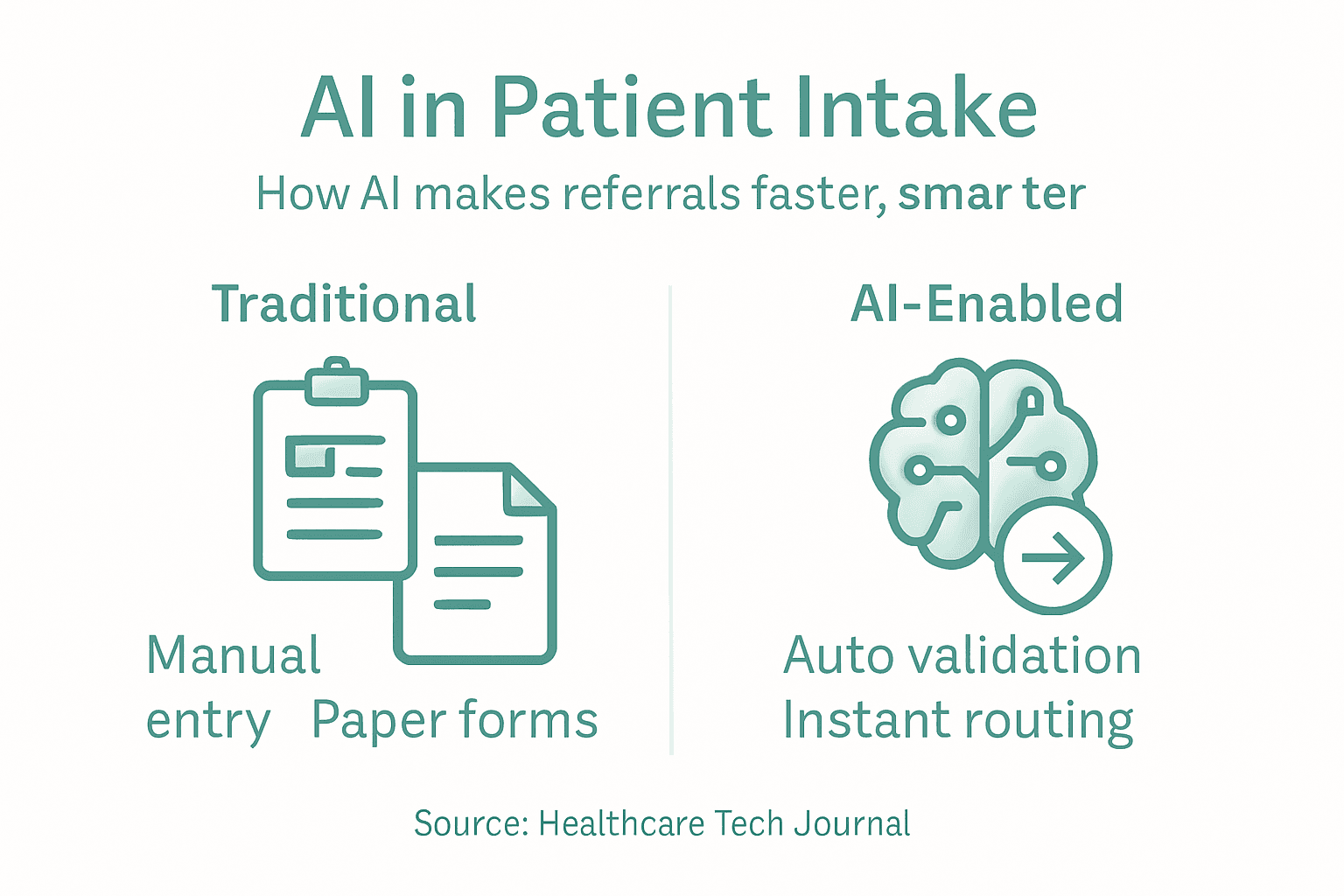
The strategic implementation of AI in patient intake systems requires a nuanced approach that balances technological capabilities with human expertise. By thoughtfully integrating AI tools, skilled nursing facilities can create more efficient, accurate, and patient-centered intake processes.
Here’s a summary of how AI impacts key patient intake areas in skilled nursing facilities:
| Area of Impact | Traditional Approach | AI-Enabled Approach | Business Benefit |
|---|---|---|---|
| Data Collection | Manual entry, prone to errors | Automated & accurate data capture | Fewer errors, saved time |
| Eligibility Verification | Staff review insurance, paperwork | Real-time, automated screening | Faster admissions |
| Clinical Risk Assessment | Manual analysis of records | Intelligent predictive analytics | Early intervention |
| Patient Engagement | Paper forms, slow updates | Digital, interactive intake | Improved experience |
Pro tip: Start with small, incremental AI integrations and continuously gather feedback from both staff and patients to refine your approach.
Automation and Workflow Improvements in Referrals
Referral management in skilled nursing facilities represents a critical administrative process that significantly impacts patient intake efficiency. Traditional manual referral workflows often create bottlenecks, consuming valuable time and resources that could be better allocated to patient care. Referral automation strategies can dramatically reduce processing times and minimize administrative overhead.
The key components of an automated referral workflow include:
- Intelligent document parsing to extract critical patient information
- Automated eligibility screening against facility admission criteria
- Real-time communication channels with referring healthcare providers
- Digital document routing to appropriate review teams
- Predictive analytics for faster decision-making
Successful referral automation requires a comprehensive approach that integrates technological solutions with existing healthcare information systems. By implementing smart automation tools, skilled nursing facilities can transform their referral processes from time-consuming manual tasks to streamlined, efficient workflows.
Automation doesn’t replace human judgment – it empowers healthcare professionals to make faster, more informed decisions.
Technological advancements enable administrators to reduce referral processing times from hours to minutes, creating a more responsive and patient-centered intake experience. The goal is not to eliminate human oversight but to provide intelligent support that accelerates administrative processes and improves overall healthcare delivery.

Pro tip: Conduct a comprehensive workflow audit before implementing automation to identify specific bottlenecks and customize your technological solutions.
Integrating AI With EMR and Insurance Portals
Effective integration of AI with Electronic Medical Records (EMR) and insurance portals represents a transformative approach to healthcare administrative processes. AI integration strategies enable healthcare facilities to create seamless, intelligent data ecosystems that dramatically improve operational efficiency and patient care management.
Key components of successful AI integration include:
- Interoperability standards like HL7 and FHIR
- Real-time data synchronization
- Automated eligibility verification
- Intelligent data extraction
- Predictive risk assessment
- Secure communication protocols
Healthcare administrators must approach EMR and insurance portal integration systematically, ensuring comprehensive data governance and technical compatibility. The goal is to create a unified platform that allows for smooth information exchange while maintaining strict privacy and security standards.
Successful AI integration transforms complex administrative tasks into streamlined, intelligent workflows that support clinical decision-making.
Technological interoperability goes beyond simple data transfer. Advanced AI systems can now interpret unstructured medical data, extract meaningful insights, and provide predictive analytics that help skilled nursing facilities make faster, more informed patient intake decisions.
Pro tip: Develop a phased implementation strategy that allows for incremental AI integration, enabling your team to adapt and optimize the technology progressively.
To help select an AI integration strategy, here’s a comparison of phased vs. full implementation:
| Strategy | Approach Description | Change Management Challenges | Typical Outcomes |
|---|---|---|---|
| Phased Integration | Gradually add AI features | Staff adaptation, retraining | Smooth transition, less risk |
| Full Integration | Implement all at once | User resistance, workflow shifts | Rapid results, higher initial impact |
Enhancing Patient Eligibility and Clinical Assessment
Artificial intelligence is revolutionizing patient eligibility and clinical assessment processes in skilled nursing facilities by providing unprecedented insights and efficiency. AI-enhanced patient evaluation transforms traditional clinical methods by integrating advanced data analytics and comprehensive patient information analysis.
Critical components of AI-powered clinical assessment include:
- Multimodal data processing
- Predictive risk stratification
- Electronic health record integration
- Real-time diagnostic support
- Personalized treatment recommendations
- Comprehensive patient profile analysis
Healthcare administrators can leverage AI technologies to create more nuanced and accurate patient eligibility determinations. Machine learning algorithms can rapidly analyze complex medical histories, treatment protocols, and potential risk factors, enabling more informed decision-making that goes beyond traditional screening methods.
AI does not replace clinical judgment – it augments human expertise with data-driven insights and comprehensive analysis.
Advanced AI systems now enable skilled nursing facilities to conduct more sophisticated clinical assessments by processing diverse datasets from electronic health records, imaging studies, and patient-reported information. These intelligent systems can identify subtle patterns and potential clinical risks that might be overlooked in manual review processes.
Pro tip: Implement a hybrid approach that combines AI-generated insights with expert human review to maximize assessment accuracy and maintain clinical nuance.
Risks, Data Privacy, and Legal Considerations
Implementing AI in patient intake requires a comprehensive understanding of the complex legal and ethical landscape surrounding healthcare technology. Healthcare AI governance demands careful navigation of data privacy, security, and regulatory compliance challenges that can significantly impact patient trust and organizational liability.
Key legal and privacy considerations include:
- HIPAA compliance protocols
- Patient data anonymization
- Algorithmic bias prevention
- Informed consent mechanisms
- Transparent decision-making processes
- Comprehensive data security frameworks
Healthcare organizations must develop robust governance strategies that address the multifaceted risks associated with AI implementation. This involves creating comprehensive policies that protect patient information, ensure algorithmic fairness, and maintain clear lines of accountability for AI-driven decisions.
Legal and ethical considerations are not obstacles to AI implementation, but essential safeguards that protect both patients and healthcare providers.
Effective risk management requires a proactive approach that integrates legal expertise, technological understanding, and a commitment to patient-centered care. Skilled nursing facilities must continuously evaluate and update their AI systems to ensure compliance with evolving regulatory standards and ethical guidelines.
Pro tip: Develop a cross-functional governance team that includes legal, clinical, and technology experts to comprehensively address AI implementation risks.
Optimizing Bed Fill Rates and Reducing Burnout
Skilled nursing facilities face persistent challenges in maintaining optimal bed occupancy while protecting staff from overwhelming administrative burdens. AI-driven predictive analytics offer a transformative solution by forecasting patient flow, optimizing bed allocation, and streamlining operational workflows.
Key strategies for improving bed management and reducing staff burnout include:
- Automated patient flow prediction
- Real-time bed availability tracking
- Intelligent patient-bed matching
- Workload distribution algorithms
- Predictive staffing optimization
- Administrative task automation
Healthcare organizations can leverage AI technologies to create more efficient and less stressful work environments. By automating repetitive tasks and providing intelligent resource allocation, these tools help reduce the cognitive load on healthcare professionals, allowing them to focus more on patient care and less on administrative complexities.
Technology should enhance human potential, not replace it – AI is a tool for empowerment, not a substitute for clinical expertise.
Successful implementation requires a holistic approach that balances technological capabilities with human-centered design. Skilled nursing facilities must view AI as a collaborative partner that supports staff performance and improves overall operational efficiency.
Pro tip: Conduct regular feedback sessions with staff to continuously refine AI implementation and ensure the technology genuinely addresses their operational challenges.
Unlock Efficiency in Patient Intake with AI-Powered Referral Management
The challenge of managing patient intake and streamlining referrals is clear from the article. Manual administrative tasks and delayed referral processing slow down skilled nursing facilities, contributing to staff burnout and suboptimal bed occupancy. Key pain points include lengthy referral review times, eligibility verification bottlenecks, and the need for accurate clinical risk assessments while preserving human oversight. The discussion highlights AI-driven solutions like real-time eligibility verification, automated data extraction, and intelligent clinical analysis as essential tools to overcome these obstacles.
Smart Admissions offers a tailored SaaS platform designed to address exactly these challenges. By automating repetitive referral workflows and seamlessly integrating with existing Electronic Medical Records and insurance portals, it transforms your patient intake process. With features that reduce manual errors, accelerate admissions, and improve bed fill rates, Smart Admissions empowers your healthcare team to focus on what matters most: patient care. Discover how combining advanced AI with practical ease of use can revolutionize your intake operations at Smart Admissions.
Ready to eliminate referral bottlenecks and reduce staff burnout today?
Explore how our AI-powered referral assistant can speed up your admissions process, enhance eligibility verification, and support clinical assessments. Visit Smart Admissions now to schedule a demo and begin transforming your patient intake workflow immediately.
Frequently Asked Questions
What is the role of AI in patient intake systems?
AI enhances patient intake by automating administrative tasks, improving data accuracy, and streamlining workflows, thereby allowing healthcare providers to focus more on patient care.
How does AI improve the referral process in skilled nursing facilities?
AI automates referral management through intelligent document parsing, real-time communication, and automated eligibility screening, reducing processing times and administrative overhead.
What are the key benefits of integrating AI with EMR and insurance portals?
AI integration optimizes operational efficiency, allows for real-time data synchronization, enhances eligibility verification, and improves predictive risk assessments, resulting in better patient care.
What legal and data privacy considerations should be addressed when implementing AI in healthcare?
Organizations must ensure compliance with HIPAA protocols, prevent algorithmic bias, maintain informed consent mechanisms, and implement comprehensive data security measures to protect patient information.