
AI referral screening is software that reads an incoming patient referral, pulls out the clinical and payer details your team needs, and flags what matches your admission criteria so a person can decide faster. It does not replace the admissions coordinator. It removes the retyping, the page-flipping and the phone tag that sit between a referral arriving and a decision going out. This guide explains what AI referral screening does in skilled nursing and post-acute care, where it can go wrong, and how to set it up safely in your facility.
TL;DR
- AI referral screening extracts diagnoses, medications, payer and eligibility details from referral packets and surfaces mismatches for your team to review.
- The strongest tools show where each finding came from in the source document, so staff can verify it in seconds.
- It is decision support. A licensed clinician or your admissions leadership still makes the final admission call.
- Accuracy depends on your data, so validate locally before go-live and monitor performance afterward.
- Start with a narrow pilot, clear baselines and a small governance group, then expand.
Table of Contents
- What AI referral screening does in skilled nursing and post-acute admissions
- How AI screens a referral, step by step
- What information AI referral screening helps you assess
- Seven practical benefits for your admissions team
- How accurate is AI referral screening?
- Safeguards: privacy, fairness and human oversight
- How to evaluate and monitor an AI referral-screening workflow
- A short example of a screened referral
- Where Smart Admissions fits
- Perspective: why we build for the admissions desk
- Next steps for your facility
- FAQ
- Sources
What AI referral screening does in skilled nursing and post-acute admissions
A referral usually arrives as a bundle: a face sheet, hospital notes, a medication list, therapy notes, and sometimes a scanned fax. Your admissions coordinator reads it, checks whether your building can meet the patient’s care needs, confirms coverage, and then answers the referring hospital or case manager. When census is tight, that process is repeated dozens of times a week.
AI referral screening automates the first pass of that work. In practice it typically does four things:
- Reads and structures the packet. It converts unstructured documents into organized fields: diagnoses, procedures, wound status, IV needs, therapy recommendations, and discharge date.
- Checks payer and eligibility information. It compares insurance details against payer portals and flags coverage questions early.
- Compares the clinical picture to your criteria. It highlights needs your facility may not handle, such as specific equipment or staffing levels.
- Routes and tracks the referral. It assigns the case to the right reviewer and records the response time and outcome.
The result is a prepared summary instead of a stack of pages. Your coordinator starts from a structured view and spends their time on judgment, not data entry. For a broader look at how this fits the intake process, see our overview of how AI transforms patient intake and referrals.
What it is not
AI referral screening is not a diagnostic tool, and it is not an automatic accept-or-decline engine. It also differs from applicant screening software used in hiring, which shares a similar name but has nothing to do with patient admissions. In your facility, the keyword means one thing: reviewing patient referrals before admission.
How AI screens a referral, step by step
Understanding the workflow helps you judge any tool, ours included. Here is the typical sequence from referral arrival to decision.
- Intake. The referral enters through your EMR, a referral portal, email or fax. Integration with your existing EMR keeps data from being rekeyed. Our guide to how to integrate EMR with referrals covers what to expect.
- Extraction. The software reads each document and identifies clinical concepts, dates and payer information.
- Eligibility check. It verifies insurance details in real time against payer sources, so a coverage problem surfaces before the team invests an hour in review.
- Criteria matching. The referral is compared to your admission rules, such as services offered, bed type, and payer mix targets.
- Flagging. Potential inconsistencies or red flags appear in a short summary for the reviewer.
- Human review. Your coordinator or clinical liaison verifies the flagged items and the source documents.
- Decision and tracking. The response goes out and the outcome is logged for later analysis.
The verification step in the middle matters most. According to a professional-association article on building trust in AI in skilled nursing facilities, AI tools can link a finding to its exact location in the original document, so staff can check the information in its context. That traceability is what separates a tool your team will trust from one they will quietly work around.
What information AI referral screening helps you assess
Referral decisions are rarely about one factor. A U.S. retrospective study of referrals sent to 627 skilled nursing facilities between January 2020 and March 2022 found that diagnosis category and insurance type were significantly associated with acceptance decisions. Facility five-star rating and urban versus rural location were also significantly associated. The authors concluded that care challenges tied to diagnoses and financial challenges tied to payment type were among the strongest drivers of decisions.
That matches what admissions directors see every day. Good screening makes those drivers visible and consistent. Typical assessments include:
- Clinical fit: Does the diagnosis, wound care, IV therapy or behavioral profile match what your team can deliver?
- Coverage: Is the payer active, and does the stay meet coverage rules?
- Timing: Is the discharge date workable for your staffing and bed availability?
- Documentation gaps: Is anything missing that the hospital must send before you can decide?
Coverage rules your screening should reflect
Medicare is the clearest example. CMS states that Medicare coverage of SNF services generally requires a qualifying inpatient hospital stay of 3 consecutive days, subject to a waiver, and that the qualifying stay affects coverage and payment. A screening workflow that checks the hospital stay early can prevent a surprise denial after admission. Our post on LTACH vs SNF referrals explains how denial risk differs by setting.
Seven practical benefits for your admissions team
When the first pass is automated, the gains show up in specific places.
- Faster first response. Referring hospitals tend to favor facilities that answer quickly. A prepared summary shortens the time to a yes or a no.
- More consistent decisions. The same criteria are applied to every referral, whoever is on shift.
- Fewer errors. Structured fields reduce transcription mistakes. See our list of ways to minimize referral errors.
- Less burnout. Coordinators spend less time on repetitive administrative tasks.
- Better payer visibility. Eligibility problems appear before the team commits to the review.
- Cleaner data for analysis. Every decision and reason is recorded, which supports referral data analysis for bed occupancy.
- Higher bed fill. Faster, clearer answers help you convert more good referrals into admissions. Our article on why automate admissions goes deeper on occupancy.
We also compile the broader case in benefits of AI clinical screening tools.
How accurate is AI referral screening?
No AI is perfect, and you should ask any vendor how accuracy is measured in settings like yours. Published research gives a useful reference point for what language models can do with discharge data. In a retrospective study, extraction-based language-model classification improved performance in predicting SNF discharge, and the best model reached an AUROC of 0.851. That is a strong result for a research setting, but it measures prediction on one hospital system’s records. It does not guarantee the same performance on your referrals.
Where errors come from
Most problems in AI referral screening trace back to a handful of causes:
- Poor source documents. Blurry faxes, handwritten notes and missing pages limit what any system can read.
- Local differences. Terminology, templates and referral sources vary from one market to another.
- Outdated criteria. If your admission rules changed and the configuration did not, the screening will apply old rules.
- Biased inputs. A model can reproduce patterns in historical decisions, including unfair ones.
- Over-trust. Staff who stop reading the source documents will miss what the software misses.
The fix for each is the same: keep a person in the loop, make findings traceable, and measure results on your own referrals.
Safeguards: privacy, fairness and human oversight
A tool that handles protected health information must fit your HIPAA compliance program. Ask for a business associate agreement, details about encryption and access controls, and how data is retained. These are baseline requirements before any pilot.
Keep the decision with a clinician
The AAPACN-published article describes AI as decision support rather than decision replacement. It surfaces possible inconsistencies and red flags, while a human clinician remains responsible for the final admission determination. Write that rule into your policy, and make sure staff know they can override the software.
Watch for proxy discrimination
Fairness deserves specific attention in admissions. An FTC commissioner has warned that a common risk in health AI is the use of biased inputs or proxies, such as using healthcare costs as a proxy for health needs, which can disproportionately harm minority patients. The same remarks explain that facially neutral characteristics can correlate with protected classes, so companies should evaluate their inputs.
For your facility, that means asking three questions of any screening tool:
- Which data fields feed the recommendation?
- Could any of them stand in for race, age, disability or another protected characteristic?
- Can the vendor show how those fields were tested?
If your facility serves a payer mix with a mix of Medicare, Medicaid and managed care, review decline reasons regularly. A pattern of declines tied to payer type or neighborhood deserves a conversation with your compliance lead, not just a dashboard note.
How to evaluate and monitor an AI referral-screening workflow
A written plan keeps the rollout honest. An academic review of healthcare AI governance recommends assembling multidisciplinary governance boards to vet models against ethical and technical checklists, requiring local data validation, and using automated dashboards for ongoing monitoring. After launch, it advises tracking performance drift and triggering predetermined review plans when metrics fall below baselines. It also suggests treating AI oversight like an infection-control committee, with institutional accountability.
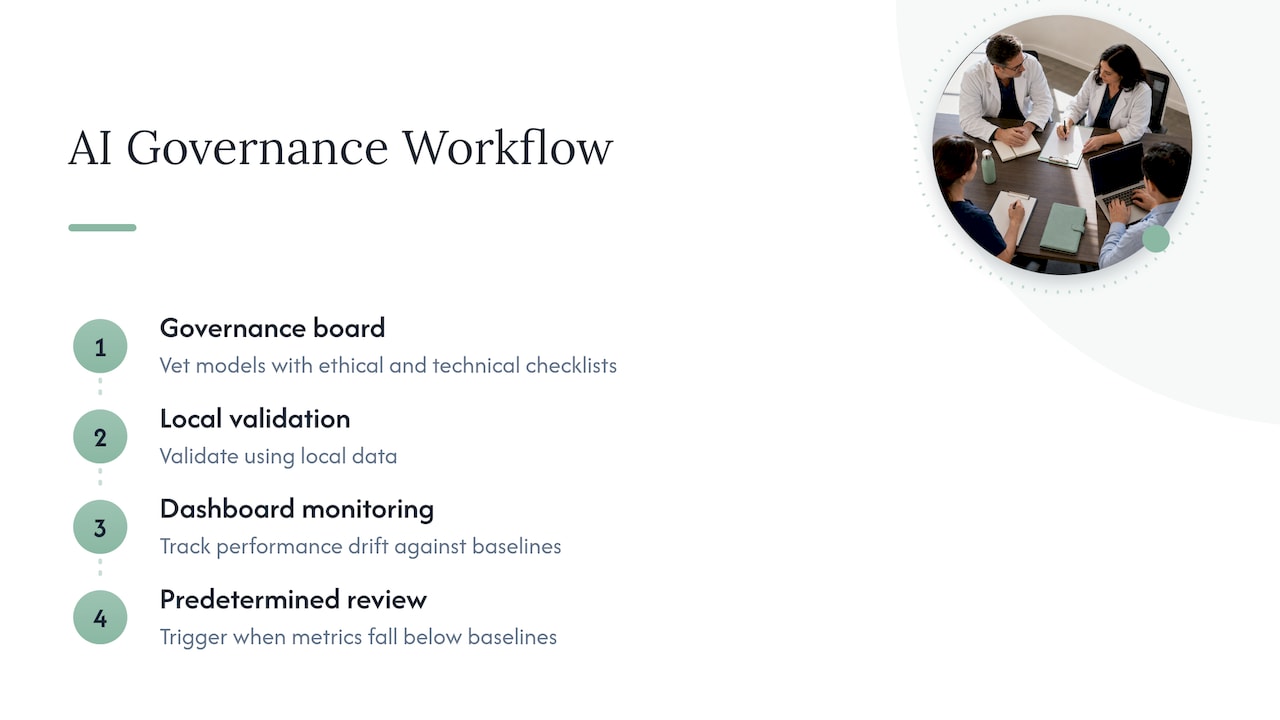
For a skilled nursing facility, a scaled-down version looks like this.
Before go-live
- Form a small review group. Include your administrator, admissions director, director of nursing, a therapy lead, compliance and someone from IT.
- Record baselines. Measure average time from referral receipt to decision, percentage of referrals missing information, decline reasons and conversion to admission.
- Validate locally. Run the tool on a set of past referrals and compare its summary with what your coordinators concluded.
- Define override rules. Decide who can overrule a flag and how that is documented.
After go-live
- Review monthly. Compare current numbers with your baselines.
- Sample for accuracy. Pull a handful of referrals each week and check every extracted field against the source.
- Set trigger points. Agree in advance what level of error or delay prompts a configuration review.
- Revisit criteria. Update admission rules whenever your service lines or staffing change.
Our complete implementation checklist for SNFs turns this into phases you can assign to your team.
A short example of a screened referral
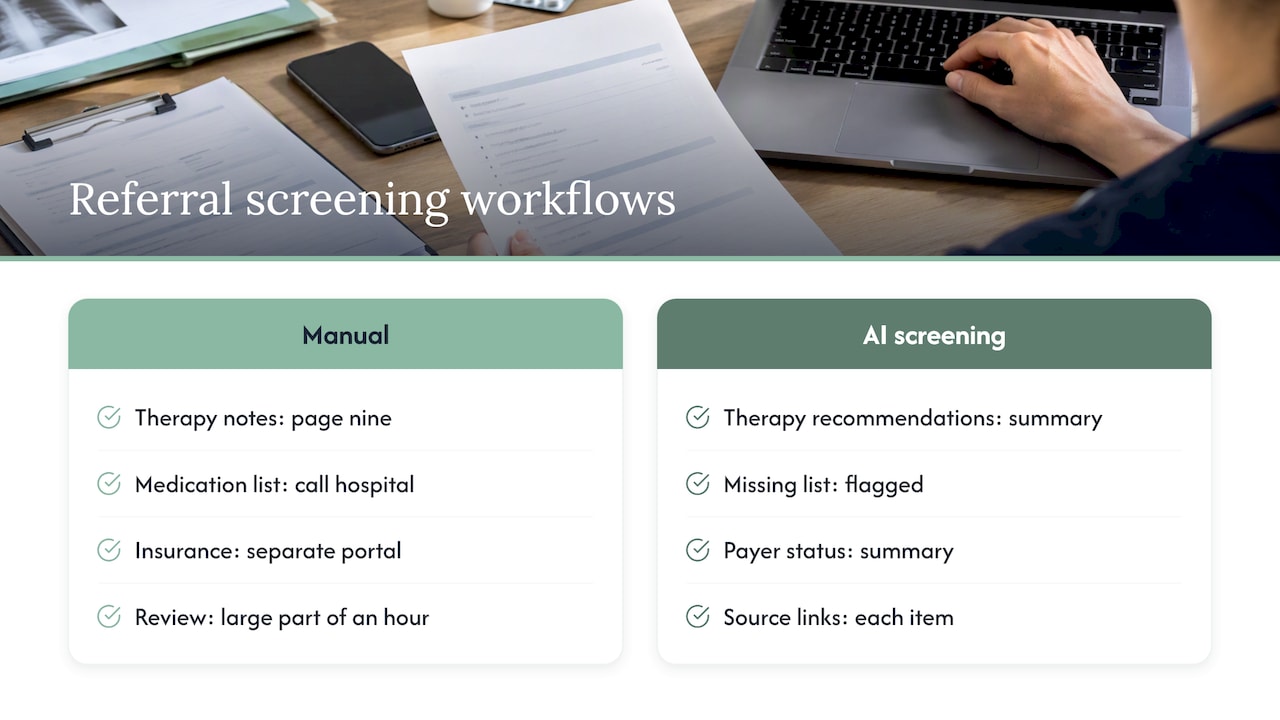
Consider a hospital referral for a patient recovering from hip surgery, with a documented need for physical therapy and a wound dressing. Without automation, your coordinator reads the packet, finds the therapy notes on page nine, calls the hospital about the missing medication list and checks the insurance on a separate portal. That can take a large part of an hour.
With AI referral screening, the same referral arrives as a summary: diagnosis, therapy recommendations, wound details, payer status and a flag that the medication list is missing. Each item links back to the page it came from. The coordinator verifies the wound note, requests the medication list, confirms the clinical liaison agrees, and replies. The judgment is still human. The preparation is not.
This example is illustrative, not a customer result, and your own time savings will depend on referral volume, document quality and staffing.
Where Smart Admissions fits
Smart Admissions is a SaaS platform built for skilled nursing facilities, rehabilitation centers and post-acute providers. Its AI referral management assistant integrates with your existing EMR and insurance portals to support real-time eligibility verification, clinical assessments and documentation management. Onboarding is designed to take under an hour, and our team provides hands-on support after that.
Pricing is published: $597 per month or $6,447 per year. We also offer a risk-free guarantee that the software pays for itself within 30 days. If you want to see how your referral workflow would look, start at our pricing page or explore the Smart Admissions platform.
Perspective: why we build for the admissions desk
We built Smart Admissions with healthcare documentation experts because the admissions desk is where occupancy, revenue and clinical safety meet. Most facilities do not lack good coordinators. They lack time. A coordinator who spends the morning retyping data is a coordinator who answers the hospital hours later than a competitor down the road.
Our view is that AI should shorten the path to a well-informed human decision, never replace it. That is why we favor traceable findings, configurable criteria and analytics that let your leadership see what is happening in the referral pipeline. It is also why we recommend a measured pilot with baselines before you scale. Facilities that define success up front tend to feel more confident, because they can see for themselves whether the tool is working.
If you take one thing from this guide, make it this: judge any AI referral screening tool by whether your team can verify its output quickly. Speed without trust gets abandoned. Speed with trust becomes the way your team works.
— Harry
Next steps for your facility
You do not need a large IT project to begin. A practical sequence:
- Document how a referral moves through your building today, from first contact to response.
- Capture your baseline response time and conversion rate.
- Review your admission criteria and make them explicit enough to configure.
- Pick a pilot scope, such as one referral source or one unit type.
- Confirm HIPAA safeguards and data handling with the vendor.
- Train your coordinators to verify, not just accept, the output.
- Meet monthly to compare results with your baselines.
For related reading, see our admissions decision-making guide for skilled nursing facilities and our piece on intake process optimization.
FAQ
What is AI referral screening in skilled nursing?
It is software that reads incoming patient referrals, extracts key clinical and payer details, and compares them with your admission criteria. Your admissions team then reviews a prepared summary instead of the raw packet. The final decision stays with your staff.
Is AI referral screening accurate?
Accuracy varies by tool, data quality and setting. Research shows language models can perform well on discharge-related prediction, with one study reporting an AUROC of 0.851, but results from one system do not automatically transfer to yours. Validate on your own past referrals and sample outputs regularly.
Can AI decide whether to admit a patient?
It should not. Best practice treats AI as decision support that flags potential issues, while a clinician remains responsible for the admission determination. Your policy should state who can override the software and how that is recorded.
How do we prevent bias in AI referral screening?
Ask the vendor which data fields drive recommendations and whether any could act as a proxy for a protected characteristic. Then review your decline reasons by payer type and other patterns on a regular schedule. Involve your compliance lead in that review.
How much does Smart Admissions cost?
Our published plans are $597 per month or $6,447 per year. You can see the current details on our pricing page.
Sources
- Building Trust in AI in Skilled Nursing Facilities (AAPACN)
- Factors Influencing Admission Decisions in Skilled Nursing Facilities (PMC)
- Enhancing the prediction of hospital discharge disposition (PMC)
- CMS: Skilled Nursing Facility 3-Day Rule Billing
- FTC: Remarks on Algorithmic and Economic Justice
- Healthcare AI: Risks, Governance & Patient Safety