
Every referral that enters your Skilled Nursing Facility sets off a chain of critical administrative and clinical steps. When just one link in this process stalls, admissions bottlenecks form and staff frustration rises. Healthcare workflow efficiency goes far beyond simply moving faster—it means optimizing each step while upholding safety and quality. For Admissions Directors balancing high patient volumes with limited time, understanding real efficiency and debunking common myths is essential to making operational improvements that truly last.
Table of Contents
- Defining Healthcare Workflow Efficiency and Myths
- Types of Healthcare Workflows Explained
- Key Benefits for Patient Intake Operations
- How Automation Transforms Workflow Efficiency
- Common Pitfalls and Implementation Risks
Key Takeaways
| Point | Details |
|---|---|
| Understand Workflow Types | Identifying clinical, administrative, and operational workflows is crucial for optimization and can reveal significant efficiency gains. |
| Balance Speed and Quality | Efficiency is not just about speeding up processes but ensuring quality and safety alongside timely patient care. |
| Leverage Automation Wisely | Automation can eliminate repetitive tasks, enhance consistency, and reduce errors, but must be carefully tailored to existing workflows. |
| Involve Staff in Changes | Engaging your admissions team in the design and implementation of new systems ensures smoother transitions and increases buy-in for new processes. |
Defining Healthcare Workflow Efficiency and Myths
When your admissions team processes a patient referral, multiple steps happen behind the scenes. From initial intake to bed assignment, each task depends on the previous one. Healthcare workflow efficiency refers to the sequence and optimization of these steps from start to finish.
Workflow isn’t just about speed. It encompasses the entire delivery process while maintaining care quality and safety. Admissions directors need to understand what truly constitutes efficiency before making operational changes.
What Efficiency Actually Means in Healthcare
Efficiency in healthcare involves producing maximum results from your available resources. This includes staff time, technology, and clinical expertise. The goal isn’t simply doing things faster—it’s achieving better outcomes with what you have.
Understanding different efficiency types helps clarify what your facility should prioritize:
- Technical efficiency means performing tasks correctly with minimal waste
- Productive efficiency involves maximizing output per staff member
- Allocative efficiency ensures resources go to the highest-value activities
Most facilities focus only on speed, missing the quality component entirely. Your admissions process requires balancing faster bed occupancy with accurate eligibility verification and clinical assessments.
Quality and efficiency work together, not against each other—optimizing one without the other creates problems downstream.
Common Myths About Healthcare Efficiency
Many admissions directors believe technology alone solves efficiency problems. Purchasing new software without analyzing your actual workflow gaps wastes money and frustrates staff.
Another widespread myth: “All referrals follow the same path.” Clinical and administrative tasks vary significantly based on patient complexity, insurance type, and facility capacity. Time-motion studies reveal workflow variability that most people underestimate.
Your team likely believes these myths:
- One-size-fits-all processes work for all patient types
- Efficiency means eliminating all delays
- Manual work is always bad
- Staff simply needs to work harder
- Efficiency improvements happen overnight
Reality checks matter here. Some manual verification steps protect patient safety. Certain delays prevent costly errors. Your best staff perform tasks efficiently because they understand the workflow, not because the workflow is simple.
What Makes a Workflow Efficient
Actual efficiency involves eliminating redundant steps while keeping necessary safeguards. An efficient admissions workflow captures information once, verifies eligibility accurately, and routes patients to appropriate care levels without rework.
Your facility experiences inefficiency when these happen repeatedly:
- Information gets entered multiple times into different systems
- Staff wait for missing documentation before proceeding
- Insurance verifications take hours or days
- Clinical assessments require manual chart reviews
- Decision-makers lack visibility into referral status
True optimization addresses these pain points systematically. It isn’t about cutting corners—it’s about removing obstacles that slow legitimate work.
When streamlining healthcare administration becomes a priority, skilled nursing facilities discover they can accelerate bed fill rates while maintaining clinical rigor.
Pro tip: Document how your admissions team currently handles a referral from start to finish, noting where staff wait, where information gets duplicated, and where bottlenecks occur—this reveals real inefficiencies worth fixing.
Types of Healthcare Workflows Explained
Your skilled nursing facility operates multiple overlapping workflows daily. Not all workflows serve the same purpose or follow the same logic. Understanding each type helps you identify where efficiency improvements matter most.
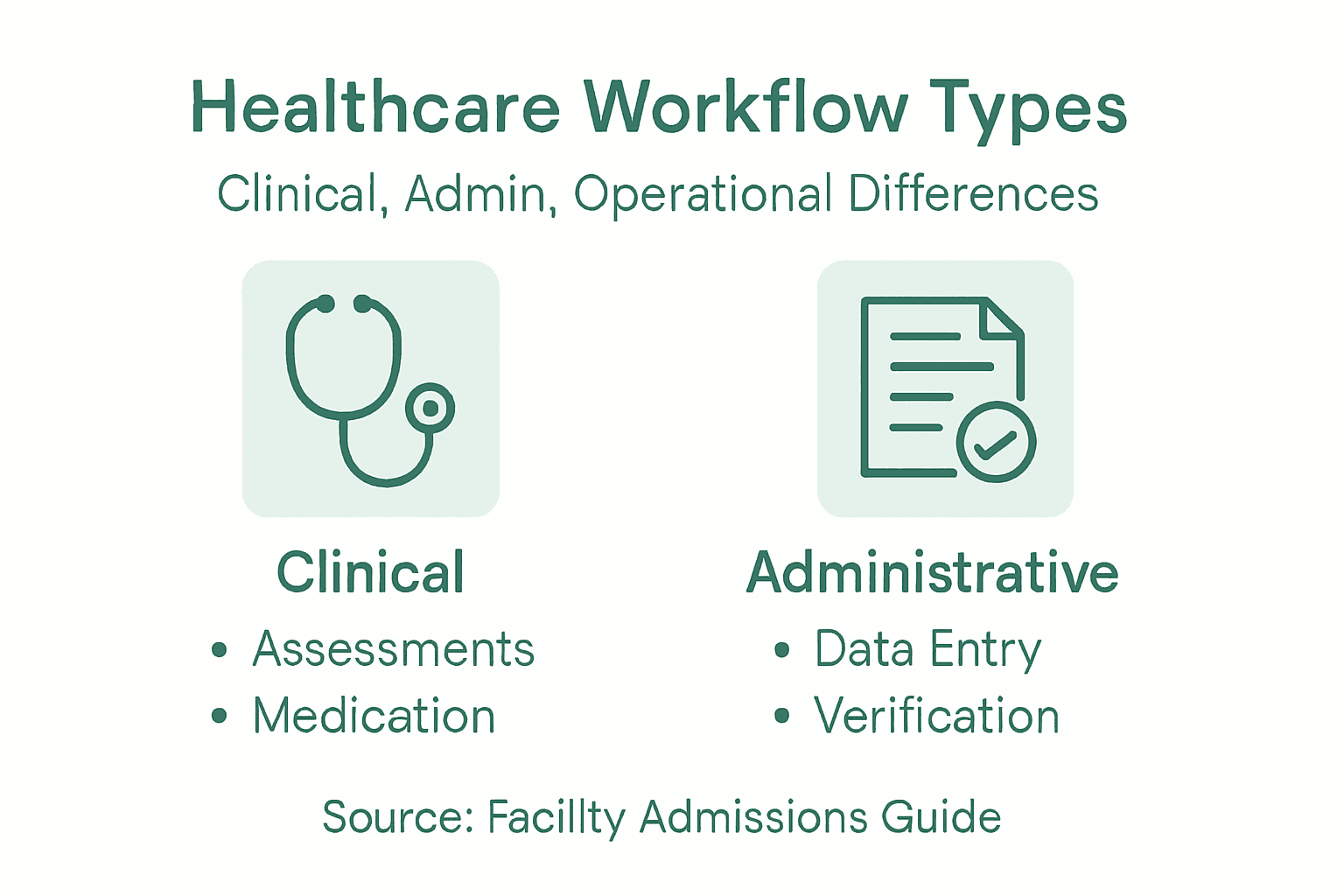
Healthcare workflows encompass clinical, administrative, and operational processes, each addressing distinct system functions. Your admissions team likely touches all three types without realizing the distinctions.
Clinical Workflows
Clinical workflows involve direct patient care delivery. These include patient assessments, medication administration, wound care, and clinical decision-making. Your facility’s nurses and care coordinators drive these workflows.
In admissions, clinical workflows begin with the initial patient evaluation. The receiving clinician reviews medical history, assesses functional status, and determines care level placement.
These workflows prioritize accuracy and safety over speed. A rushed clinical assessment creates downstream problems. Your best staff slow down when patient safety demands it.

Administrative Workflows
Administrative workflows handle the paperwork side of operations. These include appointment scheduling, billing, insurance verification, documentation, and referral management.
Your admissions team spends significant time on administrative tasks:
- Entering patient information into multiple systems
- Verifying insurance coverage and benefits
- Collecting authorization documents
- Updating electronic health records
- Processing billing information
Administrative workflows often create the biggest efficiency opportunities. Many tasks involve repetitive data entry that technology can automate.
Operational Workflows
Operational workflows manage facility resources. These cover staff scheduling, bed management, equipment maintenance, and supply chain processes.
Your census depends heavily on operational efficiency. An empty bed costs money regardless of why it’s empty. Poor bed management workflows directly impact occupancy rates.
Here’s a summary of how different healthcare workflow types contribute to operational excellence:
| Workflow Type | Main Focus | Key Activities | Impact on Efficiency |
|---|---|---|---|
| Clinical | Direct patient care | Patient evaluations, treatments | Maintains safety and quality |
| Administrative | Paperwork and coordination | Insurance, documentation, billing | Reduces manual workload |
| Operational | Resource management | Bed assignments, staff scheduling | Maximizes facility capacity |
Understanding workflow type reveals where to focus improvements—rushing clinical workflows damages care quality, but accelerating administrative workflows improves everyone’s day.
How These Workflows Interact
Workflow types interact in ways that affect overall performance outcomes. A slow administrative workflow delays clinical assessments, which delays bed assignment, which impacts operational efficiency.
When a referral sits in your queue waiting for insurance verification, the clinical team can’t begin their assessment. That delay cascades through the entire facility.
Your intake automation strategy should respect these differences. The goal isn’t making everything faster—it’s removing obstacles that don’t serve patient safety or care quality.
Consider intake process optimization specifically designed for post-acute care settings. The best solutions automate administrative tasks while protecting clinical judgment.
Pro tip: Map your current referral-to-admission process and label each step as clinical, administrative, or operational—you’ll quickly spot where automation helps versus where human expertise matters most.
Key Benefits for Patient Intake Operations
Optimizing your intake workflow delivers tangible results that directly impact your facility’s bottom line. Better intake processes mean faster bed occupancy, happier staff, and improved patient experiences.
Let’s look at what actually improves when you fix your intake operations.
Faster Patient Placement
Slowing referrals down costs you money every single day. When a patient sits in your queue waiting for insurance verification or missing documentation, that bed stays empty.
Improving patient intake workflows through structured processes significantly reduces patient waiting times. Your admissions team can move referrals from initial contact to bed assignment in hours instead of days.
Faster placement means your facility captures available volume. You’re not turning away referrals because your intake backlog is overwhelming. Revenue follows good processes.
Reduced Operational Costs
Your staff currently spends hours on repetitive manual work. Insurance verification, document collection, information entry into multiple systems—these tasks don’t require clinical judgment.
Automating administrative tasks delivers measurable savings:
- Fewer staff hours spent on data entry
- Reduced errors that require rework
- Less overtime due to referral backlogs
- Improved bed turnover rates
- Better resource allocation across the facility
These aren’t small gains. One facility might save 45 minutes per referral when automation handles verification and documentation collection.
Better Staff Experience
Your admissions team burns out because they’re drowning in paperwork, not because the job is hard. Manual workflows frustrate capable people who want to focus on patient interaction.
When administrative friction disappears, staff engagement improves. Your team gets to do the work they trained for instead of repeating data entry tasks.
Streamlined intake processes reduce staff burnout while improving patient outcomes—your team becomes more efficient and more satisfied simultaneously.
Improved Patient Outcomes
Faster intake isn’t just convenient—it improves clinical care. When patients start appropriate care sooner, their conditions stabilize faster. Better outcomes lead to shorter stays and improved quality metrics.
Structured intake processes ensure nothing gets missed. Clinical assessments happen systematically. Documentation is complete. Care coordination begins immediately.
Your facility’s reputation grows when patients experience smooth, professional intake. Word-of-mouth referrals increase when discharge planners see consistent, high-quality admissions.
Enhanced Data and Visibility
Most facilities lack real-time visibility into their referral pipeline. Your leadership can’t see bottlenecks until problems become crises.
Modern intake automation provides actionable insights about intake automation benefits. You get dashboards showing referral status, admission times, and operational metrics.
With this visibility, you identify problems early. You spot trends. You make data-driven decisions instead of guessing.
Pro tip: Track your current average time from initial referral contact to bed assignment, then set a target to reduce it by 25 percent—this single metric drives behavioral change across your entire intake team.
How Automation Transforms Workflow Efficiency
Automation doesn’t just speed things up—it fundamentally changes how your facility operates. When you remove manual bottlenecks, your entire workflow becomes more reliable and predictable.
Understand how automation actually reshapes your intake operations and why it matters for admissions directors.
Eliminating Redundant Manual Tasks
Your staff enters the same patient information into multiple systems throughout the day. This repetition wastes time and introduces errors every single time.
Healthcare automation integrates digital tools to reduce manual tasks and errors. When a patient referral arrives, automation captures that information once and distributes it wherever it needs to go.
No more typing the same address, date of birth, or insurance details into different systems. No more lost documents. No more wondering if information matches across platforms.
Standardizing Processes Across Your Facility
Right now, different team members probably handle identical referrals in different ways. One person checks insurance first, another gathers documentation first, a third verifies eligibility before anything else.
Automation enforces consistent processes. Every referral follows the same pathway. Every step happens in the right order. This consistency improves outcomes.
Standardized workflows mean:
- New staff train faster because processes are predictable
- Quality improves because nothing gets skipped
- Bottlenecks disappear because steps happen in optimal sequence
- Results become measurable and repeatable
Your best performers aren’t good because they work harder—they’re good because they’ve figured out the right order. Automation codifies their expertise.
Enabling Real-Time Visibility and Decision-Making
Most facilities operate with delayed information. By the time leadership discovers a backlog, it’s already created problems.
Workflow automation guides patients through optimal treatment pathways, providing real-time insights into your referral pipeline. You see bottlenecks as they form, not days later.
This visibility lets you make informed decisions:
- Redirect staff when specific steps slow down
- Identify which referral types cause delays
- Spot patterns in what causes rework
- Allocate resources based on actual demand
Data-driven management replaces guesswork.
Reducing Errors and Safety Risks
Manual processes create opportunities for mistakes. A misread insurance number, a missing clinical detail, a forgotten authorization—each error cascades downstream.
Automation enforces safety protocols. It catches missing information before it causes problems. It prevents conflicting data from existing in different systems.
Automation doesn’t replace clinical judgment—it protects it by handling routine verification tasks flawlessly so clinicians focus on what matters most.
Accelerating Turnaround Times
When insurance verification takes two hours because someone must call the carrier and wait on hold, your referral sits idle. Automation completes this task in minutes by accessing verification systems directly.
This acceleration happens across every administrative step. Individual time savings add up to dramatic overall improvements.
Many facilities report referral-to-admission times dropping from 3-5 days to 24 hours when automation handles healthcare admissions efficiently. That’s not incremental improvement—that’s transformation.
The following table compares traditional versus automated intake processes for admissions teams:
| Aspect | Traditional Intake | Automated Intake | Efficiency Gain |
|---|---|---|---|
| Data Entry | Manual, repetitive | Automated, streamlined | Less duplication, fewer errors |
| Referral Processing | Variable, multi-day | Consistent, rapid | Often same-day admission |
| Staff Experience | High frustration | Higher job satisfaction | Reduced burnout, more focus |
| Error Likelihood | Frequent, hard to trace | Lower, easily tracked | Improved accuracy and safety |
Pro tip: Start by automating your slowest, most repetitive task—usually insurance verification or documentation collection—then measure the time saved before expanding automation to other processes.
Common Pitfalls and Implementation Risks
Automation projects fail when facilities ignore the complexity of their own operations. Good intentions don’t guarantee success. Understanding what goes wrong helps you avoid expensive mistakes.
Let’s examine the real risks you’ll face during implementation.
Misunderstanding Your Current Workflow
You can’t improve what you don’t understand. Many facilities assume they know how their intake process works, then discover entirely different patterns when they actually observe it.
One admissions director thought insurance verification took 30 minutes. Actual observation revealed 90 minutes spread across multiple steps with waiting periods no one had documented.
Key pitfalls in workflow automation include inadequate understanding of existing workflows before implementation. Skipping this analysis leads to automating the wrong steps or building solutions that don’t match reality.
Before deploying any automation, spend time watching your actual process:
- Track how long each step takes
- Note where staff wait for information
- Identify what causes rework
- Observe variation between team members
- Document exceptions and workarounds
This groundwork prevents costly mistakes later.
Underestimating Staff Resistance and Training Needs
Your team has been doing things the same way for years. Change feels threatening, even when it improves their day.
Implementation risks often involve resistance to change and insufficient training. Staff who feel excluded from decisions are less likely to adopt new systems. Those given inadequate training struggle and revert to old habits.
Staff resistance creates these problems:
- Slow adoption despite system capability
- Workarounds that defeat automation benefits
- Data entry errors from frustrated users
- Loss of your best people to burnout
- Poor system configuration choices
Involve your team in solution design from the start. Let them see how changes improve their work. Invest in proper training, not just a quick walkthrough.
Creating Workflow Rigidity
Automation can lock your facility into inflexible processes. What works today might not work tomorrow when patient volumes change or referral patterns shift.
Solutions that don’t adapt to local conditions create new problems. A process optimized for weekday volume collapses on Mondays. Rules built for typical referrals fail with complex cases.
Automation that doesn’t accommodate clinical complexity creates bottlenecks instead of eliminating them.
Poor Alignment with Your Organization’s Culture
Your facility has its own way of working. Imposing a solution that contradicts established culture guarantees failure.
If your admissions team values relationships and personal connection, automating away all human interaction will backfire. If your culture emphasizes safety, automation that skips verification steps will meet resistance.
Successful implementation requires:
- Leadership actively supporting change
- Solutions matching your operational values
- Stakeholders engaged throughout design
- Clear communication about why changes matter
- Flexibility to customize for your context
Creating New Bottlenecks
Optimizing one step sometimes creates delays elsewhere. Automating insurance verification might reveal that documentation collection is now your slowest step.
Monitoring your workflow continuously prevents surprises. Track metrics before and after implementation. Watch for unintended consequences.
Pro tip: Establish baseline metrics—average referral-to-admission time, staff hours per admission, error rates—before implementing any automation, then measure the same metrics monthly to catch new bottlenecks early.
Unlock True Healthcare Workflow Efficiency with Smart Admissions
The article highlights how healthcare workflow efficiency requires balancing faster referrals with clinical accuracy and operational visibility. If your facility struggles with redundant manual steps, delays in insurance verification, or lack of real-time referral insights, these common pain points can stall bed occupancy and increase staff burnout. Concepts like automating administrative workflows and enabling data-driven decision-making are critical to transforming your intake process into a seamless, reliable system.
Smart Admissions offers a purpose-built SaaS platform for skilled nursing and post-acute care providers designed to solve exactly these challenges. Its AI-powered referral management assistant automates repetitive tasks such as insurance verification and documentation collection while integrating smoothly with your EMR systems. This ensures faster patient placement, reduced operational costs, and improved staff satisfaction without sacrificing care quality.
Streamline your healthcare administration and experience the power of automated intake workflows tailored for your facility.
Take control of your admissions workflow today and accelerate bed fill rates with confidence. Visit Smart Admissions to discover how our solution can help you reduce referral review times and enhance operational efficiency in ways that truly matter now.
Frequently Asked Questions
What is healthcare workflow efficiency?
Healthcare workflow efficiency refers to the optimization and sequence of tasks in healthcare processes, particularly in admissions, ensuring that each step is completed effectively to maintain care quality and safety.
Why is it important to balance speed and quality in healthcare workflows?
Balancing speed and quality is crucial because prioritizing one at the expense of the other can lead to errors, delays, and compromised patient safety. Effective workflows ensure that patients receive timely care without sacrificing quality.
What are common myths about healthcare efficiency?
Common myths include the belief that one-size-fits-all processes work for all patients, that efficiency means eliminating all delays, and that staff simply needs to work harder. These misconceptions can lead to ineffective strategies for improving workflow.
How can automation improve healthcare workflow efficiency?
Automation can enhance efficiency by eliminating redundant manual tasks, standardizing processes, providing real-time visibility, and reducing errors. This leads to faster patient placements, reduced operational costs, and improved staff satisfaction.
Recommended
- Streamlining Healthcare Administration: Boosting Efficiency
- Streamlining Healthcare Administration: Boosting Efficiency
- The Busy Administrator’s Guide to Streamlining Referral Processes in Under an Hour – Smart Admissions
- Stop Wasting 45 Minutes on Each Referral: Try These 5 Post-Acute Care Automation Hacks – Smart Admissions
- Coworking Space nutzen Workflow für effiziente Teamarbeit | ProOffice Business Center Blog